Japan has taken a historic step in its post-World War II military posture by conducting its first overseas missile firing since 1945, signaling a fundamental shift in Indo-Pacific security dynamics.
During Balikatan 2026, the Japan Ground Self-Defense Force (JGSDF) launched Type 88 anti-ship missiles from northern Philippines into the Luzon Strait, a key chokepoint between the South China Sea and the Pacific Ocean.
The missiles struck and sank the decommissioned Philippine Navy vessel BRP Quezon, demonstrating precision strike capability in a highly strategic battlespace.
Japan’s Type 88 surface-to-ship missile sank decommissioned Philippine warship during Exercise Balikatan
1st overseas launch of this kind by Japan since WWII
In Philippines
Facing South China SeaChina has driven regional powers into clear military alignment against it. pic.twitter.com/Bfn0VnMQpG
— David Walpiri (@DWalpiri) May 7, 2026
More Than a Drill: A New Warfighting Concept Emerges
The launch was not just a tactical exercise — it revealed the emergence of a distributed, multinational coastal defense network.
The exercise integrated:
- Japanese Type 88 missile batteries
- U.S. HIMARS rocket systems
- U.S. Marine Corps NMESIS anti-ship platforms
- Philippine coastal missile systems
Together, these systems form a layered anti-access/area-denial (A2/AD) architecture designed to restrict hostile naval movement through critical maritime corridors.
Why the Luzon Strait Matters
The Luzon Strait is one of the most important maritime chokepoints in the world.
- It connects the South China Sea to the western Pacific
- It lies close to Taiwan — a major geopolitical flashpoint
- It serves as a key route for Chinese naval breakout operations
Control over this corridor is essential in any future Indo-Pacific conflict.
By deploying missiles in northern Luzon, allied forces demonstrated the ability to:
➡️ Monitor and control naval movement
➡️ Deny access to adversary fleets
➡️ Project power deep into contested waters
Type 88 Missile: Technical Overview
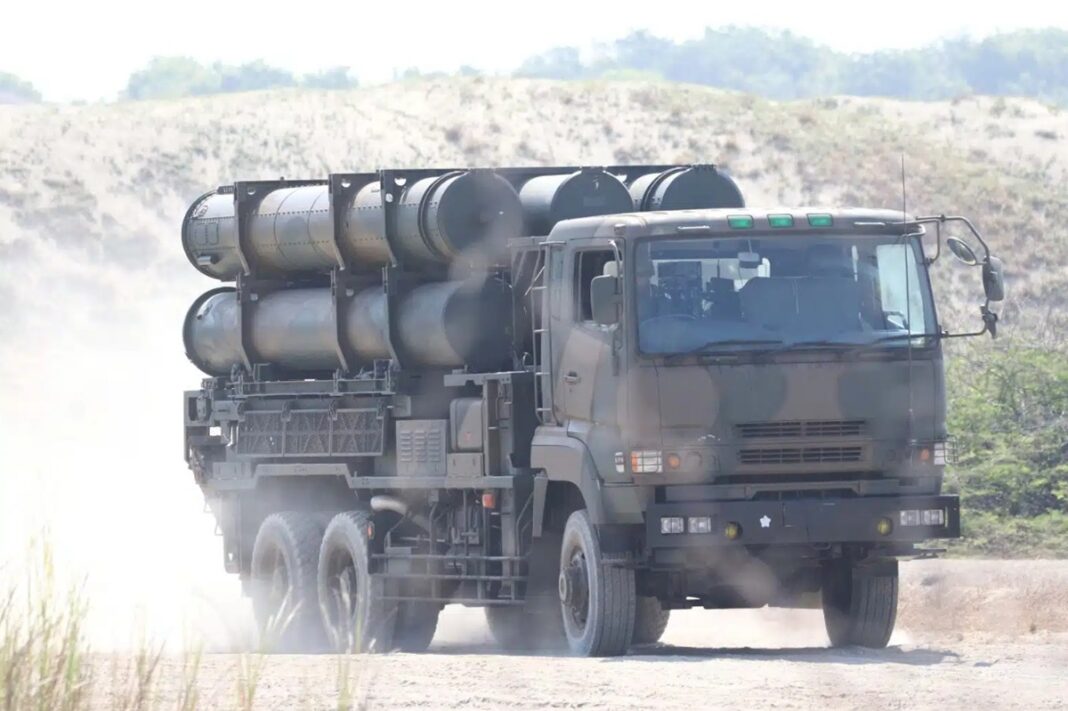
The Japanese Type 88 (SSM-1) is a land-based anti-ship cruise missile designed for coastal defense.
Key Capabilities:
- Range: ~150–200 km
- Warhead: ~225 kg high explosive
- Guidance: Inertial + terminal active radar homing
- Flight Profile: Sea-skimming for reduced detection
- Launch Platform: Mobile 8×8 truck-based system
The missile uses:
- A solid booster for launch
- A turbojet engine for sustained flight
This combination allows it to strike targets with high accuracy and reduced interception windows.
From Homeland Defense to Expeditionary Warfare
Historically, Japan’s missile doctrine focused on defending its home islands.
Balikatan 2026 marks a clear shift:
➡️ From territorial defense
➡️ To forward-deployed expeditionary operations
This evolution aligns closely with the U.S. Marine Corps’ Expeditionary Advanced Base Operations (EABO) concept, which emphasizes:
- Distributed forces
- Mobile missile systems
- Rapid deployment across islands
Japan is now actively integrating into this doctrine, signaling deeper operational coordination with allies.
Legal and Strategic Foundations of the Shift
Japan’s deployment to the Philippines was enabled by a Reciprocal Access Agreement (RAA) signed in 2025.
This agreement allows:
- Easier troop deployment
- Shared logistics and basing
- Expanded joint operations
Under Prime Minister Sanae Takaichi, Japan has accelerated:
- Defense spending increases
- Long-range strike capabilities
- Relaxation of arms export restrictions
China’s Reaction: Rising Strategic Concern
China has strongly criticized the missile launch, viewing it as part of a broader effort to contain its naval power.
Beijing’s concerns focus on:
- Growing missile networks along the First Island Chain
- Increasing US–Japan–Philippines coordination
- Potential restrictions on naval access to the Pacific
The exercise highlights a key strategic reality:
The Indo-Pacific is moving toward layered deterrence through distributed missile networks
Toward a Multinational Coastal Missile Network
Balikatan 2026 demonstrated the emergence of a coordinated missile network across allied nations.
Key components include:
- Japanese coastal missile systems
- Philippine BrahMos batteries
- U.S. HIMARS and NMESIS platforms
- Distributed reconnaissance and targeting systems
This network is designed to:
➡️ Complicate adversary naval operations
➡️ Increase survivability through dispersion
➡️ Enable rapid, coordinated strikes
Conclusion: A Strategic Turning Point in the Indo-Pacific
Japan’s missile launch from the Philippines represents more than a symbolic milestone — it marks a fundamental shift in regional military strategy.
The key takeaway:
👉 Japan is no longer preparing only to defend — it is preparing to fight forward alongside allies.
As distributed missile networks expand across the Indo-Pacific, the region is entering a new era of:
- Multi-domain deterrence
- Rapid-response warfare
- Increased great-power competition
The implications will shape the future of security across the First Island Chain — and beyond.