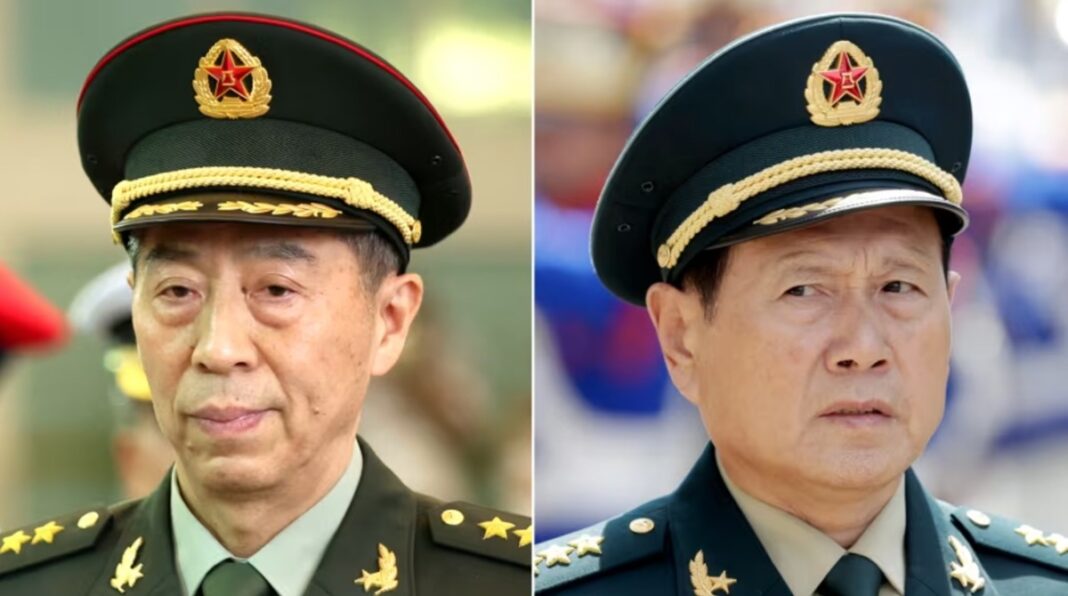
In a dramatic escalation of its sweeping military crackdown, China has sentenced two former defense ministers — Wei Fenghe and Li Shangfu — to death with a two-year reprieve for corruption, a punishment that will be commuted to life imprisonment without parole.
The ruling, delivered by a military court, marks one of the most high-profile actions in President Xi Jinping’s ongoing purge of the People’s Liberation Army (PLA).
BREAKING: China has sentenced former defence ministers Wei Fenghe and Li Shangfu to death with a two-year reprieve over graft charges, after the two men were expelled from the ruling Communist Party in 2024 for “serious violations of discipline”, according to Reuters.
🔴 More… pic.twitter.com/DMAVOA79YB
— Al Jazeera Breaking News (@AJENews) May 7, 2026
From Power to Prison: Fall of China’s Defence Leadership
Wei Fenghe, who served as China’s defense minister from 2018 to 2023, and his successor Li Shangfu — who held the post for less than a year — were both convicted of bribery following investigations launched in 2023.
Their rapid downfall highlights:
- Deep-rooted corruption within senior military ranks
- The scale of Xi’s anti-graft campaign
- The vulnerability of even top-level officials
The verdict signals that no rank within the PLA is immune from scrutiny.
Xi’s Expanding Crackdown Across the PLA
Xi Jinping’s campaign has extended far beyond individual cases.
- More than 100 officers have reportedly been purged since 2022
- At least 36 generals and lieutenant generals officially removed
- Dozens more are missing or under investigation
The purge has also reached the very top of the military hierarchy, including the removal of senior leadership figures overseeing operational command.
A Military Under Transformation — and Pressure
The crackdown is part of Xi’s broader strategy to:
- Eliminate corruption within the PLA
- Reinforce political loyalty to the Communist Party
- Accelerate military modernization
State media has framed the purge as essential to:
➡️ “Remove toxic influences”
➡️ Strengthen combat capability
➡️ Ensure absolute loyalty to Xi’s leadership
Concerns Over Military Readiness
However, analysts warn that the scale of the purge may come with risks.
According to assessments:
- Over 50% of top PLA leadership positions have been affected
- Frequent leadership changes may disrupt command continuity
- Operational readiness could be impacted in the short term
The removal of experienced commanders raises questions about the PLA’s ability to conduct complex, high-intensity operations.
Power Consolidation or Structural Reform?
The purge reflects a dual objective:
1. Anti-Corruption Drive
Xi has long emphasized the need to clean up corruption within the military, which he views as a threat to effectiveness and legitimacy.
2. Political Control
At the same time, the campaign reinforces Xi’s personal control over the armed forces — a critical pillar of power in China’s political system.
This dual nature makes the purge both a reform initiative and a consolidation of authority.
Strategic Implications for China’s Military Future
The ongoing restructuring of the PLA comes at a time of increasing geopolitical competition, particularly in:
- The South China Sea
- Taiwan Strait
- Indo-Pacific region
While the purge may strengthen long-term discipline and loyalty, it could also:
- Slow decision-making processes
- Create internal uncertainty
- Impact operational confidence
Conclusion: A Stronger Military — or a Risky Transition?
China’s sentencing of two former defense ministers underscores the intensity of Xi Jinping’s campaign to reshape the PLA.
The key question now is whether this sweeping purge will:
✔️ Create a more disciplined and capable military
❌ Or weaken readiness during a critical period of global competition
As China pushes forward with modernization, the balance between control and capability will define the future of its armed forces.