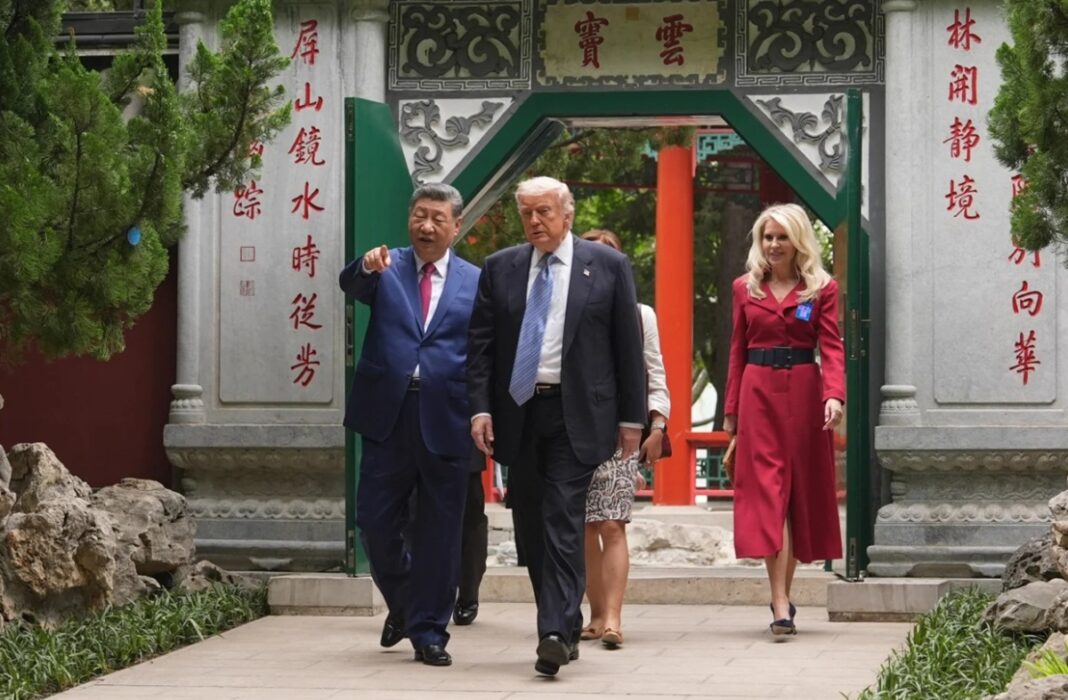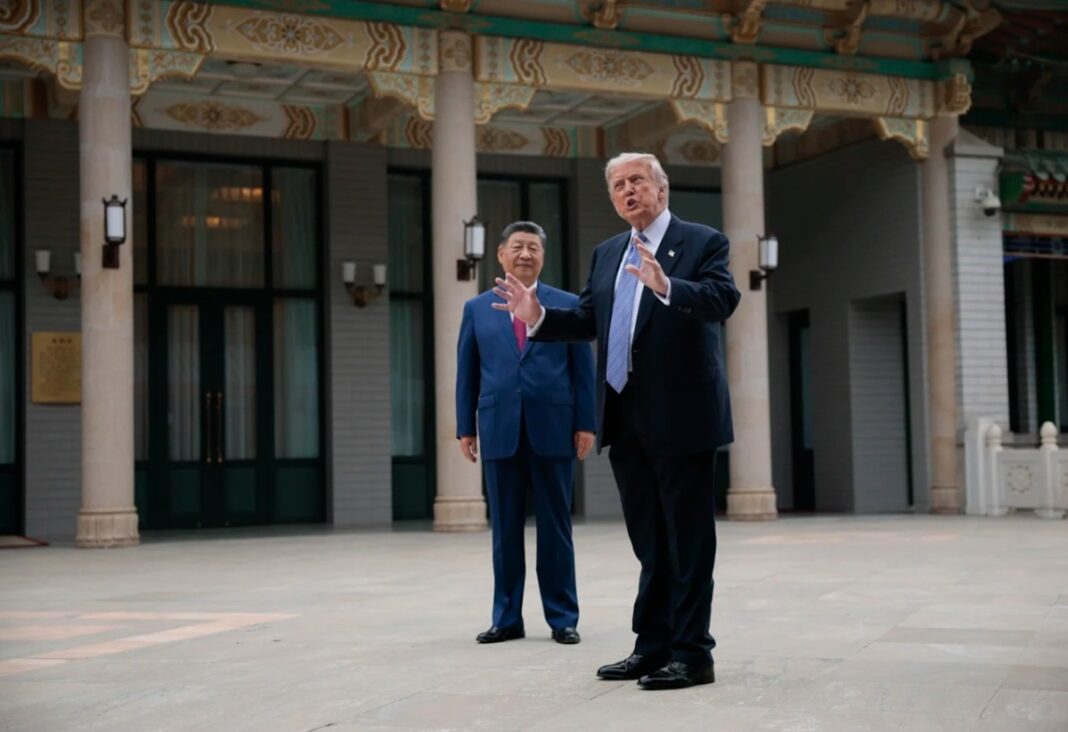
U.S. President Donald Trump left Beijing without a major agreement on Taiwan, tariffs, or the Strait of Hormuz. But for strategic observers, the summit may be remembered for something deeper:
A growing perception that the balance of global power is shifting.
In the immediate aftermath of Trump’s meeting with Chinese President Xi Jinping, analysts are increasingly debating whether the ongoing Iran war has weakened perceptions of U.S. power — and whether Beijing now sees greater strategic opportunity around Taiwan.
The summit itself produced no breakthrough.
Trump acknowledged he made:
“No commitment either way” on Taiwan.
Xi, meanwhile, reportedly warned that mishandling Taiwan could trigger confrontation between Washington and Beijing.
The message was unmistakable:
Taiwan remains the most dangerous flashpoint in U.S.-China competition.
But what changed after Beijing may be equally important.
The Iran War’s Strategic Impact Extends Far Beyond the Middle East
For decades, the post-Cold War international system rested on a core assumption:
The United States could dominate escalation anywhere in the world.
Whether in:
- The Balkans
- Iraq
- Afghanistan
- Libya
Washington generally maintained the image of a superpower capable of imposing decisive outcomes.
The Iran war has complicated that perception.
Not necessarily because Iran achieved military superiority — but because:
Tehran survived sustained military pressure, preserved strategic capabilities, and remained politically intact.
This has fueled broader debate about whether U.S. coercive power now faces greater limits than many allies and rivals previously assumed.
Why Beijing Is Watching the Iran Conflict Closely
For China, the Iran conflict offers more than Middle East lessons.
It provides:
A live case study in U.S. escalation management.
Chinese planners are likely examining several key questions:
1. Can Washington Sustain Multiple Crises Simultaneously?
The U.S. remains deeply engaged in:
- Middle East security operations
- Indo-Pacific deterrence
- European security commitments
A prolonged conflict with Iran risks stretching military and political bandwidth.
2. How Quickly Can the U.S. Deliver Decisive Outcomes?
The Iran conflict exposed the difficulty of:
- Achieving rapid strategic success
- Preventing retaliation
- Avoiding regional spillover
3. How Strong Is U.S. Political Resolve?
Domestic political divisions and economic costs increasingly shape military decision-making.
For Beijing, these variables matter deeply in any Taiwan contingency scenario.
Taiwan’s Security Question Grows More Complicated
Trump’s comments after Beijing created fresh uncertainty.
Asked directly whether the U.S. would defend Taiwan, he avoided giving a clear answer.
“There’s only one person that knows that — me.”
Strategic ambiguity has long been central to U.S. Taiwan policy.
But moments of perceived geopolitical transition often amplify uncertainty.
For Taiwan, the concern is not necessarily immediate abandonment.
It is whether:
Beijing increasingly believes Washington may hesitate during a crisis.
Perception often matters as much as military reality.
China May See Strategic Opportunity — But Risks Remain High
Despite speculation about declining U.S. influence, Beijing still faces serious constraints.
A Taiwan operation would carry enormous risks:
- U.S. military intervention remains possible
- Regional allies could become involved
- Economic consequences would be massive
- Semiconductor supply chains would be disrupted globally
China also faces:
- Slowing economic growth
- Demographic pressures
- Regional distrust
While Beijing may see opportunity, it also understands:
Taiwan remains one of the highest-risk geopolitical scenarios imaginable.
From Middle East to Indo-Pacific: A More Fragmented Order Emerging
The broader issue may not be whether America is “declining.”
Instead, the international system increasingly appears:
More fragmented, contested, and multipolar.
Several recent trends support this view:
Europe:
Some leaders have publicly debated strategic autonomy from Washington.
Middle East:
Regional states increasingly diversify security partnerships between:
- The U.S.
- China
- Russia
- Regional powers
Asia:
Countries seek stronger deterrence while avoiding direct superpower confrontation.
The result is a system where:
U.S. power remains enormous — but increasingly challenged.
Is This the ‘Post-American Era’?
Some analysts have begun describing the Iran war as:
The first major conflict of a more post-American international order.
That argument rests on several observations:
- Rivals increasingly resist U.S. pressure
- Regional powers act more independently
- Military superiority no longer guarantees rapid outcomes
However, declaring the end of American primacy may be premature.
The United States still retains:
- The world’s strongest alliance system
- Massive military capability
- Technological leadership
- Financial dominance
What may be changing instead is:
The assumption that American power alone can easily shape geopolitical outcomes.
Taiwan Is Now Watching Closely
For policymakers in Taipei, the lessons of Beijing and the Iran conflict are likely sobering.
Questions increasingly shaping Taiwan’s calculations include:
- How reliable is U.S. deterrence?
- Will Washington avoid another major war?
- Can Taiwan strengthen self-defense fast enough?
This is why Taiwan continues prioritizing:
- Asymmetric defense
- Missile stockpiles
- Air defense systems
- U.S. arms procurement
Because in an era of uncertainty:
Self-preparedness becomes more important.
Conclusion: After Beijing, the Strategic Mood Has Shifted
Trump’s Beijing summit did not produce dramatic policy changes.
But geopolitically, it may still prove significant.
The Iran war and the summit together reinforced a growing reality:
Rivals increasingly believe U.S. power has limits.
Whether that perception is accurate matters less than the fact that:
World leaders are increasingly acting as if it might be true.
For Taiwan, this creates a more dangerous environment.
For China, it may create strategic temptation.
And for Washington:
The challenge is no longer simply maintaining power — but maintaining credibility in a world that is increasingly testing its limits.