The first public appearance of the highly classified AIM-260A Joint Advanced Tactical Missile (JATM) may represent one of the most consequential developments in global airpower competition in years.
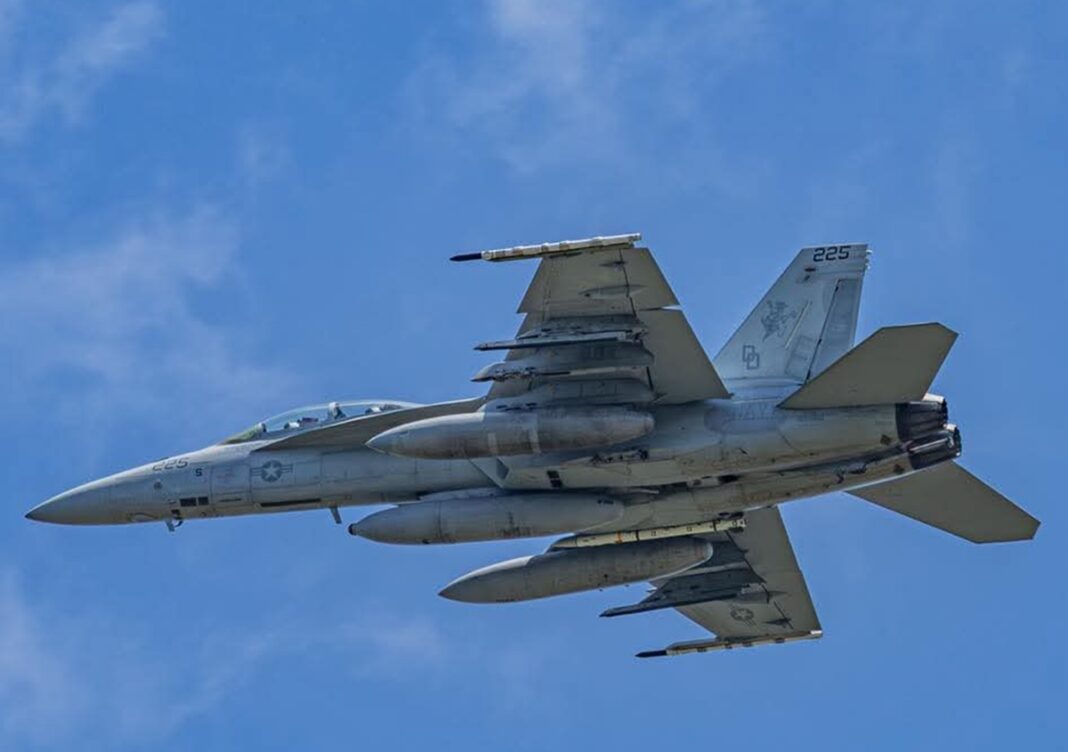
Recent imagery showing what analysts believe to be a live AIM-260A carried beneath a U.S. Navy Boeing F/A-18F Super Hornet has triggered intense discussion among military planners about how the next generation of air combat could reshape strategic competition between the United States and China.
First public glimpse of the AIM-260A JATM.
The highly secretive next-gen U.S. air-to-air missile was spotted carried by a U.S. Navy F/A-18F Super Hornet during a test flight from Eglin AFB.
AIM-260 is expected to replace or complement the AIM-120 AMRAAM with significantly… pic.twitter.com/lkCKFTRT9u
— 𝔗𝔥𝔢 𝕯𝔢𝔞𝔡 𝕯𝔦𝔰𝔱𝔯𝔦𝔠𝔱△ 🇬🇪🇺🇦🇺🇲🇬🇷 (@TheDeadDistrict) May 15, 2026
For Washington, the missile appears designed to solve one increasingly urgent problem:
China’s growing advantage in long-range beyond-visual-range (BVR) missile combat.
And for Taiwan, the implications could be profound.
Why the AIM-260A Matters
The missile was reportedly spotted during a test involving a U.S. Navy aircraft from Air Test and Evaluation Squadron 31 (“Dust Devils”) operating out of Eglin Air Force Base.
Observers noted:
- Operational markings indicating a live rocket motor
- Apparent warhead integration
- Coordinated range activity over the Gulf of Mexico
Most significantly:
The aircraft reportedly returned without the missile.
That has fueled speculation that either:
- A separation test occurred
- A live-fire event took place
If confirmed, it would indicate the program has moved into a far more operational phase than previously understood.
The Missile Built to Counter China’s PL-15
The AIM-260A was reportedly accelerated after mounting concern inside the Pentagon that China had quietly changed the balance of air combat.
For years, U.S. planners increasingly worried about China’s PL-15, which challenged long-held Western assumptions regarding:
- First-shot advantage
- Detection range superiority
- Airborne survivability
The concern deepened further with reports of China’s even longer-range PL-17 missile and Russia’s R-37M system.
The fear inside Washington was simple:
U.S. fighters could increasingly face adversaries capable of firing first.
The AIM-260A appears designed to reverse that equation.
How the AIM-260A Could Change Air Combat
Unlike revolutionary systems requiring entirely new fighter designs, the AIM-260A reportedly preserves compatibility with existing AIM-120 AMRAAM launch dimensions.
That means it could integrate directly onto:
- Lockheed Martin F-22 Raptor
- Lockheed Martin F-35 Lightning II
- Boeing F/A-18 Super Hornet
without major redesigns.
This gives the U.S. military a major advantage:
Faster deployment across existing fleets.
Military analysts believe the missile likely delivers:
- Greater range than AIM-120
- Improved speed and kinematics
- Better survivability in electronic warfare environments
- Enhanced long-range interception capability
The Taiwan Factor: Why Beijing Is Paying Attention
The missile’s appearance comes at a particularly sensitive moment.
As discussed following President Donald Trump’s recent Beijing summit with Xi Jinping, Taiwan remains one of the most dangerous geopolitical flashpoints in the world.
China’s military doctrine increasingly emphasizes:
Long-range anti-access and area-denial (A2/AD) systems designed to complicate U.S. intervention near Taiwan.
One key strategy involves threatening vulnerable U.S. support assets such as:
- Tankers
- Airborne early warning aircraft
- Command-and-control platforms
The AIM-260A could potentially help counter that challenge by extending engagement ranges available to U.S. stealth fighters.
Simply put:
Washington wants to restore first-shot dominance.
A New Era of Networked Air Warfare
The AIM-260A may also represent a broader doctrinal shift.
Rather than platform-centric combat, future aerial warfare increasingly relies on:
Networked kill chains
This means:
The aircraft launching a missile may not be the aircraft detecting the target.
Analysts believe the AIM-260A could incorporate:
- Advanced radar seekers
- Multi-mode guidance systems
- Third-party targeting integration
- Electronic warfare resistance
Such architecture aligns with Pentagon plans for:
Distributed, sensor-driven air combat ecosystems.
America Is Investing Heavily
The Pentagon’s budget signals the missile’s importance.
According to reported figures:
- Combined U.S. Air Force and Navy investment could exceed $15 billion
- Spending is expected to surge between 2026 and 2027
- Production reportedly began under low-rate manufacturing in 2024
Funding levels strongly suggest:
The missile is no longer experimental.
It is becoming operational.
Despite delays in achieving full operational capability, procurement momentum indicates the AIM-260A now sits among America’s top tactical aviation priorities.
China vs U.S. Airpower Competition Is Accelerating
The missile emerges amid accelerating U.S.-China military competition.
China continues to expand:
- J-20 stealth fighter production
- Long-range missile development
- Electronic warfare systems
- Anti-access networks around Taiwan
Meanwhile, the U.S. is responding through:
- AIM-260A deployment
- F-35 expansion
- Indo-Pacific alliance strengthening
- Networked air combat modernization
The result:
A rapidly intensifying airpower race across the Pacific.
Australia Already Joining the Program
The strategic importance of the AIM-260A is underscored by export plans.
Australia reportedly became the first international customer through approval for:
Approximately 450 missiles
worth over $2.6 billion.
The deal reinforces:
- U.S.-Australia interoperability
- Indo-Pacific deterrence
- Allied force integration near China’s periphery.
Conclusion: More Than a Missile — A Strategic Signal
The public appearance of the AIM-260A is about far more than a new weapon.
It signals:
👉 Washington understands the airpower challenge posed by China — and is preparing accordingly.
For Beijing, the message is clear:
The U.S. intends to remain competitive in the skies over:
- Taiwan
- The South China Sea
- The wider Indo-Pacific
As geopolitical tensions continue rising, the AIM-260A may ultimately become:
The defining missile of the next era of great-power aerial warfare.
And in any future Taiwan crisis:
Who shoots first — and from farther away — could decide everything.