The British Army is moving toward a new era of attack aviation after Anduril Industries UK was selected for the next phase of Project NYX, a major British Ministry of Defence (MoD) effort to develop autonomous “wingman” drones for the Boeing AH-64E Apache Guardian helicopter fleet.
UK MoD has selected Anduril, BAE Systems, Tekever, and Thales UK for Project NYX — a £10M ($13.3M) program to develop autonomous drone wingmen for Army Apache helicopters. Up to two finalists chosen Autumn 2026. IOC targeted 2030.
Read more: https://t.co/i0cj3rfGhu pic.twitter.com/EyWrmxNqOU
— Dylan Malyasov | 🧐 (@DylanMalyasov) May 15, 2026
The programme represents far more than another drone acquisition.
Instead, defence analysts say it signals:
A major transformation in how NATO attack helicopters may fight in future high-threat environments dominated by:
- Advanced air defenses
- Electronic warfare
- Battlefield surveillance systems
- Drone swarms
For the UK military, the goal is clear:
Extend Apache reach, survivability, and combat effectiveness without exposing pilots to unnecessary risk.
What Is Project NYX?
Project NYX is a British Army initiative designed to develop autonomous collaborative drones capable of operating alongside Apache crews.
Rather than functioning as traditional remotely piloted drones, the systems would serve as:
“Loyal wingmen” operating ahead of crewed helicopters.
Their mission set could include:
- Reconnaissance
- Target acquisition
- Electronic warfare
- Decoy operations
- Precision strike support
In practical terms:
The drones would enter dangerous airspace first, helping Apache crews locate threats and shape the battlefield before helicopters move deeper into contested areas.
Anduril Among Four Selected Defence Firms
The UK Ministry of Defence has committed approximately £10 million to the next phase of Project NYX.
Four companies were selected:
- Anduril Industries UK
- BAE Systems
- Tekever
- Thales
The MoD plans to evaluate designs over the coming months before selecting up to two finalists in autumn 2026 for prototype development.
If successful, the British Army aims to field an operational system by 2030
Why Apache Helicopters Need Drone Wingmen
The battlefield has changed dramatically.
Attack helicopters — once dominant tank hunters — now face growing threats from:
- Layered air defense systems
- Portable anti-air missiles
- Electronic warfare jamming
- Cheap drone surveillance
The war in Ukraine highlighted how vulnerable helicopters can become in contested environments.
Project NYX seeks to solve this challenge by:
Keeping Apache crews farther away from first contact.
Instead of exposing helicopters directly to hostile defenses, drones would:
- Scout ahead
- Detect targets
- Relay battlefield intelligence
- Trigger electronic effects
- Potentially conduct strikes
This increases:
✔ Survivability
✔ Situational awareness
✔ Combat mass
‘Command Rather Than Control’ Doctrine
One of Project NYX’s most important features is its operational philosophy.
The UK military describes the concept as:
“Command rather than control.”
This means Apache crews would not manually fly drones.
Instead:
- Pilots define mission parameters
- Autonomous systems execute tasks independently
- Human operators retain lethal authority
This reflects a broader NATO trend toward:
AI-enabled distributed combat networks.
In future warfare, crewed aircraft increasingly function as:
Command nodes coordinating multiple autonomous systems.
Anduril’s High-Tech Approach
According to disclosed details, Anduril’s NYX proposal combines:
- Collaborative mission autonomy
- Modular payload integration
- Hybrid-electric vertical take-off and landing (VTOL) capability
- Long-range deployment capacity
The company says the platform is being designed to:
- Self-deploy over long distances
- Operate in contested environments
- Carry larger payloads than required
- Integrate future British systems
Crucially, Anduril emphasizes an open architecture model.
That means future integration could include:
- UK-built sensors
- New electronic warfare systems
- Counter-drone payloads
- Precision-guided weapons
The approach helps prevent technological obsolescence over the next decade.
The U.S. Army Is Already Testing Similar Concepts
The UK’s effort aligns closely with developments already underway in the United States.
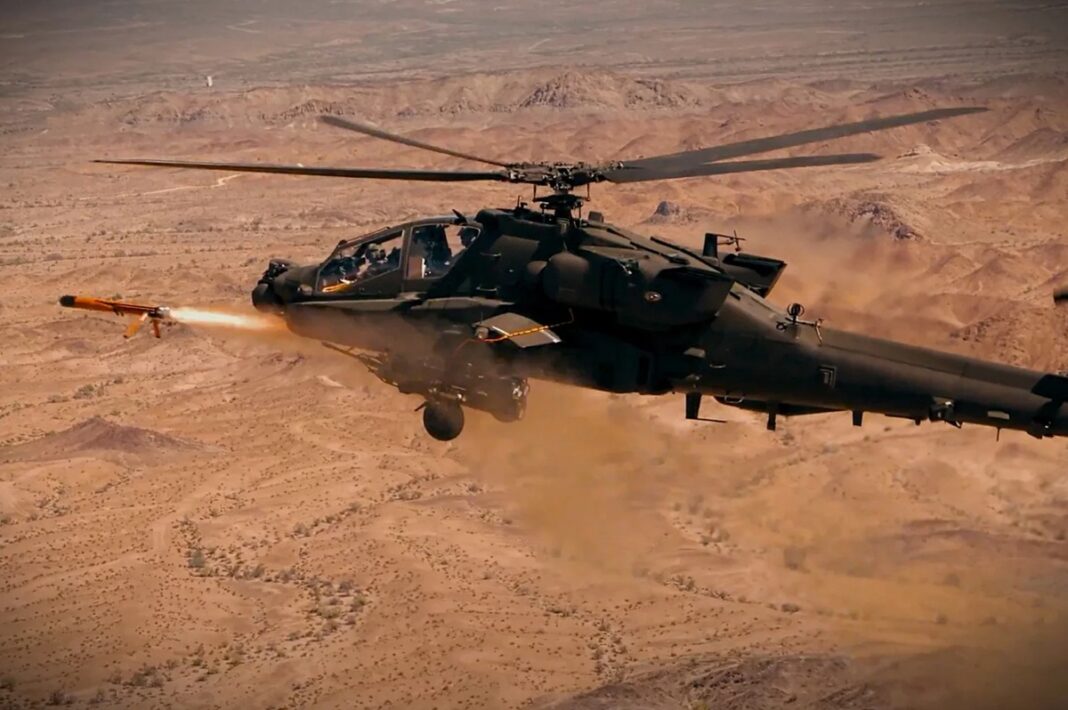
At Yuma Proving Ground, U.S. Army Apache helicopters recently tested launching:
Altius 700 autonomous systems
during advanced battlefield experiments.
The tests demonstrated how helicopters can:
- Extend sensor range
- Conduct deception operations
- Improve targeting beyond onboard systems
The broader lesson:
Attack helicopters are evolving from isolated strike platforms into networked combat hubs.
Industrial and Sovereign Capability Push
Project NYX also reflects Britain’s effort to expand sovereign defence technology.
Anduril UK says it has:
- Invested tens of millions of pounds into autonomy development
- Conducted full-scale test flights
- Expanded testing facilities in North Wales
Its British industrial ecosystem reportedly includes:
- GKN Aerospace
- Archer Aviation
- Multiple UK technology firms focused on autonomy and aerospace integration.
For London, this supports:
Defence industrial resilience and sovereign capability growth.
Why Project NYX Matters for NATO
The programme carries implications beyond Britain.
Across NATO, militaries are rethinking battlefield doctrine after lessons from:
- Ukraine
- Middle East drone warfare
- Electronic warfare proliferation
Future wars increasingly reward:
- Distributed systems
- Faster decision-making
- Autonomous capability
- Lower-cost force multiplication
Project NYX may therefore become:
A blueprint for future allied attack aviation.
Conclusion: The Apache Era Is Changing
Project NYX signals a major shift in military aviation thinking.
The future Apache helicopter may no longer fight alone.
Instead:
Crewed helicopters could command autonomous drone ecosystems operating across contested battlespaces.
For the British Army, this could mean:
- Greater survivability
- Expanded battlefield reach
- Stronger targeting capability
- Reduced pilot exposure to danger
And for NATO:
The age of the autonomous helicopter wingman may be arriving faster than expected.