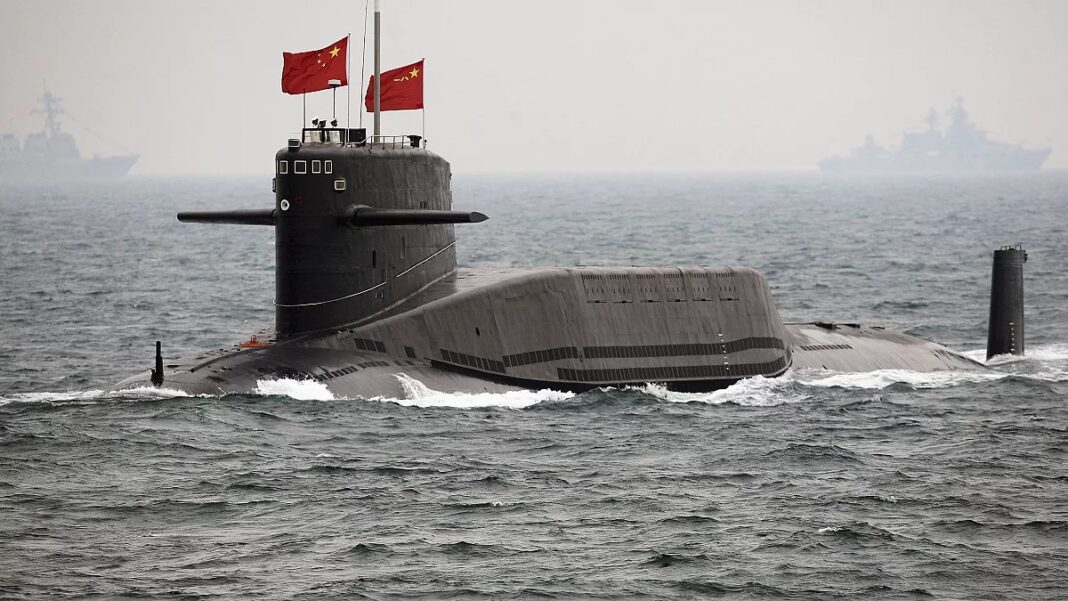
A rare surfaced transit of what open-source intelligence (OSINT) analysts believe to be China’s most advanced operational nuclear-powered attack submarine near crowded tourist beaches in Hainan Island has unexpectedly pulled back the curtain on one of Beijing’s most secretive military capabilities.
Footage reportedly captured on May 14 near Yalong Bay, close to the city of Sanya, appeared to show a submarine widely assessed by OSINT analysts as a Type 093B (Shang III) nuclear-powered attack submarine moving toward facilities linked to Yulin Naval Base.
The footage — reportedly recorded by a Russian tourist and later amplified across social media — quickly drew attention because the submarine was seen transiting unusually close to swimmers, civilian boats, and beachgoers.
The latest and most advanced Type 093B SSN has been seen going into the Harbour of Yulin Naval Base, Hainan, skimming near public tourists beachespic.twitter.com/4LopTAiYxX
— PLA Military Updates🇨🇳 (@PLA_MilitaryUpd) May 16, 2026
For defense analysts, however, this was not merely an unusual viral moment.
It offered a rare public glimpse into one of the most strategically important elements of China’s rapidly expanding undersea warfare capabilities.
Why This Sighting Matters
The significance lies in the submarine’s suspected identity.
The Type 093B represents:
China’s most advanced operational nuclear-powered attack submarine (SSN) currently believed to be in service.
It serves as a transitional platform between earlier Shang-class submarines and the future Type 095 next-generation attack submarine, which is expected to play a central role in Beijing’s long-term naval ambitions.
Unlike conventional diesel-electric submarines, nuclear-powered attack submarines provide:
- Long-endurance deployments
- Greater operational range
- Sustained high-speed operations
- Intelligence gathering capability
- Long-range strike options
For the People’s Liberation Army Navy, this capability is central to transforming China into a true blue-water naval power.
A Strange Collision of Tourism and Strategic Secrecy
One of the most striking aspects of the incident was geography.
Unlike many Cold War submarine facilities built in isolated regions, Yulin Naval Base sits adjacent to one of China’s busiest tourism zones.
Luxury resorts, beaches, and recreational waters surround parts of the naval infrastructure near Sanya and Yalong Bay.
The result:
Sensitive military movements occasionally unfold within sight of ordinary civilians.
Some assessments suggest portions of the military complex lie only a few hundred feet from nearby commercial infrastructure.
This creates an unusual strategic paradox:
Highly secretive nuclear submarines operating in one of China’s most photographed tourist regions.
The latest sighting may therefore reflect:
Geography rather than unusual military activity.
Analysts caution there is no evidence the surfaced transit represented:
- Emergency deployment
- Escalation
- Operational crisis
Instead, it likely captured a routine movement unexpectedly exposed by smartphones and social media.
What Makes the Type 093B Different?
The Type 093B (Shang III) is important because it reflects years of Chinese effort to solve one of its biggest naval weaknesses:
Submarine noise
Historically, Western analysts criticized earlier Chinese nuclear submarines for being:
Too loud.
Earlier Type 093 variants were frequently compared to older Soviet-era submarines rather than advanced American or British platforms.
The major reported leap in the 093B appears to involve:
Pump-jet propulsion
Instead of traditional exposed propellers:
- Rotating systems are enclosed inside ducts
- Turbulence is reduced
- Cavitation noise decreases
- Acoustic survivability improves
This matters enormously because:
In submarine warfare, survival depends on not being heard.
The quieter a submarine becomes:
The harder it is to detect using:
- Sonar arrays
- Passive acoustic systems
- Anti-submarine warfare networks
Western analysts increasingly view the pump-jet transition as one of China’s biggest undersea technological advances in years.
How Good Is China’s Type 093B Compared to U.S. Submarines?
The answer remains debated.
Some Western assessments suggest the Type 093B may approach:
- Late-Cold War Soviet Sierra-class standards
- Improved Los Angeles-class U.S. submarines
Others argue it still remains:
Roughly one generation behind the Virginia-class submarine or Britain’s Astute-class submarine.
The truth is difficult to verify because:
Submarine acoustics remain among the world’s most closely guarded military secrets.
Noise levels depend on:
- Speed
- Depth
- Ocean conditions
- Tactical profile
Public certainty is impossible.
But one trend is increasingly clear:
China has narrowed the gap.
China’s Bigger Advantage: Production Speed
What may concern Indo-Pacific planners most is not necessarily whether the Type 093B equals Western submarines individually.
It is:
How quickly China can build them.
OSINT estimates suggest:
Between six and nine Type 093B submarines may already be in production or launch phases. Several could already be operational.
China’s defense-industrial system increasingly prioritizes:
- Rapid iteration
- Serial production
- Continuous upgrades
The implication is significant:
Even if individual submarines remain slightly inferior technologically:
Quantity changes strategy.
More submarines mean:
- Greater deployment tempo
- Expanded patrol areas
- More pressure on U.S. and allied naval planning
Why Hainan and Yulin Matter Strategically
Yulin Naval Base is among the most important facilities in China’s military inventory.
The base provides:
Direct operational access to:
- The South China Sea
- The Western Pacific
- Wider Indo-Pacific maritime corridors
Perhaps most intriguing:
The facility reportedly includes:
Underground mountain tunnel complexes
These hardened shelters may allow submarines to:
- Hide from satellite surveillance
- Prepare deployments underground
- Exit into contested waters with limited detection.
For Beijing, this dramatically enhances survivability.
Could the Type 093B Carry Cruise Missiles?
Some open-source assessments suggest the submarine may support:
Vertical launch systems (VLS)
potentially carrying around:
24 cruise missiles
for:
- Anti-ship warfare
- Land attack missions
If accurate, that would make the platform far more than an undersea hunter.
It becomes:
A strategic strike asset.
Capable of threatening:
- Carrier groups
- Regional military bases
- Land infrastructure across the Indo-Pacific.
The Bigger Strategic Lesson
The viral footage matters less because of visual drama.
Its importance lies elsewhere:
It briefly exposed the hidden infrastructure of China’s military modernization.
The sighting reinforced several realities:
✔ China’s submarine force is becoming more sophisticated
✔ Undersea modernization is accelerating
✔ Production pace increasingly matters
✔ The South China Sea remains central to Beijing’s strategy
For Washington and regional allies:
The challenge is no longer simply tracking Chinese military growth.
It is understanding:
How quickly China’s hidden capabilities are maturing beneath the surface.
Conclusion
The surfaced transit near Hainan was likely routine.
But routine moments increasingly matter in an age of:
- Smartphones
- Satellite imagery
- Open-source intelligence
Submarines are built for invisibility.
Yet paradoxically:
In the digital era, even accidental exposure can send powerful strategic signals.
And this signal was unmistakable:
China’s undersea force is becoming quieter, more survivable, and more capable — fast.