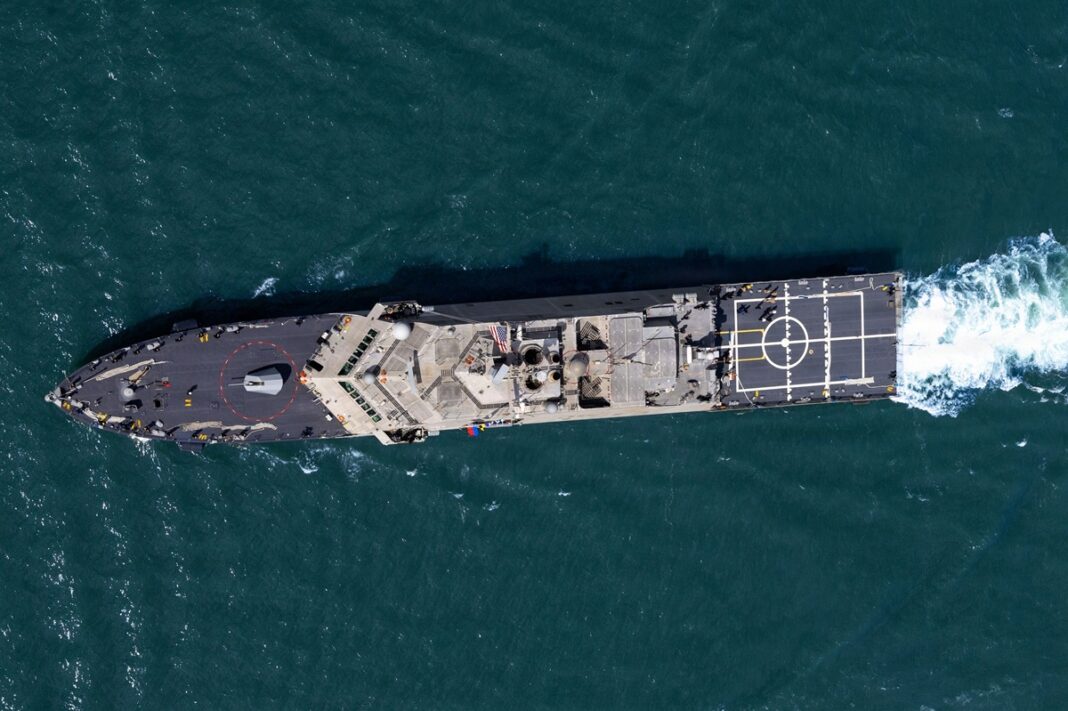
The United States Navy has officially commissioned USS Cleveland (LCS 31), the final Freedom-variant Littoral Combat Ship (LCS) built by the Lockheed Martin–led team at Fincantieri Marinette Marine, marking the end of a controversial yet strategically important chapter in U.S. naval procurement.
Commissioned during a ceremony in Cleveland, Ohio, the vessel enters service as a fast, shallow-draft combat ship optimized for:
✔ Coastal warfare
✔ Maritime interdiction
✔ Escort operations
✔ Counter-drone and small-boat threats
✔ Security missions in congested waterways.
Its arrival reflects how the Navy increasingly sees the role of Freedom-class ships:
Not as mini destroyers — but as flexible maritime security platforms for contested littoral environments.
The lifeblood of our Navy is the Sailor.
📍CLEVELAND – Adm. Karl Thomas, commander of U.S. Fleet Forces, administered the Oath of Enlistment to Sailors assigned to the Freedom-variant littoral combat ship USS Cleveland (LCS 31) during their reenlistment aboard the ship. pic.twitter.com/TectjYcGfI
— U.S. Fleet Forces (@USFleetForces) May 18, 2026
As Washington faces rising pressure across:
- The Red Sea
- The Indo-Pacific
- The Persian Gulf
- Strategic chokepoints worldwide
the Navy is increasingly seeking ways to preserve high-end destroyers for major warfighting while assigning lower-intensity missions to smaller combatants.
USS Cleveland appears built for exactly that role.
What Is USS Cleveland?
USS Cleveland belongs to the:
Freedom-class littoral combat ship
family — specifically the:
Freedom-variant steel monohull design
This distinguishes it from the:
Independence-class aluminum trimaran ships
based primarily on the U.S. West Coast.
According to U.S. Navy specifications, Cleveland measures:
- 387.6 feet (118.1 meters) long
- 57.7-foot beam
- 14.1-foot shallow draft
- Approximately 3,450 metric tons displacement
Perhaps most importantly:
It exceeds 40 knots in speed
making it one of the Navy’s fastest surface combatants.
That combination of speed and shallow draft gives the ship a distinct operational niche.
Unlike larger destroyers, USS Cleveland can operate closer to:
Ports, chokepoints, archipelagos, and coastal traffic lanes
where maneuverability matters more than heavy missile firepower.
Why the Navy Still Needs Littoral Combat Ships
The commissioning comes after years of criticism surrounding the Littoral Combat Ship program.
Several earlier Freedom-class ships were retired early because of:
- Maintenance issues
- Reliability concerns
- Sustainment costs
- Questions over survivability
Yet despite criticism, the Navy still faces a major operational problem:
Too many missions, not enough destroyers.
High-end vessels such as:
are increasingly tied up with:
- Carrier strike group defense
- Ballistic missile defense
- Red Sea missile interception
- China deterrence missions
That leaves lower-intensity but still essential tasks underserved.
USS Cleveland helps fill this gap by taking on:
✔ Counter-narcotics patrols
✔ Maritime security operations
✔ Partner force exercises
✔ Escort missions
✔ Boarding operations
✔ Port and strait surveillance.
In short:
Cleveland is designed to free up bigger warships for higher-end combat.
USS Cleveland’s Firepower: Built for Coastal Combat
USS Cleveland is optimized for:
Surface Warfare
Its primary armament includes:
Mk 110 57mm Naval Gun
A rapid-fire weapon capable of:
220 rounds per minute
with roughly:
Nine miles of range
This system is effective against:
- Small attack boats
- Coastal targets
- Low-end aerial threats
- Maritime interdiction scenarios.
Longbow Hellfire Missiles
The ship carries:
24 Hellfire missiles
via the:
Surface-to-Surface Missile Module
designed for:
Fast attack craft and swarm threats.
The system has already demonstrated utility in:
- Red Sea drone defense
- Ship-to-shore strike missions.
RIM-116 Rolling Airframe Missile (RAM)
For short-range self-defense against:
- Cruise missiles
- Drones
- Asymmetric maritime threats
However:
The distinction matters.
USS Cleveland offers:
Point defense
—not regional air defense.
Meaning:
It protects itself.
It does not replace a destroyer.
Helicopters and Drones Multiply Its Reach
One of Cleveland’s greatest strengths lies not in missiles —
but aviation.
Its Surface Warfare Mission Package includes:
MH-60R Seahawk
equipped with:
- Hellfire missiles
- .50 caliber weapons
- Machine guns
alongside support for:
MQ-8 Fire Scout
unmanned aircraft.
This dramatically expands the ship’s ability to:
✔ Scout beyond radar range
✔ Identify suspicious contacts
✔ Support boarding teams
✔ Conduct maritime surveillance
The vessel also carries:
11-meter RHIB boats
for:
Visit, Board, Search, and Seizure (VBSS) missions.
That makes Cleveland particularly useful in:
Grey-zone maritime environments
where law enforcement and military operations increasingly overlap.
Why USS Cleveland Matters for US Naval Strategy
The ship arrives at a critical strategic moment.
The Navy’s:
Navigation Plan 2024
prioritizes:
- Distributed maritime operations
- Fleet readiness by 2027
- Greater use of autonomous systems
- More deployable hulls for regional deterrence.
USS Cleveland fits neatly into this vision.
Rather than concentrating power only in expensive destroyers and carriers,
the Navy increasingly wants:
Distributed, mission-specific platforms
capable of handling daily maritime competition.
Especially in places like:
- The South China Sea
- The Red Sea
- The Caribbean
- Strategic chokepoints
where persistent presence matters.
The Final Freedom-Class Ship — and a Symbolic End
Cleveland also closes an era.
The ship is:
The final Freedom-variant LCS ever built
ending a production run shaped by:
- High expectations
- Major criticism
- Operational adaptation
The original LCS vision promised rapid mission-swapping between:
- Surface warfare
- Anti-submarine warfare
- Mine countermeasures
Reality proved more complicated.
Instead:
The Navy increasingly narrowed the class to:
Defined maritime security and surface warfare missions.
That narrower mission set may finally be where the platform succeeds.
Conclusion: USS Cleveland Won’t Change Naval Warfare — But It Solves a Real Problem
USS Cleveland will not redefine sea power.
Nor will it rival destroyers in major naval combat.
But it was never meant to.
Its value lies somewhere else:
Doing the everyday work of maritime security without consuming scarce high-end warships.
In an era of:
- Drone threats
- Chokepoint tensions
- Maritime grey-zone conflict
the Navy increasingly needs ships that are:
Fast, flexible, affordable, and constantly deployable.
USS Cleveland may be the final Freedom-class ship —
but its operational logic is likely to shape U.S. naval thinking for years to come.