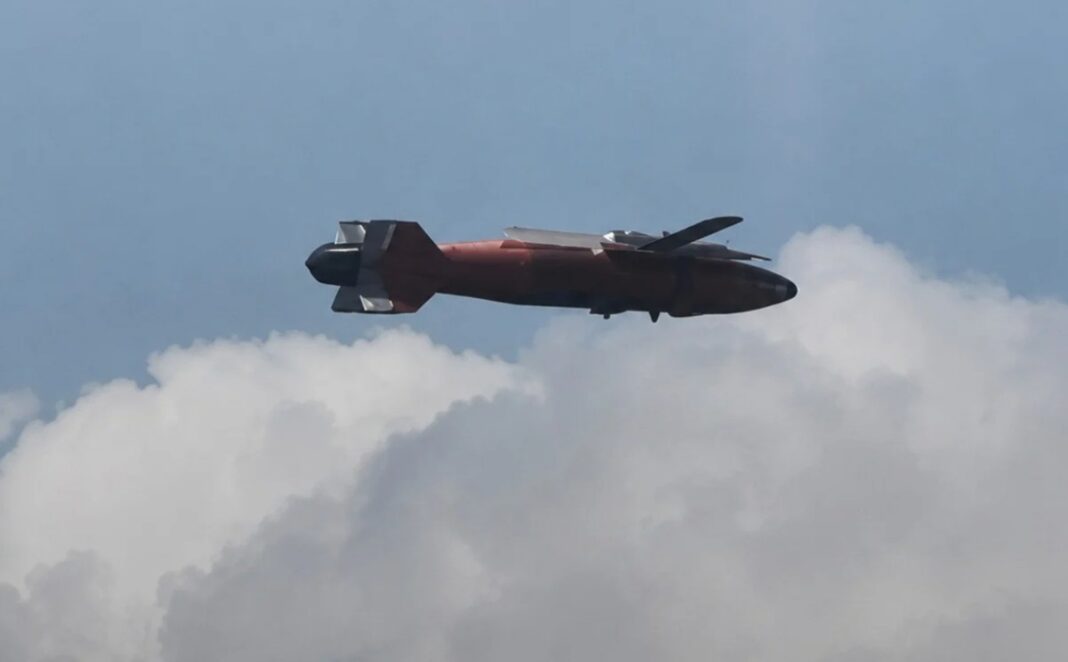
Ukraine has introduced its first domestically developed glide bomb, marking a significant milestone in Kyiv’s effort to reduce dependence on Western weapons and expand its long-range strike capability against Russian forces.
Developed by Ukrainian defense company DG Industry through the country’s Brave1 defense technology hub, the weapon reportedly carries a 250-kilogram warhead and is now entering combat deployment after 17 months of development, according to Ukrainian defense sources.
The first Ukrainian glide bomb from @BRAVE1ua is ready for combat deployment. Development took 17 months. The warhead weighs 250 kg. The Ukrainian glide bomb features a unique design created specifically for the realities of modern warfare.
Pilots are currently rehearsing… pic.twitter.com/Zb4TvBquUF
— Defense of Ukraine (@DefenceU) May 18, 2026
The development is strategically important.
Not because it suddenly changes the military balance against Russia —
but because it signals something larger:
Ukraine is building its own sovereign precision-strike ecosystem under wartime conditions.
At a time when Kyiv faces uncertainty over long-term foreign arms supplies, indigenous weapons production is becoming increasingly critical.
And glide bombs are now among the most important battlefield tools in modern war.
What Is Ukraine’s New Glide Bomb?
Confirmed technical details remain limited.
But several key features have emerged.
Ukraine says the weapon:
Carries a 250kg Warhead
The munition is designed for high-impact strikes against:
- Fortifications
- Command posts
- Reinforced military positions
- Fixed battlefield infrastructure.
Has a Standoff Range of “Dozens of Kilometers”
Allowing Ukrainian aircraft to strike targets without flying directly over heavily defended Russian positions.
Is an Indigenous Design
Unlike many battlefield adaptations seen during the war, Ukrainian officials say this is:
Not a modification of Soviet or Western bombs
but a domestically engineered platform.
However, many important details remain undisclosed.
Ukraine has not publicly confirmed:
- Total weapon weight
- Guidance architecture
- Accuracy (CEP)
- Wing design
- Release altitude profile
- Aircraft compatibility
- Whether the weapon uses a terminal seeker.
These omissions matter.
Because in modern air warfare:
Precision matters more than explosive size alone.
Why Glide Bombs Have Become One of the Most Important Weapons in Ukraine
The war in Ukraine has transformed perceptions of air-delivered munitions.
Over the past two years, Russia increasingly relied on:
FAB-series bombs equipped with UMPK glide kits
These modified bombs became one of Moscow’s most effective battlefield tools.
Instead of risking aircraft near front-line air defenses, Russian pilots could:
Release bombs from safer distances
allowing the weapon to glide toward targets.
According to NATO assessments:
Russia was reportedly launching:
Around 3,500 glide bombs per month by early 2025
while Ukrainian intelligence estimated Moscow could produce:
Up to 120,000 glide bombs in 2025
including longer-range variants.
That production scale created:
A serious battlefield asymmetry.
Ukraine’s new bomb does not erase that imbalance.
But it does give Kyiv:
A domestic precision strike option it can improve over time.
The Technical Challenge Is Far More Complex Than Adding Wings
At first glance, glide bombs may appear simple.
Add wings to a bomb.
Increase range.
Problem solved.
Reality is much harder.
A functioning glide bomb must:
Separate Safely from the Aircraft
Without destabilizing the aircraft or munition.
Generate Lift
Using aerodynamic surfaces to maintain flight.
Navigate Precisely
Likely using:
- Inertial navigation systems (INS)
- Satellite guidance assistance
though Ukraine has not confirmed its guidance architecture.
Survive Electronic Warfare
Perhaps the biggest battlefield challenge.
Russian forces increasingly jam:
- GPS
- Satellite navigation
- Communications signals
making guidance reliability a major combat issue.
The war increasingly rewards:
Weapons that can function inside electronic warfare environments.
How Powerful Is a 250kg Warhead?
The reported 250kg warhead could place the bomb in an important tactical category.
Military analysts note:
A 250kg warhead should not automatically be confused with:
A 250kg total bomb weight
The distinction matters.
If the figure refers to explosive payload alone:
The weapon could potentially exceed the destructive effect of many:
500-pound class precision bombs
Its likely battlefield targets include:
- Trench hubs
- Ammunition depots
- Command shelters
- Reinforced buildings
- Bridge approaches
- Communications infrastructure.
However:
Its ability to destroy hardened underground bunkers would depend on:
- Casing strength
- Impact velocity
- Penetration angle
- Fuse timing
all still unknown publicly.
Brave1: Ukraine’s Wartime Weapons Innovation Machine
The glide bomb program also highlights the growing importance of:
Brave1
Ukraine’s defense innovation platform.
Established in April 2023, Brave1 connects:
- Defense startups
- Engineers
- Military operators
- Government procurement agencies
to accelerate battlefield technology.
The numbers are striking.
Government figures reportedly show:
- 3,500+ registered defense developments
- 260+ NATO-standardized systems
- 470+ grants issued
- UAH 1.3 billion invested
across projects involving:
- Missiles
- Anti-Shahed systems
- Lasers
- Naval drones
- Drone swarms
- Guided munitions.
The glide bomb belongs to this wider strategy:
Turn battlefield necessity into domestic defense production.
Combat Deployment Will Be the Real Test
The first experimental batch now entering service may matter less for immediate military effect —
and more for:
Learning under combat conditions
Wartime testing will expose problems impossible to fully simulate in laboratories, including:
- Battery performance in freezing temperatures
- Guidance errors under jamming
- Aircraft integration challenges
- Release envelope problems
- Coordinate loading mistakes
- Structural vibration during flight.
That means:
Early battlefield use will likely function as:
A live operational testing phase.
Can Ukraine Produce Enough of Them?
The biggest question is scale.
Russia’s glide bomb advantage comes not only from technology —
but from:
Mass production
Ukraine now faces a difficult industrial challenge.
Large-scale output depends on:
- Guidance electronics
- Anti-jam navigation systems
- Batteries
- Actuators
- Fuzes
- Wing assemblies
- Explosive production capacity.
If Kyiv achieves sustained production:
The Ukrainian Air Force gains a new precision strike option that reduces dependence on:
- Western JDAM-ER kits
- French AASM Hammer bombs
- Limited cruise missile inventories
If production stays small:
The weapon’s battlefield effect may remain limited —
but its strategic symbolism will still matter.
Conclusion: Ukraine Is Building More Than a Bomb
Ukraine’s first indigenous glide bomb will not suddenly reverse battlefield momentum.
Nor will it erase Russia’s major production advantage.
But that misses the point.
The real significance lies elsewhere:
Ukraine is steadily building a sovereign precision-strike industry while fighting a major war.
In modern conflict:
The side that can adapt, manufacture, and innovate fastest increasingly gains advantage.
And Kyiv appears increasingly determined to ensure:
Its future battlefield options are built:
Inside Ukraine — not entirely abroad.