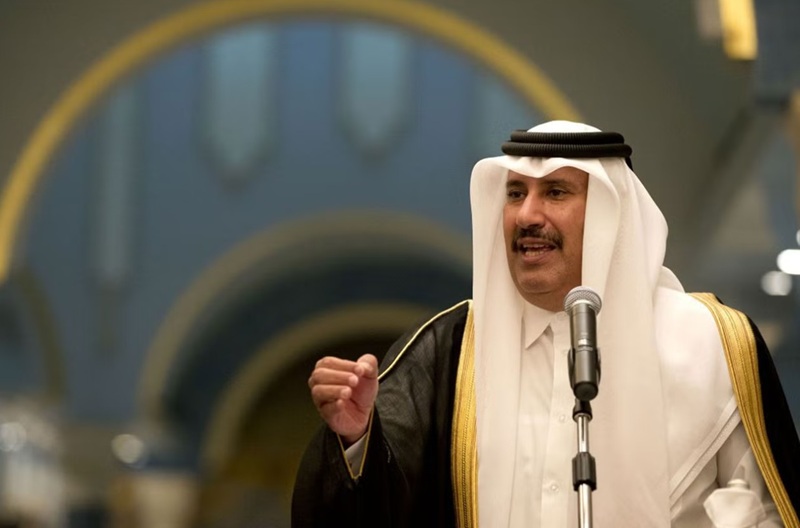
Former Qatari Prime Minister Hamad bin Jassim bin Jaber Al Thani has issued a blunt assessment of the ongoing Iran conflict, warning that military action has failed to serve regional stability and may instead be producing unintended consequences.
In a series of remarks, he argued that:
- The conflict has harmed U.S. allies in the region
- Military escalation has not delivered strategic gains
- The operation appears to have served narrow political objectives rather than regional security
His comments reflect a growing sentiment in parts of the Gulf that the current trajectory risks destabilizing the broader Middle East.
“#Ukraine gave up its nuclear weapons — and look what happened to it.”
Former Qatari Prime Minister Sheikh Hamad bin Jassim told Al Jazeera that #Iran sees its nuclear program as a matter of survival and sovereignty, pic.twitter.com/UCcU9PuvoO
— Aurora Borealis 🤫 (@aborealis940) May 12, 2026
“The War Served Netanyahu, Not the Region”
Al Thani directly linked the military campaign to the political agenda of Israeli Prime Minister Benjamin Netanyahu.
According to his assessment:
- The operation aligns with Netanyahu’s vision of reshaping the region
- It supports efforts toward new geopolitical alignments
- It is tied to broader ideas about a “new Middle East map”
This framing suggests the war is being viewed by some regional leaders as politically driven rather than strategically necessary.
Iran’s Power Structure: Built to Survive
A central argument in Al Thani’s remarks is that external actors misunderstand Iran’s internal resilience.
He emphasized that:
- Iran’s political system has evolved over 47 years since the fall of the Shah
- Power is distributed across multiple institutions
- The system is designed to absorb pressure and adapt
The implication is clear:
Expectations of rapid regime collapse are unrealistic.
Iran’s Negotiation Strategy: Delay and Endurance
Al Thani also highlighted Iran’s long-standing diplomatic approach:
- Enter negotiations when necessary
- Prolong discussions
- Use time as a strategic tool
He described this as a subtle but effective tactic:
“Sometimes the trick is not to use a trick.”
This reflects Iran’s ability to:
- Manage external pressure
- Avoid decisive concessions
- Maintain strategic ambiguity
Nuclear Program: A Matter of Sovereignty
According to the former Qatari premier, Iran views its nuclear program as:
- A sovereign right
- A matter of national survival
- Non-negotiable without significant concessions
He noted that Iranian officials often reference historical precedents — including Ukraine’s disarmament — as cautionary examples.
This reinforces a key point:
Iran is unlikely to abandon its nuclear ambitions without strong guarantees.
Regional Nuclear Reality Shapes Iran’s Thinking
Al Thani pointed to the broader regional context influencing Iran’s decisions:
- Israel’s undeclared nuclear capability
- Pakistan’s established nuclear deterrent
From Tehran’s perspective:
Nuclear capability is not just strategic —
it is a matter of parity and survival in a nuclearized region.
Long-Term Outlook: Iran Will Persist
The former prime minister offered a clear prediction:
- Iran will continue its current trajectory
- Negotiations will not fundamentally alter its strategic goals
- Over time, Tehran is likely to achieve its objectives
His conclusion suggests that:
Pressure alone is unlikely to change Iran’s long-term nuclear ambitions.
Implications for the Region
Al Thani’s remarks highlight several broader implications:
- Military escalation may increase instability rather than reduce it
- Regional alliances remain fluid and uncertain
- Long-term solutions require diplomatic engagement, not just force
For Gulf states, the priority remains:
Stability, economic security, and controlled escalation
Conclusion: A Warning From the Gulf
The comments from Qatar’s former prime minister provide a rare insider perspective on how parts of the Gulf view the Iran conflict.
His message is clear:
- Military action has limits
- Iran’s system is more resilient than assumed
- Nuclear ambitions are deeply embedded in national strategy
Without a realistic understanding of these dynamics, attempts to reshape the region through force may produce the opposite outcome.