
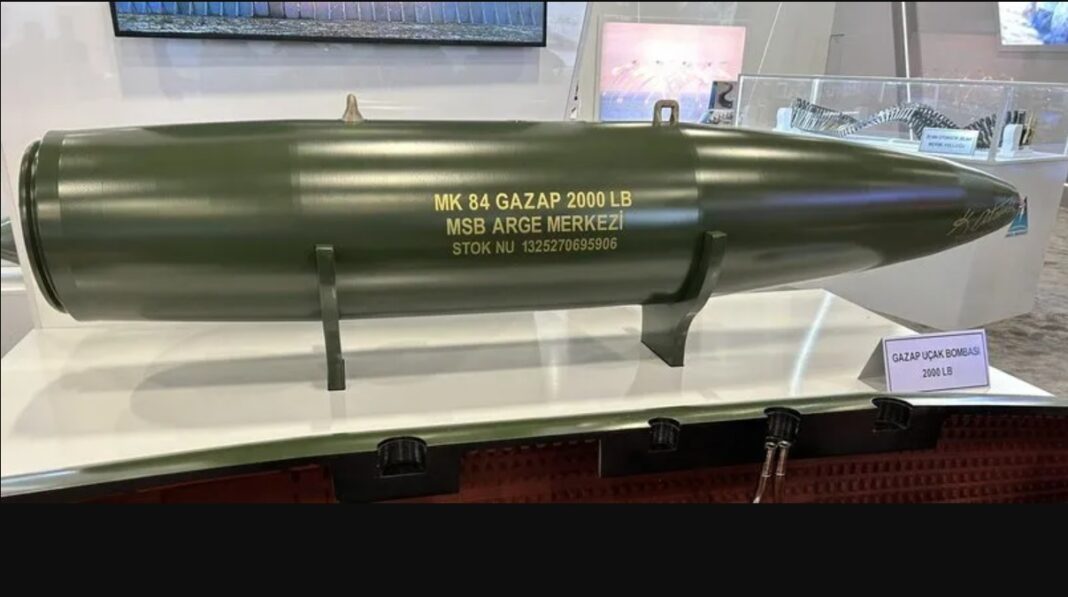
Pakistan’s reported acquisition of Türkiye’s GAZAP thermobaric-fragmentation bomb may signal a significant shift in South Asia’s conventional strike balance, particularly as reports suggest the Pakistan Air Force (PAF) is preparing to integrate the weapon onto its fleet of F-16 multirole fighters.
If confirmed, the development would place one of Türkiye’s most powerful non-nuclear aerial munitions into a regional battlespace increasingly defined by hardened command bunkers, underground logistics hubs, missile storage sites, and precision deep-strike doctrine.
More importantly, the integration of a thermobaric munition onto Pakistan’s frontline combat aircraft could substantially enhance Islamabad’s ability to conduct precision strikes against fortified infrastructure without immediately relying on strategic missile inventories.
At a broader level, the reported transfer also highlights the rapidly expanding military-industrial partnership between Pakistan and Türkiye.
What Is Türkiye’s GAZAP Bomb?
GAZAP is a next-generation thermobaric-fragmentation aerial bomb reportedly developed by Türkiye’s Ministry of National Defence Research and Development Centre and publicly showcased during the IDEF 2025 defence exhibition in Istanbul.
The weapon is reportedly based on the architecture of the US-made Mk-84 2,000-pound general-purpose bomb — one of the world’s most widely used heavy aerial munitions.
However, unlike conventional bombs that rely primarily on blast and fragmentation, GAZAP reportedly combines thermobaric explosive effects with high-density fragmentation.
That distinction matters.
Thermobaric weapons generate sustained overpressure and thermal effects by dispersing fuel into the air before ignition, consuming atmospheric oxygen and creating prolonged blast waves particularly effective against enclosed and hardened targets.
In simple terms, such weapons are designed to defeat targets conventional bombs often struggle to neutralise efficiently.
Why GAZAP Matters for Pakistan’s F-16 Fleet
The most significant aspect of the reported acquisition may be its integration onto Pakistan’s F-16 fighter fleet.
Pakistan’s F-16s remain among the country’s most capable strike platforms due to advanced avionics, targeting systems, survivability, and operational experience.
If integrated successfully, GAZAP could provide the Pakistan Air Force with an air-delivered capability specifically optimised for destroying:
- Hardened command bunkers
- Underground logistics facilities
- Tunnel networks
- Aircraft shelters
- Missile depots
- Fortified operational headquarters
Unlike cruise missiles or ballistic systems, thermobaric bombs could offer a comparatively lower-cost method for targeting protected infrastructure during conventional conflict scenarios.
Because GAZAP reportedly remains compatible with existing Mk-84 carriage systems, guidance kits, and release mechanisms, integration complexity may remain relatively limited for F-16 operations.
This could significantly reduce logistical friction and shorten operational deployment timelines.
How Powerful Is the GAZAP Bomb?
According to defence reporting, GAZAP reportedly weighs between 907kg and 970kg and carries approximately 453kg of thermobaric explosive material.
Turkish defence sources claim the weapon can disperse roughly 10,000 fragments while generating extremely intense thermal and overpressure effects inside enclosed spaces.
Some Turkish media reports have suggested temperatures could approach 3,000 degrees Celsius in localised impact zones, though independent verification remains unavailable publicly.
Military analysts caution against exaggerated descriptions often associated with so-called “vacuum bombs,” noting that public discourse frequently overstates technical realities for psychological or signalling purposes.
Even so, thermobaric systems remain among the most effective conventional weapons for attacking protected structures.
Why Thermobaric Weapons Matter in Modern Warfare
Modern warfare increasingly revolves around survivability.
Military planners across the world increasingly invest in underground infrastructure, reinforced bunkers, tunnel complexes, distributed logistics, and hardened command networks specifically designed to survive conventional bombardment.
This trend has increased interest in thermobaric systems globally.
Unlike traditional high-explosive bombs that disperse force rapidly, thermobaric munitions create sustained pressure waves that can penetrate enclosed environments with devastating effects.
Russian operations in Syria and Ukraine, as well as broader global military procurement trends, have reinforced renewed interest in enhanced-blast munitions optimised for urban warfare and hardened-target destruction.
However, such weapons also remain controversial due to the devastating overpressure effects they can create in civilian environments if used indiscriminately.
International humanitarian law does not explicitly prohibit thermobaric weapons but heavily scrutinises their use under proportionality and civilian protection standards.
The Bigger Pakistan-Türkiye Defence Story
Beyond the bomb itself, the reported transfer reinforces the deepening defence relationship between Pakistan and Türkiye.
Military cooperation between Ankara and Islamabad has expanded steadily across naval systems, drones, aerospace technologies, guided munitions, and defence-industrial collaboration.
Türkiye has already supplied Pakistan with advanced naval platforms, drone systems, and precision-strike technologies.
Both countries also increasingly pursue strategic autonomy by reducing dependence on traditional Western defence ecosystems.
For Türkiye, exporting GAZAP strengthens its position as an emerging defence exporter capable of producing advanced strike systems outside conventional Western supply chains.
For Pakistan, access to Turkish-origin systems provides greater procurement flexibility while expanding operational capabilities.
The reported transfer may therefore represent more than a weapons sale.
It could reflect a deeper long-term strategic alignment involving technology transfer, interoperability, and broader military-industrial integration.
What Does This Mean for India and Regional Security?
The reported introduction of GAZAP into Pakistan’s strike inventory may complicate regional military planning.
India and Pakistan increasingly prioritise hardened command centres, survivable infrastructure, and precision deep-strike capability as central elements of crisis stability and escalation management.
A thermobaric-enhanced F-16 strike capability could pressure regional militaries to reassess bunker survivability, blast protection, and underground operational resilience.
Even a limited inventory could generate disproportionate battlefield effects if integrated into coordinated strike packages targeting critical infrastructure.
At the same time, important uncertainties remain.
Neither Islamabad nor Ankara has publicly confirmed acquisition numbers, operational readiness, or exact integration timelines.
That uncertainty makes it difficult to assess immediate strategic impact.
GAZAP vs MOAB: Key Difference
The comparison frequently made in defence discussions is between GAZAP and the US-made Massive Ordnance Air Blast (MOAB), often called the “Mother of All Bombs.”
However, the two systems are designed for different missions.
GAZAP appears intended for precision modern tactical warfare, particularly hardened-target destruction using frontline fighter aircraft.
MOAB, by contrast, functions primarily as a large-scale area-denial and strategic pressure weapon requiring heavy transport aircraft deployment.
In practical terms, GAZAP may offer Pakistan a more flexible battlefield tool suited to contemporary high-intensity regional warfare.
The Bottom Line
Pakistan’s reported acquisition of Türkiye’s GAZAP bomb reflects a broader transformation in modern conventional warfare.
Future conflicts are increasingly shaped by hardened infrastructure, underground logistics, precision strikes, and survivable command systems.
In that environment, thermobaric weapons provide militaries with powerful conventional tools for defeating targets traditional bombs struggle to neutralise.
If integrated successfully onto Pakistan’s F-16 fleet, GAZAP could significantly strengthen Islamabad’s conventional bunker-strike capability without immediately escalating toward strategic missile exchanges.
For South Asia, that may represent another important step in the evolving balance of regional airpower.