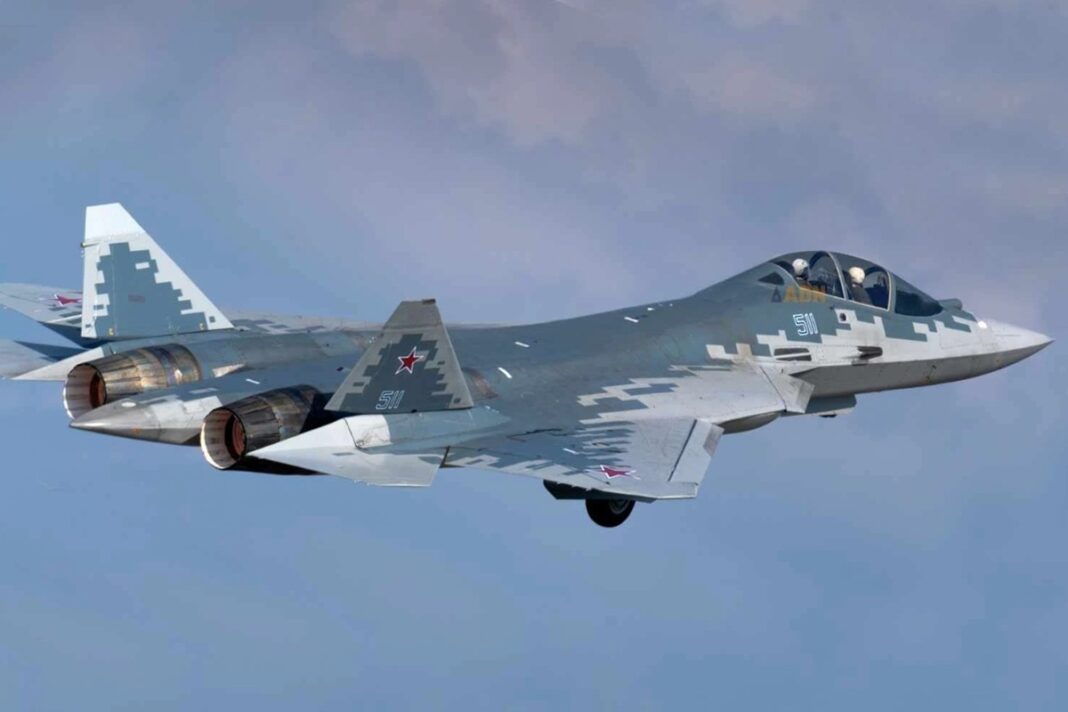
Russia’s proposal to supply and co-produce the Su-57E stealth fighter for India has evolved into far more than a conventional fighter aircraft sale. If accepted, the package could reshape India’s fifth-generation airpower, accelerate indigenous aerospace development, and significantly influence the strategic balance across the Indo-Pacific.
According to Russian officials, Moscow is prepared to offer New Delhi an unprecedented level of defence-industrial cooperation, including local manufacturing, technology transfer, mission systems integration, and long-term co-development.
Should AMCA Follow the Su-57 and F-15EX Path with a Two-Seat Variant? https://t.co/Thdau5DONd pic.twitter.com/u1icEyQ7GX
— idrw (@idrwalerts) June 30, 2026
The proposal comes at a time when India faces mounting pressure from China’s rapidly expanding fleet of J-20 stealth fighters and growing reports that Pakistan could eventually induct Chinese-built J-35 aircraft.
For New Delhi, the Su-57E is increasingly being viewed not simply as a new combat aircraft, but as a potential bridge to India’s future Advanced Medium Combat Aircraft (AMCA) programme.
Putin Signals a New Level of Defence Cooperation
The proposal received significant political momentum after Russian President Vladimir Putin publicly declared during the St. Petersburg International Economic Forum 2026 that Moscow was prepared to cooperate with India without major restrictions.
Unlike previous export arrangements, Russia has indicated a willingness to expand cooperation well beyond aircraft deliveries.
Reports suggest the proposal includes:
- Licensed production in India
- Extensive technology transfer
- Software integration
- Mission-system cooperation
- Long-term industrial collaboration
- Future joint development programmes
If implemented, it would represent one of the deepest aerospace partnerships Russia has ever offered a foreign customer.
Filling India’s Fifth-Generation Capability Gap
One of the strongest arguments supporting the Su-57E proposal is timing.
India’s indigenous Advanced Medium Combat Aircraft (AMCA) remains under development and is not expected to enter operational service for several years.
Meanwhile, regional competitors continue modernising rapidly.
China has steadily expanded production of the J-20 stealth fighter while investing heavily in network-centric warfare, advanced sensors and long-range air-to-air missiles.
At the same time, reports suggesting Pakistan may eventually receive the Chinese J-35 have intensified discussions inside Indian defence circles about maintaining a credible fifth-generation capability.
Under the reported Russian proposal, India could receive between 36 and 60 operational Su-57E fighters before domestic production gradually expands through licensed manufacturing.
Such an approach would allow the Indian Air Force to field stealth squadrons while AMCA continues toward operational maturity.
More Than a Fighter Purchase
Perhaps the most significant aspect of the proposal is not the aircraft itself but the reported depth of technology access.
Unlike traditional export contracts, Moscow is believed to have discussed cooperation involving:
- Mission software architecture
- Radar integration
- Electronic warfare systems
- Maintenance data
- Weapons integration interfaces
- Future upgrade pathways
For India, this could substantially strengthen domestic expertise in stealth engineering, avionics integration and aerospace software development.
Rather than remaining dependent on overseas suppliers for every modernization cycle, Indian engineers could gain valuable experience supporting future indigenous programmes.
HAL Could Become the Centre of Production
Russia also appears prepared to leverage India’s existing aerospace infrastructure.
Technical teams have reportedly inspected Hindustan Aeronautics Limited (HAL) facilities in Nashik, where India has decades of experience assembling and maintaining the Su-30MKI.
Using existing infrastructure would significantly reduce both cost and implementation time.
India already possesses:
- Experienced aerospace engineers
- Established logistics chains
- Russian maintenance expertise
- Existing production facilities
- Operational familiarity with Russian combat aircraft
This foundation could accelerate domestic assembly while strengthening India’s broader aerospace manufacturing ecosystem.
Supporting Atmanirbhar Bharat
The proposal aligns closely with India’s Atmanirbhar Bharat initiative, which seeks to expand indigenous defence manufacturing and reduce long-term dependence on foreign suppliers.
Instead of importing fully assembled fighters throughout the aircraft’s service life, India would gradually expand domestic capabilities across production, maintenance, modernization and future upgrades.
Such an approach would also strengthen India’s defence-industrial base while creating opportunities for local suppliers and technology development.
A New Twin-Seat Su-57?
One of the most interesting elements of the proposal involves reported cooperation on a future twin-seat Su-57 variant, sometimes associated with Russia’s emerging Su-57D programme.
A second crew member dramatically expands operational possibilities.
Modern fifth-generation warfare increasingly requires simultaneous management of:
- Electronic warfare
- Sensor fusion
- Long-range missile engagements
- Drone coordination
- Battle management
- Network-centric operations
A two-seat configuration could prove particularly valuable as air forces move toward manned-unmanned teaming and loyal wingman concepts.
India has extensive operational experience with twin-seat fighters through the Su-30MKI, making such a configuration especially attractive.
Potential Benefits for the AMCA Programme
Perhaps the greatest long-term benefit lies in what India could learn rather than simply what it could purchase.
Operational experience with a fifth-generation platform would provide engineers valuable insight into:
- Low-observable maintenance
- Radar-absorbent materials
- Internal weapons integration
- Electronic warfare architecture
- Sensor fusion
- Mission software development
These lessons could accelerate India’s AMCA programme while reducing technical risk during future development.
Rather than beginning entirely from scratch, Indian designers would gain practical operational knowledge from an active fifth-generation platform.
Challenges Remain
Despite the proposal’s potential advantages, several important questions remain unanswered.
Independent analysts continue debating aspects of the Su-57 programme, including:
- Engine maturity
- Production rates
- Stealth performance
- Long-term sustainment
- Maintenance requirements
There are also geopolitical considerations.
India has significantly expanded defence cooperation with the United States, France and other Western partners over the past decade.
A major new Russian fighter programme would require careful diplomatic balancing while preserving India’s strategic autonomy.
The Regional Impact
Should India proceed with the acquisition, the regional consequences would extend well beyond South Asia.
China would likely view widespread Su-57 deployment as an important addition to India’s airpower, particularly along the Himalayan frontier.
Pakistan could respond by accelerating procurement of advanced Chinese systems, including the J-35 and additional electronic warfare capabilities.
The result would likely be another phase in the region’s ongoing fifth-generation modernization race.
Russia’s Strategic Objective
For Moscow, the proposal serves multiple strategic purposes.
Beyond securing another major defence contract, Russia seeks to preserve its long-standing defence relationship with India at a time when global defence markets are becoming increasingly competitive.
Western sanctions, geopolitical competition and changing procurement trends have intensified pressure on Russia’s defence industry.
Offering India an unusually deep industrial partnership helps Moscow remain relevant in one of the world’s largest defence markets.
The Bigger Picture
The negotiations illustrate how modern fighter programmes increasingly involve far more than aircraft procurement.
Today’s military partnerships revolve around:
- Technology transfer
- Industrial cooperation
- Software sovereignty
- Local manufacturing
- Long-term upgrade control
- Indigenous capability development
Countries increasingly want strategic autonomy rather than permanent dependence on foreign suppliers.
The Su-57E proposal reflects that broader transformation.
Final Assessment
No final agreement has yet been announced, and India continues evaluating the proposal alongside its long-term indigenous modernization plans.
However, the advanced stage of discussions highlights how rapidly the Indo-Pacific airpower competition is evolving.
For India, the decision is not simply whether to buy another fighter aircraft.
It is whether acquiring the Su-57E can provide an effective bridge toward the AMCA while simultaneously strengthening domestic aerospace capability and preserving credible deterrence during a decade of accelerating regional military modernization.
If the proposal moves forward, it could become one of the most consequential defence-industrial partnerships in Asia, influencing airpower competition, technology development and strategic alignment well into the 2030s.