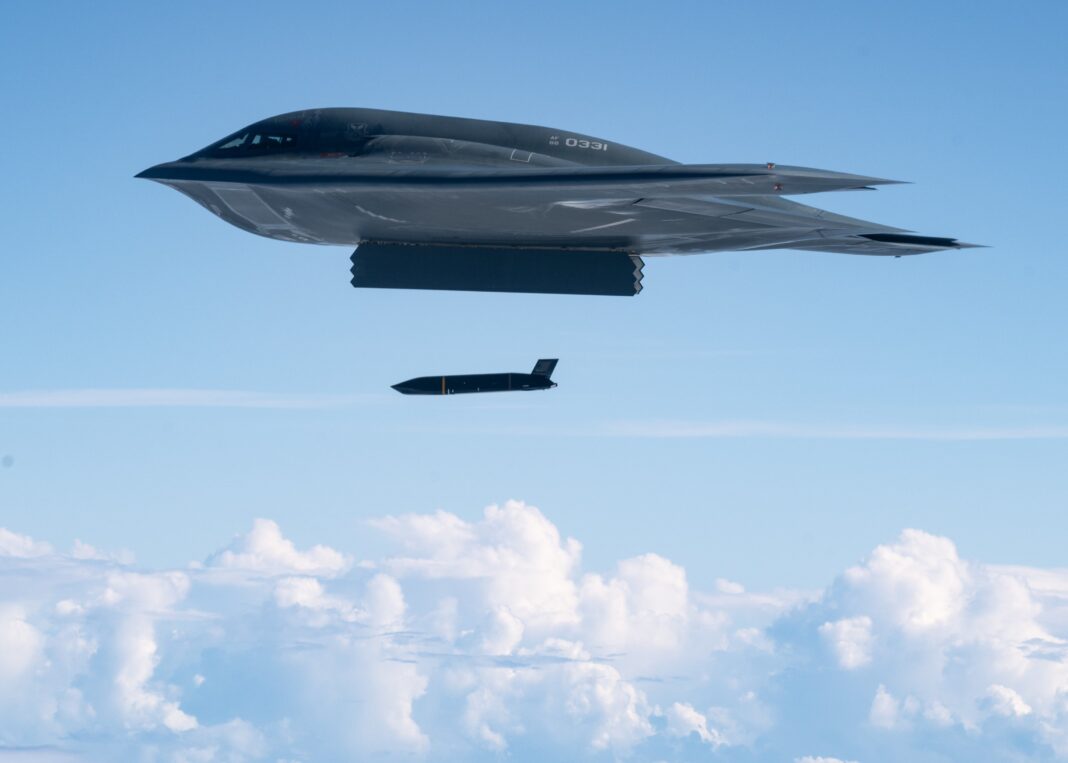
The United States has publicly unveiled a previously undisclosed maritime strike capability after a B-2 Spirit stealth bomber successfully launched a live AGM-158C Long Range Anti-Ship Missile (LRASM) during Valiant Shield 2026, signaling a major shift in American naval deterrence strategy across the Indo-Pacific.
What initially appeared to be another multinational live-fire exercise quickly evolved into a powerful strategic message aimed at demonstrating Washington’s ability to strike heavily defended naval targets deep inside contested maritime environments.
Conducted north of the Mariana Islands near Guam, the exercise highlighted the growing importance of long-range stealth aviation in countering China’s rapidly expanding naval power and anti-access/area-denial (A2/AD) capabilities.
The @PACAF successfully conducted a live-fire Sinking Exercise using the B-2 Spirit north of the Mariana Islands. Deploying the Long Range Anti-Ship Missile – demonstrating enhanced ability to achieve strategic objectives within range of potential threats.https://t.co/8PPP7bT3Pb pic.twitter.com/t2c0XTjfeo
— Air Force Global Strike Command (@AFGlobalStrike) June 29, 2026
A New Role for the B-2 Spirit
The B-2 Spirit has long been associated with strategic bombing missions against high-value land targets.
Its successful integration with the AGM-158C LRASM now expands that mission dramatically.
For the first time, the stealth bomber has publicly demonstrated the ability to conduct long-range anti-ship operations against sophisticated naval formations protected by layered air-defense systems.
According to Pacific Air Forces, the B-2 launched the missile during a live SINKEX (Sinking Exercise) approximately 200 nautical miles north of Guam within the Mariana Islands Range Complex.
The target was the decommissioned Austin-class amphibious transport dock ex-USS Juneau (LPD-10), which absorbed coordinated attacks from US and allied forces before reportedly being sunk by a heavyweight torpedo fired from a Japan Maritime Self-Defense Force submarine.
The exercise represented far more than a weapons test.
It publicly confirmed a capability that significantly alters how the United States can project maritime power across the Pacific.
Why the LRASM Matters
The AGM-158C LRASM is among the world’s most advanced anti-ship missiles.
Unlike traditional anti-ship weapons that depend heavily on continuous external guidance, the LRASM is designed to operate even in highly contested electronic warfare environments.
Its key features include:
- Low-observable stealth design
- Autonomous target recognition
- Imaging infrared seeker
- Electronic support measures
- Advanced onboard decision-making algorithms
- Resistance to GPS denial and electronic jamming
With an operational range exceeding 200 nautical miles, the missile allows launch platforms to remain well outside many enemy air-defense envelopes while still threatening high-value naval assets.
For military planners, this greatly complicates an adversary’s defensive calculations.
Combining Stealth With Long-Range Firepower
The true significance lies in combining two stealth systems into a single operational package.
The B-2 itself is designed to penetrate advanced integrated air-defense networks.
The LRASM is likewise engineered to avoid detection while independently locating and engaging maritime targets.
Together they create a highly survivable strike capability capable of attacking:
- Aircraft carriers
- Amphibious assault ships
- Surface combatants
- Naval logistics vessels
- Maritime command platforms
Because the B-2 can reportedly carry multiple members of the AGM-158 missile family inside its internal weapons bays, analysts believe future maritime strike missions could involve large salvos designed to overwhelm sophisticated fleet defenses.
A Clear Message to China
Although American officials avoided directly naming China during the exercise, the strategic implications were unmistakable.
China now operates the world’s largest navy by vessel numbers and continues expanding:
- Aircraft carrier operations
- Amphibious assault capabilities
- Long-range anti-ship ballistic missiles
- Integrated air-defense systems
- Maritime surveillance networks
- Electronic warfare capabilities
These investments form the foundation of Beijing’s anti-access/area-denial strategy designed to restrict US military operations within the First Island Chain and surrounding waters.
The B-2/LRASM combination directly challenges that concept.
Rather than relying exclusively on forward-deployed carrier strike groups operating inside China’s missile envelope, Washington can now employ stealth bombers launching stand-off anti-ship missiles from much greater distances.
Valiant Shield 2026 Demonstrated Coalition Warfare
The exercise also showcased how future Pacific operations are expected to be fought—not by individual platforms but by integrated multinational networks.
Participating forces included:
- US Air Force strategic bombers
- US Navy surface combatants
- American submarines
- Carrier aviation
- Japanese maritime forces
- Multi-domain command-and-control assets
The reported participation of a Japanese submarine delivering the final sinking strike highlighted Tokyo’s increasingly important role in regional maritime security.
Japan’s expanding counter-strike capabilities and deeper integration with US operational planning continue to strengthen allied deterrence throughout the Indo-Pacific.
Guam’s Strategic Importance Continues to Grow
The location of the exercise was equally significant.
Guam has become the logistical centerpiece of America’s military posture in the Western Pacific.
The island hosts:
- Andersen Air Force Base
- Strategic bomber rotations
- Submarine support facilities
- Missile-defense systems
- Ammunition stockpiles
- Expeditionary logistics infrastructure
As China’s long-range missile capabilities expand, Guam has become both one of America’s most valuable military hubs and one of its most important potential targets.
The B-2 demonstration reinforced Washington’s investment in distributed basing and resilient logistics designed to preserve combat capability during missile-intensive conflicts.
Distributed Maritime Strike Is Becoming the New Doctrine
The exercise illustrated a broader doctrinal shift inside the US military.
Rather than concentrating combat power around a handful of carrier strike groups, future operations increasingly emphasize distributed lethality.
Under this concept, multiple platforms—including stealth bombers, submarines, surface ships, satellites and cyber assets—work together as a single network capable of delivering coordinated strikes from multiple directions.
Such an approach complicates enemy targeting while increasing operational resilience.
The B-2’s new anti-ship capability fits naturally within this evolving operational framework.
Implications for Taiwan and the South China Sea
The capability has particular relevance for potential crises involving Taiwan or the South China Sea.
Any future conflict in those regions would likely involve dense Chinese missile coverage threatening forward US naval forces.
Long-range stealth bombers operating from Guam, Diego Garcia or even the continental United States provide commanders with additional options that reduce dependence on vulnerable forward-deployed assets.
This flexibility enhances deterrence by forcing potential adversaries to defend against attacks originating from multiple directions and platforms.
Looking Ahead to the B-21 Raider
The public disclosure may also provide insight into the future role of the next-generation B-21 Raider.
As the B-21 gradually enters service, many analysts expect it to assume an even larger role in maritime strike operations.
If equipped with LRASM or future long-range anti-ship weapons, the B-21 could significantly expand America’s ability to conduct stealth maritime operations across the Indo-Pacific.
The B-2 demonstration therefore serves not only as confirmation of an existing capability but also as a preview of future US airpower doctrine.
Strategic Implications
The significance of Valiant Shield 2026 extends well beyond the successful destruction of a target ship.
The exercise publicly demonstrated that the United States is adapting its military doctrine to an era defined by contested maritime environments, electronic warfare and long-range precision strike operations.
For regional allies including Japan, Australia and the Philippines, the demonstration reinforces confidence in America’s ability to maintain credible maritime deterrence despite China’s expanding naval capabilities.
For Beijing, it signals that numerical naval superiority alone may not guarantee operational freedom if stealth bombers armed with advanced anti-ship missiles can threaten high-value fleets from unexpected directions.
Final Assessment
The B-2 Spirit’s successful employment of the AGM-158C LRASM represents one of the most important developments in American maritime strike capability in recent years.
Rather than simply adding another weapon to the bomber’s inventory, the integration fundamentally expands how the United States can project power across the Indo-Pacific.
Combined with allied naval forces, distributed sensor networks and resilient logistics centered on Guam, the B-2/LRASM pairing strengthens Washington’s ability to deter aggression across the Western Pacific.
As strategic competition with China intensifies, future naval warfare will increasingly depend not only on the size of fleets but on the ability to locate, penetrate and destroy high-value targets inside heavily defended operational environments.
Valiant Shield 2026 demonstrated that the United States intends to remain at the forefront of that evolving battlespace.