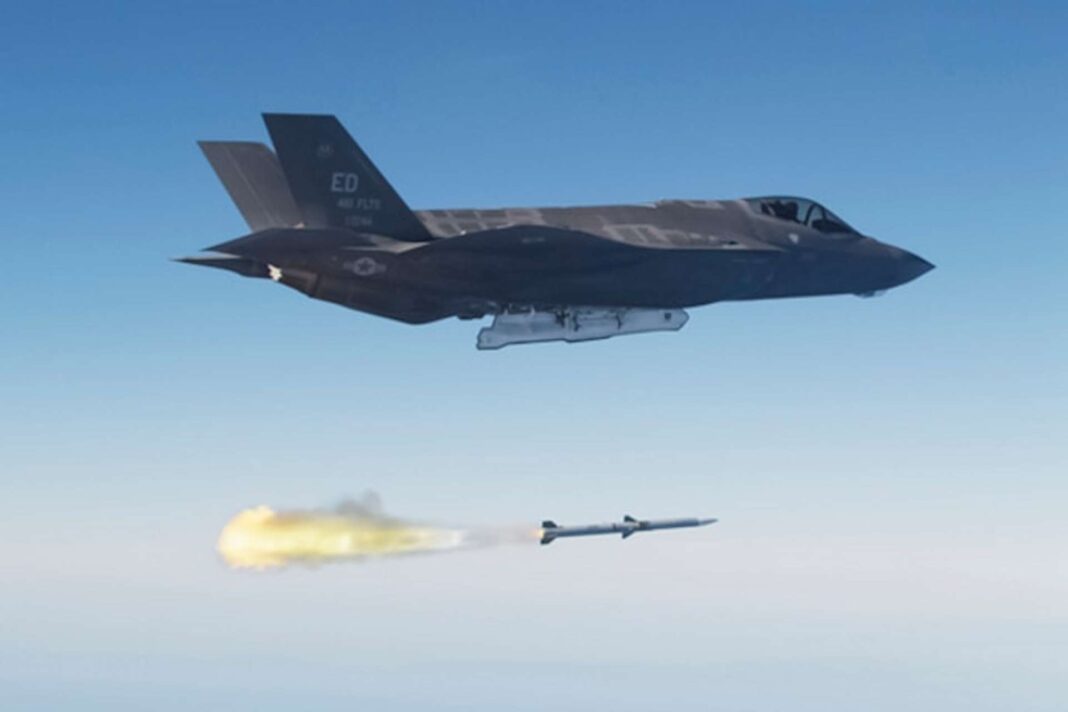
South Korea’s reported effort to expand its inventory of AIM-120C-8 Advanced Medium-Range Air-to-Air Missiles (AMRAAM) reflects more than routine military procurement.
For Seoul, geography leaves little room for error.
The Korean Peninsula’s compressed battlespace means military escalation can unfold within minutes, not days. North Korean missile launch areas sit close to South Korean population centres, air bases, ports, command headquarters, and military infrastructure, leaving limited time to transition from surveillance to engagement.
🇰🇷 South Korea received approval from the U.S. State Department to procure AIM-120C-8 Advanced Medium Range Air-to-Air Missiles (AMRAAMs) through U.S. Foreign Military Sales (FMS) program.
The possible sale, worth $292 million, includes 70 AIM-120C-8 AMRAAMs, two AIM-120C-8… pic.twitter.com/3S3bohFnic
— DefPost (@defpostmedia) June 11, 2026
In this environment, expanding stocks of advanced air-to-air missiles becomes less about military prestige and more about survivability. Additional AMRAAM inventories improve the Republic of Korea Air Force’s (ROKAF) ability to sustain combat operations during the crucial early phase of conflict while preserving air superiority against rapidly evolving aerial threats.
Why South Korea Needs More AMRAAM Missiles
South Korea’s air-defence challenge is shaped as much by geography as by military capability.
Key air bases such as Cheongju, Daegu, Suwon, and Seosan would likely become immediate targets during any major conflict scenario involving North Korea.
These facilities face threats from:
- Tactical ballistic missiles
- Long-range artillery rockets
- Cruise missiles
- Unmanned aerial vehicles (UAVs)
- Special operations infiltration
Because distances are short, South Korea cannot afford a slow military response cycle.
A larger stockpile of AIM-120C-8 missiles increases the number of fighter aircraft that can rapidly generate combat-ready sorties while reducing the risk that early missile expenditure, training usage, or maintenance cycles quickly deplete inventories.
In practical terms, missile availability matters almost as much as aircraft availability during the opening days of war.
North Korea’s Air Threat Is Bigger Than Just Fighter Jets
Although North Korea’s air force relies heavily on ageing Soviet- and Chinese-designed aircraft, quantity still matters.
Open-source estimates continue assigning Pyongyang several hundred combat aircraft, including:
- MiG-29 fighters
- MiG-23 fighters
- Su-25 attack aircraft
- MiG-21 fighters
- Chinese-derived legacy aircraft
Many of these platforms would struggle against modern South Korean and American fighters.
However, they still pose operational problems.
Even less advanced aircraft can force South Korean pilots into interception missions, consume missile inventories, complicate target identification, and create distractions supporting broader attacks.
The greater challenge increasingly lies in North Korea’s ability to integrate aircraft operations with:
- Tactical ballistic missiles
- Cruise missiles
- Artillery rockets
- Electronic warfare
- Drone swarms
In May 2026, North Korea tested tactical ballistic missiles, artillery rockets, and AI-guided precision cruise missiles, reinforcing concerns about multi-layered strike operations.
Why the AIM-120C-8 Matters
The AIM-120C-8 AMRAAM strengthens South Korea’s layered air-defence network by improving airborne interception capability.
Ground-based systems such as Patriot and Cheongung-II remain essential for defending against incoming threats.
But fixed missile batteries cannot fully replace fighter aircraft.
Aircraft armed with AMRAAM missiles offer several operational advantages:
- Forward patrol capability
- Early identification of hostile aircraft
- Engagement before enemy weapons release
- Rapid redeployment across different sectors
A fighter armed with AIM-120C-8 missiles can force enemy aircraft into defensive manoeuvres before they even reach launch range.
That effect alone can disrupt attacks before missiles are fired.
This becomes especially important for protecting high-value military assets including:
- Airborne early warning aircraft
- Tanker aircraft
- Electronic intelligence platforms
- Strike fighters targeting North Korean missile infrastructure
In modern warfare, disrupting an attack can be as valuable as destroying the attacking aircraft.
Strengthening the US–South Korea Air Alliance
The missile acquisition also reinforces interoperability between US and South Korean forces.
Maintaining a common missile family across allied fighter fleets simplifies:
- Stockpile management
- Pilot training
- Mission planning
- Targeting procedures
- Electronic threat databases
This matters because multiple aircraft across the alliance already operate with AMRAAM capability, including:
- US Air Force F-16s in Korea
- US F-35A fighters
- South Korean F-35As
- KF-16 fighters
- F-15K Slam Eagles
South Korea’s growing F-35A fleet makes missile compatibility even more important.
After selecting the F-35A in 2014 and basing the first aircraft at Cheongju in 2019, Seoul announced plans for an additional 20 fighters in 2023.
The missile purchase therefore aligns naturally with broader airpower modernisation.
Will 70 AMRAAM Missiles Change the Balance?
On its own, a package of 70 AIM-120C-8 missiles will not fundamentally alter military balances on the Korean Peninsula.
Even US defence notifications typically describe such sales as unlikely to shift regional military equilibrium.
However, strategic impact should not be measured only by numbers.
The acquisition improves one specific but highly important element of South Korea’s defensive kill chain: the probability that South Korean fighters can detect, engage, and disrupt airborne threats before weapons are launched against defended territory.
In a conflict measured in minutes, incremental improvements matter.
The Bigger Strategic Picture
South Korea’s missile acquisition reflects a broader military reality.
North Korea continues increasing both the density and complexity of its threat ecosystem — combining missiles, drones, aircraft, artillery, and electronic warfare into increasingly integrated attack models.
For Seoul, deterrence depends on keeping air bases operational, protecting command infrastructure, preserving air superiority, and sustaining offensive and defensive air operations after the first exchange.
The AIM-120C-8 does not solve all those problems.
But it improves a measurable part of South Korea’s ability to survive, fight, and respond during the most dangerous opening phase of any future conflict on the Korean Peninsula.
In an increasingly compressed and missile-saturated battlespace, that may matter more than ever.