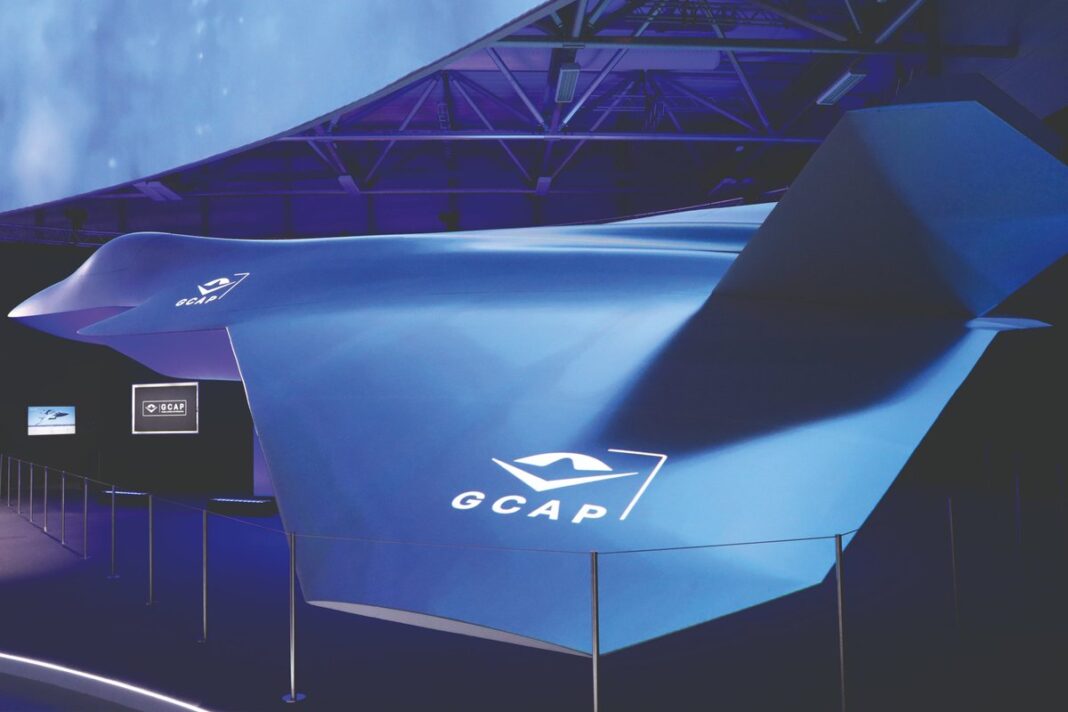
The United Kingdom has reaffirmed its commitment to next-generation air power by allocating £8.6 billion over the next four years to the Global Combat Air Programme (GCAP), the ambitious sixth-generation fighter initiative being jointly developed with Japan and Italy.
The investment, announced as part of Britain’s new Defence Investment Plan, will fund the programme through its critical concept, design and early development phases while reinforcing London’s determination to remain one of the world’s leading combat aircraft developers.
For GCAP, DIP UK frees up £8.6 bn over next 4 years into the design and development phase. Government had said earlier in June that the first full international contract would be awarded “by the end of the month”, and by this measure they’ve just about made it. 2/6 pic.twitter.com/LDE2bhPBI4
— Gareth Jennings (@GarethJennings3) June 30, 2026
Prime Minister Sir Keir Starmer described the funding as a major commitment to Britain’s future security and aerospace industry, saying the investment would help deliver the Tempest fighter aircraft—designed to secure British air superiority well into the second half of the 21st century.
The announcement represents one of the largest single investments within the Defence Investment Plan and highlights the importance the UK places on maintaining sovereign combat air capability amid intensifying global competition in sixth-generation military aviation.
What Is the Global Combat Air Programme?
The Global Combat Air Programme (GCAP) is a trilateral defence partnership bringing together the United Kingdom, Japan and Italy to develop a next-generation combat aircraft capable of replacing the Royal Air Force’s Eurofighter Typhoon beginning in the mid-2030s.
Originally launched as Britain’s Tempest programme before merging with Japan’s F-X fighter project, GCAP has evolved into one of the world’s most ambitious military aerospace initiatives.
Rather than simply producing another fighter aircraft, the programme seeks to develop an integrated combat air system combining advanced stealth technology, artificial intelligence, autonomous aircraft and network-centric warfare.
The aircraft is expected to enter operational service in 2035, replacing ageing fourth-generation fighters while complementing Britain’s growing fleet of F-35B Lightning II aircraft.
More Than Just a Fighter Jet
Unlike previous generations of combat aircraft, GCAP is being designed as a complete combat ecosystem.
The future aircraft is expected to integrate:
- Advanced low-observable stealth technology
- Artificial intelligence-assisted mission management
- Multi-domain sensor fusion
- Adaptive electronic warfare systems
- Long-range precision strike capability
- Advanced networking with allied platforms
- Manned-unmanned teaming
Perhaps its most revolutionary feature will be its ability to command autonomous aircraft operating alongside the crewed fighter.
These so-called Collaborative Combat Aircraft (CCA) or “loyal wingman” drones could perform reconnaissance, electronic warfare, decoy operations or weapons delivery while reducing risk to human pilots.
The Defence Investment Plan separately allocates funding for these autonomous systems, underscoring Britain’s belief that future air combat will rely on teams of crewed and uncrewed aircraft rather than individual fighters operating alone.
Replacing the Eurofighter Typhoon
For the Royal Air Force, GCAP represents the long-term successor to the Eurofighter Typhoon, which has formed the backbone of UK air defence for more than two decades.
Although the Typhoon remains highly capable following continuous upgrades, military planners increasingly recognise that future threats—including advanced stealth fighters, long-range missiles and sophisticated electronic warfare systems—will require a fundamentally new generation of combat aircraft.
To ensure there is no capability gap before GCAP enters service, the Defence Investment Plan also confirms continued investment in upgrading the Typhoon fleet through the 2040s.
Those modernisation efforts will include improved radar systems, electronic warfare suites, weapons integration and software upgrades, enabling the aircraft to remain operationally relevant while the Tempest programme matures.
Why the Investment Matters
The £8.6 billion commitment reflects more than aircraft procurement.
It is an investment in Britain’s long-term technological and industrial base.
The programme supports thousands of highly skilled jobs across the UK aerospace sector involving:
- Aircraft design
- Advanced manufacturing
- Software engineering
- Artificial intelligence
- Propulsion systems
- Radar development
- Electronic warfare technology
Key industrial partners include:
- BAE Systems
- Rolls-Royce
- Leonardo UK
- MBDA UK
Together, these companies form the backbone of Britain’s sovereign combat aviation industry.
Maintaining those capabilities is considered strategically important because only a handful of countries retain the ability to independently design and manufacture advanced combat aircraft.
A Strategic Partnership With Japan and Italy
GCAP is also one of the most significant international defence collaborations currently underway.
Japan brings world-class expertise in advanced electronics, sensors and precision manufacturing.
Italy contributes extensive experience through Leonardo and its long history of multinational aerospace programmes.
Britain, meanwhile, provides decades of experience in combat aircraft development, systems integration and engine technology.
The partnership distributes development costs while ensuring all three nations maintain sovereign access to future fighter technologies.
It also strengthens defence cooperation among key allies facing increasingly complex security challenges across both Europe and the Indo-Pacific.
Responding to a Changing Security Environment
The timing of Britain’s investment reflects a rapidly evolving strategic environment.
Military planners are increasingly focused on the emergence of:
- China’s expanding military capabilities
- Russia’s continued airpower modernisation
- Long-range precision missile threats
- Artificial intelligence in warfare
- Electronic warfare
- Integrated air defence systems
Future conflicts are expected to involve highly contested electromagnetic environments where information dominance becomes just as important as traditional kinetic firepower.
GCAP is being designed specifically for this environment.
Instead of operating as an isolated platform, the aircraft will function as the centre of a network connecting satellites, drones, airborne sensors, ground forces and allied command systems.
Competing in the Global Sixth-Generation Race
Britain’s investment also highlights the growing international competition to field sixth-generation combat aircraft.
Several major programmes are currently under development, including:
- The United States’ Next Generation Air Dominance (NGAD) programme
- The Future Combat Air System (FCAS) being developed by France, Germany and Spain
- China’s next-generation stealth fighter initiatives
Each programme seeks to define the future of air warfare through advanced networking, greater automation and enhanced survivability.
GCAP positions Britain, Japan and Italy among the small group of nations shaping that future rather than purchasing technology developed elsewhere.
Challenges Ahead
Despite strong political backing, GCAP remains one of the most technologically ambitious military programmes ever undertaken.
Major challenges include:
- Managing development costs
- Maintaining programme schedules
- Integrating cutting-edge technologies
- Coordinating multinational industrial partners
- Ensuring export competitiveness
History demonstrates that advanced fighter programmes frequently experience delays and budget growth as new technologies mature.
The £8.6 billion announced this week funds only the next phase of development.
Far larger investments will be required as the programme moves into prototype construction, flight testing and full-rate production during the next decade.
Why This Matters for the UK
The government argues that investment in GCAP goes beyond defence.
It is also about preserving Britain’s position as a global aerospace leader.
Developing a sixth-generation fighter sustains critical national capabilities in engineering, manufacturing and advanced research that have strategic importance far beyond military applications.
Success would also strengthen Britain’s export potential, ensuring the country remains a leading supplier of advanced defence technology for decades to come.
Final Assessment
Britain’s £8.6 billion investment signals unwavering confidence in the Global Combat Air Programme despite the technological and financial challenges associated with developing a sixth-generation fighter.
By combining advanced stealth technology, artificial intelligence, autonomous aircraft and multinational industrial cooperation, GCAP is expected to become one of the most sophisticated combat air systems ever built.
For the Royal Air Force, it provides a pathway beyond the Eurofighter Typhoon and secures future air superiority.
For Britain’s defence industry, it preserves sovereign aerospace expertise and supports thousands of highly skilled jobs.
And for the wider international security environment, it demonstrates that the UK, alongside Japan and Italy, intends to remain at the forefront of next-generation military aviation as the global race for sixth-generation air power accelerates.