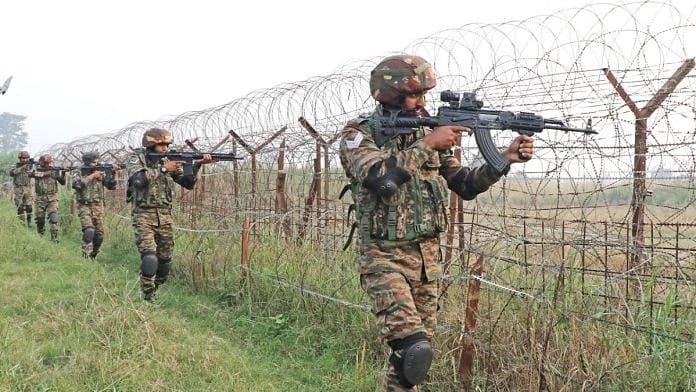
The Indian Army has formally begun raising five Integrated Battle Groups (IBGs) along its frontier with China, marking one of the most significant structural reforms of India’s land warfare doctrine in decades.
The move represents a major shift in how New Delhi intends to respond to future crises along the disputed Line of Actual Control (LAC), with the newly created formations expected to dramatically reduce mobilization times and improve the Army’s ability to launch coordinated combat operations within hours rather than days.
According to Indian media reports, the five IBGs will operate under the Mountain Strike Corps and are being deployed primarily in Arunachal Pradesh and Sikkim, two strategically sensitive sectors bordering China.
Army begins raising 5 Integrated Battle Groups along China border
These IBG’s will be a part of the Mountain Strike Corps and be stationed in two north-eastern states – Sikkim and Arunachal Pradesh – that share a boundary with China@ajaynewsman reportshttps://t.co/spg4VT15UD
— The Tribune (@thetribunechd) July 2, 2026
Government approval for raising the formations was reportedly finalized on July 1, allowing recruitment, force restructuring, command appointments and administrative work to begin immediately.
Military officials expect the new formations to become operational by mid-2027.
What Are Integrated Battle Groups?
Integrated Battle Groups are highly mobile, self-contained combat formations designed to operate independently during high-intensity conflict.
Unlike traditional Indian Army divisions that depend on multiple headquarters for support, an IBG combines various combat capabilities under a single commander.
Each formation generally integrates:
- Infantry battalions
- Mechanized units where terrain permits
- Artillery
- Air defence systems
- Engineers
- Electronic warfare assets
- Intelligence and surveillance units
- Logistics support
- Communications elements
This structure enables commanders to respond rapidly without waiting for reinforcements from higher headquarters.
The concept mirrors modern combined-arms organizations adopted by several advanced militaries worldwide.
From Cold Start to Mountain Warfare
Although the IBG concept originally emerged from India’s Cold Start Doctrine after Operation Parakram (2001–2002), it has now evolved into a broader operational philosophy.
Cold Start was initially designed to enable rapid offensive operations against Pakistan by eliminating the lengthy mobilization periods experienced during Operation Parakram.
However, following repeated confrontations with China—including the Doklam standoff (2017) and the Galwan Valley clash (2020)—Indian planners adapted the concept for high-altitude warfare.
The five new IBGs are therefore specifically optimized for mountain operations rather than conventional mechanized warfare.
Why the China Border?
The timing reflects India’s continuing concern over military competition with China along the Himalayan frontier.
Although disengagement agreements have reduced tensions in some sectors, thousands of troops from both countries remain deployed across eastern Ladakh and other disputed areas.
India believes future confrontations may develop with little warning.
Rapid reaction forces capable of deploying within 24 hours have therefore become a major operational priority.
Military planners increasingly emphasize that speed of response may determine battlefield advantage before larger formations can be mobilized.
Deployment in Arunachal Pradesh and Sikkim
The five IBGs are expected to be stationed primarily in:
- Arunachal Pradesh
- Sikkim
These regions remain among the most sensitive sectors of the India-China border.
China continues to claim almost all of Arunachal Pradesh as “South Tibet,” while Sikkim has historically witnessed periodic military tensions despite improved border management.
Positioning rapid-response formations in these states enables India to reinforce threatened sectors much faster than under previous force structures.
Fire Support Groups Will Back the IBGs
Indian reports indicate each IBG will be supported by dedicated Fire Support Groups equipped with:
- Long-range artillery
- Rocket systems
- Missile units
- Surveillance assets
These supporting formations provide additional firepower while allowing the IBGs themselves to remain highly mobile.
Combined with improved ISR (Intelligence, Surveillance and Reconnaissance) capabilities, the Army expects significantly faster targeting cycles.
Faster Decision-Making
One of the biggest advantages of IBGs is command efficiency.
Traditional military formations often require coordination across multiple headquarters before combat operations begin.
IBGs consolidate combat power under a single commander—typically a Major General.
This enables:
- Faster operational planning
- Shorter decision cycles
- Rapid force concentration
- Better coordination between combat arms
Military analysts describe this as a critical improvement for high-tempo warfare.
Modern Warfare Requires Smaller, Faster Units
The reform reflects broader global military trends.
Recent conflicts in Ukraine, Nagorno-Karabakh, and the Middle East have demonstrated the growing importance of:
- Mobility
- Precision fires
- Integrated ISR
- Electronic warfare
- Drone operations
- Decentralized command
Large static formations have become increasingly vulnerable to precision strikes.
Smaller combined-arms formations capable of relocating quickly offer greater survivability.
India’s IBGs reflect this changing operational environment.
China’s Military Modernization
The restructuring also responds to China’s extensive military modernization.
The People’s Liberation Army (PLA) has invested heavily in:
- Integrated combined-arms brigades
- Long-range rocket artillery
- Hypersonic weapons
- UAVs
- Electronic warfare
- Network-centric operations
Indian planners believe matching China’s operational tempo requires similarly flexible formations.
IBGs are intended to narrow this gap.
Implications for India-China Military Balance
The creation of five mountain IBGs does not fundamentally change the military balance.
China continues to maintain significant advantages in:
- Infrastructure
- Logistics
- Long-range missiles
- Airpower
- ISR capabilities
However, the new formations significantly improve India’s ability to:
- Respond faster
- Reinforce threatened sectors
- Coordinate combined-arms operations
- Sustain localized combat
This increases deterrence by reducing opportunities for limited territorial incursions.
Part of India’s Wider Military Transformation
The IBG programme complements several other modernization initiatives, including:
- Induction of S-400 air defence systems
- New Apache and Chinook helicopters
- Indigenous ATAGS artillery
- Pinaka rocket systems
- BrahMos missile deployment
- Expanded surveillance drone fleet
- Integrated Theatre Commands (under development)
Together, these reforms seek to transform the Indian Army into a faster, more networked fighting force.
Strategic Significance
The decision to raise five Integrated Battle Groups along the China border represents more than a routine force restructuring.
It reflects India’s recognition that future conflicts in the Himalayas are likely to unfold rapidly, requiring commanders capable of responding within hours rather than days.
For Beijing, the move signals that New Delhi intends to strengthen deterrence through greater operational readiness rather than simply increasing troop numbers.
For the wider Indo-Pacific, it underscores how competition between Asia’s two largest militaries is increasingly focused on mobility, integrated command structures, precision firepower and rapid decision-making.
Although the five IBGs alone will not transform the strategic balance along the Line of Actual Control, they represent an important milestone in the Indian Army’s modernization and its long-term effort to prepare for high-intensity mountain warfare against a technologically advanced adversary.