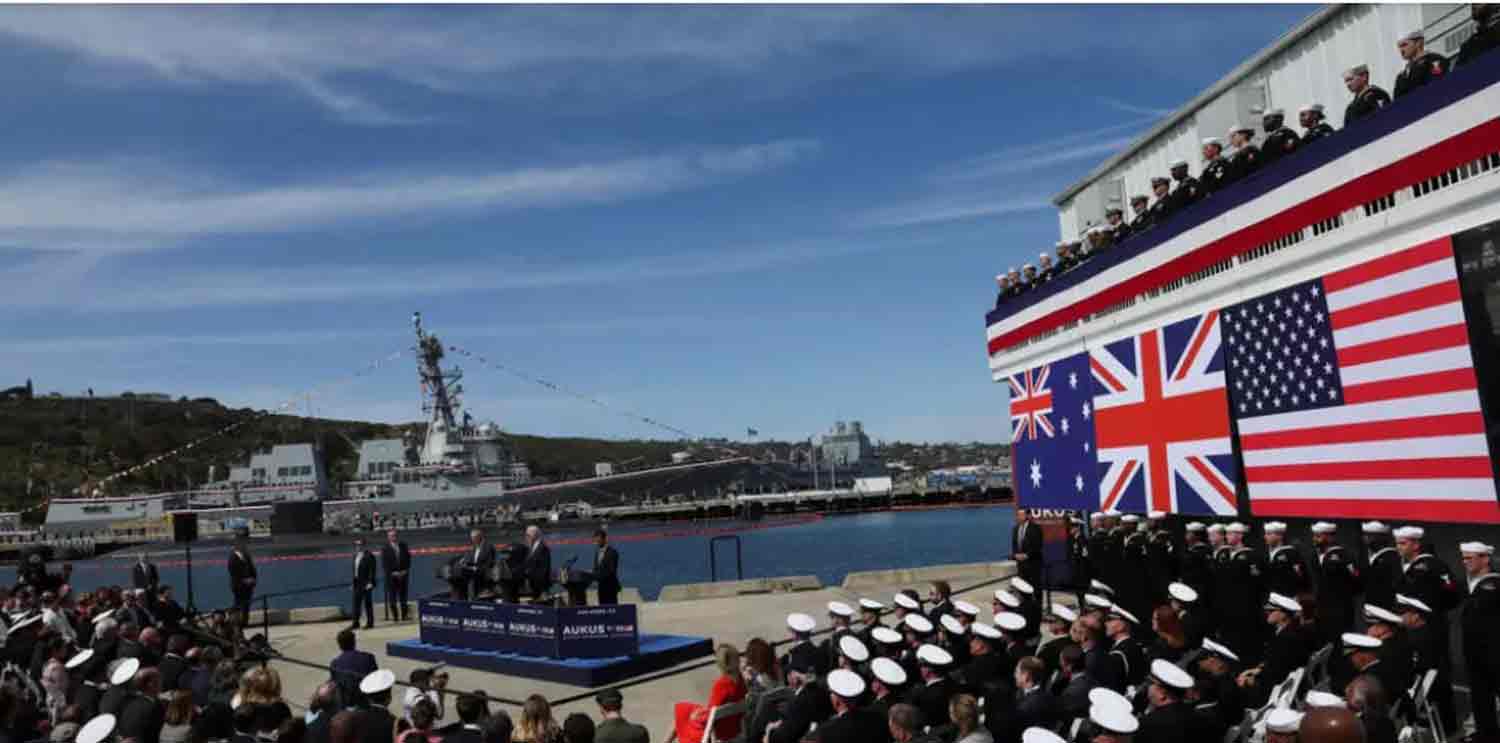
The United States Navy has officially reactivated Submarine Squadron 3 (CSS-3) in Western Australia, marking a major milestone in the implementation of the AUKUS security partnership and significantly strengthening allied undersea deterrence across the Indo-Pacific.
The move establishes a forward submarine command element at HMAS Stirling in Western Australia, creating the logistical, maintenance, and operational backbone needed to support future rotations of US and British nuclear-powered attack submarines under the Submarine Rotational Force-West (SRF-West) programme.
More importantly, the decision signals that AUKUS is moving beyond long-term planning and into active military implementation.
Rather than remaining a future acquisition framework centred on nuclear-powered submarines, AUKUS is increasingly becoming a functioning operational ecosystem connecting the United States, Australia, and the United Kingdom into a shared undersea warfare architecture.
Why the Reactivation of Submarine Squadron 3 Matters
The reactivation of CSS-3 represents far more than the return of a former US Navy submarine squadron.
Previously headquartered in Pearl Harbor, Hawaii, the squadron was disestablished in 2012 as part of broader force restructuring. Now, however, it returns with an entirely different mission: serving as the command and coordination hub for AUKUS submarine operations in Australia.
From 2027 onward, US and UK nuclear-powered attack submarines are expected to begin regular rotations through HMAS Stirling under SRF-West.
CSS-3 will coordinate the maintenance, logistics, operational planning, and support infrastructure required to make those rotations sustainable.
In practical terms, this creates a forward-positioned support system much closer to key maritime chokepoints and contested operational areas across the Indo-Pacific.
For allied naval planners, that proximity matters.
AUKUS Is Becoming an Operational Reality
For years, AUKUS was widely discussed as a long-term submarine acquisition programme focused primarily on Australia eventually obtaining conventionally armed, nuclear-powered submarines.
The reactivation of CSS-3 changes that perception.
Instead of waiting decades for capability delivery, Washington and Canberra are now building the practical infrastructure needed to support active submarine operations today.
This includes:
- Rotational basing arrangements for allied submarines
- Maintenance and repair infrastructure
- Logistics coordination
- Port and diving support services
- Workforce training for Australian personnel
- Nuclear stewardship and operational safety systems
In effect, Australia is gradually transforming into an operational hub for allied undersea warfare.
Why HMAS Stirling Is Strategically Important
The location of HMAS Stirling gives the move substantial geostrategic significance.
Located on Australia’s west coast near Perth, the naval base provides direct access to the eastern Indian Ocean, Southeast Asian maritime corridors, and onward approaches into the Western Pacific.
This geography gives allied submarines far greater operational flexibility.
Instead of relying primarily on distant facilities in Guam, Hawaii, Japan, or the US West Coast, nuclear-powered attack submarines will gain a forward operating location closer to contested maritime environments.
In military terms, this reduces transit times, increases operational endurance, and complicates adversary tracking efforts.
In an Indo-Pacific increasingly shaped by long-range missiles, expanding submarine fleets, and maritime competition, distributed basing significantly improves survivability and deterrence.
Building Australia’s Future Nuclear Submarine Workforce
One of the most important aspects of CSS-3’s reactivation involves workforce development.
The squadron will integrate closely with Royal Australian Navy personnel, civilian maintainers, divers, and Fleet Support Unit teams to prepare Australia for eventually operating its own sovereign nuclear-powered submarine fleet.
Australian personnel are already receiving specialised training through Pearl Harbor Naval Shipyard and associated US Navy programmes.
According to reports, dozens of Australian sailors and civilian specialists have completed training in Hawaii, with hundreds more currently undergoing instruction.
The experience gained through supporting visiting US and UK submarines will help Australia gradually develop expertise in:
- Nuclear submarine maintenance
- Port safety and emergency response
- Diving operations
- Intermediate-level repairs
- Logistics planning
- Operational sustainment
For Canberra, this represents a direct pathway toward sovereign SSN capability.
For Washington, it creates a more resilient forward support network for US fast-attack submarines.
What This Means for Indo-Pacific Deterrence
The broader military implications extend well beyond Australia.
The Indo-Pacific is increasingly becoming a theatre defined by undersea competition, maritime chokepoints, seabed infrastructure vulnerability, and anti-access military strategies.
Submarines remain among the most survivable and strategically valuable military assets in this environment.
A stronger allied undersea network improves capabilities across several missions:
- Anti-submarine warfare
- Intelligence gathering
- Maritime surveillance
- Sea-denial operations
- Special operations support
- Protection of critical sea lanes
For potential adversaries, distributed submarine infrastructure makes allied force posture harder to predict, track, and disrupt.
That alone strengthens deterrence.
Why This Matters for China
Although AUKUS is officially framed as a stability and deterrence initiative, the broader strategic context remains difficult to ignore.
China’s expanding naval power, growing submarine fleet, long-range missile capabilities, and increasingly assertive maritime posture have accelerated security cooperation among US allies.
A forward submarine support network in Australia provides allied forces with greater flexibility across the eastern Indian Ocean and Western Pacific — areas increasingly central to strategic competition with Beijing.
From China’s perspective, the reactivation of CSS-3 may reinforce concerns that AUKUS is evolving into a long-term containment architecture.
For the United States and Australia, however, the arrangement is framed as strengthening deterrence and preserving regional balance.
The Bigger Picture
The return of Submarine Squadron 3 marks one of the clearest signs yet that AUKUS is shifting from political promise to operational reality.
By linking CSS-3, Naval Support Activity Stirling, Pearl Harbor maintenance support, and Australian workforce development into one integrated structure, Washington and Canberra are building the foundations for a durable allied submarine network before full rotations begin in 2027.
The move strengthens allied readiness, accelerates Australia’s submarine ambitions, and turns HMAS Stirling into one of the Indo-Pacific’s most important future hubs for undersea warfare.
In practical terms, AUKUS is no longer just a future defence agreement.
It is increasingly becoming a working military architecture designed to shape Indo-Pacific deterrence for decades to come.