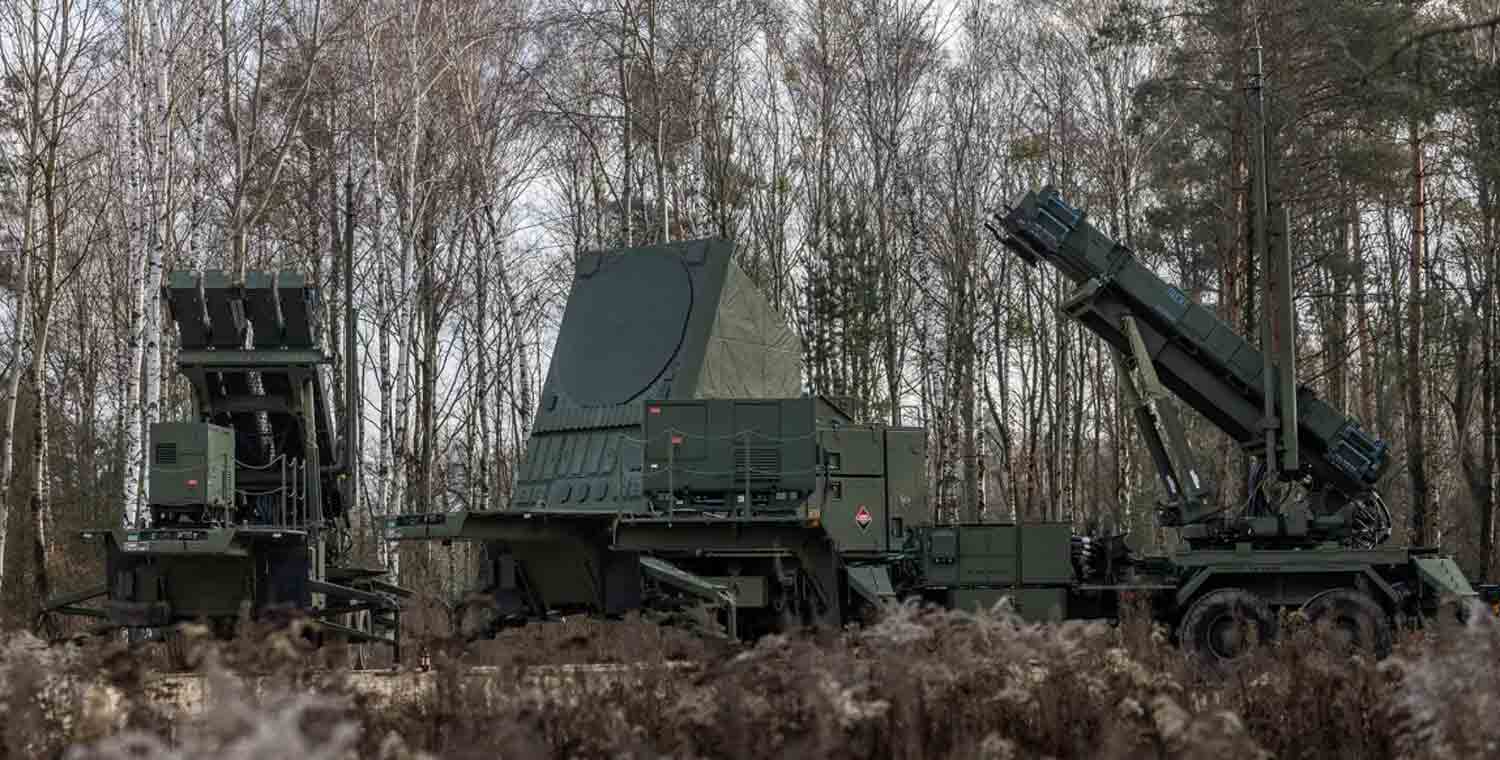
The United States has successfully conducted the first-ever maritime test of its advanced “Hammer of the Gods” electronic warfare system, marking another major step in the Pentagon’s efforts to prepare for future conflicts dominated by electronic attacks, GPS denial and multi-domain warfare.
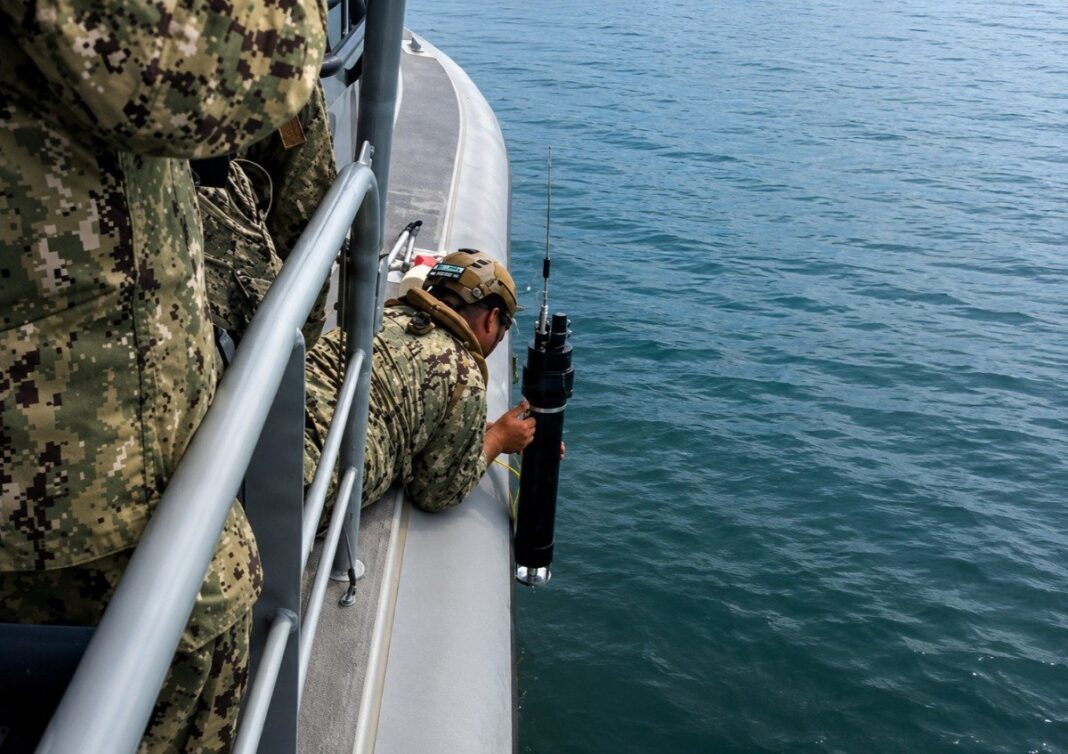
The trial took place during Project Convergence Capstone 6 (PC-C6) in mid-July 2026, where the U.S. Army, U.S. Navy and U.S. Space Force jointly evaluated the system aboard a maritime platform for the first time. The experiment demonstrates Washington’s growing emphasis on integrating electronic warfare, cyber operations and space capabilities into a single battlefield network.
Unlike conventional weapons, Hammer of the Gods does not fire missiles or projectiles. Instead, it attacks and shapes the electromagnetic battlespace by transmitting specialised electronic signals capable of disrupting enemy communications, navigation and targeting systems while protecting friendly forces.
What is the Hammer of the Gods?
Hammer of the Gods is an advanced electronic warfare emitter designed to provide command-and-control functions alongside offensive and defensive electromagnetic capabilities from a highly mobile and low-signature platform.
Its primary advantage lies in its ability to operate while emitting minimal detectable signals, allowing it to move closer to contested battlefields without revealing its location to enemy sensors.
This makes the system particularly valuable in environments where adversaries employ advanced surveillance, radar networks and electronic intelligence assets.
Electronic warfare has become one of the defining features of modern military operations, with success increasingly determined not only by firepower but also by control of the electromagnetic spectrum.
First Maritime Deployment Marks Major Milestone
Although land-based versions of Hammer of the Gods have participated in joint military exercises for nearly two years, the latest test represented its first operational evaluation at sea.
The maritime environment presents unique challenges for electronic warfare systems, including:
- Constant ship movement
- Saltwater corrosion
- Heavy radar reflections from the ocean surface
- Complex communications environments
- Integration with naval combat systems
Successfully adapting the system to naval operations significantly expands its operational flexibility and allows it to support future expeditionary and Indo-Pacific missions.
The maritime trial was made possible through cooperation between U.S. Space Forces Pacific, Naval Base San Diego, and the U.S. Army Space and Missile Defense Command, reflecting the Pentagon’s broader strategy of developing joint capabilities from the outset rather than integrating them after development.
Project Convergence: Preparing for Multi-Domain Warfare
Project Convergence has become the U.S. Army’s flagship experimentation programme aimed at integrating military capabilities across every operational domain:
- Land
- Sea
- Air
- Space
- Cyber
- Electromagnetic spectrum
Rather than testing individual weapons in isolation, Project Convergence evaluates how different services can rapidly share information, coordinate attacks and maintain operational effectiveness against technologically advanced adversaries.
According to Lt. Col. Darrin Hall of U.S. Space Forces Pacific:
“Joint experimentation is how we prepare for future fights. By integrating space, cyber and conventional forces into realistic scenarios, we strengthen our ability to operate as one joint team in contested environments.”
The successful maritime demonstration of Hammer of the Gods represents another step toward achieving seamless joint-force operations.
Counter-PNT: Targeting the Backbone of Modern Warfare
A central objective of the experiment focused on Counter-PNT (Positioning, Navigation and Timing) capabilities.
PNT forms the foundation of nearly every modern military operation by supporting:
- GPS navigation
- Precision-guided missiles
- Cruise missiles
- Long-range artillery
- Drone operations
- Military communications
- Battlefield synchronisation
By disrupting an opponent’s PNT systems, militaries can significantly reduce the effectiveness of precision-guided weapons while creating confusion across enemy formations.
Hall explained the significance of the capability:
“This experiment proved that counter-PNT capabilities can be deployed, controlled and recovered in real-world maritime operations while extending operational reach through resilient mesh networking.”
He further emphasised:
“Positioning, Navigation and Timing is the foundation of modern military operations. Counter-PNT effects enhance lethality by impacting the backbone for pinpoint targeting via long-range artillery, guided missiles and cruise munitions.”
Lessons from Ukraine Are Shaping US Electronic Warfare
The importance of Counter-PNT has been reinforced by the ongoing war in Ukraine, where electronic warfare has become one of the conflict’s defining characteristics.
Both Russian and Ukrainian forces have extensively employed:
- GPS jamming
- Signal spoofing
- Drone disruption
- Communications interference
- Navigation denial
These operations have repeatedly demonstrated that disrupting satellite navigation can reduce the effectiveness of precision strikes, delay military operations and complicate battlefield coordination.
The Pentagon has closely monitored these developments, accelerating investments in resilient navigation technologies, electronic warfare systems and alternative positioning methods capable of functioning even when GPS becomes unavailable.
Hammer of the Gods directly addresses these operational challenges by enabling U.S. forces to both survive and exploit contested electromagnetic environments.
Why the Maritime Test Matters
The successful sea trial is significant beyond the technical achievement itself.
Future military confrontations—particularly in the Indo-Pacific—are expected to involve heavy electronic warfare, cyber attacks and attempts to disable satellite navigation before conventional combat begins.
By proving Hammer of the Gods can operate effectively aboard naval platforms, the Pentagon gains a deployable capability capable of supporting distributed maritime operations, expeditionary forces and joint campaigns across multiple theatres.
The system also aligns with the U.S. military’s broader strategy of achieving electromagnetic spectrum dominance, allowing commanders to disrupt enemy networks while preserving friendly communications and precision targeting.
Defence Analysis
The maritime debut of Hammer of the Gods highlights a broader transformation in how the U.S. military is preparing for high-end warfare. Rather than relying solely on kinetic superiority, Washington is investing heavily in capabilities that can degrade an adversary’s decision-making, navigation and communications before missiles or aircraft are employed.
The emphasis on Counter-PNT also reflects growing concern over vulnerabilities exposed by recent conflicts. Precision-guided weapons, autonomous drones and network-centric operations all depend on reliable positioning and timing data. If those signals are denied, the effectiveness of even the most advanced military systems can decline dramatically.
For potential adversaries such as China and Russia—both of which have invested heavily in electronic warfare and anti-satellite capabilities—the U.S. focus on resilient electromagnetic operations signals that future conflicts will be fought as much in the invisible spectrum as on land, at sea or in the air.
The successful maritime integration of Hammer of the Gods therefore represents more than a technology demonstration. It is another indicator that the Pentagon views control of the electromagnetic spectrum as one of the decisive factors in winning tomorrow’s wars.