
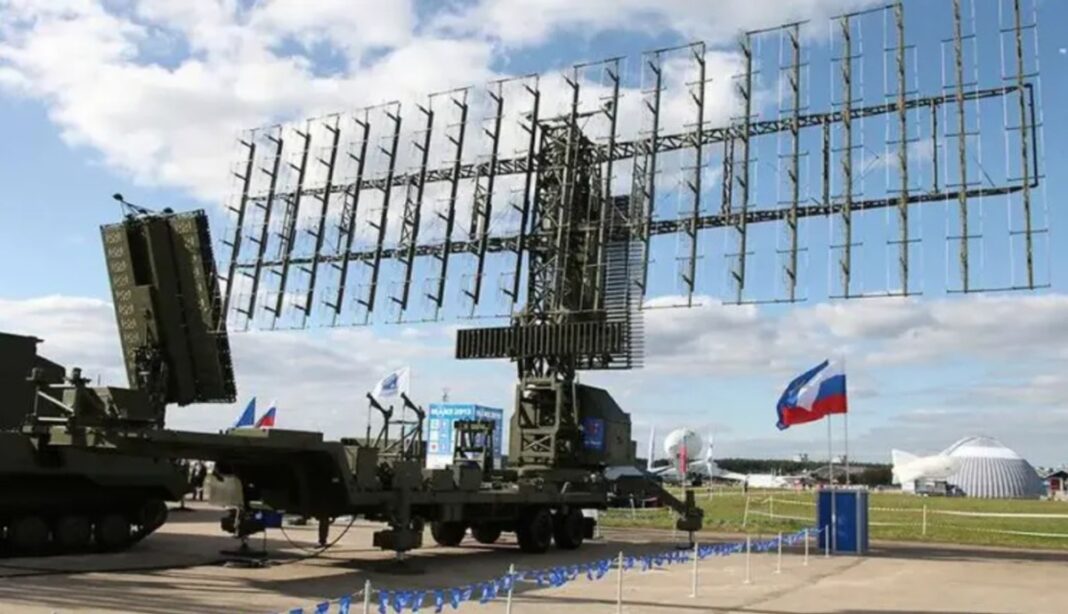
India has taken another major step toward strengthening its air-defence network with the induction of the Russian-built 55Zh6ME Nebo-UM Very High Frequency (VHF) radar, a system specifically designed to improve the detection of stealth aircraft and low-observable cruise missiles.
The radar’s public appearance during the Indian Air Force’s Vayu Shakti 2026 exercise immediately attracted international attention because it signals New Delhi’s growing focus on countering the rapid expansion of China’s fifth-generation airpower while preparing for the possibility that Pakistan may eventually field Chinese-built J-35 stealth fighters.
Unlike traditional radar acquisitions, the Nebo-UM represents a strategic investment in counter-stealth warfare, an area becoming increasingly central to military competition throughout the Indo-Pacific.
One of the quietest additions to India’s air defence network.
The Nebo-UM is a Russian VHF-band 3D long-range surveillance radar with a claimed detection range of up to 600 km, designed to detect low-observable (stealth) aircraft and provide long-range early warning.
What’s… pic.twitter.com/bhk90UVk2C
— Alpha Defense™🇮🇳 (@alpha_defense) June 28, 2026
As China expands deployments of the J-20 and develops the carrier-capable J-35, India is shifting from platform-centric modernization toward building an integrated sensor network capable of detecting, tracking and defeating low-observable aircraft.
Why India Needed the Nebo-UM
For decades, air superiority largely depended on the quality and quantity of fighter aircraft.
That equation is changing.
Modern warfare increasingly rewards the side capable of detecting an opponent first.
Stealth aircraft are designed to reduce radar signatures, compress reaction time and penetrate sophisticated air-defence systems before defenders can respond.
India now faces precisely this challenge.
China continues expanding its fleet of J-20 stealth fighters while simultaneously developing the carrier-based J-35, extending Beijing’s reach across both the Himalayan frontier and the Indian Ocean.
Meanwhile, Pakistan’s reported interest in acquiring the export version of the J-35 introduces the possibility that India could eventually confront stealth aircraft on both its northern and western fronts.
That emerging reality makes long-range anti-stealth surveillance an operational necessity rather than a technological luxury.
What Makes the Nebo-UM Different?
Unlike conventional surveillance radars operating in higher-frequency bands, the Nebo-UM uses Very High Frequency (VHF) wavelengths.
This distinction is critical.
Most stealth aircraft are optimized to reduce radar reflections against higher-frequency fire-control radars commonly used for missile guidance.
Longer VHF wavelengths interact differently with aircraft structures.
Instead of reflecting primarily from edges and surfaces designed to scatter radar energy, VHF signals interact with larger structural components including:
- Wings
- Vertical stabilizers
- Engine inlets
- Fuselage sections
This makes complete radar invisibility far more difficult.
Military analysts frequently emphasize that stealth does not make aircraft invisible.
Instead, it reduces detection ranges.
VHF radar helps recover part of that lost detection capability.
Countering China’s J-20 and Pakistan’s Future J-35
China’s rapidly growing fleet of J-20 fighters has become one of the primary drivers behind India’s anti-stealth modernization.
The People’s Liberation Army Air Force continues improving the J-20 through new engines, enhanced sensors and expanded networking capability.
The emergence of the carrier-capable J-35 adds another layer of complexity by extending Chinese stealth operations into the maritime domain.
Should Pakistan eventually acquire the export version of the aircraft, India would face a much more complicated operational environment.
A dual-front stealth threat would compress warning timelines, complicate radar coverage and force greater coordination between India’s northern and western commands.
The Nebo-UM is intended to restore some of that lost warning time.
A Critical Layer in India’s Air Defence Network
The Nebo-UM is not designed to shoot down aircraft.
Instead, it functions as an early-warning and surveillance sensor feeding information into India’s wider integrated air-defence network.
Once a potential stealth aircraft is detected, target data can be transferred to:
- S-400 Triumf missile batteries
- Fighter aircraft
- Netra airborne early-warning aircraft
- Phalcon AWACS
- Indigenous Ashwini and Arudhra radar systems
- Integrated command-and-control networks
This layered architecture significantly strengthens India’s overall kill chain.
Rather than relying on a single radar, multiple sensors cooperate to detect, identify and engage incoming threats.
This “system-of-systems” approach increasingly defines modern air warfare.
Mobility Is Becoming Just as Important as Detection
Modern radar stations cannot afford to remain stationary.
Precision-guided weapons, loitering munitions, anti-radiation missiles and long-range drones have dramatically increased the vulnerability of fixed surveillance sites.
The Nebo-UM addresses this challenge through mobility.
Mounted on BAZ-6909 high-mobility 8×8 vehicles, the radar can relocate rapidly after emitting radar signals.
This “shoot-and-scoot” philosophy improves survivability by making it more difficult for enemy electronic intelligence systems to identify and target radar positions.
Mobility has become one of the defining characteristics of modern integrated air-defence doctrine.
Electronic Warfare Will Shape Future Air Battles
Future conflicts are unlikely to involve aircraft operating alone.
Instead, stealth fighters, electronic warfare platforms, cyber operations, drones and stand-off missiles will operate simultaneously.
The Nebo-UM incorporates modern digital signal processing designed to improve:
- Clutter rejection
- Electronic counter-countermeasures (ECCM)
- Target discrimination
- Resistance to jamming
These capabilities become increasingly important as adversaries attempt to blind radar systems before launching precision strikes.
What This Means for China
Although the Nebo-UM alone cannot eliminate the advantages of stealth aircraft, it complicates Chinese operational planning.
Stealth aircraft perform best when defenders cannot locate them.
Improved detection forces attacking aircraft to assume greater operational risk.
That alone strengthens deterrence.
For Beijing, India’s investment signals that New Delhi intends to compete not only in fighter procurement but also in the broader contest for information superiority.
What This Means for Pakistan
Pakistan’s expected acquisition of Chinese J-35 fighters has become another important factor behind India’s radar modernization.
Even a relatively small stealth fleet could complicate Indian planning during the opening phase of a crisis.
The Nebo-UM is therefore intended to reduce uncertainty by extending early-warning capability against low-observable aircraft approaching from western sectors.
While Pakistan would still gain important advantages from stealth technology, the radar reduces the assumption that such aircraft could operate without detection.
The Bigger Strategic Picture
India’s induction of the Nebo-UM reflects a much broader transformation occurring across the Indo-Pacific.
Military competition is no longer defined solely by fighter aircraft numbers.
Instead, future air superiority will increasingly depend on:
- Sensor fusion
- Anti-stealth detection
- Electronic warfare
- AI-assisted command networks
- Distributed radar architecture
- Integrated missile defence
Countries across Asia are investing heavily in counter-stealth technologies because stealth aircraft alone no longer guarantee uncontested access to defended airspace.
The contest has shifted from building invisible aircraft to building better detection networks.
Final Assessment
The Nebo-UM does not make India’s airspace immune to stealth aircraft.
Detection performance will always depend on target altitude, flight profile, electronic warfare conditions and the broader operational environment.
However, it significantly strengthens India’s ability to detect, track and respond to emerging low-observable threats.
Perhaps more importantly, it reinforces India’s transition toward a fully integrated air-defence architecture capable of operating in an era dominated by stealth fighters, electronic warfare and network-centric combat.
As China continues expanding its fifth-generation fleet and Pakistan moves closer to acquiring advanced stealth capabilities, systems like the Nebo-UM are likely to become as strategically important as the fighter aircraft they are designed to detect.
In the evolving Indo-Pacific security environment, the race is no longer simply about who possesses the best stealth aircraft.
It is increasingly about who can detect them first.