Ukraine has taken another significant step toward expanding its domestic defence industry after President Volodymyr Zelensky confirmed productive discussions with French President Emmanuel Macron on securing a licence to manufacture SCALP EG long-range cruise missiles inside Ukraine.
If finalized, the agreement would represent one of the most important technology-transfer arrangements between Kyiv and a Western defence partner since Russia’s full-scale invasion, enabling Ukraine to locally produce one of Europe’s most capable precision strike weapons.
The development also reflects a broader shift among Kyiv’s allies toward helping Ukraine build a sustainable domestic defence-industrial base rather than relying solely on foreign military deliveries.
Ukraine is conductingnegotiations for a license to produce French long-range SCALP missiles, said Defense Minister Fedorov. SCALP flies at low altitude, is difficult to intercept by air defense systems, and is resistant to electronic warfare. The missile is designed to strike… pic.twitter.com/WhQVSngDDL
— S p r i n t e r (@SprinterPress) June 30, 2026
Zelensky and Macron Discuss Local Missile Production
President Zelensky described his recent conversation with President Macron as “very good,” emphasizing that the two leaders discussed expanding defence cooperation and the possibility of producing SCALP cruise missiles under licence in Ukraine.
Further details were provided by Ukrainian Defence Minister Mykhailo Fedorov, who confirmed that negotiations are continuing between the Ukrainian government, the French government and missile manufacturer MBDA.
According to Fedorov, discussions focus on finalising the remaining technical, industrial and legal arrangements required for licensed production.
The proposal builds upon a Letter of Intent signed by France and Ukraine on 9 February 2026, establishing a framework for joint defence manufacturing projects involving both governments and their defence industries.
Why the SCALP Missile Matters
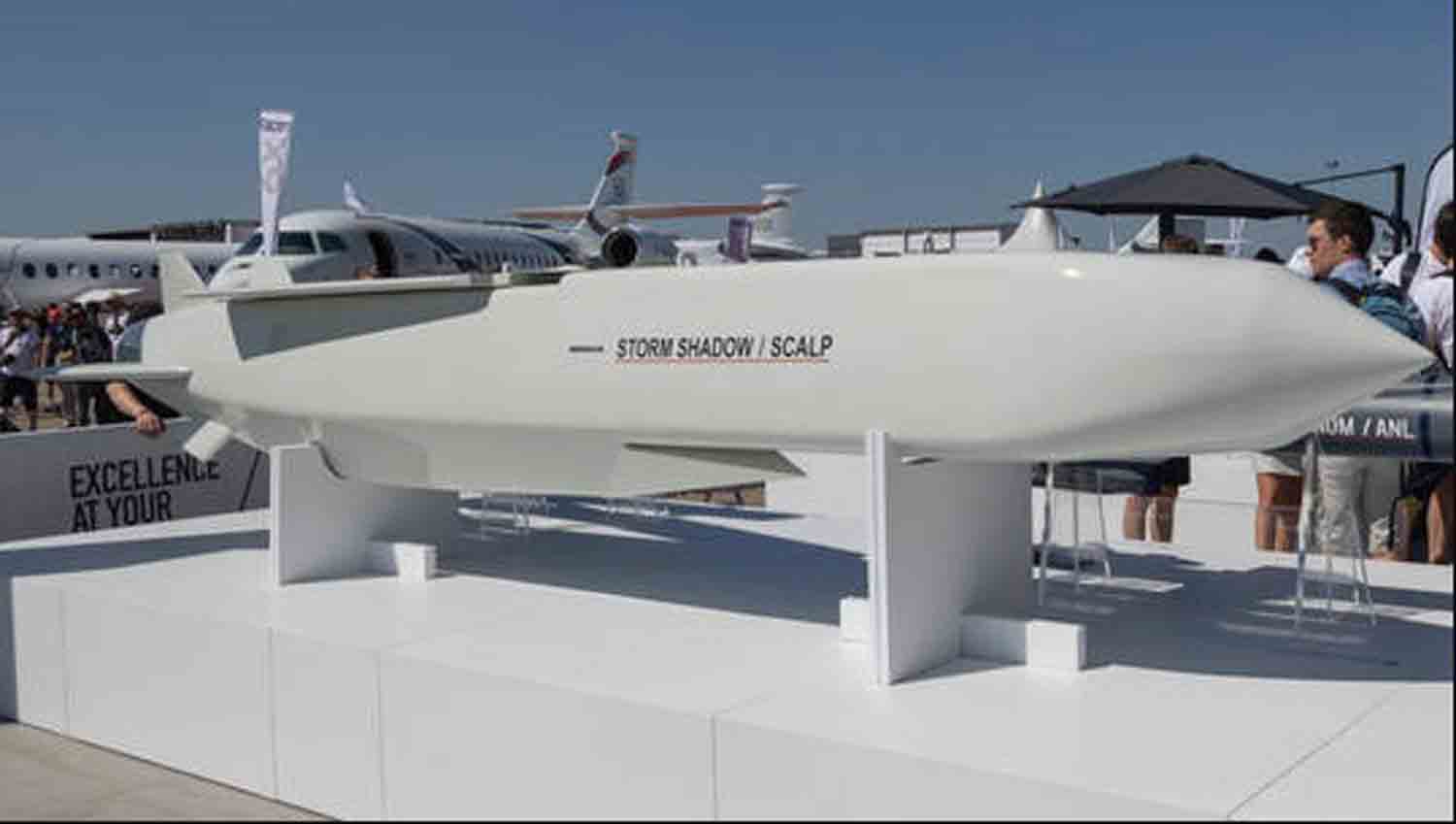
The SCALP EG, known in British service as Storm Shadow, is among the most advanced long-range air-launched cruise missiles currently in operational service.
Developed jointly by France and the United Kingdom and manufactured by MBDA, the missile is specifically designed to penetrate sophisticated air-defence systems before striking high-value targets with exceptional precision.
Unlike conventional guided bombs, the SCALP is capable of attacking strategic infrastructure located deep behind enemy lines.
Typical targets include:
- Command-and-control centres
- Hardened bunkers
- Airbases
- Logistics hubs
- Ammunition depots
- Radar installations
- Critical military infrastructure
Its combination of long range, low-observable flight profile and precision guidance has made it one of Ukraine’s most effective long-range strike weapons.
Technical Characteristics
The SCALP/Storm Shadow is approximately 5.1 metres long, weighs around 1,300 kilograms, and carries a 450-kilogram BROACH penetrating warhead designed to destroy hardened structures.
Key features include:
- Long-range stand-off strike capability
- Terrain-following flight profile
- GPS, inertial and terrain-reference navigation
- Imaging infrared terminal guidance
- Low radar signature
- High precision against fortified targets
The missile flies at low altitude to reduce detection before striking its target with remarkable accuracy.
Its stand-off capability allows launch aircraft to remain outside the engagement range of many surface-to-air missile systems.
Combat Experience in Ukraine
Since entering Ukrainian service, SCALP and Storm Shadow missiles have played an increasingly important role in Kyiv’s long-range strike campaign.
One of the latest reported examples came on 27 June, when Ukrainian forces used the missile against a Russian communications and radio-technical support battalion located at Taganrog-Central Air Base.
Previous strikes have also targeted:
- Military headquarters
- Logistics centres
- Ammunition depots
- Airfields
- Bridges supporting Russian military operations
The missile’s precision allows Ukraine to engage strategically important targets while limiting collateral damage compared with many conventional strike options.
Building Ukraine’s Defence Industry
Perhaps the most significant aspect of the proposed agreement is not the missile itself but where it could be built.
Licensed production inside Ukraine would gradually reduce Kyiv’s dependence on overseas deliveries while strengthening its domestic defence-industrial base.
Since 2022, Ukraine has increasingly prioritized local production of:
- Drones
- Artillery ammunition
- Armoured vehicles
- Air-defence systems
- Precision-guided weapons
Adding SCALP production would represent another major milestone in that strategy.
Rather than waiting for new missile deliveries from foreign stockpiles, Ukraine could eventually sustain at least part of its long-range strike capability through domestic manufacturing.
France Signals a New Level of Cooperation
For Paris, allowing licensed production of one of its most advanced cruise missiles would represent a significant political and strategic decision.
France has consistently supported Ukraine while also seeking to strengthen Europe’s defence-industrial capacity.
Earlier this year, Paris opposed proposals to finance additional British-made Storm Shadow purchases using European funds, arguing that investment should also support European Union defence industries.
Licensed SCALP production inside Ukraine would align with that broader objective by combining military assistance with long-term industrial cooperation.
Growing International Support
The proposed production agreement follows broader international efforts to strengthen Ukraine’s defence manufacturing capabilities.
At the G7 Summit in June, member states expressed support for expanding licensing agreements that would allow Ukraine to produce additional advanced military equipment domestically.
Western governments increasingly recognise that long-term security assistance cannot rely solely on transferring equipment from existing national stockpiles.
Instead, helping Ukraine establish its own defence production capacity has become a strategic priority.
Strategic Implications
Local SCALP production would have implications extending well beyond Ukraine.
For Russia, it could complicate military planning by increasing the potential availability of long-range precision weapons capable of reaching critical military infrastructure far behind the front line.
For Europe, it demonstrates a growing willingness to share advanced defence technologies with trusted partners facing major security threats.
For NATO, stronger Ukrainian industrial capacity reduces long-term pressure on allied inventories while improving Kyiv’s ability to sustain military operations independently.
Challenges Remain
Despite political momentum, several hurdles remain before production can begin.
Negotiators must still finalize:
- Technology-transfer arrangements
- Intellectual property protections
- Industrial production standards
- Supply-chain integration
- Security measures for manufacturing facilities
- Long-term production financing
Protecting any future production facilities from Russian missile and drone attacks will also be a significant consideration.
Final Assessment
The proposed licensed production of SCALP cruise missiles marks another important step in the evolution of Ukraine’s defence industry.
Rather than relying exclusively on foreign deliveries, Kyiv is steadily building the industrial capacity needed to sustain long-term military operations while strengthening cooperation with European defence manufacturers.
If negotiations with France and MBDA are successfully concluded, Ukraine would gain not only access to one of Europe’s most capable precision-strike weapons but also valuable experience in advanced missile production.
As the war increasingly becomes a contest of industrial endurance as much as battlefield performance, agreements like this may prove just as strategically important as the weapons themselves.
For France, the initiative reinforces its leadership in European defence cooperation.
For Ukraine, it offers the prospect of greater military self-reliance.
And for the broader European security landscape, it represents another significant milestone in the gradual integration of Ukraine into the continent’s defence-industrial ecosystem.