Monday, April 20, 2026
Home Blog Page 93

Blinken describes Trump’s proposal to acquire Greenland as an unfavorable notion

0

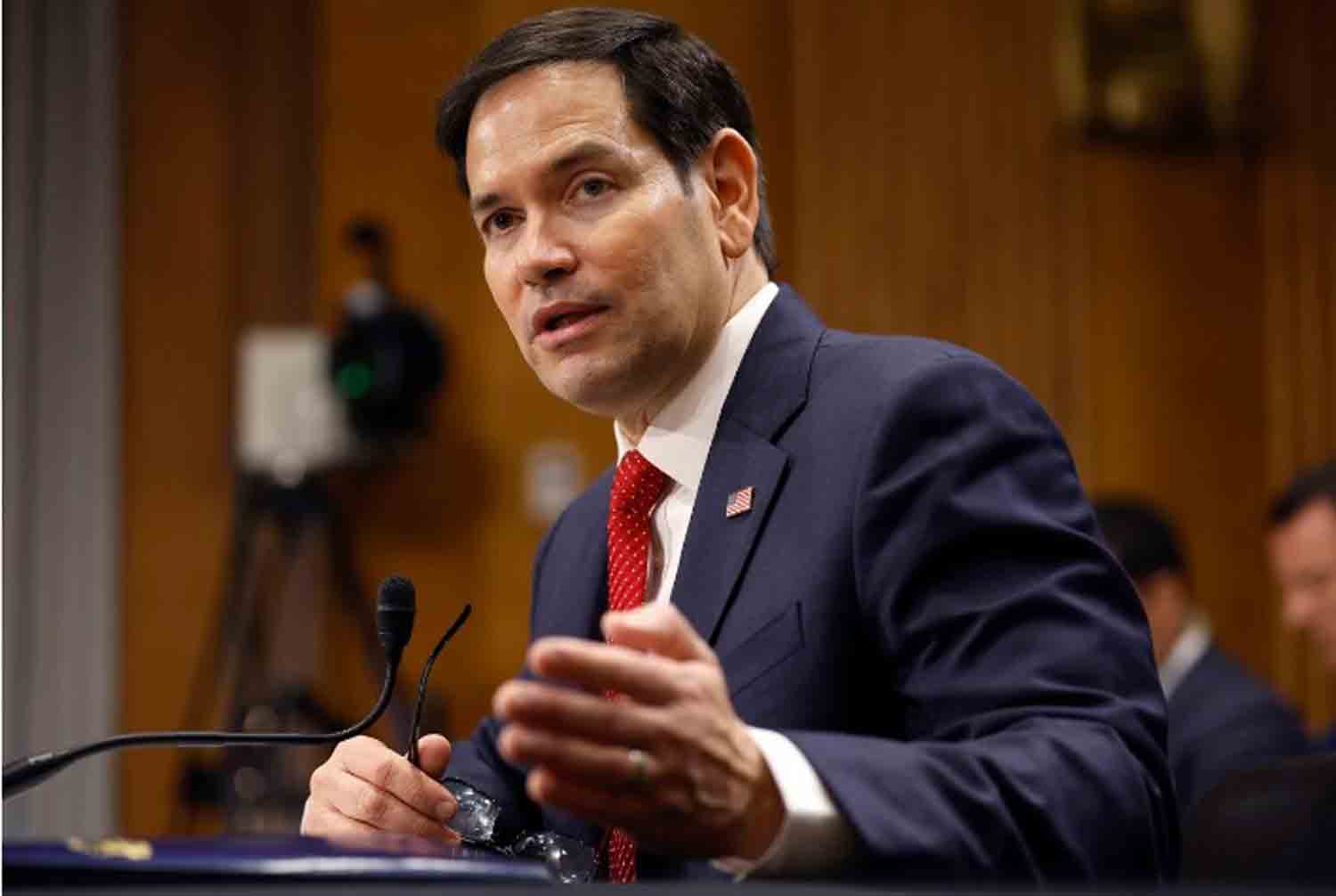
U.S. Secretary of State Antony Blinken on Wednesday rejected President-elect Donald Trump‘s proposal to acquire Greenland, labeling it as “obviously not a good” idea and asserting that it would not materialize. Trump had reiterated his interest in the autonomous territory of Denmark on Tuesday, suggesting that the U.S. might need to consider force to gain control over the expansive Arctic island, citing national security concerns.

Blinken emphasized the importance of collaboration with allies during a press conference in Paris alongside French Foreign Minister Jean-Noel Barrot. He stated, “One of the fundamental principles we’ve adhered to over the past four years is that we are more robust, more effective, and achieve better outcomes when we work closely with our allies, rather than making statements or taking actions that could alienate them.” He further remarked, “The notion regarding Greenland is clearly not a sound one, and more importantly, it is evidently not going to happen, so we should not spend excessive time discussing it.”

Denmark’s foreign minister noted on Wednesday that while Greenland could pursue independence if its residents desired it, the likelihood of it becoming a U.S. state remains low. Trump, who will assume office on January 20, has indicated a willingness to adopt a foreign policy that disregards traditional diplomatic protocols, also not ruling out military or economic measures in his ambition to regain control of the Panama Canal.

In 2019, President Trump canceled a planned trip to Denmark after Prime Minister Mette Frederiksen rejected his proposal for the United States to buy Greenland, which was a Danish colony until 1953 and is currently a semi-autonomous territory within the Danish realm.

Greenland, which is part of NATO due to Denmark’s membership, holds strategic importance for the U.S. military and its ballistic missile early-warning system, as the most direct route from Europe to North America passes through this Arctic island.

Prime Minister Mute Egede of Greenland has emphasized that the island is not for sale and, during his New Year address, intensified calls for independence.

Greenland could gain independence, but Denmark states it won’t become a U.S. state

0
Denmark's Foreign Minister Lars Loekke Rasmussen answers questions from the press in the Parliament, Christiansborg Castle, in Copenhagen, Denmark.

Greenland has the potential to achieve independence if its inhabitants desire it, but it will not transition into a U.S. state, stated Denmark‘s foreign minister on Wednesday. This comment followed U.S. President-elect Donald Trump’s suggestion that he would not dismiss the possibility of using force to assert control over the Arctic territory.

On the same day, Greenland’s leader engaged in discussions with the Danish king in Copenhagen, just a day after Trump’s statements brought significant attention to the future of the Danish-administered island.

Trump, who is set to assume office on January 20, indicated on Tuesday that he would not exclude military or economic measures to incorporate Greenland into the United States. Coinciding with this, his eldest son, Donald Trump Jr., made a private visit to the island.

Greenland, recognized as the largest island globally, has been under Danish rule for 600 years, although its population of 57,000 currently manages its own internal affairs. The local government, led by Prime Minister Mute Egede, aspires for eventual independence.

“We fully acknowledge Greenland’s aspirations. Should they come to fruition, Greenland will achieve independence, but it is unlikely to seek status as a federal state within the United States,” remarked Danish foreign minister Lars Lokke Rasmussen. He also noted that the United States’ increased security concerns in the Arctic are justified due to rising activities from Russia and China in the area.

I do not believe we are facing a crisis in foreign policy, he stated. We are willing to engage in discussions with the Americans regarding potential avenues for closer cooperation to ensure that their objectives are met.

Nevertheless, while Denmark has downplayed the severity of Trump’s territorial threats, the incoming president’s openly expressed desire to extend U.S. borders has unsettled European allies just weeks before he assumes office.

France’s foreign minister, Jean-Noel Barrot, asserted that Europe would not permit any nation to infringe upon its sovereign borders, although he did not foresee a U.S. invasion. A spokesperson for the German government reiterated that borders should not be altered through force. Additionally, a representative from the European Commission emphasized the necessity of respecting the sovereignty of EU member states.

TENSIONS IN RELATIONS

Recent tensions have emerged between Greenland and Denmark due to accusations of historical mistreatment of Greenlanders. Egede has firmly stated that the island is not for sale, and in his New Year address, he intensified his call for independence. Denmark maintains that the future of the territory should be determined solely by the Greenlandic people.

Danish Prime Minister Mette Frederiksen remarked on Tuesday that she could not envision Trump’s ambitions resulting in U.S. military action in Greenland. Denmark’s military presence in the region is limited to four inspection vessels, a Challenger surveillance aircraft, and dog sled patrols.

In response to Trump’s tariff threats against Denmark, Frederiksen expressed her belief that a trade war with the United States would not be a constructive path forward. Denmark is home to Novo Nordisk, the most valuable company in Europe, known for its weight-loss drug Wegovy, which has gained significant popularity in the United States.

The Danish royal palace has not provided any information prior to King Frederik’s meeting in Copenhagen on Wednesday with Greenland’s Prime Minister Egede. While a significant number of Greenlanders aspire for independence from Denmark, the king enjoys considerable popularity on the island, having spent substantial time there, including a four-month journey across the ice sheet. Recently, the royal court updated its coat of arms, increasing the size of a polar bear that represents Greenland.

Damien Degeorges, a consultant based in Reykjavik with expertise in Greenland, stated to Reuters, “I believe the king is uniquely positioned in Denmark to address this matter at present due to his extensive history with Greenland. His popularity there suggests he can play a significant role in strengthening the Danish-Greenlandic relationship.”

During his first term, Trump brought up the idea of the U.S. acquiring Greenland, and his recent comments have left many in Denmark perplexed. “I find it extremely ridiculous,” remarked Jeppe Finne Sorenson, a data engineer in the Danish capital. “We have an alliance; we are allies. This perspective does not honor that.”

India is considering participating in development initiatives in Afghanistan soon

0

India is contemplating involvement in development initiatives in Afghanistan in the near future, as stated by the Foreign Ministry on Wednesday, despite the absence of formal diplomatic ties.

This announcement came after a meeting between Indian Foreign Secretary Vikram Misri and Afghanistan’s Acting Foreign Minister Mawlawi Amir Khan Muttaqi in Dubai.

The statement indicated that, in response to a request from the Afghan side, India plans to initially offer additional material support focused on the health sector and the rehabilitation of refugees.

To date, India has sent multiple shipments of wheat, medicines, COVID-19 vaccines, and winter clothing to Afghanistan.

India does not recognize the Taliban government, which took control in 2021, and subsequently closed its embassy in Kabul following the Taliban’s rise to power.

Additionally, Afghanistan’s embassy in New Delhi was shut down in November 2023 after diplomats from the Afghan government, ousted by the Taliban, were unable to obtain visa extensions from Indian authorities.

US reports that its forces targeted Houthis armament depots in Yemen

0
firefighter works to extinguish a fire at a power station following Israeli airstrikes in Sanaa, Yemen.

The US military announced on Wednesday that its forces targeted weapons storage sites utilized by Yemen’s Houthis for assaults on American naval vessels and commercial ships.

According to a statement from US Central Command (CENTCOM), the operation included “multiple precision strikes,” and it confirmed that there were no injuries or damage to US personnel or equipment.

The statement did not disclose the specific locations of the targeted facilities.

CENTCOM emphasized that the strikes are part of its strategy to undermine Iranian-backed Houthi efforts to pose threats to regional allies and military and commercial vessels in the area.

The Houthis’ Al-Masirah TV reported that five strikes occurred in the northwestern Amran province and two in Sanaa province, where the capital is situated.

Since seizing Sanaa in 2014 from Yemen’s internationally recognized government, the Houthis have maintained control over many of the country’s most densely populated regions.

For over a year, they have been launching missiles and drones at Israel and vessels in the Red Sea and Gulf of Aden, claiming these actions demonstrate solidarity with Palestinians amid the ongoing Israel-Hamas conflict in Gaza.

The Houthi attacks in the Red Sea and Gulf of Aden have created instability in a crucial shipping route, leading to US and occasional British military responses that began in January 2024.

While most Houthi missiles and drones aimed at Israel have been intercepted, a missile strike in December injured 16 individuals in Tel Aviv, as reported by Israel’s military and emergency services.

Spain’s Sanchez accuses Musk of undermining European institutions and fostering animosity

0
Spanish Prime Minister Pedro Sanchez speaks on the day of a European Union leaders summit in Brussels, Belgium.

Spain’s Prime Minister Pedro Sanchez criticized billionaire Elon Musk on Wednesday for his involvement in European political matters, alleging that he is jeopardizing democratic values.

Sanchez remarked, “The international far-right, which we have been combating in Spain for years, is led in this instance by the wealthiest individual in the world, who openly assaults our institutions, fosters hatred, and supports the descendants of Nazism in Germany,” referring to Musk without explicitly naming him.

The Prime Minister made these comments during a ceremony in Madrid marking the 50th anniversary of dictator Francisco Franco’s death. Musk recently engaged in Spanish political discourse by commenting on X about an article that indicated that most rape convictions in Catalonia were attributed to foreigners.

Sanchez emphasized the vulnerability of democracy, stating that it faces a significant existential threat. “If history teaches us anything, it is that freedom is never permanently secured,” he added.

What are Trump’s motivations for seeking Greenland, and is it feasible for him to acquire it?

0
A view of Pituffik Space Base (formerly Thule Air Base) in Greenland.

U.S. President-elect Donald Trump has indicated his desire to incorporate Greenland into the United States, suggesting that he may consider military or economic measures to persuade Denmark to relinquish control of the mineral-rich and strategically significant island. In a post on Truth Social, Trump remarked, “Greenland is an incredible place, and the people will benefit tremendously if, and when, it becomes part of our Nation.” He further emphasized the importance of this acquisition, stating, “This is a deal that must happen,” coinciding with a private visit to Greenland by his son, Donald Trump Jr.

WHY DOES TRUMP WANT GREENLAND?

Trump’s interest in acquiring the largely ice-covered territory, which is home to approximately 57,000 residents, first emerged in 2019 but was met with rejection from Denmark.

The rationale behind Trump’s interest in Greenland lies in its strategic importance. As a member of NATO through Denmark, Greenland plays a crucial role in the U.S. military’s operations, particularly for its ballistic missile early-warning system, given that the most direct route from Europe to North America traverses the Arctic island.

The U.S. military currently maintains a permanent base at Pituffik in northwest Greenland and has shown interest in enhancing its military footprint there, including the installation of radar systems to monitor maritime activities between Greenland, Iceland, and Britain—key transit routes for Russian naval forces and nuclear submarines. According to Ulrik Pram Gad, a senior researcher at the Danish Institute for International Studies, it is essential for the United States to prevent other major powers from establishing a presence on the island, which is geographically part of North America.

The island of Greenland, with its capital Nuuk located closer to New York than to Copenhagen, is rich in mineral, oil, and natural gas resources; however, progress in development has been sluggish. A survey conducted in 2023 revealed that 25 out of 34 minerals classified as “critical raw materials” by the European Commission are present in Greenland. These include substantial amounts of battery materials like graphite and lithium, as well as rare earth elements essential for electric vehicles and wind turbines.

Due to environmental concerns, Greenland has prohibited the extraction of oil and natural gas, and the advancement of its mining industry has been hindered by bureaucratic obstacles and opposition from indigenous communities. As a result, the economy remains heavily dependent on fishing, which constitutes over 95% of exports, alongside annual subsidies from Denmark that account for approximately half of the public budget. Denmark allocates nearly $1 billion each year to support Greenland.

WHO OWNS GREENLAND AND COULD TRUMP BUY IT?

Greenland has been under Danish rule for over 600 years but now exercises significant control over its domestic affairs as a semi-autonomous territory within the Danish realm. It was officially designated as a territory of Denmark in 1953 and is governed by the Danish constitution, meaning any alteration to its legal status would necessitate a constitutional amendment. In 2009, the island was granted extensive self-governing powers, including the ability to pursue independence from Denmark through a referendum.

Greenland’s Prime Minister Mute Egede has intensified efforts toward independence, consistently asserting that the island is not for sale and that its future should be determined by its inhabitants. On Wednesday, Egede engaged in discussions in Copenhagen with King Frederik, likely influenced by recent comments from former President Trump. In 2019, both Greenland and Denmark turned down Trump’s proposal to purchase the island. Historically, during the Cold War, the U.S. under President Harry Truman attempted to acquire Greenland for $100 million in gold, but Copenhagen refused the offer.

WHAT IF GREENLAND ACHIEVES INDEPENDENCE?

Should Greenland attain independence, it might consider establishing a relationship with the United States. While a significant portion of the Greenlandic population desires independence, many believe that complete autonomy is impractical due to their economic reliance on Denmark, a member of the prosperous European Union. One potential pathway could involve creating a “free association” agreement with the United States, akin to the arrangements of Pacific island nations such as the Marshall Islands, Micronesia, and Palau. Ulrik Pram Gad, a senior researcher and Greenland expert, noted, “Greenland is pursuing independence from Denmark, but no Greenlanders wish to simply exchange one colonial ruler for another.”

It is improbable that Greenland will pursue independence without first securing the well-being of its citizens.

WHAT DOES GREENLAND WANT?

While a majority of Greenland’s population favors independence, opinions are split regarding the appropriate timing and the potential effects on living conditions. Since 2019, Greenlandic politicians have expressed a desire to enhance cooperation and trade with the United States. However, Aaja Chemnitz, a Greenlandic representative in the Danish parliament, firmly opposed the notion of a U.S. acquisition, stating, “I don’t want to be a pawn in Trump’s hot dreams of expanding his empire to include our country.”

WHAT DOES DENMARK SAY?

This renewed interest arises amidst increasing tensions between Greenland and Denmark, following disclosures of past injustices by the former colonial power. Denmark, a close NATO ally of the United States, categorically rejected Trump’s 2019 proposal to purchase the island, with Prime Minister Mette Frederiksen calling it “absurd.”

In response to Trump’s renewed interest on Tuesday, Frederiksen remarked, “We need very close cooperation with the Americans.” She further emphasized, “At the same time, I urge everyone to acknowledge that the Greenlanders are a distinct people; it is their country, and only they can determine and shape Greenland’s future.”

Ukraine claims attack on oil depot serving air base for Russian nuclear bombers

0
The AI-enabled drone of Swarmer company flies, amid Russia's attack on Ukraine, in Kyiv region, Ukraine.

Ukraine conducted a nighttime strike deep within Russian territory, igniting a fire at an oil depot in Engels, which supports an air base for Russian nuclear bombers, according to the Ukrainian military on Wednesday.

The governor of the Russian region reported that both Engels and Saratov, located on opposite banks of the Volga River, experienced a “mass drone attack,” resulting in a fire at an unspecified industrial site. He noted that there were no reports of casualties.

The Ukrainian military indicated that multiple explosions occurred at the “Kristal” oil depot, which supplies fuel to the “Engels-2” military airfield. The strike is said to pose significant logistical challenges for the Russian strategic aviation forces and greatly diminishes their capacity to target Ukrainian cities and civilian infrastructure, as stated in a Telegram announcement.

Presidential adviser Oleksandr Kamyshin revealed that Ukraine utilized “long-range capabilities” for the attack, sharing this information on X with the hashtag #MadeInUkraine to emphasize that the weapons were domestically produced rather than supplied by Western nations.

In a notable escalation of the ongoing conflict, Ukraine began using U.S. ATACMS ballistic missiles and British Storm Shadows against Russian targets last year, prompting Russia to respond with the deployment of a new hypersonic missile, the Oreshnik, aimed at Ukraine. The Kremlin has vowed to retaliate each time Ukraine employs long-range Western weaponry against Russian territory.

Russian news outlets reported that a fire broke out at an oil facility in Engels. Social media posts featured videos and images of a significant blaze, characterized by bright orange flames and thick smoke billowing into the night sky. Reuters confirmed the fire’s location within an industrial area of Engels using satellite imagery.

Roman Busargin, the regional governor, stated on Telegram that there are adequate forces and resources available to contain the fire.

In a statement, Russia’s defense ministry indicated that 11 Ukrainian drones were intercepted overnight in the Saratov region, with an additional 21 downed in other areas of Russia and over the Azov Sea. The ministry did not report any resulting damage.

Residents of Engels shared in a Telegram chat that they heard numerous explosions. Authorities urged the public to remain calm and advised against taking photos or videos of the drones. The Engels air base is situated approximately 730 km (450 miles) southeast of Moscow and is several hundred kilometers from the Ukrainian border. In December 2022, a drone incident at the base resulted in the deaths of three Russian air force personnel.

Trump’s aggressive stance towards Greenland, Canada, and Panama illustrates his expansionist strategy

0
Donald Trump gestures at Turning Point USA's AmericaFest in Phoenix, Arizona, U.S.

Donald Trump’s ambitions regarding Greenland, Canada, and Panama often resemble the thoughts of a real estate mogul who views foreign and trade policy as opportunities for new ventures.

However, there is a rationale behind his expansionist approach. Trump is addressing national security challenges that the United States must confront in a world increasingly influenced by China’s ascent, the disparities created by globalization, the melting of polar ice, and the instability among great powers.

His perspective also reflects the “America First” doctrine, which emphasizes leveraging U.S. power to aggressively pursue specific national interests, even at the expense of smaller allied nations.

Trump’s comments about potentially ending the Panama Canal Treaty particularly highlight the current administration’s concerns regarding foreign influence in the Western Hemisphere. This issue is not new; it has been a recurring theme in American history, originating with the Monroe Doctrine in the 1820s when European colonialism posed a threat. This concern persisted through the Cold War’s communist anxieties. Today, the perceived challengers are China, Russia, and Iran.

Moreover, Trump’s conviction that the United States should maintain dominance within its sphere of influence offers insight into how he may approach critical global issues, such as the conflict in Ukraine and the situation in Taiwan.

His approach to 21st-century neocolonialism poses significant risks and is likely to clash with international law. Furthermore, Trump could undermine America’s influence by damaging long-established alliances and distancing the nation from its allies.

Trump maintains the option of military action

On Tuesday, Trump heightened global tensions as he responded to a reporter’s inquiry about the possibility of using force to reclaim the Panama Canal or to assert control over strategically vital Greenland.

“I’m not going to commit to that, no,” Trump stated at Mar-a-Lago. “It might be that you’ll have to do something.”

Canadians expressed relief upon hearing that the president-elect would not deploy the 82nd Airborne across the border. Instead, he indicated a preference for economic measures to annex the proud sovereign nation to the north, envisioning it as the 51st state.

As is often the case with Trump, his remarks blended a sense of threat with a touch of humor. The situation took on a comical tone when his son, Donald Jr., flew the family’s Boeing to Greenland, with a bobblehead of Trump positioned on the cockpit control panel. “Make Greenland Great Again!” the president-elect posted on his Truth Social platform shortly before his son’s arrival.

It seems improbable that Trump will achieve his objectives regarding Canada, Panama, or Greenland. His strategy may instead focus on negotiating more favorable terms for the U.S.—potentially securing reduced fees for American ships navigating the crucial waterway between the Atlantic and Pacific Oceans, enhanced access to rare earth minerals in Greenland, and new trade agreements with Canada that could benefit U.S. manufacturers. Trump would likely frame any such outcomes as significant victories that only he could have accomplished, even if they ultimately prove to be superficial, similar to his first-term US-Mexico-Canada agreement.

Trump’s threats highlight a key aspect of his foreign policy: the belief that nations should pursue their interests independently, which tends to favor powerful, wealthy countries like the United States.

“As president, I have turned away from the unsuccessful strategies of the past, and I am proudly prioritizing America, just as you should prioritize your own nations. That’s perfectly acceptable — that’s what you ought to be doing,” Trump stated at the United Nations General Assembly in 2020.

This perspective is rooted in Trump’s long-standing approach of being the most assertive individual in any situation, seeking victories over less formidable adversaries. This mindset is reflected in his suggestion that Denmark should cede Greenland, a self-governing territory within its realm, due to its significance for U.S. security. He further threatened, “I would impose high tariffs on Denmark” if they did not comply.

Additionally, Trump criticized the U.S. decision to transfer control of the Panama Canal in 1999, under a treaty negotiated by Jimmy Carter, labeling it a mistake that wasted American power. He inaccurately claimed that U.S. vessels faced discrimination in transit fees and suggested that China, rather than Panama, was managing the canal. “We handed the Panama Canal to Panama. We didn’t hand it to China, and they’ve taken advantage of it,” Trump remarked just before Carter’s remains were brought to Washington for his state funeral.

Trump’s assertive demeanor also accounts for his perception of minimal differences between US allies and adversaries. For instance, he expressed dissatisfaction on Tuesday regarding Canada, which he considers America’s closest geographical ally, claiming it is taking advantage of the US defense system and should therefore be a state rather than an independent nation. This perspective undermines the US-led liberal order, which views alliances as strategic investments that enhance American influence and safeguard democracy and freedom.

While the US may be withdrawing from global engagements, it is intensifying its focus on its immediate region

The idea of deploying troops to seize control of the Panama Canal or Greenland may seem at odds with Trump’s campaign rhetoric advocating for avoidance of new foreign commitments. However, it illustrates the “America First” philosophy. A potential withdrawal from traditional global roles during a second Trump term could give way to a form of “continentalism” that might replace globalism, as suggested by Hal Brands, a professor at the Johns Hopkins School of Advanced International Studies, in an article for Foreign Affairs last May.

This approach would modernize the doctrine established by President James Monroe in 1823, which was later expanded by President Theodore Roosevelt to assert that the United States should safeguard lives and property in Latin American nations.

Although Trump’s recent comments regarding the Panama Canal have sparked international concern, he initially adopted a more assertive stance in the Western Hemisphere during his first term. “In the Western Hemisphere, we are dedicated to preserving our independence from the encroachment of expansionist foreign powers,” Trump stated at the UN General Assembly in 2018. “It has been the formal policy of our country since President Monroe to reject foreign interference in this hemisphere and in our domestic affairs.”

His approach marked a departure from the policies of the Obama administration, aligning with Trump’s reactionary political stance. In 2013, former Secretary of State John Kerry stated to the Organization of American States, “The era of the Monroe Doctrine is over.”

The updated Monroe Doctrine of the 21st century focuses on countering the influence of China, Russia, Iran, and their alliances in countries such as Venezuela, Bolivia, Nicaragua, and Cuba.

Marco Rubio, an unexpected choice for Trump’s secretary of state due to his conventional foreign policy views, shares his boss’s perspective on issues concerning the hemisphere. During a Foreign Relations Committee hearing in 2022, the Florida senator remarked that China was exerting economic pressure that negatively impacted regional economies and empowered cartels responsible for the trafficking of fentanyl and violence across U.S. borders. “They do this because they know that chaos in Latin America and the Caribbean would severely hurt us, destabilize us, who they view as their primary and central rival,” Rubio stated. “We simply can’t afford to let the Chinese Communist Party expand its influence and absorb Latin America and the Caribbean into its private political-economic bloc.”

The potential pitfalls of Trump’s aggressive rhetoric

Trump’s ambitious vision suggests a strong sense of confidence as he approaches his second term, which he aims to use to make a significant impact on America’s role in the world.

His embodiment of the idea that the strong prevail over the weak may also shape his stance on other international matters, particularly the conflict in Ukraine. In a notable statement on Tuesday, Trump expressed understanding for Russian President Vladimir Putin’s concerns regarding the possibility of NATO expansion into Ukraine. “Russia has somebody right on their doorstep, and I could understand their feeling about that,” the president-elect commented.

Concerns regarding Trump’s potential acceptance of Russia’s demands have been prevalent. H.R. McMaster, his former national security adviser, noted an instance where Putin drew parallels between his unlawful claims on Ukraine and historical U.S. apprehensions about its own sphere of influence. In his book “At War with Ourselves,” McMaster stated, “Putin utilized his interactions with Trump to initiate a calculated and ongoing effort to influence him.” He further remarked that Putin attempted to create a moral equivalence between U.S. actions in Latin America and Russia’s invasion of Ukraine by referencing the “Roosevelt Corollary” to the Monroe Doctrine.

While Trump’s brashness may resonate with his base, it is often perceived as hubristic by many international observers. An endeavor to take control of the Panama Canal would be seen as an act of geopolitical theft, and an invasion of Greenland would undermine international legal standards.

Canadian Prime Minister Justin Trudeau, whose political career has already faced significant challenges due to Trump’s tariff threats, ridiculed Trump’s ambitions regarding Canada. He stated on X, “There isn’t a snowball’s chance in hell that Canada would become part of the United States.”

This response illustrates the drawbacks of Trump’s tactics. His aggressive stance towards America’s allies could alienate entire populations. Some foreign policy analysts express concern that U.S. threats and pressure in Latin America might inadvertently drive these nations closer to China.

Insults suggesting that Canada would be better off as the 51st state are likely to strengthen negative sentiments among Canadians towards the incoming U.S. president, complicating future negotiations for the next prime minister.

Trump’s apparent indifference to the patriotism of other nations could jeopardize America’s longstanding alliances. It may also instill fear in entire populations. Aaja Chemnitz, a member of the Danish parliament and a resident of Greenland, expressed to CNN’s Erin Burnett, “The majority in Greenland find it quite scary and quite uncomfortable … that the U.S., in a disrespectful manner, is indicating a desire to purchase or control Greenland.”

“Greenland does not align with MAGA. Greenland will not embrace MAGA.”

United States is using Saudi Arabia’s funds to support a presidential candidate in Lebanon

0
Saudi Minister of Foreign Affairs Prince Faisal bin Farhan meets U.S. Envoy to Lebanon Amos Hochstein in Doha.

The United States has informed Lebanese officials that Saudi Arabia is willing to invest hundreds of millions of dollars into the reconstruction of Lebanon, contingent upon the election of Lebanese army commander Joseph Aoun as president, according to a senior Arab official and a former senior US official speaking to Middle East Eye.

During his visit to Lebanon on Monday, US envoy Amos Hochstein emphasized this potential financial support while advocating for Aoun, engaging with key figures including Lebanese parliamentary speaker Nabih Berri.

Aoun has already garnered the backing of Lebanon’s Sunni Prime Minister Najib Mikati.

“The Americans are firmly committed. They do not support any candidate other than Aoun,” stated the senior Arab official. “Hochstein has linked Aoun’s election to Saudi Arabia’s financial backing for Lebanon’s reconstruction.”

The Lebanese parliament is scheduled to conduct presidential elections on January 9, although previous attempts have faced delays.

This election is particularly significant, as it coincides with ongoing negotiations for the renewal of a 60-day ceasefire that concluded intense hostilities between Hezbollah and Israel, with a deadline approaching on January 26.

It has been widely acknowledged within Beirut’s political landscape that the US favors Aoun for the presidency, a position that has remained unfilled since 2022. Traditionally, the presidency is held by a Maronite Christian, with Jihad Azour, a senior banker at the International Monetary Fund, also viewed as a pro-US alternative.

The US advocates for Aoun’s presidency, believing his military background will be crucial for enforcing the ceasefire, according to both current and former officials.

With Hezbollah in a weakened state, Lebanese and American officials are optimistic that Israel and Lebanon could officially establish their borders following an Israeli withdrawal, as noted by the Arab official.

The current strength of the U.S. initiative to support Aoun is significantly enhanced by the involvement of Saudi Arabia, aiming to restore the kingdom’s position as the primary Sunni powerbroker in Lebanon.

Saudi Arabia’s Historical Influence in Lebanon

Historically, Saudi Arabia has played a pivotal role in Lebanon’s post-civil war reconstruction, notably through the Taif Agreement reached nearly thirty years ago.

Following the 2006 conflict, Saudi Arabia committed $500 million for Lebanon’s reconstruction, and affluent Saudis invested in luxury properties in Beirut.

However, in 2008, the limitations of Saudi influence became evident when Hezbollah outmaneuvered Sunni factions during violent confrontations, prompted by the Lebanese government’s attempts to curb Hezbollah’s power.

In 2017, Saudi Arabia’s frustration with then-Prime Minister Saad Hariri’s inability to counter Hezbollah’s influence led to his detention.

For a time, it seemed that Saudi Arabia had largely abandoned Lebanon. With Hariri stepping away from politics to join the UAE royal family, the kingdom lost its key Sunni partner.

In recent years, Riyadh has remained largely passive as Lebanon faced a severe economic crisis, with its currency plummeting over 90 percent and a catastrophic explosion devastating Beirut’s port. In 2021, Saudi Arabia imposed a ban on all imports from Lebanon.

Saudi Arabia’s willingness to reengage highlights the significant shifts in the regional landscape following Hamas’s attack on southern Israel on October 7, 2023. This event has disrupted the existing balance of power, leaving Iran considerably weakened while bolstering Israel’s position.

On Sunday, Hochstein met with Saudi Foreign Minister Prince Faisal bin Farhan in Riyadh.

According to a former US official briefed on the discussions, “The Saudis and Americans concurred that Hezbollah’s miscalculations have created a rare opportunity, one not seen in thirty years, to restore Lebanon’s sovereignty.”

Hochstein prioritized his visit to Riyadh before heading to Beirut to confirm Saudi Arabia’s commitment to the reconstruction funds he intended to secure, as noted by an Arab official. The meeting with bin Farhan reassured American officials of Saudi Arabia’s seriousness, allowing Hochstein to approach Aoun’s lobbying efforts in Beirut with confidence.

For Hochstein, facilitating Aoun’s election as president holds personal significance. He played a crucial role in mediating a maritime demarcation agreement between Lebanon and Israel in 2022 and was instrumental in negotiating a ceasefire between Hezbollah and Israel in November.

Will Israel withdraw from Lebanon?

Initially, the US sought to restrict Israel’s military actions in Lebanon but shifted its stance to support its ally’s invasion after Israel executed an unprecedented strike on Hezbollah’s communication infrastructure and assassinated its leader, Hassan Nasrallah, in September.

The ceasefire facilitated by the United States reaffirmed previous UN Security Council resolutions that demand Hezbollah’s complete withdrawal from southern Lebanon and its eventual disarmament. In contrast to the ceasefire established in 2006, the November agreement includes a provision that allows the US to support Israel in unilaterally addressing violations by Hezbollah.

This ceasefire has also expanded the US’s involvement in Lebanon by establishing a committee made up of representatives from Israel, Lebanon, France, and the US, along with a UN official to oversee violations. The committee is led by US Major General Jasper Jeffers.

Israeli forces are expected to retreat from the areas of southern Lebanon they currently occupy, with the Lebanese Armed Forces (LAF) and UN peacekeepers stepping in to fill the void.

On Monday, the LAF commenced positioning itself in the southern Lebanese border town of Naqoura, following the third Israeli withdrawal from the region since the ceasefire was enacted.

Both the UN and the Lebanese government have urged Israel to expedite its withdrawal. Israel did not enter Naqoura until after the ceasefire was implemented.

“These withdrawals will persist until all Israeli forces have completely exited Lebanon, as the Lebanese army continues to deploy southward to the Blue Line,” Hochstein stated on Monday.

“I have every reason to believe that all parties involved will remain dedicated to fulfilling the agreement they have reached,” he added later.

One of the obstacles to executing the agreement is the Lebanese military’s insufficient funding.

According to the Stockholm International Peace Research Institute, the LAF’s total expenditure last year was $241 million, with US aid constituting approximately half of that amount. The US has committed to providing additional financial support to the LAF as part of the ceasefire, which includes funding for the recruitment of more soldiers and the purchase of equipment such as Humvees necessary for border patrols.

On Monday, Reuters reported that the US informed Congress of its decision to reallocate $95 million in military funds originally designated for Egypt to the LAF.

Taliban designate Shaheen as their representative in Qatar

0

The Taliban have appointed Suhail Shaheen, the former head of their political office in Qatar, as their new ambassador to Doha, as confirmed by Zabihullah Mujahid, the spokesperson for the Taliban, in a message to Amu TV on Wednesday.

Mujahid did not provide further information about the future of the Taliban’s political office but announced that Mohammad Naeem, who has been serving as the acting ambassador in Qatar, will now take on the role of deputy ambassador.

These appointments come as the Taliban seek to gain international recognition. They have previously requested the United Nations and the Security Council to acknowledge Shaheen as Afghanistan’s permanent representative to the U.N., a request that has remained unanswered for three years.

Since regaining power in August 2021, the Taliban have encountered significant obstacles in obtaining legitimacy from the international community, facing widespread criticism for their human rights record and their restrictive policies towards women and minorities. The recent diplomatic appointments seem to be part of their broader strategy to enhance their global standing.

As of now, Qatari officials and the United Nations have not commented on these new appointments.

Greenland’s leader will meet with the Danish monarch amid Trump’s attempt to acquire the territory

0
Greenland's Prime Minister Mute Bourup Egede speaks at a press conference during the opening of the European Commission's new office in Nuuk, Greenland.

Greenland’s Prime Minister is set to meet with the Danish monarch in Copenhagen on Wednesday, following remarks from U.S. President-elect Donald Trump expressing interest in acquiring the Arctic territory, which is an autonomous region of Denmark. Trump, who will assume office on January 20, indicated on Tuesday that he would not dismiss the possibility of employing military or economic measures against Denmark to facilitate Greenland‘s integration into the United States. On the same day, his eldest son, Donald Trump Jr., made an unannounced visit to the resource-abundant island.

Prime Minister Mute Egede, who arrived in Copenhagen late Tuesday, had previously announced that his meeting with King Frederik of Denmark was postponed. However, on Wednesday, the Danish royal court confirmed that the meeting would proceed, without providing additional details. Greenland, home to 57,000 residents, has been under Danish sovereignty for 600 years and currently exercises significant control over its domestic governance as a semi-autonomous territory. Recent tensions have arisen in their relationship due to accusations of historical injustices faced by Greenlanders during colonial times.

Egede has firmly stated that the island is not for sale, and during his New Year address, he intensified calls for independence from Denmark. The Danish government has echoed this sentiment, asserting that the future of the territory is a matter solely for the Greenlandic people to decide. In 2019, Trump canceled a planned visit to Denmark after Prime Minister Mette Frederiksen rejected his proposal for the U.S. to purchase Greenland.


In 2024, Russia gained 4,000 square kilometers in Ukraine. How many soldiers did it lose?

0
House destroyed by Russian missile strike, Chernihiv, Ukraine.

This week, Russia announced its capture of the resource-rich town of Kurakhove in eastern Ukraine, marking a significant advance in the region nearly three years into the ongoing conflict.

While Ukraine has initiated a new offensive in Russia’s Kursk, causing distress among local residents, Moscow’s forces have continued to achieve gradual progress in eastern Ukraine. This protracted conflict seems to be affecting the morale of Ukrainian troops, who are grappling with manpower shortages amid continuous Russian assaults.

Recent data indicates a notable increase in the toll that this war is exacting on both sides in what has become Europe’s largest conflict since World War II. Experts report that Russia acquired Ukrainian territory equivalent to twice the size of Mauritius in 2024. However, the question remains: what were the military losses incurred during this expansion?

What was the extent of Ukrainian territory that Russia annexed in 2024?

In 2024, Russian forces reportedly seized 4,168 square kilometers (1,609 square miles) of Ukrainian land, as evidenced by geolocated data from the Institute for the Study of War (ISW) based in Washington, DC.

This area is twice the size of Mauritius and five times larger than New York City.

The territorial gains made by Russia in 2024 primarily consist of agricultural land and small settlements, in addition to areas reclaimed from Ukraine in Kursk, according to the ISW.

Furthermore, Russia successfully captured four mid-sized settlements: Avdiivka, Selydove, Vuhledar, and Kurakhove, as reported by the ISW.

What is the reported number of soldiers lost by Russia, according to Ukraine?

Regarding military casualties, as of December 30, 2024, Ukraine’s Commander-in-Chief Colonel General Oleksandr Syrskii stated that 427,000 Russian soldiers had either died or been injured during the conflict in 2024.

In a statement released on January 2, Ukraine’s Defence Ministry estimated Russian losses for the previous year at 430,790 soldiers.

Based on the latest figures, Russian casualties in 2024 averaged approximately 1,180 per day, translating to about 103 losses for every square kilometer gained.

Ukraine reports that Russian military losses have escalated as the year drew to a close. The Defence Ministry indicated that the peak losses occurred in November, totaling 45,720, followed by December with 48,670. The exact breakdown of fatalities versus injuries among these Russian soldiers remains uncertain, leaving the total number of those removed from combat unclear.

How many soldiers did Russia lose? What others say?

Regarding Russian military casualties, the independent Russian outlet Mediazona has confirmed at least 31,481 Russian soldiers’ deaths from January 1, 2024, to December 17, 2024. Mediazona employs open-source research methods to compile the names of the deceased, corroborating the data through obituaries, family posts, local authority statements, and other public records.

The website notes that the figures for 2024 are considered “preliminary conclusions,” suggesting that the year is on track to be the deadliest of the conflict. While definitive proof is still pending, the emergence of casualty data often experiences significant delays.

Timothy Ash, an associate fellow at Chatham House, remarked to Al Jazeera that Russian fatalities are likely exceeding 100,000. Conversely, Ukrainian commander Syrskii stated in a December 17 interview with Le Monde that the number of Russian troops in Ukraine seems to be on the rise.

Oleg Ignatov, a senior analyst at Crisis Group, pointed out that such statements from Syrskii prompt inquiries about how Russian troop levels can increase despite substantial losses. He questioned whether this is due to an effective Russian recruitment strategy or if the actual casualty figures are lower than reported.

Why is it difficult to verify death tolls?

The challenge in verifying death tolls stems partly from the significant propaganda implications these numbers hold for both sides.

There exists a conflict of narratives from both parties involved. Each side employs statistics to showcase its achievements on the battlefield while attempting to discredit the opposing side. According to Ignatov in an interview with Al Jazeera, these narratives are integral to the ongoing conflict.

On December 8, Ukrainian President Volodymyr Zelenskyy revealed via a Telegram post that 43,000 Ukrainian soldiers had perished in combat since the war’s onset in February 2022. The last reported figure from him was in February 2024, when he stated that 31,000 Ukrainian troops had been killed. This indicates that approximately 12,000 Ukrainian soldiers lost their lives in combat over a span of about ten months in 2024.

However, both Russia and Ukraine do not consistently release data regarding their military casualties.

This lack of transparency is intended to prevent the opposing side from gaining insights into the effectiveness of their military strategies, as noted by Marina Miron, a researcher at the Department of War Studies at King’s College London, in an October interview with Al Jazeera.

Such tactics are not unusual in wartime; for example, during World War II, both sides typically underreported their own casualties by half while inflating enemy losses by two to three times, according to Miron.

Additional complexities arise as a soldier’s death is only confirmed once the body is recovered, after which the relevant defense ministry notifies the family.

Miron also pointed out that if a government does not officially recognize a soldier as deceased, it can evade the obligation to compensate the families of the fallen.

Are Russian casualties at a historic high?

Regardless of the precise number of Russian military fatalities in the conflict, particularly in 2024, experts agree that the casualty figures for Russia are unprecedented, marking the highest levels since World War II. During that war, an estimated 8.7 million Soviet military personnel were killed, the highest toll for any nation. Among the 15 Soviet republics, Russia suffered the greatest losses, with approximately 6.7 million soldiers killed.

Russian casualties in Ukraine appear to be significantly higher than previously estimated, according to Ash.

He noted that the repercussions for Russian society will be long-lasting. “Consider the human toll, along with the healthcare and economic implications for the workforce,” he stated. Ash further explained that this situation “partly accounts for the current tight labor markets in Russia and the high levels of wage-price inflation.”

“Russia was already facing a challenging demographic situation, and this conflict has exacerbated it considerably.”

Regarding the territorial gains in 2024, experts suggest that the advancements made by both Russia and Ukraine hold limited strategic value for either nation.

“Ukraine can continue to thrive economically without the territories currently under Russian control, but what truly matters is ensuring security for the rest of Ukraine. This is why the terms of any peace agreement are crucial for Ukraine,” Ash remarked.

“For Russia, the territories gained offer minimal economic or strategic benefits,” he added.

In fact, Ash contended that the occupied Ukrainian regions “will impose a significant burden on the Russian economy in terms of reconstruction costs.”

“This comes at a time when the Russian economy is already constrained by sanctions,” he noted.

Ignatov emphasized that territorial gains by either party are not the primary focus of the conflict. Rather, he described it as a war of attrition, where the key factors are casualties, resources, and infrastructure.

He noted that neither side seems to be inclined towards a ceasefire at this point. With increasing manpower losses, Ignatov indicated that Moscow could encounter difficulties in 2025. “The sustainability of the Russian recruitment model remains uncertain, and it is unclear whether Russia will need to mobilize this year,” he stated.

Turkey warns of potential military intervention against Kurdish forces in Syria

0
Foreign Minister of Turkey Hakan Fidan

Turkey has issued a warning regarding a potential military operation against Kurdish forces in Syria unless they comply with Ankara’s terms for a “bloodless” transition following the recent ousting of Bashar al-Assad.

In an interview with CNN Turk late Tuesday, Foreign Minister Hakan Fidan stated that “we will take necessary actions” if the People’s Protection Units (YPG) do not adhere to Ankara’s requirements. Turkey aims to position itself as a significant influence as stability returns to its southern neighbor.

Fidan indicated that a “military operation” could be imminent, although he noted that the new Syrian leadership, which has received Turkey’s backing, possesses the capability to confront the YPG independently.

The recent removal of al-Assad by opposition forces has heightened the possibility of Turkey directly engaging with Kurdish factions in Syria, which Ankara accuses of having ties to the Kurdistan Workers’ Party (PKK).

The PKK has been in conflict with the Turkish government for many years, and Turkey, along with the United States and the European Union, has designated it as a “terrorist organization.” The ongoing conflict has resulted in the deaths of over 40,000 individuals.

The role of the YPG in Syria is pivotal to Turkey’s security framework, as it perceives a fundamental connection between the YPG and other groups that share similar ethno-nationalist separatist goals.

“International fighters from Turkey, Iran, and Iraq must exit Syria without delay. Currently, we observe no signs of preparation or intention for this, and we are awaiting action,” Fidan stated in an interview with CNN Turk.

As Turkish-backed factions in northern Syria reignited their conflict with Kurdish forces, the rebels initiated an offensive on November 27, which resulted in the ousting of al-Assad just 11 days later.

“Allow some time for this process.”

The newly appointed interim Syrian leader, Ahmed al-Sharaa, whose Hayat Tahrir al-Sham group has maintained longstanding connections with Turkey, expressed to Al Arabiya TV on Sunday that Kurdish-led forces should be incorporated into the national army.

Fidan, who met with al-Sharaa in Damascus last month, indicated that Ankara anticipates the new leadership to tackle the YPG situation, while also expressing a willingness to “allow some time” for ongoing discussions between Damascus and the YPG.

“International terrorist fighters must depart from Syria, and the PKK leadership should leave the country. Remaining members need to disarm and integrate into the new system to ensure a peaceful and seamless transition.”

When questioned about Turkey’s potential intervention in Syria despite U.S. backing for the YPG, Fidan responded, “We have previously acted in Afrin, Ras al-Ain, and Tal Abyad,” referencing areas in northern Syria that Turkey has targeted.

He stated that Turkiye would not hesitate to take similar action in the future. “This is essential for our national security. We have no alternative.”

British minister asserts that Musk is completely uninformed regarding child rape scandals

0

A British minister, whom Elon Musk has labeled a “rape genocide apologist,” stated on Tuesday that the U.S. billionaire is “absolutely ignorant” regarding the child sexual abuse scandals he has been discussing. Musk, a supporter of U.S. President-elect Donald Trump, has been vocal on his social media platform X, accusing British Prime Minister Keir Starmer of neglecting to prosecute groups of men who sexually assaulted young girls during Starmer’s tenure as director of public prosecutions from 2008 to 2013.

Musk has also criticized Starmer’s safeguarding minister, Jess Phillips, calling her a “rape genocide apologist” who deserves imprisonment. Phillips has dedicated much of her career to supporting victims of domestic violence, sexual violence, and human trafficking. Both Musk and opposition politicians are advocating for a new national inquiry into these scandals, following Phillips’ suggestion that a town council, where sex abuse cases were reported, should conduct its own investigation.

Various investigations into child abuse scandals have been undertaken in different regions of northern England. A comprehensive nationwide public inquiry into child sexual abuse, which included cases within religious institutions and schools, issued its findings in 2022, along with several recommendations that remain unaddressed. In response to Musk’s allegations, Starmer defended his record as the UK’s chief prosecutor on Monday, asserting that “those who propagate lies and misinformation…are not focused on victims, but rather on their own interests.”

In an interview with ITV, Phillips expressed her discontent with Musk’s remarks, labeling them as “ridiculous” and stating they turned her “world upside down.” She remarked, “It’s not ideal, and what frustrates me the most is that it consumes so much of my time, coming from someone who is completely uninformed about the topic at hand.”

On Monday, Sky News reported that a man has been charged in connection with threats made against Phillips. Devon and Cornwall Police confirmed that the individual faces three counts of malicious communication occurring between April 2024 and January 2025, although the victims’ identities were not disclosed.

In a separate discussion with Sky News, Phillips emphasized her lifelong commitment to combating child exploitation, expressing her distress at seeing the issue being treated as a “political football.” In response to Starmer’s criticisms, Musk took to X to assert that the prime minister was “deeply complicit in the mass rapes in exchange for votes,” claiming, “That’s what the inquiry would reveal.”

EU won’t tolerate attacks on its borders, French foreign minister says after Trump’s Greenland comments

0

The European Union will firmly protect its sovereign borders against any external threats, stated French Foreign Minister Jean-Noel Barrot in reaction to U.S. President-elect Donald Trump‘s remarks about Greenland and its “ownership and control.” This Arctic territory has been under Danish governance for more than 600 years.

Barrot emphasized, “There is absolutely no scenario in which the European Union would permit other countries to infringe upon its sovereign borders, regardless of their identity… We are a resilient continent.”

Ukrainian drones have targeted a city that serves as the base for the Russian strategic bomber fleet

0
The AI-enabled drone of Swarmer company flies, amid Russia's attack on Ukraine, in Kyiv region, Ukraine.

Ukrainian drones launched attacks on the Russian cities of Saratov and Engels, where an air base housing strategic bomber aircraft is located, according to the regional governor on Wednesday.

Governor Roman Busargin reported that both cities experienced a significant drone assault, resulting in damage to an industrial facility. However, he did not confirm whether the Engels air base was affected.

Busargin noted that a fire broke out at the industrial site that was targeted, but there were no reported casualties.

Russian media outlets connected to security services released images depicting a large fire and indicated that residents had heard multiple explosions. One outlet, Baza, mentioned that the fire occurred near an oil facility.

The Engels base is a key site for Russia’s long-range bomber fleet, which is part of its strategic nuclear capabilities. It is situated approximately 730 km (450 miles) southeast of Moscow and is located several hundred kilometers from the Ukrainian border.

This is not the first time Ukraine has targeted the base; in December 2022, a drone was shot down there, resulting in the deaths of three Russian air force personnel.

As Trump approaches, Pakistan prepares for upcoming foreign policy challenges in 2025

0
Pakistan's Prime Minister Shehbaz Sharif arrives for the United Nations General Assembly

Pakistan welcomed the new year with a sense of relative tranquility following a turbulent 30-month period characterized by unstable politics, a contentious election, and an economy on the brink of collapse.

As the domestic political landscape begins to stabilize and there are hopes for economic recovery in South Asia’s second-most populous nation, foreign policy and security issues are expected to become the primary challenges facing the country this year.

Experts anticipate a challenging 2025 for Pakistan as it navigates relationships with neighboring countries, global allies, and adversaries, particularly in light of Donald Trump‘s impending return to power in the United States.

Many of Pakistan‘s foreign policy and security dilemmas stem from its geographic neighbors, notably Afghanistan to the west and its longstanding rival India to the east.

Following the Taliban’s takeover of Kabul in 2021, violence from armed groups and insurgents surged across Pakistan. In 2024, nearly 700 law enforcement personnel lost their lives in armed attacks, marking one of the deadliest years for the nation of 240 million.

The majority of these assaults were attributed to the Pakistan Taliban (Tehreek-e-Taliban Pakistan, TTP), which views the Afghan Taliban as its ideological counterpart. Additionally, separate attacks targeted locations associated with the China-Pakistan Economic Corridor (CPEC), a $62 billion megaproject that has significantly strengthened the political and economic alliance between Islamabad and Beijing.

Christopher Clary, a non-resident fellow at the Stimson Center, a nonprofit organization based in the United States, and an associate professor of political science at the University at Albany, asserts that Pakistan is currently confronting its “most severe” national security challenge in at least a decade, potentially since the 1990s.

Clary stated to Al Jazeera, “Pakistan lacks a significant strategic option other than to stabilize its economy and mend its relations with major powers and neighboring countries. This process will likely require years of effort, and it remains uncertain whether Pakistan has the time needed to undertake this work before facing a potential collapse.”

The following outlines the nations that will be central to Islamabad’s foreign policy in the coming year:

China

Pakistani officials often emphasize their friendship with China as being “deeper than the oceans, taller than the mountains.” However, 2024 has exposed vulnerabilities in this alliance.

Recent attacks targeting Chinese citizens and interests have led to a rare public admonition from Beijing’s envoy in Islamabad. Jiang Zaidong remarked at an event in October, “It is unacceptable for us to be attacked twice in only six months.”

Muhammad Faisal, an expert in foreign policy regarding China, cautions that while China is likely to continue its financial assistance to Pakistan, the prospects for further expansion of the China-Pakistan Economic Corridor (CPEC) project within the country appear limited.

Pakistan faces significant challenges in managing increasing pressure from Beijing regarding a proposed ‘Joint Security Mechanism’, which would involve the presence of Chinese security personnel on its territory. This situation could expose these personnel to militant attacks, thereby complicating the already intricate security landscape, Faisal noted.

The deployment of Chinese soldiers to oversee projects in Pakistan would signify a recognition of Islamabad’s security shortcomings, heightening the risk of violence against Chinese nationals and raising the politically sensitive issue of potential Chinese military actions against Pakistani citizens.

Additionally, experts express concern that the adversarial approach of the Trump administration towards China may compel Beijing to seek overt support from Pakistan, forcing Islamabad to carefully balance its diplomatic relations to avoid straining ties with Washington, a long-standing ally.

During his first term, Trump adopted a confrontational stance towards China, leading to a trade war between the two nations. In his second term, he has indicated intentions to impose tariffs as high as 60 percent on Chinese imports.

“However, since Pakistan does not occupy a prominent position on the Trump administration’s international agenda, there is a potential advantage. Nevertheless, uncertainty remains a common thread in Pakistan’s dealings with China,” Faisal remarked.

Kamran Bokhari, senior director at the US-based New Lines Institute for Strategy and Policy, pointed out that China’s dissatisfaction with Pakistan arises from the limited returns on its substantial investments in the China-Pakistan Economic Corridor (CPEC). He suggested that this predicament could be leveraged to the advantage of the United States.

China has expressed significant disappointment with Pakistan, leading to a strained relationship that has persisted for some time. However, Beijing finds itself in a difficult position due to its substantial investments in Pakistan through the China-Pakistan Economic Corridor (CPEC), which amount to billions, yet have not yielded the expected benefits. This predicament for China in Pakistan may present an advantageous situation for the United States, as noted by Bokhari in an interview with Al Jazeera.

The United States

The relationship between Pakistan and the United States dates back to Pakistan’s independence from British colonial rule in 1947. However, the dynamics of Islamabad-Washington relations have largely depended on Pakistan’s support for US initiatives in the region, particularly during the Soviet invasion of Afghanistan in the 1970s and 1980s, as well as during the US-led “war on terror” that followed the September 11 attacks in 2001.

With the Taliban regaining control in Kabul, the strategic partnership between Pakistan and the US has diminished. As the US reduces its involvement in Afghanistan, Pakistan has increasingly turned to China to fulfill its economic, military, and technological requirements.

Hassan Abbas, a professor at the National Defense University in Washington, DC, emphasizes the need for Pakistan to “carefully navigate” its relationship with the US amidst rising tensions with both China and India. He observes that while there is evident apprehension on Pakistan’s part, significant shifts in the relationship seem unlikely.

“Security concerns and regional challenges, particularly the instability in Afghanistan,” Abbas remarked to Al Jazeera, “are expected to dominate the interactions between the two nations.” Abbas is also the author of “The Return of Taliban: Afghanistan after Americans Left.”

Bokhari indicated that Pakistan is not a priority for the United States, which is focused on more urgent global challenges, including the Russia-Ukraine conflict and various crises in the Middle East.

“At this moment, I do not observe any significant tensions escalating between the two nations, and Pakistan is navigating its situation cautiously. In Washington, the prevailing view of Pakistan is that it is a fragile and disorganized state that must first address its internal issues before engaging further,” he stated.

India

India continues to pose the most significant foreign policy challenge for Pakistan.

Although there are occasional interactions at multilateral platforms, the relationship has been largely stagnant for years. The situation escalated over Kashmir after New Delhi revoked the limited autonomy of Indian-administered Kashmir in 2019, which drew strong condemnation from Pakistan. Both nations administer parts of Kashmir but claim the entire region, contributing to one of the longest and most violent military conflicts in history.

“The disparity with India is becoming increasingly pronounced, and Pakistan has limited avenues to make India take it seriously without jeopardizing other foreign policy objectives,” analyst Clary remarked to Al Jazeera, noting that Indian Prime Minister Narendra Modi has “little ideological motivation” for improving relations with Pakistan and views such efforts as impractical amid the current domestic challenges in Pakistan.

Abdul Basit, a former Pakistani ambassador to India, perceives the Kashmir situation as an ongoing impasse that necessitates discreet diplomatic efforts. He stated to Al Jazeera, “India has demonstrated no inclination towards flexibility following the constitutional amendment,” alluding to the Modi administration’s repeal of Article 370, which had conferred a degree of autonomy to Indian-administered Kashmir.

As India strengthens its ties with the West, particularly the United States, in light of their shared concerns regarding China, Basit believes that Islamabad must seek avenues for engagement with New Delhi.

“Failing to do so will result in a perpetual cycle of deadlock, preventing us from establishing a foundation for normal relations. This, in my view, is the fundamental issue regarding India,” remarked the retired diplomat.

Conversely, Bokhari from the New Lines Institute for Strategy and Policy suggests that India may find itself under scrutiny from the US this year due to its competition with China.

“India has developed significant and practical relationships with Iran, where it is constructing a port, and it is also purchasing oil from Russia, which is currently involved in a conflict in Ukraine. Therefore, there is a greater likelihood that India will face pressure from the incoming [Trump] administration,” he noted.

Bokhari asserts that for Pakistan to regain US interest, it must present itself as strategically valuable, similar to its role during the Soviet invasion of Afghanistan and the subsequent US military engagements post-9/11.

“To capture US attention, you must provide something that generates substantial interest for them; only then will you be noticed,” he explained. “The relationship was never about the US favoring Pakistan; it was about Pakistan serving a specific purpose.”

Iran

In 2024, Iran experienced significant turmoil, marked by substantial setbacks in its geopolitical standing within the Middle East, including direct military strikes from Israel on multiple occasions.

The year commenced with Iran conducting operations in Pakistan’s Balochistan province, targeting the armed group Jaish al-Adl, which it identified as a security threat along its borders. This prompted a rapid military response from Pakistan. However, the situation did not escalate further, as Tehran opted for diplomatic channels to address the conflict.

Umer Karim, a researcher at the University of Birmingham, anticipates that this “uneasy rapprochement” will persist, alongside the emergence of new challenges, particularly with the potential return of Trump to the presidency.

Karim cautions that a decline in relations between Pakistan and Iran could exacerbate border security issues, potentially empowering Baloch separatists known to have bases in Iran. These rebels have long sought an independent state.

“Pakistan will aim for constructive engagement with Iran to mitigate further tensions amid increasing domestic unrest,” Karim stated.

Iran urges France to reconsider its ‘unconstructive’ stance prior to the upcoming meeting

0

Iran urged Paris to reconsider its “unconstructive” stance just days before Tehran is scheduled to engage in a new round of discussions regarding its nuclear program with key European nations.

On Monday, Emmanuel Macron expressed concerns that Tehran’s uranium enrichment activities are approaching a critical threshold and cautioned that European partners involved in the faltering 2015 nuclear agreement with Iran should contemplate reinstating sanctions if no advancements are made.

“False assertions from a government that has itself neglected its commitments under the nuclear agreement and has significantly contributed to (Israel’s) nuclear weapons development are misleading and accusatory,” stated Foreign Ministry spokesperson Esmaeil Baghaei on X on Wednesday.

France, Germany, and Britain were among the signatories of the 2015 agreement, in which Iran consented to limit its enrichment activities—viewed by the West as a covert attempt to develop nuclear weapons—in exchange for the lifting of international sanctions.

Iran maintains that its uranium enrichment is intended for peaceful purposes and has intensified its program since U.S. President-elect Donald Trump withdrew the United States from the 2015 agreement during his first term and reinstated stringent sanctions on Tehran.

Diplomats from France, Germany, and Britain are scheduled to meet with their Iranian counterparts on January 13, following a previous meeting in November aimed at exploring the potential for serious negotiations in the coming months to ease tensions with Tehran, coinciding with Trump’s anticipated return to the White House on January 20.

Baghaei did not address the remarks made by French Foreign Minister Jean-Noel Barrot concerning the three French nationals detained in Iran. Barrot stated on Tuesday that the future of relations and any potential easing of sanctions on Iran would be contingent upon their release.

European Union cautions that Trump’s actions could significantly undermine efforts to combat climate change

0
EU Commissioner for Climate Action Wopke Hoekstra attends a press conference.

Global initiatives aimed at combating climate change would face significant setbacks if U.S. President-elect Donald Trump decides to withdraw the nation from the Paris Agreement once again, according to the European Union‘s climate policy chief.

Sources from Trump’s transition team indicate that plans for executive orders to exit the United States—currently the second-largest emitter of greenhouse gases after China—from this pivotal global climate treaty are in place.

EU climate commissioner Wopke Hoekstra expressed to Reuters that such a move would severely undermine international climate diplomacy. He emphasized that if the U.S. were to exit the Paris Agreement again, it would necessitate a stronger commitment from other nations to enhance their climate diplomacy efforts.

Hoekstra remarked, “There is no alternative to ensure that everyone contributes, as climate change affects all indiscriminately.” He highlighted the necessity for global collaboration in addressing this pressing issue during U.N. climate discussions.

The Paris Agreement serves as the cornerstone of U.N. climate negotiations, where nearly 200 countries convene to strategize on emission reductions and financial support for these initiatives. The United States has historically played a crucial role in these discussions, notably collaborating with China—both the largest polluter and the second-largest economy—to establish the foundation for recent international climate agreements.

A shift in U.S. policy is anticipated with Trump’s return to the presidency on January 20. He has previously dismissed climate change as a hoax and withdrew from the Paris Accord during his first term from 2017 to 2021. Recently, he cautioned the EU to increase its purchases of U.S. oil and gas or risk facing tariffs.

Hoekstra stated that the EU intends to “constructively engage” with the new U.S. administration on various issues, including climate change. He mentioned that the Commission is reaching out to U.S. representatives across the political spectrum, including those at the non-federal level. “It is essential that our American partners remain involved and collaborate with us as much as possible, and that is something I will actively pursue,” he remarked.

However, as Brussels faces increasing pressure to enhance its climate leadership in light of a potential U.S. retreat, the EU is poised to miss a February deadline for all nations to submit updated national climate plans to the U.N. The outgoing Biden administration has already released the U.S. contribution. Hoekstra acknowledged that the timing of the EU’s political cycle does not align with the U.N. deadline, but assured that Europe would have its 2035 climate plan prepared by this year’s U.N. climate summit in November in Belem, Brazil. “The key is to ensure we present an ambitious target before arriving in Belem,” he emphasized. “I can assure you that we will achieve this.”

Trump shares maps depicting Canada as part of US territory

0

US President-elect Donald Trump has posted two maps on social media depicting Canada as part of the United States. This action came shortly after Canadian officials dismissed his ongoing assertion that Canadians would prefer to live under US governance.

On Tuesday, Trump utilized his Truth Social platform to share a map illustrating the US and Canada merged into one nation, with the border between them removed and the label ‘United States’ placed over the combined territory.

He also shared an image showing both countries colored in the design of the US flag, with the caption “Oh Canada.”

During a press conference on Tuesday, Trump indicated that the US might employ “economic force” to integrate Canada, threatening to impose severe tariffs on Canadian goods.

“If you eliminate that artificially-drawn line and visualize the outcome, it would significantly enhance national security,” Trump contended.

In response, Canada’s outgoing Prime Minister Justin Trudeau stated on X that “there isn’t a snowball’s chance in hell that Canada would become part of the United States.”

Pierre Poilievre, leader of the opposition Conservative Party, echoed this sentiment, asserting that “Canada will never be the 51st state.”

Despite the dismissal of Trump’s proposal to annex Canada, Ottawa politicians have emphasized the necessity of preserving strong bilateral relations as Canada approaches its election season. Trudeau announced earlier this week his intention to resign as prime minister and leader of the Liberal Party due to declining popularity.