The recent conflict involving the United States and Iran may have triggered a deeper strategic shift across the Gulf.
While Washington still maintains a significant military footprint in the region, Gulf Cooperation Council (GCC) states are increasingly reassessing the long-term value of hosting U.S. forces, especially after the costs and risks exposed during the latest escalation.
The question is no longer whether the U.S. will remain present.
It is on what terms — and for how long.

The Backbone of US Power in the Gulf
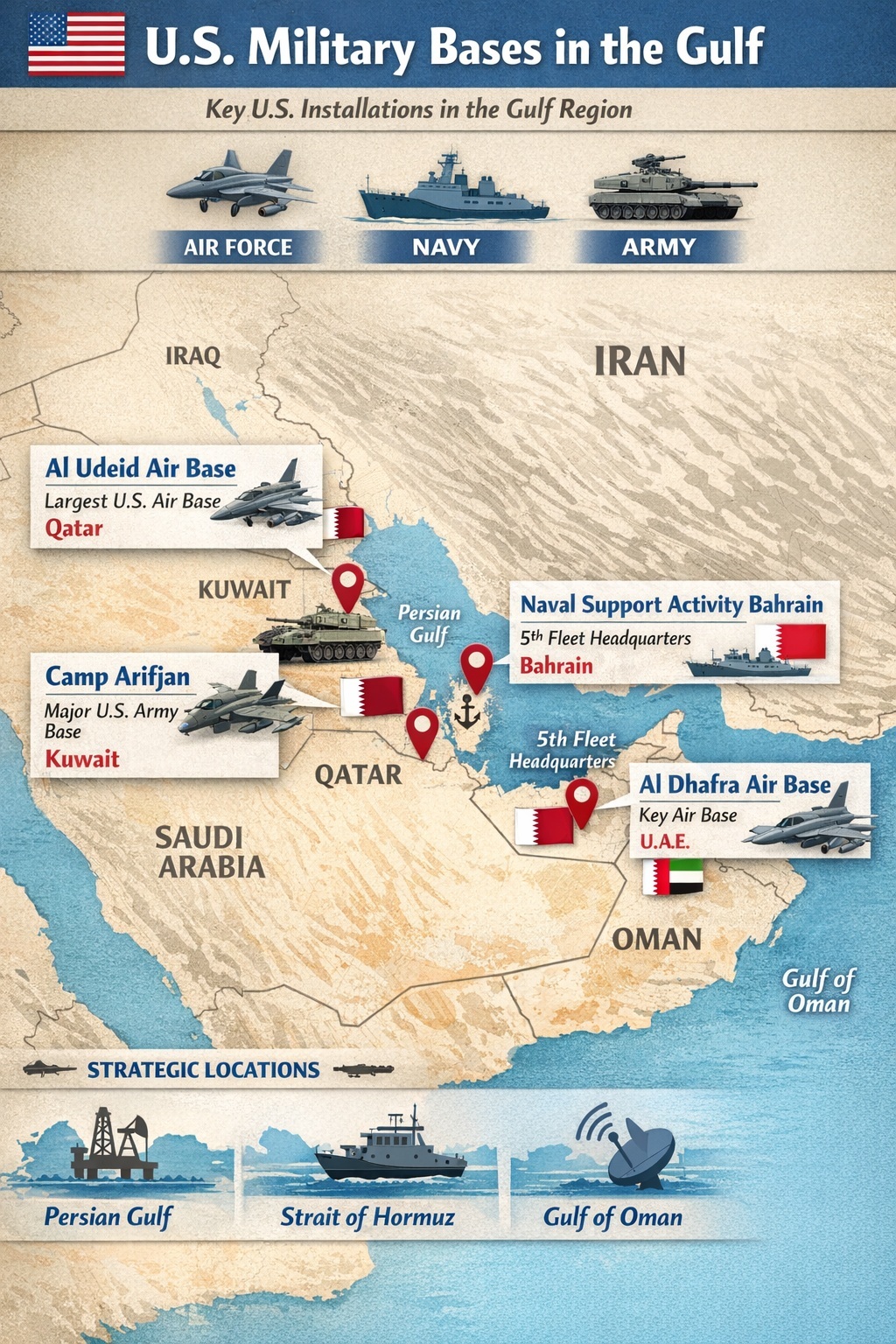
For decades, U.S. regional dominance has relied on a network of major bases across the Gulf:
- Al Udeid Air Base – largest U.S. air base in the region
- Al Dhafra Air Base – key air operations hub
- Naval Support Activity Bahrain – headquarters of the U.S. Fifth Fleet
- Camp Arifjan – major U.S. Army logistics base
These installations have enabled U.S. operations across the Middle East for decades.
But rebuilding, maintaining, and politically sustaining them is becoming increasingly complex.
Bahrain and Kuwait Signal Policy Friction

In Bahrain, public and political voices are increasingly calling for a shift toward diplomacy and a reassessment of foreign troop presence.
Questions are being raised about the long-term role of the U.S. Fifth Fleet, especially in a region moving toward de-escalation.
Meanwhile, Kuwait has taken a more cautious approach.
While officially limiting offensive operations from its territory, it has still played a role in enabling U.S. military activity — highlighting the gap between public policy and strategic reality.
Qatar and Oman Take Divergent Paths
Qatar has reportedly signaled one of the most significant shifts, with discussions about reducing or restructuring U.S. troop presence.
This reflects growing concern that hosting foreign forces may increasingly expose Gulf states to retaliation.
In contrast, Oman has taken a more openly critical stance, condemning recent military actions and emphasizing neutrality.
This positions Muscat as a potential diplomatic bridge — but also underscores widening divisions within the GCC.
Saudi Arabia Draws Red Lines
Saudi Arabia has made perhaps the clearest strategic move.
Crown Prince Mohammed bin Salman has reportedly communicated that the Kingdom will not allow its territory, airspace, or waters to be used for offensive operations in conflicts it is not directly part of.
This marks a significant shift from past practice.
At the same time, Riyadh is expanding its strategic options, including:
- deeper security coordination with non-Western partners
- diversified defense procurement
- broader regional deterrence posture

UAE Reassesses Its Strategic Position
The United Arab Emirates, long seen as one of Washington’s closest regional partners, has also faced growing pressure.
Recent attacks and economic disruptions have exposed vulnerabilities, particularly for hubs like Dubai.
At the same time, Abu Dhabi is increasingly engaging with China, including high-level diplomatic outreach aimed at securing long-term stability in a shifting regional order.
A Shift From Dependence to Diversification
Across the Gulf, a broader pattern is emerging:
- reduced reliance on a single security partner
- increased hedging between global powers
- greater emphasis on regional autonomy
This does not mean the United States is leaving the region.
But it does suggest its role is evolving — from dominant security guarantor to one of several competing external powers.
Is the US Still Seen as a Stabilizing Force?
Perhaps the most important shift is perception.
For decades, U.S. presence was viewed as a stabilizing force.
Now, in some Gulf capitals, it is increasingly seen as:
- a source of escalation risk
- a trigger for regional retaliation
- a factor complicating diplomacy
This change in perception may prove more significant than any physical redeployment of forces.

Entering a New Phase of Regional Order
The region now appears to be entering what some analysts describe as a new phase — a transition toward a multi-polar security environment.
In this emerging order:
- Gulf states play a more independent role
- the U.S. remains influential but less dominant
- China and Russia gradually expand their presence
The outcome of this shift will shape the Middle East for years to come.