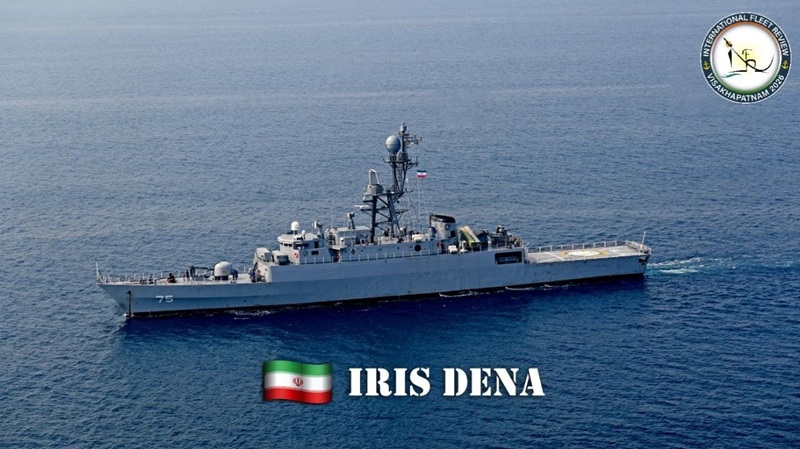
The reported U.S. torpedo strike on the Iranian frigate IRIS Dena near Sri Lanka has sparked debate about security dynamics in the Indian Ocean and India’s role as a regional maritime leader.
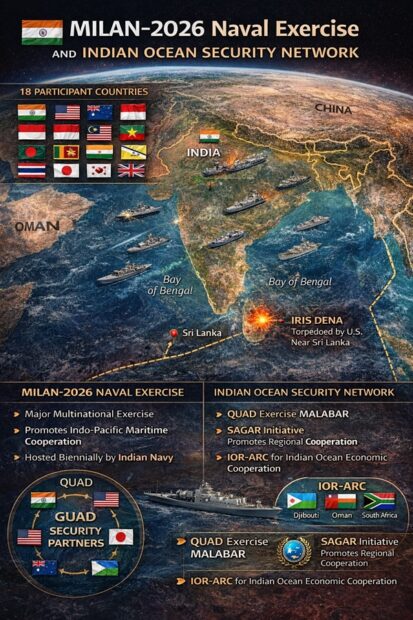
The incident occurred shortly after the Iranian warship had participated in MILAN-2026, India’s flagship multinational naval exercise. The event, hosted by the Indian Navy, brought together 18 foreign warships and dozens of maritime forces in a demonstration of regional cooperation.
Video just now released showing the sinking of the IRIS Dena off the coast of Sri Lanka with an Mk. 48 torpedo. pic.twitter.com/oaZ2kGEwfC
— OSINTdefender (@sentdefender) March 4, 2026
For New Delhi, the sinking of a vessel that had recently been a guest of the Indian Navy raises difficult strategic and diplomatic questions.
From Naval Exercise to Battlefield
The Iranian frigate had just completed participation in MILAN-2026, a major naval exercise designed to promote cooperation among Indo-Pacific navies.
The exercise aims to strengthen maritime security partnerships and reinforce India’s role as a coordinator of regional naval collaboration.
However, the destruction of a participating vessel soon after it departed the exercise has changed the narrative.
Instead of highlighting cooperation, the event risks drawing attention to how quickly the Indian Ocean can become entangled in wider geopolitical conflicts.
India’s Maritime Neighborhood in the Spotlight
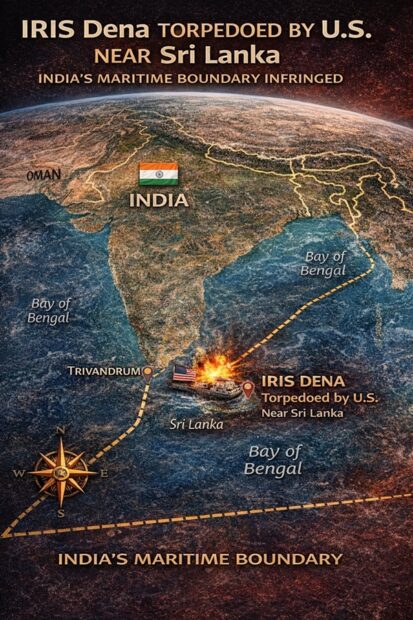
The strike reportedly occurred near Sri Lanka, south of India’s maritime boundary.
This region is strategically important for India because it sits along major sea lanes linking the Middle East, South Asia, and Southeast Asia.
New Delhi has long tried to maintain stability in these waters, viewing the area as part of its immediate maritime neighborhood.
The incident therefore raises uncomfortable questions about whether external powers can conduct military operations in the region without coordination with India.
Diplomatic Sensitivities of Naval Hospitality
Naval diplomacy operates according to a number of informal traditions.
One of these norms is the concept of naval hospitality—when a country hosts foreign warships for exercises or port visits, those vessels are treated as guests.
Attacking a ship shortly after it leaves such an event can be seen by some observers as diplomatically sensitive.
While the United States may consider the strike a legitimate wartime action, others argue that it risks sending a message that participation in multinational exercises does not necessarily shield visiting ships from conflict elsewhere.
Implications for India’s MAHASAGAR Vision
India has promoted the concept of MAHASAGAR (Mutual and Holistic Advancement for Security and Growth Across Regions) as a framework for regional maritime cooperation.
The initiative seeks to position India as a preferred security partner in the Indian Ocean.
Central to that vision is the idea that India can:
-
Convene regional navies
-
Promote maritime stability
-
Provide security leadership in the Indian Ocean
Events like the torpedo strike could complicate that narrative by showing that major powers can still shape the region’s security dynamics independently.
The Indian Ocean and the Middle East Conflict
Another concern is the geographical spillover of the broader U.S.–Iran conflict.
India has traditionally tried to keep the Indian Ocean insulated from Middle Eastern conflicts.
However, if naval engagements connected to that conflict begin occurring near South Asian waters, the region could become an extension of a wider geopolitical confrontation.
Such developments could increase risks for:
-
Commercial shipping routes
-
Energy supply lines
-
Regional maritime security cooperation
Hard Power vs Soft Power
The episode highlights the contrast between military power and diplomatic influence in international relations.
India has spent years building its reputation through:
-
Naval diplomacy
-
Multilateral exercises
-
Regional cooperation initiatives
A single wartime strike by a major power can quickly overshadow those diplomatic efforts.
For some analysts, the incident illustrates how hard power actions can disrupt carefully cultivated soft-power strategies.
Strategic Questions for the Future
The sinking of the Iranian frigate has therefore opened a broader debate about the future of security in the Indian Ocean.
Key questions now being discussed include:
-
How much influence can India realistically exert in its maritime neighborhood?
-
Can multinational naval exercises guarantee diplomatic safety for participants?
-
Will great-power competition increasingly shape the security dynamics of the Indian Ocean?
As tensions between major powers continue to grow, the Indian Ocean may become a more contested strategic space.
For India, balancing diplomacy, regional leadership, and great-power rivalry could become one of the defining challenges of its maritime strategy in the years ahead.