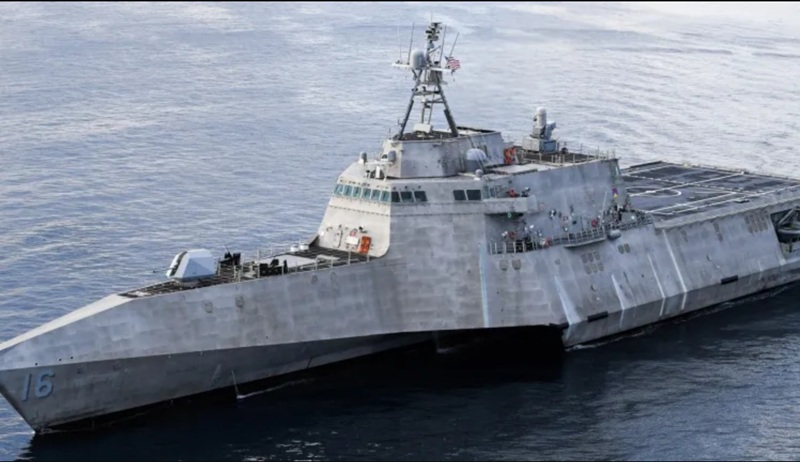
Satellite imagery and photographs showing two U.S. Navy Littoral Combat Ships (LCS) in Malaysia have drawn the attention of defence analysts, raising questions about whether the United States is adjusting its naval priorities between the Middle East and the Indo-Pacific.
The vessels identified as USS Tulsa (LCS-16) and USS Santa Barbara (LCS-32) were photographed at the North Butterworth Container Terminal in Penang on 15 March 2026. Their presence in Southeast Asia is notable because the ships had previously been assigned to mine-countermeasure duties in the Persian Gulf.
Two U.S. Navy minesweeping ships — USS Tulsa and USS Santa Barbara — were spotted in Malaysia, despite previously being deployed to Bahrain for Strait of Hormuz mine-clearing missions.
Their absence means 2 of the 3 U.S. mine countermeasure ships assigned to the Middle East are… pic.twitter.com/D7KO6pguhc
— Clash Report (@clashreport) March 16, 2026
Why Mine-Countermeasure Ships Matter in the Persian Gulf
For decades, the United States maintained dedicated mine-warfare vessels in Bahrain to ensure the Strait of Hormuz remained open to commercial shipping.
The waterway is one of the world’s most important maritime chokepoints, carrying a large share of global oil exports.
Naval mines are considered one of the most effective asymmetric weapons in the region because they can disrupt shipping without requiring large naval fleets.
Even a limited mining operation could halt tanker traffic and trigger major global energy disruptions.
Because of this threat, specialised mine-countermeasure ships are usually kept close to the Persian Gulf to ensure rapid response capability.
Transition From Avenger-Class Minesweepers to Littoral Combat Ships
Until recently, the U.S. Navy relied on Avenger-class minesweepers based in Bahrain.
In 2025, these older vessels were retired and their mission was transferred to Littoral Combat Ships equipped with modular mine-warfare packages.
The new system integrates several technologies, including:
- Unmanned mine-hunting vehicles
- Remote sensors and underwater drones
- Advanced mine detection and clearance equipment
The transition was designed to modernize mine-warfare operations while maintaining the ability to respond quickly to threats in strategic waterways.
Why Their Appearance in Malaysia Is Unusual
The presence of the two ships in Penang is unusual because they were originally deployed to replace the Gulf-based minesweepers.
Their absence from the Persian Gulf has therefore prompted questions about whether the United States has reduced or reorganized its mine-countermeasure capability in the region.
The timing is particularly noteworthy because tensions remain high around the Strait of Hormuz, where naval mines continue to be viewed as a serious threat to shipping.
As a result, analysts have interpreted the redeployment as a potential signal of changing naval priorities.
Strategic Value of Malaysia’s Maritime Location
Penang’s location near the Malacca Strait places the ships close to one of the world’s busiest maritime trade routes.
The Malacca Strait connects:
- The Indian Ocean
- The South China Sea
- The Western Pacific
From this position, naval forces can rapidly deploy toward multiple regions, including the South China Sea, the Indian Ocean, or the wider Indo-Pacific theatre.
For vessels designed to operate in confined coastal waters, Southeast Asian choke points are operationally well suited to the Littoral Combat Ship’s mission profile.
Possible Indo-Pacific Contingency Planning
Some analysts believe the redeployment may reflect broader U.S. planning focused increasingly on the Indo-Pacific.
In potential regional conflicts, naval mines could be used to block key waterways such as:
- The Taiwan Strait
- The Malacca Strait
- Strategic sea lanes in the South China Sea
Positioning mine-countermeasure ships closer to these areas could reduce response times if clearance operations became necessary.
However, balancing naval resources between the Middle East and the Indo-Pacific has become increasingly complex as both regions remain strategically important.
Technical and Operational Constraints
The Littoral Combat Ship mine-warfare mission package has faced delays and technical challenges during its development.
Because older minesweepers were retired before the new system reached full operational readiness, the U.S. Navy currently operates a relatively limited number of dedicated mine-countermeasure platforms.
This scarcity may require frequent rotation of specialised vessels between different regions.
Such operational realities could explain the ships’ presence in Southeast Asia without necessarily indicating a major change in strategy.
Strategic Signal or Routine Transit?
Despite widespread speculation, there has been no official confirmation that the vessels have been permanently reassigned.
Naval deployments often involve port visits for:
- Resupply
- Crew rotation
- Maintenance
- Training exercises
However, the specialised role of mine-countermeasure ships means that their movements are closely watched by defence analysts.
Even routine redeployments can carry strategic implications because these ships are essential for keeping critical maritime chokepoints open.
For now, the appearance of USS Tulsa and USS Santa Barbara in Malaysia remains a development whose full significance is still unclear.