A new analysis reveals that the first 16 days of the Iran conflict have triggered a severe military sustainability crisis for the US-Israel coalition. According to the RUSI-based assessment, modern warfare is no longer just about firepower—but about how long you can afford to keep fighting.
The data shows an alarming trend: massive spending, rapid depletion of critical munitions, and a fragile defense industrial base unable to keep up.
Key Findings at a Glance
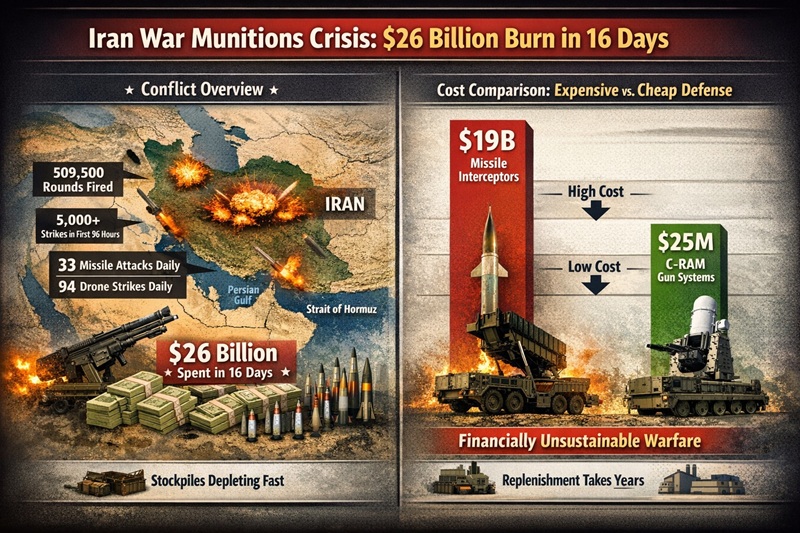
- 11,294 munitions fired in 16 days
- $26 billion spent in initial phase
- $50+ billion needed for replenishment
- Over 5,000 munitions used in first 96 hours
- Missile interceptors alone cost $19 billion
- Cheap gun-based defense cost only $25 million
Munitions Usage vs Cost (First 16 Days)
Munitions Used:        ███████████████████████ 11,294
Total Cost:            ███████████████████████ $26B
Interceptor Spending:  ███████████████████     $19B
Gun Ammunition Cost:   █                         $25M
Insight: The coalition is spending hundreds of times more on interceptors than cheaper alternatives.
The Cost-Exchange Crisis
One of the most dangerous trends identified is the cost-exchange imbalance:
- Expensive interceptor missiles (millions each)
- Used against cheap drones and basic missiles
- Result: financially unsustainable warfare model
This imbalance shocked even Ukrainian military observers, who described the defense approach as “firing thoughtlessly.”
Cheap vs Expensive Defense
Missile Interceptors:  █████████████████████ $19,000,000,000
C-RAM Gun Systems:     █                      $25,000,000
Rounds Fired:          █████████████████████ 509,500
Insight: Cheap systems handled massive volume at minimal cost—but are underutilized strategically.
Stockpile Depletion: “Empty Bins” Problem
The report warns that critical weapons are nearing exhaustion, including:
- Long-range interceptors (THAAD, Patriot)
- Precision strike missiles (Tomahawk, ATACMS)
- Advanced radar and sensor systems
Some projections suggest:
- US could run out of key missiles within 1 month
- Israel may exhaust Arrow interceptors within weeks
Industrial Bottleneck: Why Weapons Can’t Be Replaced Quickly
The real crisis isn’t just spending—it’s replenishment failure:
Key Constraints:
- Limited factories (e.g., Holston Army Ammunition Plant)
- Rare materials (gallium, tungsten, graphite)
- Chinese export controls on critical minerals
- Long production cycles (up to 5 years for some missiles)
Even replacing current usage could take years, not months.
War vs Replenishment Timeline
War Consumption:        █████████████ (16 days)
Missile Replenishment:  █████████████████████████████ (5+ years)
Insight: Modern wars are now limited by industrial endurance, not battlefield success.
The “Second-Theatre Risk”
A critical strategic warning:
Fighting Iran reduces US ability to defend elsewhere
This includes:
- Taiwan deterrence
- Ukraine support
- NATO readiness
Every missile fired in Iran weakens global military positioning.
Strategic Shift: “Command of the Reload”
The report introduces a new doctrine:
Command of the Reload
Victory depends on:
- Sustaining firepower over time
- Efficient defense spending
- Ability to replenish faster than the enemy
This replaces older doctrines like:
- “Command of the Commons”
- Traditional battlefield dominance
The Future: “Cheap Defeat” Strategy
The solution proposed:
Layered Defense Model
- Use cheap systems (guns, lasers) for drones
- Reserve expensive interceptors for high-value threats
- Build scalable, adaptive air defense networks
Without this shift, even the most powerful militaries risk economic exhaustion before military defeat.
Conclusion
The Iran war has exposed a brutal reality:
- Military superiority is no longer enough
- Industrial capacity is the real battlefield
- Cost efficiency determines survival
The US-Israel coalition may still dominate tactically—but strategically, the war is becoming a test of endurance they may struggle to win.