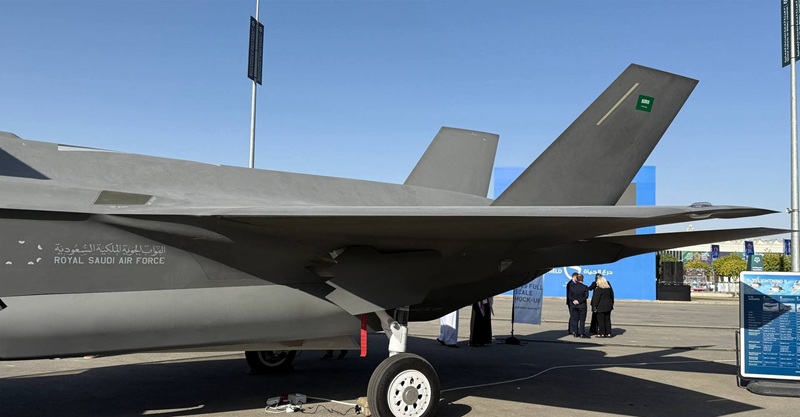
US President Donald Trump has again declared that Washington has agreed to sell Lockheed Martin F-35 Lightning II stealth fighters to Saudi Arabia, a move that could significantly reshape Gulf airpower and the broader Middle East security order.
Speaking at the Future Investment Priority Summit in Miami on March 28, 2026, Trump said:
“For the very first time, we agreed to sell Saudi Arabia perhaps the most capable fighter jet ever built, the F-35.”
This is the second time Trump has publicly presented the transfer as an approved decision, following similar remarks in November 2025 ahead of Mohammed bin Salman’s White House visit.
More Than a Fighter Jet Sale
The significance of the proposed transfer goes beyond a conventional arms sale.
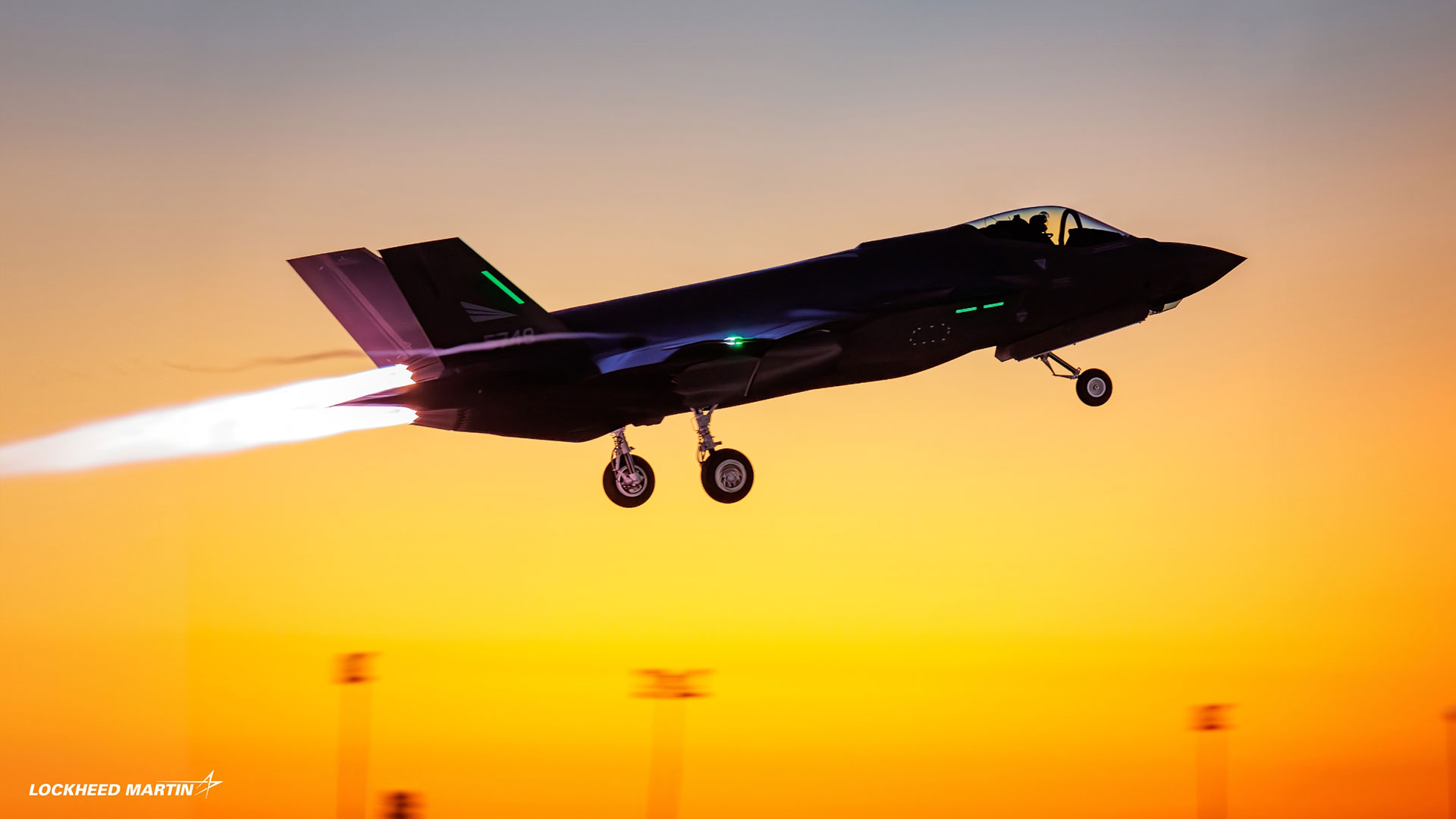
The Lockheed Martin F-35 Lightning II is not just an aircraft platform but a software-defined combat system, integrating stealth, sensor fusion, advanced avionics, and networked battlespace awareness.
Defense analysts say any state acquiring the F-35 also enters a long-term American ecosystem involving:
- training pipelines
- software updates
- diagnostics systems
- mission data support
- sustainment infrastructure
This makes the deal as much about strategic alignment as military hardware.
Formal Approval Process Still Pending
Despite Trump’s strong language, the legal and operational process remains incomplete.
As of March 30, 2026, no public Defense Security Cooperation Agency (DSCA) notification has been issued for a Saudi F-35 case.
Under US law, any major foreign military sale must undergo formal congressional review before execution.
This means the proposal currently represents a declared policy direction rather than a legally completed transfer package.
The likely congressional review period for Saudi Arabia would be 30 days, longer than the 15-day fast-track timeline available to NATO members and certain close allies.
This gap between political messaging and legal paperwork remains one of the central issues analysts are watching.
How the F-35 Would Change Saudi Airpower
If approved, the aircraft would significantly enhance Saudi Arabia’s military options.
The Lockheed Martin F-35 Lightning II is designed for high-threat environments, allowing penetration of defended airspace while remaining difficult to detect.
For Riyadh, this would strengthen capabilities in:
- suppression of enemy air defenses
- deep precision strike
- airborne sensor networking
- coalition targeting integration
Reports suggest a possible package of up to 48 F-35A aircraft, which would reposition Saudi Arabia from a fourth-generation fighter operator to a fifth-generation stealth air force.
Israel’s Military Edge Remains Key
One of the biggest structural constraints on the deal remains Israel’s qualitative military edge (QME).
US law requires Washington to ensure that Israel retains technological and operational superiority over potential regional rivals.
According to previous reporting cited in your draft, any Saudi F-35 package would likely be less advanced than Israel’s F-35I fleet, particularly in:
- electronic warfare systems
- weapons integration
- software permissions
This means that even if Saudi Arabia becomes the first Arab F-35 operator, the transfer would likely preserve a hierarchy in regional stealth capabilities.
China Factor and Strategic Lock-In
Another major factor is Washington’s concern over Saudi Arabia’s ties with China.
Because the F-35 relies heavily on secure data systems and software infrastructure, US officials remain highly sensitive to risks related to:
- data exposure
- network vulnerabilities
- technological access by rival powers
Analysts say the proposed transfer can also be read as a strategic move to bind Riyadh more tightly to the American defense-industrial base and reduce incentives to diversify toward Chinese high-end military systems.
What Comes Next
The next major indicator will be a formal DSCA notification to Congress.
Once submitted, analysts will be able to assess:
- number of aircraft
- delivery timelines
- weapons package
- sustainment requirements
- mission-system limitations
Until then, Trump’s remarks remain a politically significant declaration of intent, rather than a fully documented arms transfer.
If completed, the deal would make Saudi Arabia the first Arab operator of the F-35 and one of the few Middle Eastern states to field fifth-generation stealth aircraft.