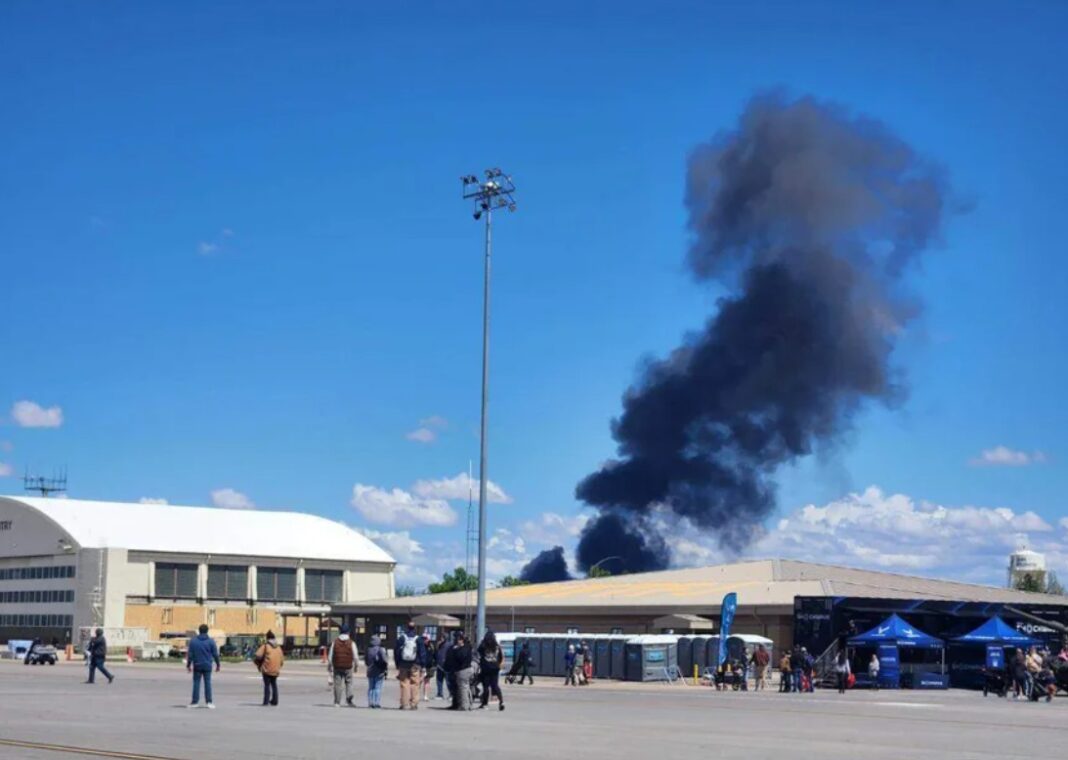
The mid-air collision of two EA-18G Growler jets during an Idaho air show has reignited debate over why the U.S. military continues to risk multimillion-dollar aircraft — and highly trained crews — in public flying demonstrations.
The incident occurred during the Gunfighter Skies Air Show at Mountain Home Air Force Base, where two Navy Growlers collided in midair while performing.
WATCH: Two US Navy F/A-18 fighter jets collided mid-air while performing at an air show in Idaho.
All pilots ejected and were seen descending safely under parachutes. pic.twitter.com/nExUeTY84q
— Clash Report (@clashreport) May 17, 2026
All four crew members successfully ejected.
Only one required hospital treatment for non-life-threatening injuries, according to a U.S. Navy statement.
The aircraft belonged to Electronic Attack Squadron 129, based in Whidbey Island and were operated by members of the Navy’s Growler Airshow Team.
The crash immediately raised familiar questions:
Why does the Pentagon continue flying expensive military jets at entertainment events?
How Much Did the Pentagon Lose?
The EA-18G Growler is among the U.S. military’s most sophisticated airborne electronic warfare platforms.
Built on the F/A-18 Super Hornet airframe, the Growler specializes in:
- Electronic attack
- Radar jamming
- Suppression of enemy air defenses
According to a 2021 Navy fact sheet, each Growler costs roughly $68 million, though replacement costs today would likely be significantly higher.
Production of the EA-18G has ended, making any losses more difficult and expensive to replace.
Operating costs are also substantial.
Aircraft in the F/A-18 family reportedly cost around $20,000 per flight hour to operate, according to Boeing figures.
Why the US Military Still Performs at Air Shows
Despite the risks, military officials and former pilots argue that air demonstrations serve purposes far beyond entertainment.
The Pentagon maintains a broad network of aviation demonstration teams.
The best known include Blue Angels and Thunderbirds which headline dozens of air shows each year.
But smaller teams such as the Growler Demonstration Team help cover smaller venues that major teams cannot attend.
According to John Venable, a former U.S. Air Force fighter pilot and senior fellow at the Mitchell Institute for Aerospace Studies, the military views these events as critical outreach opportunities.
“Both the Air Force and the Navy really value smaller venues that can’t get a major jet team, which is why teams like the EA-18G Growler Demonstration Team exist,” Venable said.
He said the goal is to connect military aviation with communities that otherwise may never interact directly with service members or advanced aircraft.
Do Military Air Shows Actually Deliver Value?
That question has long been controversial.
Military demonstration budgets are not fully public.
However, a 2012 cost-benefit study conducted by three Navy officers at the Naval Postgraduate School estimated the:
Blue Angels
budget at:
$98.6 million annually.
The study included:
- Personnel costs
- Aircraft maintenance
- Operations
- Travel
- Equipment support
Its conclusions were striking.
Researchers estimated the Blue Angels generated:
Less than $1 million in recruiting benefits
resulting in what they described as:
A negative 99% return on investment.
Even when broader:
“Goodwill”
effects — such as economic activity for host communities — were included,
the study still found a:
Negative 41% return.
The report concluded:
“The costs outweigh the benefits.”
Congress later ordered the Pentagon to conduct a new cost-benefit review in 2024 but no updated public figures have yet been released.
The Risks Are Real — And Sometimes Fatal
Air show flying inherently carries risk.
Aircraft often fly:
- Extremely close together
- At low altitude
- At very high speed
creating little margin for error.
Several fatal accidents have occurred over the decades.
Among the most notorious was the:
1982 Thunderbirds Diamond Crash
in Arizona, where four pilots died during a rehearsal flight.
In:
1994
a:
B-52 Stratofortress
crashed during practice in Washington state after investigators concluded the pilot attempted unsafe maneuvers.
More recently:
- A Blue Angels pilot died before a Tennessee show in 2016
- A U.S. Air Force major was killed during practice in 2018.
The Idaho collision therefore fits into a long history of aviation demonstration risk.
Why the Pentagon Says It’s Worth It
Supporters argue that purely financial calculations miss the broader purpose.
Military air shows regularly attract Tens or hundreds of thousands of spectators, offering direct exposure to military personnel and aviation capability.
Venable argued these events provide “Connective tissue” between the military and the public.
“The real purpose of a military air show is to give people a sense of the precision and professionalism of the military to people who wouldn’t otherwise have an opportunity to see it and, in a special few, spark the urge to serve,” he said.
Recruitment remains especially important as several U.S. military branches continue to struggle with personnel shortfalls.
Military leaders increasingly see public engagement as part of broader efforts to sustain recruiting pipelines and public support.
A Bigger Question for the Pentagon
The Idaho crash may ultimately revive a broader debate inside Washington:
Are military air shows still worth the cost and risk?
Critics argue the Pentagon should prioritize:
- Training readiness
- Operational funding
- Aircraft preservation
rather than exposing expensive systems to unnecessary danger.
Supporters counter that military legitimacy and recruiting cannot be measured purely in dollars.
For now, the Pentagon appears committed to maintaining air demonstrations despite the hazards.
But the collision of two EA-18G Growler jets has again highlighted the delicate balance between: