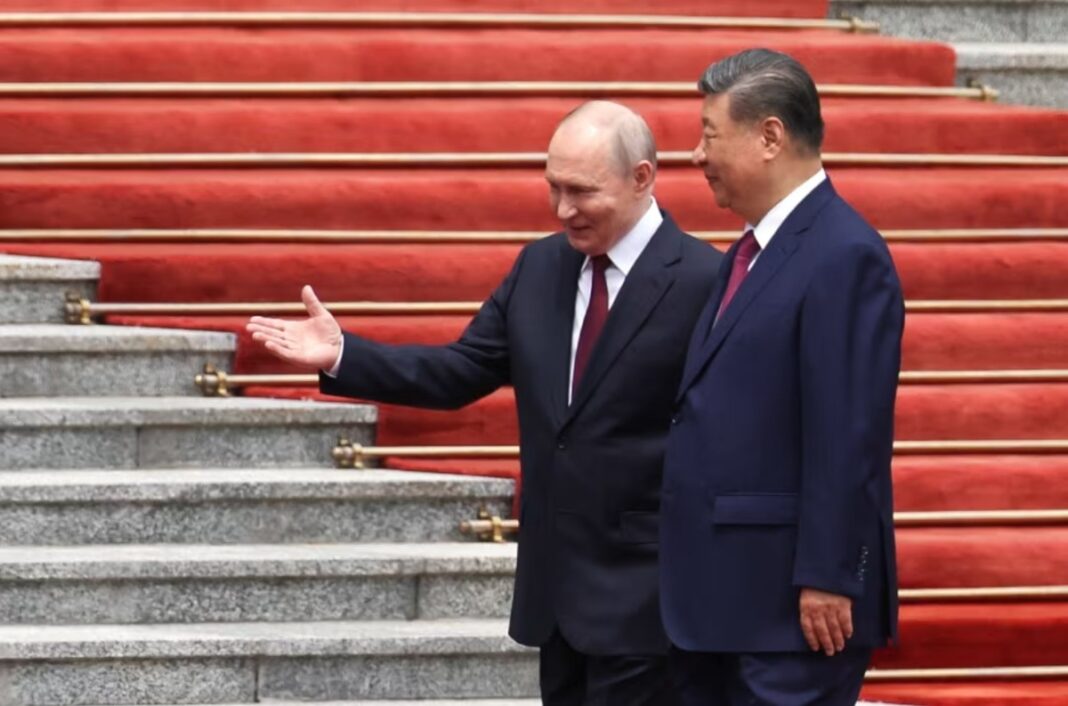
Chinese President Xi Jinping and Russian President Vladimir Putin hailed the progress of their countries’ “comprehensive strategic partnership” on Wednesday and jointly criticised U.S. President Donald Trump’s proposed Golden Dome missile defence shield, though they stopped short of announcing a breakthrough on a major gas pipeline deal.
The summit came days after Xi hosted Trump in Beijing, underscoring China’s balancing act as it seeks to manage fraught ties with Washington while deepening coordination with Moscow amid worsening geopolitical tensions.
President Xi Jinping and Russian President Vladimir Putin jointly attended the opening ceremony of the China-Russia Years of Education.
President Xi pointed out that over the years, China-Russia cooperation in education has continued to deepen and yielded notable outcomes,… pic.twitter.com/2gC6NGedD7
— Mao Ning 毛宁 (@SpoxCHN_MaoNing) May 20, 2026
Xi welcomed Putin at the Great Hall of the People with an honour guard and gun salute, mirroring the ceremonial reception Trump received during his state visit last week. The two leaders later held talks and were expected to take part in a traditional tea ceremony.
In a joint statement issued after the meeting, China and Russia said Trump’s proposed Golden Dome missile defence system posed risks to global strategic stability.
“The parties believe that the U.S. ‘Golden Dome’ project poses a clear threat to strategic stability,” the statement said, according to the Kremlin.
The statement argued that the plan undermined what Moscow and Beijing described as the longstanding principle of maintaining strategic balance through the interconnectedness of offensive and defensive nuclear systems.
The criticism reflects longstanding Russian and Chinese concerns that expanded U.S. missile defences could weaken their nuclear deterrents and upset the balance of power between major military rivals.
The two countries also criticised what they described as attempts by certain states to dominate global affairs in a “colonial-era spirit,” warning instead of a return to the “law of the jungle” in international relations.
Putin and Xi signed a joint declaration reaffirming their commitment to closer cooperation and a “multipolar world” — diplomatic language that has become routine during Putin’s visits to China but notably did not feature during Trump’s trip.
No Breakthrough on Gas Pipeline
Despite the warm rhetoric, the summit produced no publicly announced progress on the long-delayed Power of Siberia 2 natural gas pipeline, a project Moscow has long sought to secure as it redirects energy exports toward Asia following Western sanctions imposed over the Ukraine war.
The absence of a deal highlighted the unequal dynamics in the relationship, as Russia grows increasingly dependent on China economically while Beijing retains leverage in energy negotiations.
Since Russia launched its full-scale invasion of Ukraine in 2022, Moscow has become far more reliant on Chinese markets.
China is Russia’s largest trading partner, with bilateral trade reaching roughly $240 billion, according to Russian figures. China is also the largest buyer of Russian crude oil.
For China, however, Russia ranks behind the United States, Japan, South Korea and Vietnam among its top trading partners, according to the Kremlin.
Trump, Iran and Global Stability
The meeting came less than a week after Trump concluded a two-day visit to Beijing without major breakthroughs on trade disputes or Chinese assistance in ending the ongoing Iran conflict.
Trump had publicly praised Xi during the trip but left without securing tangible commitments from Beijing regarding tariffs or pressure on Tehran.
Addressing the conflict in the Middle East, Xi said an early end to fighting involving Iran would help reduce disruption to global energy supplies and supply chains.
“A comprehensive cessation of war brooks no delay, restarting hostilities is even less desirable, and persisting with negotiations is particularly important,” Xi said.
China, the world’s largest energy importer, remains heavily dependent on oil flows from the Gulf and has repeatedly warned against prolonged instability in the region.
A Relationship Forged by Shared Friction With the West
Xi and Putin have significantly strengthened cooperation across trade, diplomacy and security in recent years, driven largely by shared tensions with the United States and a common desire to reshape what they see as a Western-dominated global order.
Russia and China were once close allies after Mao Zedong founded the People’s Republic of China in 1949, but relations deteriorated during the Sino-Soviet split of the 1960s. Ties improved following the collapse of the Soviet Union in 1991 and deepened further after Russia’s confrontation with the West over Ukraine.
Opening the talks on Wednesday, Putin described bilateral ties as being at an “unprecedentedly high level” and among the “main stabilising factors” in international politics.
He also highlighted his personal rapport with Xi, using a Chinese idiom meaning “one day apart feels like three autumns,” a phrase expressing the sadness of separation.
The two leaders have met more than 40 times, making their relationship one of the closest among major world leaders.
Trump has repeatedly argued that previous U.S. administrations made a strategic mistake by allowing Russia and China to align more closely. Wednesday’s summit suggested that, despite differing interests, both sides continue to see value in presenting a united front against Washington’s global influence.