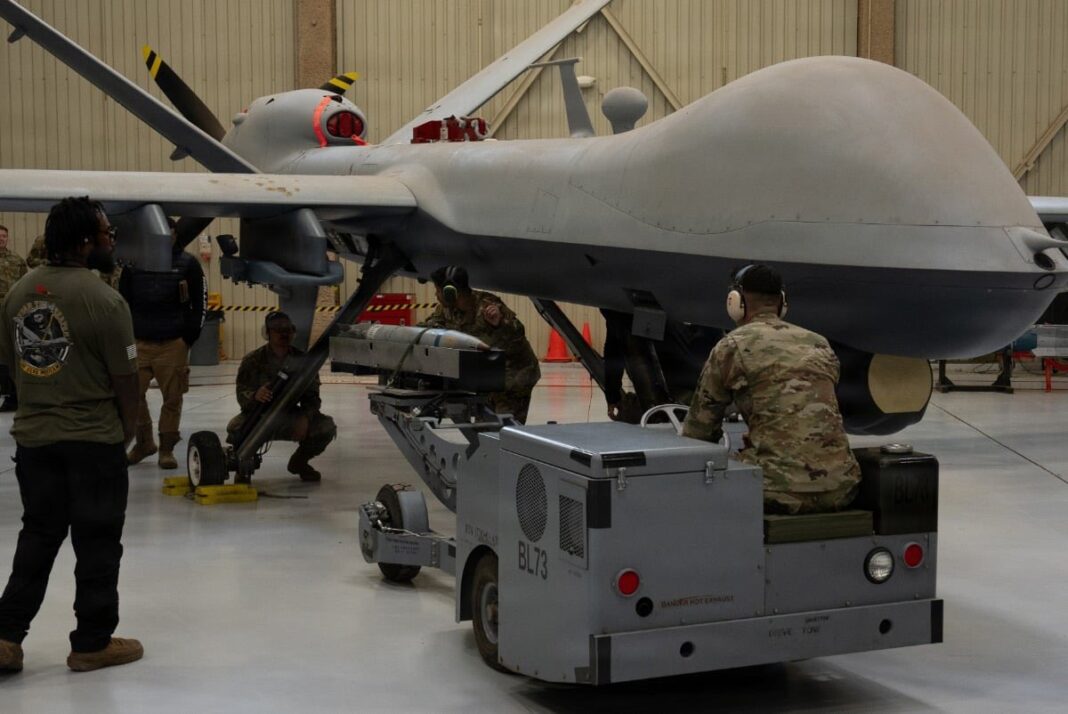
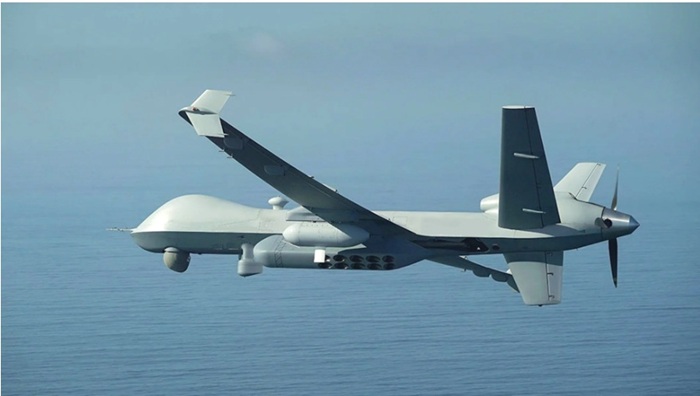
The U.S. Air Force Special Operations Command (AFSOC) has officially declared its MQ-9 Reaper fleet at Cannon Air Force Base operational with the GBU-39B Small Diameter Bomb (SDB), giving America’s premier strike drone a major new stand-off capability in increasingly contested battlefields.
U.S. Air Force Special Operations Command MQ-9 Reaper drones have reportedly been cleared to employ GBU-39/B Small Diameter Bomb glide munitions, significantly expanding precision-strike capability for long-endurance UAV operations. #USA #MQ9 #Reaper #GBU39 #SDB #DroneWar pic.twitter.com/qJb06bYPcJ
— Drone Wars (@Drone_Wars_) May 19, 2026
The upgrade allows the MQ-9 Reaper to launch precision-guided bombs from:
Up to 60 miles away
keeping the drone well outside the engagement range of many modern air-defense systems.
For military planners, the change is more significant than simply adding another weapon.
It represents:
A major evolution in how drones survive and strike in modern war.
After years of operating in permissive environments such as counterterrorism campaigns, the Reaper is increasingly being adapted for:
High-threat battlefields
where sophisticated air defenses make traditional drone operations far riskier.
What Is the GBU-39B Small Diameter Bomb?
The:
GBU-39 Small Diameter Bomb
is a:
250-pound precision glide bomb
designed to strike hardened targets with exceptional accuracy.
Unlike conventional free-fall bombs, the GBU-39B uses:
- GPS guidance
- Inertial navigation systems (INS)
to precisely navigate toward a target after release.
Small deployable wings extend the bomb’s glide path dramatically, allowing it to travel:
Roughly 60 miles
depending on release conditions.
The result:
Aircraft can strike without entering enemy air-defense zones.
That capability matters enormously in modern warfare.
Small Bomb, Big Punch
Despite weighing only:
250 pounds
the GBU-39B punches far above its size.
According to official Air Force data:
The munition can reportedly penetrate:
Up to one meter of steel-reinforced concrete
before detonation.
That makes it effective against:
✔ Hardened bunkers
✔ Command centers
✔ Weapons storage facilities
✔ Protected infrastructure
✔ Reinforced military positions
The bomb’s compact size also creates another advantage:
Higher weapon density
Many fighter aircraft can carry:
Four GBU-39Bs in the space of one 2,000-pound bomb
allowing greater precision strike flexibility.
The weapon has already been integrated across major U.S. platforms, including:
- F-15E Strike Eagle
- F-16 Fighting Falcon
- F-22 Raptor
- F-35 Lightning II
- B-1 Lancer
- B-2 Spirit
More than:
17,000 GBU-39s
have reportedly been used across U.S. and allied military campaigns.
Why This Changes the MQ-9 Reaper
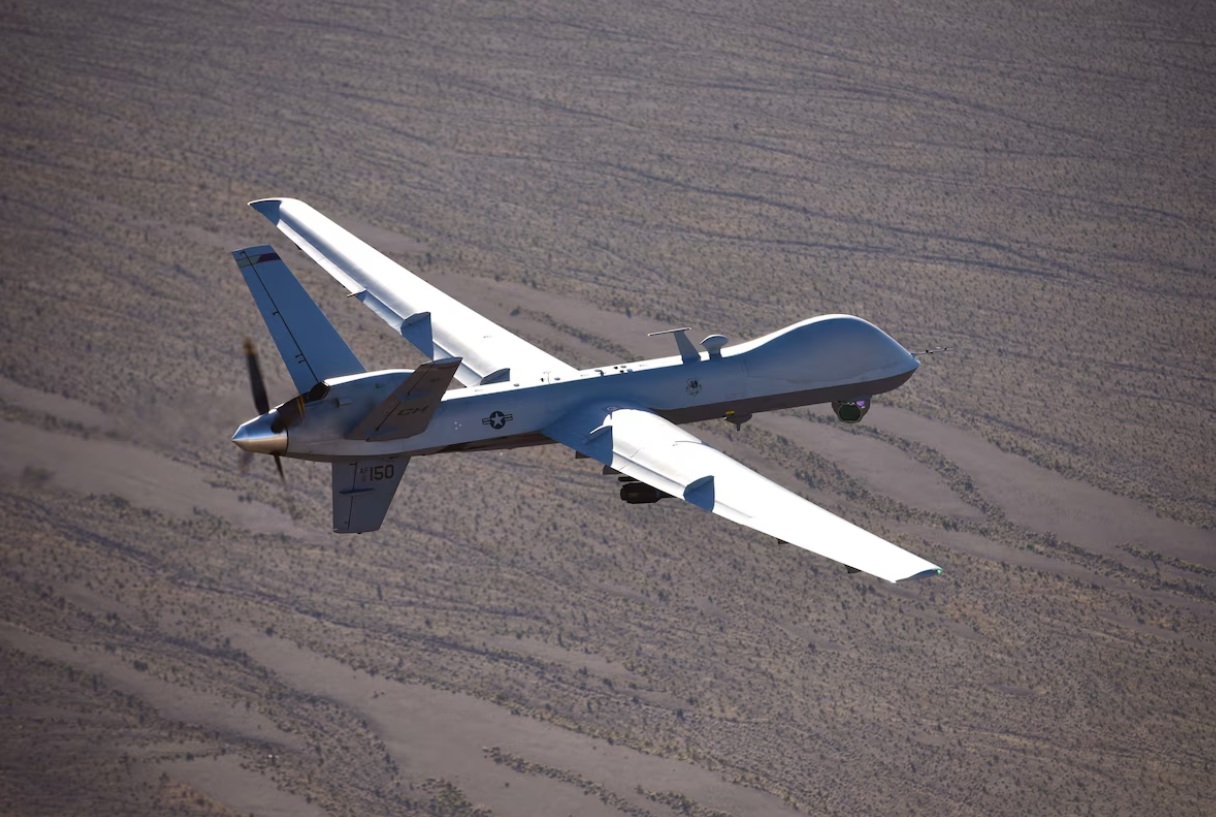
For years, the:
MQ-9 Reaper
served primarily as:
- An ISR platform (intelligence, surveillance, reconnaissance)
- A counterterrorism strike aircraft
Its most familiar weapons included:
Hellfire missiles
designed for close-range precision strikes.
The problem:
Modern air-defense environments have become far deadlier.
Adversaries increasingly deploy:
- Surface-to-air missiles
- Layered radar systems
- Electronic warfare
- Mobile air-defense networks
Meaning:
Traditional drone operations are increasingly vulnerable.
The GBU-39B changes the equation.
Instead of approaching dangerous airspace:
The MQ-9 can now strike from far outside the threat envelope.
In practical terms:
This turns the Reaper into:
A stand-off precision strike platform
rather than merely a close-support drone.
The BRU-78 System Solved a Major Engineering Problem
Integrating the bomb onto the MQ-9 was not simple.
The drone’s original hardpoints were not optimized for carrying the weapon efficiently.
To solve the issue, engineers developed:
The BRU-78 Dual Carriage System
manufactured by L3Harris
specifically for the MQ-9.
The rack allows:
Two GBU-39Bs per hardpoint
instead of just one.
That matters because:
The MQ-9 has a payload ceiling of roughly:
1,700 kilograms
Using older fighter-style racks would have consumed excessive payload space and reduced operational flexibility.
The BRU-78 offers:
More firepower without sacrificing sensors or endurance.
Why the Iran Conflict Changed Everything
The operational logic behind this upgrade becomes clearer when looking at recent combat losses.
According to reports citing U.S. officials:
More than 25 American MQ-9 drones were lost during operations linked to the 2026 Iran conflict
Some were reportedly:
- Shot down by Iranian air defenses
- Destroyed during airstrikes
- Lost in increasingly contested airspace.
This exposed a painful reality:
The old Reaper model was becoming vulnerable
in peer or near-peer conflicts.
A drone that can release weapons from:
60 miles away
dramatically improves survivability.
The logic is straightforward:
A drone outside enemy missile range is harder to kill.
AFSOC Wants Reapers to Stay in the Fight Longer
According to pilots at:
27th Special Operations Wing (SOW)
the new bomb improves mission endurance.
One MQ-9 pilot explained:
Low-yield precision weapons allow crews to:
✔ Stay on station longer
✔ Minimize collateral damage
✔ Support troops more effectively.
Meanwhile, squadron commander:
Lt. Col. Joshua Swann
described the GBU-39 as critical for:
Operating inside increasingly hostile environments
where adversaries deliberately layer:
- Radar
- Missiles
- Defensive obstacles
to deny access.
What This Means for Future Drone Warfare
The GBU-39B integration signals a much larger shift:
Drones are evolving from counterterrorism assets into peer-conflict strike systems.
The MQ-9 is no longer just:
A surveillance drone with missiles.
Increasingly:
It resembles:
A long-endurance precision strike aircraft
capable of surviving contested airspace through stand-off distance.
This trend reflects lessons from:
- Ukraine
- The Red Sea
- Iran
- Modern air-defense warfare
where survivability increasingly matters as much as firepower.
Conclusion: The Reaper Just Became Much More Dangerous
The MQ-9 Reaper has long been one of America’s most recognizable drones.
But the addition of the GBU-39B fundamentally changes what it can do.
Instead of entering dangerous airspace:
It can now strike precisely from safer distances.
For special operations forces:
That means:
More reach, more survivability, and more battlefield relevance
in a world where cheap drones, sophisticated missiles, and contested skies increasingly define warfare.
The Reaper era is not ending.
It is evolving.