

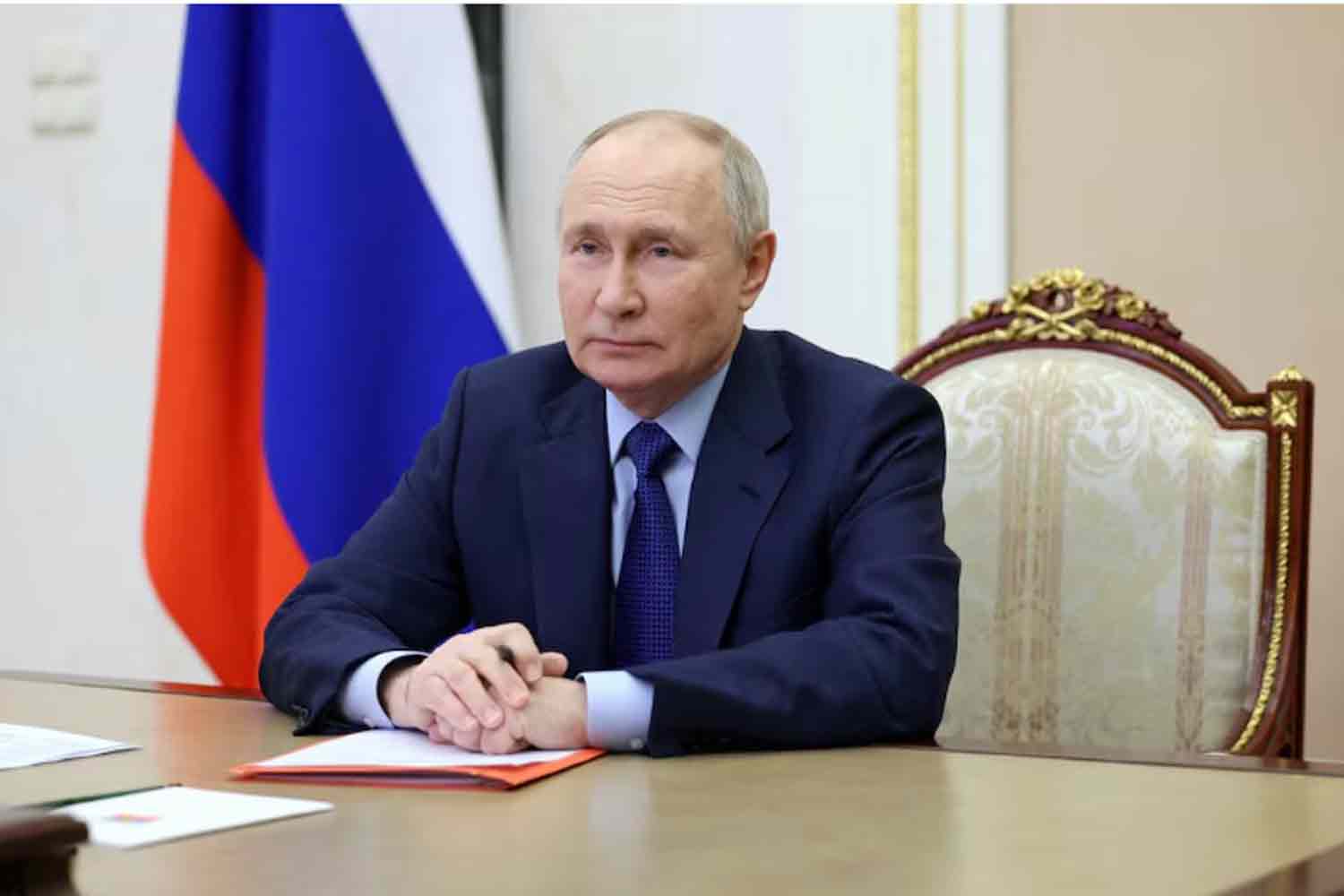
Russian President Vladimir Putin has reiterated Moscow’s commitment to maintaining balanced relations across South Asia, saying Russia will not interfere in the “delicate” dynamics between India and China while expressing confidence that Prime Minister Narendra Modi and Chinese President Xi Jinping can resolve long-standing border tensions through dialogue.
Speaking during a lengthy interaction with international news agencies on the sidelines of the St. Petersburg International Economic Forum, Putin addressed questions on India-China-Pakistan relations, Russia’s strategic partnership with New Delhi, defence cooperation, and broader geopolitical shifts shaping Eurasia.
His remarks offer an important glimpse into how Moscow views the evolving balance of power in Asia at a time of intensifying geopolitical competition involving the United States, China, India, and Russia.
Putin Rejects Claims Pakistan Is Fully Controlled by China
Addressing comments regarding Pakistan’s relationship with Beijing, Putin pushed back against suggestions that Islamabad is entirely dependent on or controlled by China.
The Russian president described Pakistan as a major state with diverse international relationships, arguing that while cooperation with China remains strategically important for Islamabad, Pakistan maintains multifaceted ties with several countries.
Putin’s comments reflect Russia’s broader diplomatic approach toward South Asia — one aimed at avoiding overt alignment with any single regional rivalry while maintaining constructive engagement with India, China, and Pakistan simultaneously.
His remarks also underscore Moscow’s recognition of Pakistan’s growing geopolitical significance amid shifting regional alignments involving China’s Belt and Road Initiative, Gulf partnerships, and evolving security dynamics in Afghanistan.
Russia Will Not Interfere in India-China Relations
Putin made clear that Moscow does not intend to involve itself directly in the complex bilateral relationship between India and China.
Calling the relationship “delicate” and “multi-faceted,” he said external interference would not be constructive and suggested both Modi and Xi remain committed to addressing disputes through political engagement rather than confrontation.
The statement carries strategic importance given continuing tensions along the disputed Himalayan frontier.
Rather than positioning Russia as a mediator, Putin appeared to signal confidence that diplomatic mechanisms between New Delhi and Beijing remain functional despite recurring military stand-offs.
For Moscow, maintaining stable relations between Asia’s two largest powers aligns with broader Russian interests in preserving Eurasian stability while strengthening platforms such as BRICS and the Shanghai Cooperation Organisation.
Putin Praises Modi and Calls India a ‘Reliable Partner’
Putin strongly reaffirmed Russia’s long-standing strategic relationship with India, describing bilateral ties as a “special privileged strategic partnership” built over decades.
Tracing relations back to diplomatic ties established in 1947, Putin praised India’s economic trajectory and credited Prime Minister Narendra Modi’s leadership for helping transform India into one of the world’s fastest-growing major economies.
He highlighted expanding economic cooperation, saying Moscow and New Delhi aim to raise bilateral trade to US$100 billion while broadening collaboration across sectors including energy, nuclear power, pharmaceuticals, and investment.
Putin also dismissed concerns that India’s expanding ties with Western countries have weakened Russia-India cooperation.
Instead, he characterised India as a dependable strategic partner capable of maintaining balanced relations with multiple global powers simultaneously.
Russia Offers Expanded Defence Cooperation With India
Defence cooperation featured prominently in Putin’s remarks.
The Russian president highlighted existing joint military programmes, particularly the BrahMos missile project, while indicating Moscow remains willing to deepen collaboration in advanced military technologies.
Putin revealed that Russia had previously proposed cooperation with India on fifth-generation fighter aircraft technology and reiterated Moscow’s readiness to continue sharing expertise in advanced aerospace and defence systems.
He also emphasised the importance of integrated air-defence architecture, arguing that successful missile defence depends not only on individual systems but on real-time information networks capable of coordinating multiple platforms simultaneously.
This point aligns closely with India’s expanding focus on layered air-defence systems, including the S-400 Triumf network and indigenous missile-defence projects.
Putin Criticises Pressure on India Over Russia Ties
In one of his more politically pointed remarks, Putin suggested external pressure on India over defence and economic cooperation with Russia is counterproductive.
Without naming Washington directly, he referenced attempts to influence Indian decision-making regarding relations with Moscow and argued such pressure harms international diplomacy rather than strengthening partnerships.
The comments come amid continued Western efforts to reduce Russia’s defence footprint globally following the Ukraine conflict.
However, India has largely maintained its policy of strategic autonomy, continuing defence cooperation with Russia while simultaneously expanding ties with the United States, Europe, and Indo-Pacific partners.
What Putin’s Comments Mean for South Asia
Putin’s remarks ultimately reflect Russia’s attempt to preserve strategic equilibrium across South Asia rather than deepen regional fault lines.
By backing India-China dialogue, rejecting simplistic narratives about Pakistan’s relationship with China, and reaffirming strong ties with India, Moscow appears intent on maintaining relevance across competing regional power centres.
For India, the message reinforces Russia’s continued political and defence support despite shifting geopolitical alignments.
For China, Putin’s comments signal Moscow’s preference for stability rather than escalation along the disputed border.
For Pakistan, the remarks suggest Russia increasingly recognises Islamabad as an independent geopolitical actor rather than merely an extension of Chinese influence.
At a broader level, Putin’s intervention reflects a changing global order in which regional powers are increasingly pursuing flexible, multi-aligned partnerships rather than rigid bloc politics.
As geopolitical competition intensifies across Eurasia and the Indo-Pacific, Russia’s balancing act between India, China, and Pakistan may become an increasingly important factor shaping regional stability.


