Modern battlefield survival has entered a new and unforgiving era.
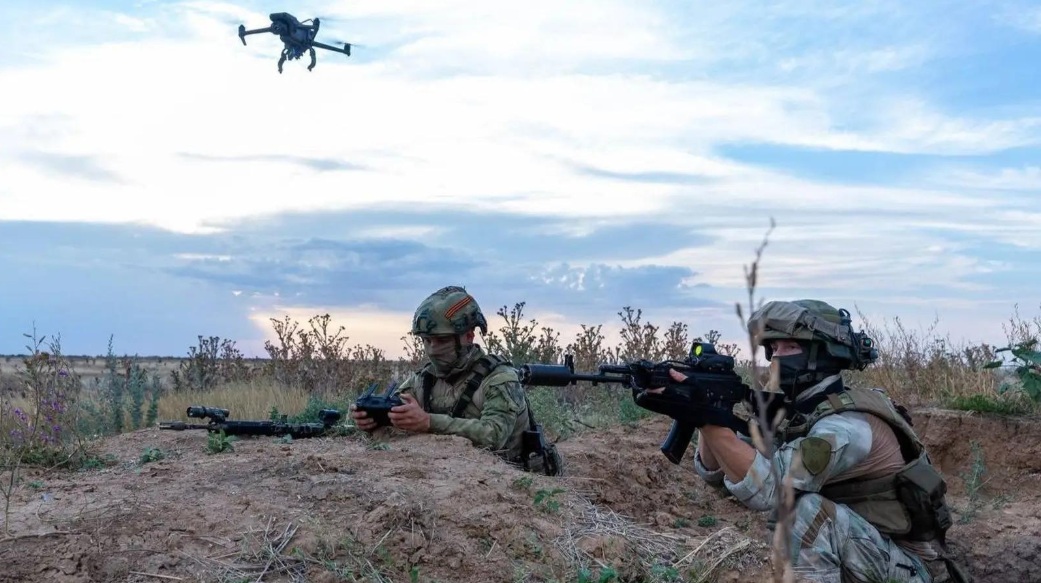
As first-person-view (FPV) drones increasingly dominate the front lines in the Russia-Ukraine war, soldiers are now being taught a harsh new reality: survival often comes down to reducing the odds, not eliminating the threat.
Military trainers no longer speak in terms of guaranteed safety.
Instead, troops are taught how to try to survive.

The first rule is brutally simple:
do not stay together.
A single FPV strike can wipe out an entire group.
If soldiers scatter, the drone operator is forced to choose a single target.
After that, survival often becomes a matter of speed, terrain, and chance.
The New Rules of Battlefield Survival
Troops are increasingly trained in basic anti-drone survival tactics.
These include:
- dispersing immediately
- dropping low to reduce visibility
- running toward hard cover
- staying in shadows
- using walls, trenches, and vegetation
- minimizing heat signature
If no cover is available, soldiers are taught to make themselves as difficult to detect as possible.
If cover exists, speed becomes critical.
Walls, tree lines, ruined buildings, and even dense brush can reduce both visual and thermal detection.

Drones Now Cause Around 80% of Battlefield Losses
The scale of the drone threat is now reshaping modern warfare.
According to current battlefield assessments, drones are now responsible for around 80% of battlefield losses in some sectors.
This includes:
- FPV attack drones
- reconnaissance drones
- loitering munitions
- thermal surveillance UAVs
The Ukraine war has become one of the clearest examples of how low-cost drones are transforming combat doctrine.
Thermal Cameras Remove the Night Advantage
One of the most significant changes is the spread of thermal imaging systems.
Unlike earlier battlefield assumptions, darkness no longer guarantees concealment.
Thermal sensors now allow drone operators to detect personnel:
- during the day
- at night
- in forests
- in open fields
- even on snow-covered terrain
This makes movement across exposed ground increasingly dangerous.
Traditional camouflage is often no longer enough.
Drone Warfare Is Scaling Rapidly
The scale of drone operations continues to grow rapidly on both sides.
Reports indicate that in March alone, Ukrainian drones struck 151,207 targets, representing a 50% increase from February.
This highlights the extraordinary pace of battlefield drone deployment.
Meanwhile, Russia is dramatically expanding its drone warfare capacity.
Current plans reportedly aim to train up to one million drone operators by 2030.
This reflects a long-term strategic shift in force structure.
FPV Operators Have Become Prime Targets
The battlefield logic is also evolving.
Russian forces are reportedly shifting priority away from traditional artillery targeting and increasingly focusing on hunting FPV drone operators themselves.
This marks an important doctrinal shift.
Neutralizing the operator can be more effective than intercepting individual drones.
At the same time, both sides are learning rapidly.
Ukraine’s large-scale use of FPV systems is also effectively providing Russia with valuable lessons in:
- drone interception
- counter-drone tactics
- electronic warfare adaptation
- thermal detection techniques
These lessons may shape future conflicts well beyond Ukraine.
People Still Decide Outcomes
Despite the scale of drone warfare, human decisions remain central.
Technology may now dominate battlefield attrition.
But outcomes still depend on:
- training
- adaptation
- decision speed
- operator skill
- battlefield discipline
The war in Ukraine is increasingly proving that while drones are changing how wars are fought, people still determine how they are won.