U.S. President Donald Trump surprised NATO allies on Friday by announcing plans to deploy an additional 5,000 U.S. troops to Poland, just hours before a key alliance meeting in Sweden, where divisions over the Iran war and the future of NATO are expected to dominate discussions.
🚨 JUST IN: Trump says he’ll be deploying 5,000 troops to POLAND, shortly after WITHDRAWING 5,000 from Germany
If our troops have to be in Europe, Poland is the place for them!
Poland’s President is MUCH friendlier to America than Germany’s chancellor. pic.twitter.com/pEpJMUM7f6
— Nick Sortor (@nicksortor) May 21, 2026
Trump announced the deployment in a post on Truth Social linking the decision directly to his relationship with Poland’s newly elected nationalist president Karol Nawrocki.
“Based on the successful Election of the now President of Poland, Karol Nawrocki, who I was proud to Endorse, and our relationship with him, I am pleased to announce that the United States will be sending an additional 5,000 Troops to Poland,” Trump wrote.
The move marks a striking shift in tone after weeks of sharp criticism from Trump toward NATO allies over what he described as insufficient support for the U.S.-Israeli military campaign against Iran.
Trump had previously questioned whether Washington should continue honoring NATO’s collective defense obligations and repeatedly accused European allies of relying excessively on American military power.
At times, he suggested the United States could reconsider its role in NATO altogether.
Poland Emerges as a Key US Security Partner
The troop announcement further strengthens Poland as one of Washington’s closest military partners in Europe.
Poland has steadily increased defense spending, expanded military modernization and positioned itself as a frontline NATO state amid growing concerns over Russia following Moscow’s war in Ukraine.
Warsaw already hosts thousands of American troops, missile defense systems and rotating NATO forces.
The additional deployment could further cement Poland’s role as a central logistics and deterrence hub on NATO’s eastern flank.
Trump’s decision also contrasts sharply with his criticism of other alliance members, particularly countries that declined to provide support infrastructure for military operations linked to the Iran conflict.
Rubio Criticizes NATO Allies Ahead of Sweden Meeting
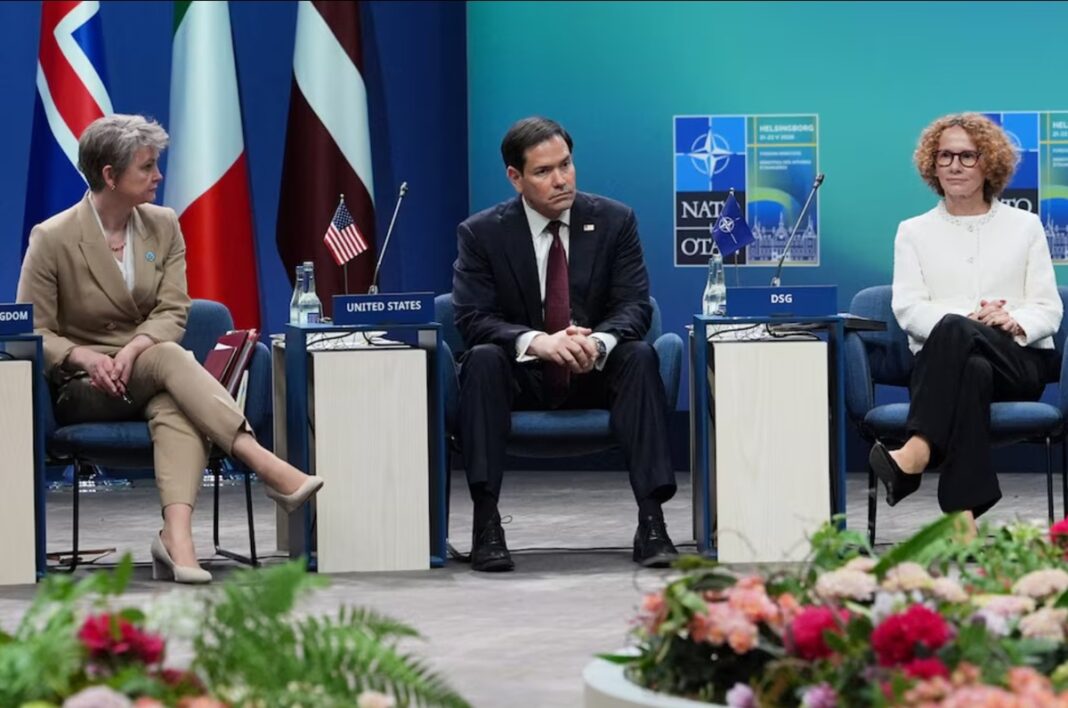
Before departing for the NATO foreign ministers’ gathering in Helsingborg. Secretary of State Marco Rubio said Trump was “Very disappointed” with allies that restricted U.S. military access during the Iran war.
Rubio singled out Spain for refusing to allow the United States to use bases on its territory.
“You have countries like Spain denying U.S. the use of these bases — well then why are you in NATO? That’s a very fair question,” Rubio told reporters.
He added that several other NATO members had been helpful, but said alliance burden-sharing and military cooperation would remain central topics of discussion.
NATO officials, however, have stressed that the alliance itself was never formally asked to participate in the Iran war.
Still, several member states reportedly honored longstanding agreements allowing American forces access to airspace and military infrastructure.
NATO Meeting Overshadowed by Iran War
The gathering in Sweden comes at a difficult moment for NATO.
European governments remain deeply divided over Washington’s approach toward Iran and growing concerns about escalation in the Strait of Hormuz where disruptions to maritime traffic have raised fears over global energy supplies.
European ministers are expected to emphasize a willingness to support Freedom of navigation operations in the Strait of Hormuz once conditions allow.
Several European governments are also expected to push for Greater European responsibility for regional security partly in response to repeated U.S. demands for allies to do more.
The issue has become increasingly urgent as Washington shifts military attention between:
- Europe
- The Middle East
- The Indo-Pacific.
Trump’s NATO Approach Continues to Alarm Europe
European officials remain uneasy over Trump’s broader posture toward NATO.
Concerns intensified earlier this year following Trump’s controversial remarks about Greenland and renewed questions about America’s long-term commitment to alliance obligations.
The uncertainty has pushed several European governments to accelerate defense spending and discuss greater strategic autonomy.
At the same time, NATO leaders have sought to reassure allies that any future U.S. force reductions in Europe would happen gradually.
NATO Supreme Allied Commander Alexus Grynkewich said this week that any drawdowns would occur over several years to allow European states time to build replacement capabilities.
Why the Poland Deployment Matters
Trump’s decision to send additional troops to Poland carries both Military and political significance. Militarily it reinforces NATO’s eastern flank at a time of heightened regional instability.
Politically,it sends a clear signal about Which allies Washington currently values most — those willing to invest heavily in defense and align closely with U.S. security priorities.
For Poland, the deployment further strengthens its role as one of NATO’s most strategically important frontline states.
For Europe more broadly, it highlights an increasingly visible divide inside the alliance over burden-sharing, military priorities and how far NATO should support U.S.-led operations beyond Europe.
As NATO ministers gather in Sweden, those tensions are expected to remain at the center of alliance politics.