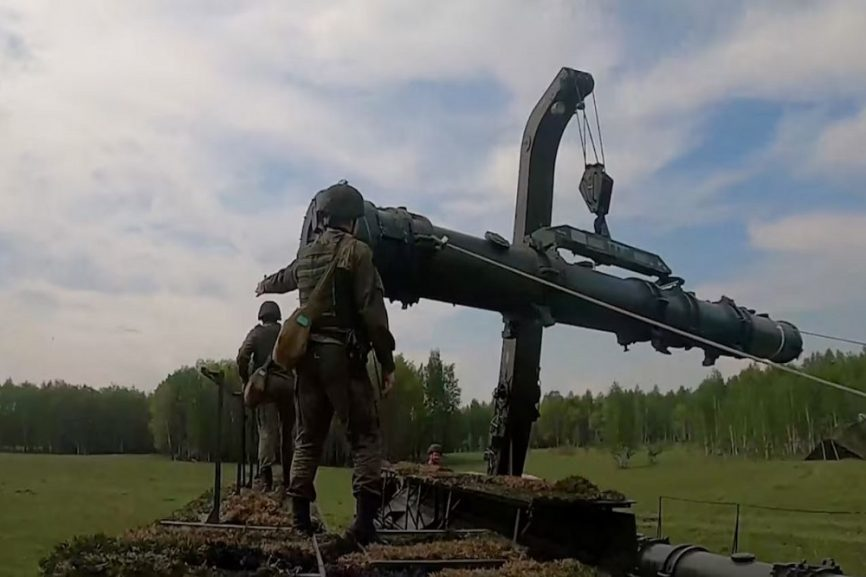
Russia on Wednesday released dramatic footage showing what it said were troops delivering nuclear warheads to mobile Iskander-M missile systems, loading them onto launchers and deploying them to firing positions as part of a major three-day nuclear readiness exercise across Russia and Belarus.
The drills come at a moment of heightened geopolitical tension as Moscow increasingly frames the war in Ukraine as an existential confrontation with the West and warns of growing risks of a direct clash with NATO.
Russia’s Defense Ministry published footage of large-scale nuclear exercises. The drills involved bringing units to maximum combat readiness for nuclear weapons deployment and loading nuclear warheads onto Iskander missile systems for launch preparation. https://t.co/wjqsVlHQxo pic.twitter.com/xJoig1GMvq
— Open Source Intel (@Osint613) May 20, 2026
According to the Russian Ministry of Defence, the exercise involves forces practicing:
“The highest levels of combat readiness for the use of nuclear weapons.”
The scale of the drills is notable:
64,000 military personnel
200+ missile launchers
140 aircraft
73 surface warships
13 submarines
participating in one of Russia’s largest recent nuclear preparedness exercises. The maneuvers reportedly include rehearsing tactical nuclear launch procedures, including systems stationed in Belarus.
The footage, released through Russian state media, showed convoys of nuclear forces moving through forested terrain, camouflaging vehicles, and erecting launch tubes into firing position — imagery clearly intended to signal operational readiness.
What Russia’s Nuclear Exercise Actually Involves
At the center of the exercise is:
Iskander-M
Russia’s mobile tactical missile system known by NATO as:
SS-26 Stone
The system replaced the Soviet-era:
Scud missile
and is considered one of Russia’s most important theater-level strike systems.
The missile reportedly has a range of:
Up to 500 kilometers (300 miles)
and can carry:
✔ Conventional warheads
✔ Nuclear warheads
depending on mission requirements.
Its mobility gives Russia a significant battlefield advantage.
Unlike fixed missile sites:
Iskander launchers can relocate rapidly, making them harder to target or destroy.
The Russian Defense Ministry said the drills include transporting nuclear payloads to mobile launch units and rehearsing launch protocols under combat conditions.
Why Belarus Matters in the Exercise
A particularly important aspect of the drills involves:
Belarus
where Russia has stationed tactical nuclear systems in recent years.
The exercises reportedly include:
Simulated launch procedures for tactical nuclear weapons based in Belarus
This matters strategically because:
Belarus sits directly on NATO’s eastern frontier.
Missiles stationed there place:
- Ukraine
- Poland
- Lithuania
- Latvia
- Other NATO members
within potential strike range.
Russia previously transferred:
Iskander-M
systems to Belarus as part of expanding military integration between the two countries.
For NATO planners:
The move reinforces concerns over:
Russia’s growing forward nuclear posture in Eastern Europe.
A Message to NATO?
The timing of the exercise appears unlikely to be accidental.
It comes as:
Russia-NATO tensions continue rising
over military support for Ukraine.
On Tuesday:
Russian Deputy Foreign Minister:
Sergei Ryabkov
warned that:
The risk of direct confrontation between Russia and NATO is increasing
because of what Moscow sees as growing European rhetoric regarding:
A potential high-intensity war with Russia
Ryabkov warned:
The consequences of such a clash could be catastrophic.
The remarks fit a broader Russian pattern:
Moscow increasingly uses:
Nuclear signaling
to discourage deeper Western military involvement in Ukraine.
Since the beginning of the war,
Russian President:
Vladimir Putin
has repeatedly reminded the West of Russia’s nuclear capabilities.
The message is straightforward:
Do not push Russia too far.
Russia’s Iskander Missile Has Already Been Used in Ukraine
Russia has repeatedly deployed:
Iskander-M
during the war in Ukraine.
According to Russian state media and military analysts:
The missile has been used against:
- Military facilities
- Logistics hubs
- Air defense systems
- Infrastructure targets
inside Ukraine.
Its ability to strike quickly and precisely while carrying different warhead types makes it one of Moscow’s most flexible battlefield assets.
Russia has also stationed the system in:
Kaliningrad
a heavily militarized Russian enclave bordering NATO territory.
From Kaliningrad:
Iskander missiles can theoretically threaten portions of:
- Poland
- Germany
- The Baltic region
adding another layer of pressure to Europe’s security calculations.
Western Analysts Say the Exercise Is Also About Perception
Not everyone sees the exercise purely through a military lens.
The:
Institute for the Study of War
(ISW) argued the drills are also designed to:
Shape NATO decision-making
and amplify long-running Russian narratives aimed at limiting Western support for Kyiv.
The think tank suggested:
The exercise may help:
✔ Reinforce deterrence messaging
✔ Increase political pressure in Europe
✔ Distract from battlefield difficulties in Ukraine
ISW also argued Russia may be seeking to:
Mask operational challenges
in its ongoing campaign.
However:
Moscow insists its military campaign remains on track and says operations in eastern Ukraine continue advancing.
Russia maintains that its objective of securing:
The Donbas region
remains unchanged.
Why Tactical Nuclear Drills Matter More Today
Unlike strategic nuclear forces aimed at intercontinental deterrence,
Tactical nuclear weapons
are designed for:
Regional battlefield scenarios
Their lower yield and shorter range make them relevant to:
- Military escalation
- Theater warfare
- Regional deterrence
This creates anxiety among security analysts because:
Tactical systems lower the threshold of nuclear signaling
even if actual nuclear use remains unlikely.
Exercises involving:
- Warhead transfers
- Launch preparation
- Mobile deployment
send strong political signals.
Especially during wartime.
Conclusion: Russia’s Nuclear Messaging Is Becoming More Visible
Russia’s latest Iskander-M exercise represents more than a military training event.
It is also:
A geopolitical message
aimed simultaneously at:
- NATO
- Ukraine
- European governments
- Washington
The scale of the drills, the visibility of nuclear warhead transport footage, and the inclusion of Belarus all reinforce one reality:
Moscow wants the West to remember Russia’s nuclear capabilities remain central to its deterrence strategy.
Whether these exercises represent genuine escalation preparation or strategic signaling,
they highlight a growing truth: