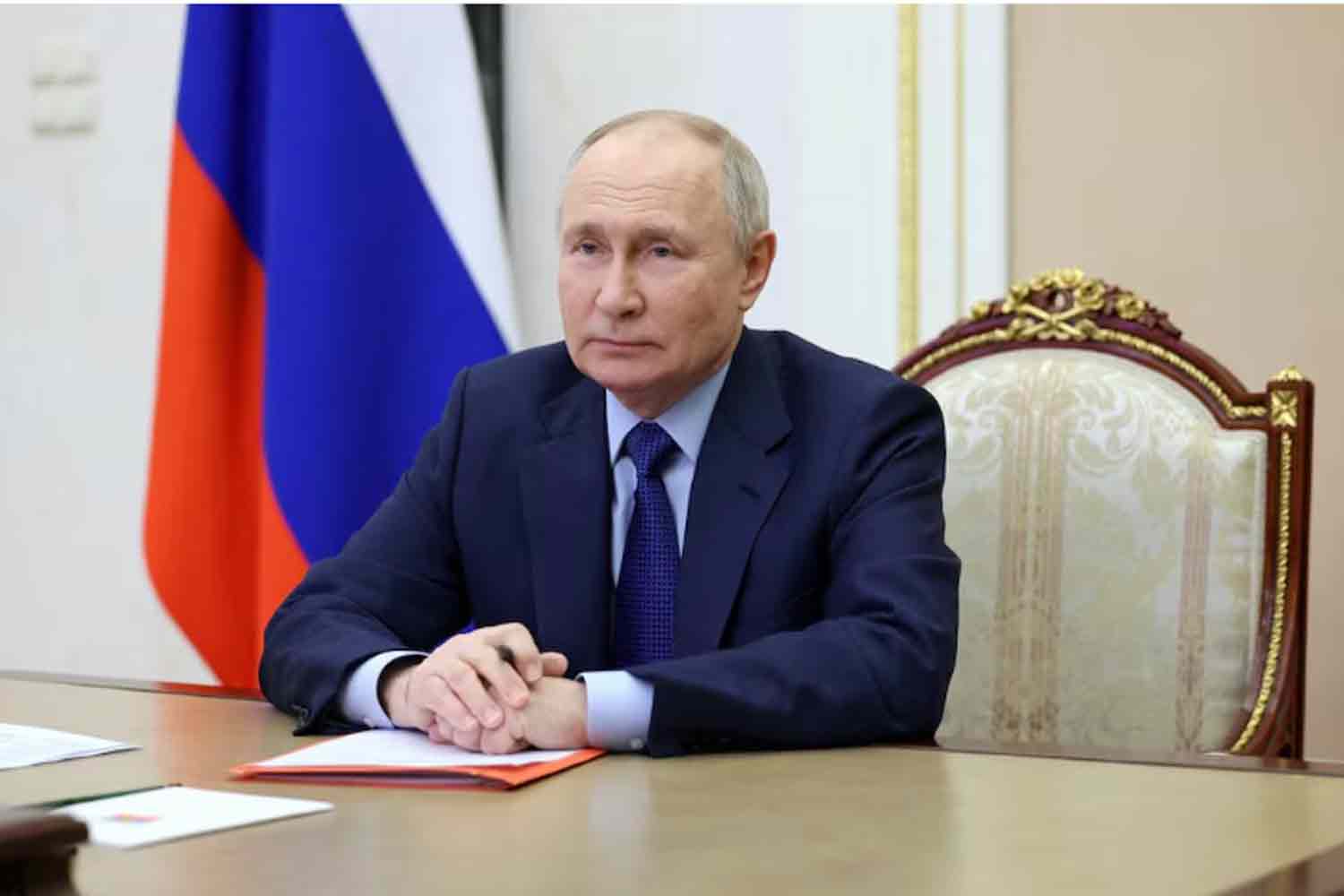

Russian President Vladimir Putin has claimed that Moscow has not yet used the Oreshnik missile system “in the full sense of the word” during operations in Ukraine, while signalling that Russia could expand future deployments of the hypersonic-capable system against designated targets.
Speaking during a lengthy question-and-answer session with international news agencies on the sidelines of the St. Petersburg International Economic Forum, Putin addressed Russia’s use of advanced missile systems, the future of the Ukraine war, relations with Europe, NATO tensions, and the legitimacy of Ukrainian President Volodymyr Zelensky.
His remarks provide one of Moscow’s clearest public explanations yet regarding the controversial Oreshnik missile programme and Russia’s evolving military strategy in Ukraine.
Putin Says Russia Has Not Fully Used the Oreshnik Missile
Putin stated that Russia had not yet conducted what he described as a “full combat use” of the Oreshnik system inside Ukraine.
According to the Russian president, Moscow previously tested related systems at military training grounds but had not yet employed the Oreshnik at maximum operational capacity.
“We have not had a single combat use of the Oreshnik in the full sense of the word on Ukrainian territory,” Putin said, adding that previous uses were designed primarily to observe battlefield performance and collect operational data.
His remarks come despite Russia previously confirming several strikes involving the missile system against targets in Ukraine, including a defence industry facility in Dnipro in late 2024, a warplane production facility in Lviv in early 2025, and another controversial strike near Kyiv that critics dismissed as targeting an insignificant structure.
Putin openly suggested that at least some previous launches were intended as battlefield testing.
“To be completely honest, we hit where it was convenient for us to see the results,” Putin said, adding that Russian drones later assessed impact effects and target dispersal after one strike.
More significantly, Putin indicated that Russia may consider broader operational use of the Oreshnik system in future military planning, including against targets located in urban environments.
What Is the Oreshnik Missile?
The Oreshnik missile has become one of Russia’s most closely watched strategic weapons due to its ability to reportedly carry both conventional and nuclear warheads.
Although Moscow has disclosed only limited technical details, the missile is believed to represent part of Russia’s broader effort to develop high-speed precision strike systems capable of bypassing advanced missile-defence networks.
Its battlefield role appears designed to bridge tactical and strategic deterrence, particularly against hardened infrastructure and time-sensitive military targets.
Putin’s latest remarks suggest Moscow still views the system as being in an operational evaluation phase rather than fully integrated wartime deployment.
Putin Questions Zelensky’s Legitimacy to Sign Peace Deal
Beyond military issues, Putin also raised questions regarding whether Ukrainian President Volodymyr Zelensky could legally sign a future peace agreement.
Without directly answering whether Zelensky remains a legitimate negotiating counterpart, Putin described the matter as “a question for lawyers.”
He argued that any peace agreement must ultimately be signed by representatives who possess unquestioned legal authority under Ukrainian law.
Zelensky’s presidential term formally expired in May 2024, though Ukraine postponed elections under wartime emergency conditions.
The issue has increasingly become part of Russia’s diplomatic messaging surrounding potential negotiations.
Putin Says Russia Is Ready for Peace — Under Its Terms
Putin reiterated that Moscow remains willing to pursue a peaceful settlement of the Ukraine conflict but only under conditions previously discussed with US President Donald Trump during talks in Anchorage last year.
According to Putin, the core challenge lies not in Russia’s willingness to negotiate but in persuading Kyiv to accept compromise terms.
He insisted that Russia’s control over territories including Donbass and other regions that Moscow claims voted to join Russia does not contradict a future peace settlement.
Putin also criticised proposals centred on an immediate ceasefire, arguing that any pause in fighting could simply allow Ukraine to regroup, rearm, and prepare for renewed combat.
“I get the impression that the ruling circles are not actually interested in a real cessation of hostilities,” Putin said.
The statement reinforces Moscow’s long-standing insistence that negotiations must address underlying territorial and security disputes rather than focus solely on halting battlefield operations.
Putin Says Europe Can Play a Role — But Must Change Approach
Putin also addressed Europe’s possible role in future peace efforts, suggesting the European Union could contribute positively to ending the war.
However, he argued this would require a major shift in European policy.
Rather than continuing military support for Kyiv, Putin suggested European governments should encourage Ukrainian authorities to accept negotiated compromises.
He further criticised European governments for what he described as a “colonial approach” toward Russia.
“If there is a desire among the European side to work with us, they must abandon their colonial approach and talk to Russia as an equal partner,” Putin said.
The comments reflect continuing tensions between Moscow and European capitals over sanctions, military aid to Ukraine, and diplomatic isolation efforts since Russia’s invasion.
Putin Dismisses Fears of Russian Attack on NATO
When asked about concerns that Russia could attack NATO member states, Putin categorically rejected the idea.
Calling such fears “nonsense” and “a deliberate provocation,” he questioned why Moscow would seek direct confrontation with the alliance.
“I have to ask why, why would we do that?” Putin said.
The Kremlin has repeatedly denied Western warnings that Russia could eventually expand military pressure beyond Ukraine, while NATO countries continue strengthening eastern flank defences in response to security concerns.
What Putin’s Remarks Mean
Putin’s statements at the St. Petersburg forum suggest Moscow is simultaneously pursuing three strategic objectives: demonstrating military confidence, shaping conditions for future negotiations, and signalling deterrence to Western adversaries.
His comments on the Oreshnik missile indicate Russia may still be evaluating how to operationally deploy one of its newest strategic weapons.
Meanwhile, his remarks on peace talks show Moscow remains willing to negotiate — but only from a position reflecting battlefield realities and territorial gains.
For NATO and Ukraine, the message is equally clear: Russia appears determined to maintain military pressure while leaving the door open to diplomacy only on terms it considers strategically acceptable.
As the war enters another critical phase, Putin’s latest comments reinforce that both battlefield escalation and diplomatic manoeuvring are likely to continue simultaneously.