Reports that Indian defense scientists successfully analyzed and decoded components of China’s PL-15E beyond-visual-range (BVR) air-to-air missile have triggered intense debate among military analysts, with many describing the development as one of the most significant electronic intelligence opportunities to emerge from South Asia in recent years.
If confirmed, the recovery and technical exploitation of the missile would extend far beyond the India-Pakistan rivalry. It could provide valuable insights into China’s advanced missile technology, electronic warfare architecture, and radar seeker design—knowledge that may influence future air combat planning across the Indo-Pacific.
However, many of the reported findings remain based on open-source reporting and have not been officially confirmed by either the Indian or Chinese governments. As a result, several technical claims should be treated with caution pending independent verification.
Battlefield Debris Has Become a Strategic Intelligence Asset
Modern wars are no longer fought solely on the battlefield. Increasingly, damaged military hardware has become a valuable source of intelligence.
Recovered aircraft wreckage, missiles, drones, radars, and electronic systems often provide insights that cannot be obtained through satellite imagery or signals intelligence alone.
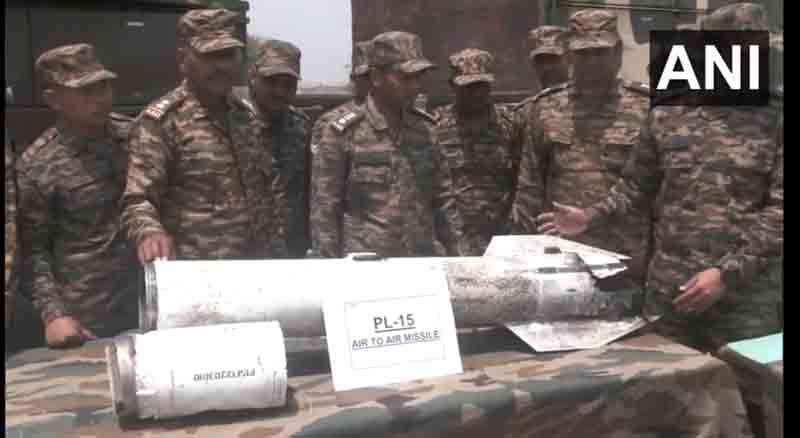
According to reports, Indian authorities recovered several fragments of China’s export-version PL-15E missile following aerial engagements during in May 2025. One missile reportedly remained largely intact after failing to completely self-destruct, providing investigators with access to sensitive onboard electronics.
What Is the PL-15E Missile?
The PL-15E is the export variant of China’s long-range beyond-visual-range air-to-air missile developed by the China Academy of Aerospace Aerodynamics for international customers.
The missile is believed to equip platforms including:
- J-10CE fighter
- JF-17 Block III
- Other export-compatible Chinese combat aircraft
Open-source estimates suggest the export version has an engagement range of approximately 145 kilometers, while some analysts believe the domestic PL-15 variant may have a significantly longer reach, although official specifications have not been released by China.
The missile reportedly features:
- Active AESA radar seeker
- Advanced anti-jamming capability
- High-speed terminal attack profile
- Data-link connectivity
- Beyond-visual-range engagement capability
- Modern electronic counter-countermeasures (ECCM)
These features make the PL-15 family one of China’s most closely watched missile programs.
How the Missile Was Reportedly Recovered
Following Operation Sindoor, images circulated on social media showing missile components recovered in India’s Punjab region, including an apparently well-preserved section reportedly discovered near Kamahi Devi village in Hoshiarpur district.
According to open-source reports, several PL-15E missiles failed to fully activate their self-destruct mechanisms after combat deployment.
If accurate, this would have allowed investigators to recover:
- Guidance electronics
- Radar seeker components
- Rear propulsion sections
- Internal communication modules
- Control systems
Military intelligence agencies place exceptional value on such recoveries because modern missile electronics rarely survive operational use intact.
DRDO Reportedly Studied Sensitive Electronic Systems
According to reports originating from the French defense publication Meta-Defense, specialists from India’s Defence Research and Development Organisation (DRDO) and the Indian Air Force (IAF) conducted laboratory analysis of the recovered missile components.
The report claims investigators examined:
- Radar emission characteristics
- Frequency behavior
- Guidance architecture
- Communication pathways
- Electronic signatures
- Target-tracking logic
If confirmed, this information could help engineers build more accurate electronic threat libraries for Indian fighter aircraft.
Neither DRDO nor the Indian Ministry of Defence has publicly released detailed technical findings regarding the reported analysis.
Why AESA Seekers Matter
One reason the PL-15E attracts so much attention is its reported Active Electronically Scanned Array (AESA) radar seeker.
Unlike older mechanically scanned radars, AESA technology uses hundreds of miniature transmit/receive modules to steer radar beams electronically.
Potential advantages include:
- Faster target acquisition
- Better resistance to jamming
- Simultaneous tracking of multiple targets
- Reduced probability of interception
- Improved reliability
- Enhanced engagement flexibility
Because the seeker effectively functions as a miniature airborne radar inside the missile, understanding its behavior could provide valuable information for electronic warfare specialists.
Electronic Warfare Is Now Decisive in Air Combat
Modern air warfare increasingly depends on software, sensors, and electronic warfare rather than aircraft performance alone.
Today’s fighter pilots rely heavily on:
- Radar warning receivers
- Electronic support measures
- Digital jammers
- Missile approach warning systems
- Artificial intelligence-assisted threat management
Knowing how an adversary’s missile communicates, tracks targets, and changes frequencies can help defensive systems react more effectively.
Analysts often compare this type of intelligence to obtaining insight into the software logic behind an advanced fighter radar.
Could India’s Fighter Fleet Benefit?
Some reports suggest the recovered intelligence has already been incorporated into India’s electronic warfare databases.
Aircraft frequently mentioned include:
Rafale
France’s Rafale uses the highly regarded SPECTRA electronic warfare suite, designed to detect, classify, and counter airborne threats.
Su-30MKI
India’s largest fighter fleet continues to receive upgrades to improve survivability against modern long-range missiles.
Tejas
The indigenous Tejas fighter is also undergoing continuous software and sensor improvements that could potentially benefit from updated electronic threat libraries.
However, there has been no official confirmation that operational systems have been modified using data from the recovered missile.
International Interest Extends Beyond India
Reports indicate that several countries have expressed interest in examining the recovered missile or its electronic characteristics.
Open-source reporting has mentioned interest from:
- United States
- France
- United Kingdom
- Japan
- Australia
Such interest would not be surprising.
Many Indo-Pacific militaries are closely monitoring China’s rapid modernization of long-range missile technology and electronic warfare capabilities.
Understanding the export version of the PL-15 could also provide indirect insights into China’s broader missile development philosophy, although the domestic variant may differ significantly.
China’s Response
Chinese sources have reportedly downplayed the significance of the reported recovery.
Some analysts argue that even if India recovered an export-version missile, it would not necessarily reveal the full capabilities of missiles used by the People’s Liberation Army Air Force (PLAAF).
China has never publicly disclosed detailed specifications of either the domestic or export versions of the PL-15.
As a result, many assumptions regarding performance remain based on defense analysis rather than official data.
Lessons from Ukraine and Modern Warfare
The reported PL-15E recovery reflects a broader trend visible in recent conflicts.
In Ukraine, captured drones, cruise missiles, electronic warfare systems, and radar components have been extensively analyzed by both sides to improve future military capabilities.
Similarly, battlefield hardware recovered in South Asia could influence:
- Electronic warfare development
- Fighter aircraft upgrades
- Missile warning systems
- Countermeasure software
- Future procurement decisions
- Air combat doctrine
Increasingly, military planners recognize that recovering enemy technology can sometimes provide intelligence benefits equal to or greater than tactical battlefield success.
Strategic Implications
If the reported analysis proves accurate, the implications could extend well beyond South Asia.
Electronic intelligence derived from recovered missile hardware could help shape future air combat doctrine, influence defense modernization programs, and strengthen electronic warfare capabilities against advanced Chinese-origin systems.
At the same time, many key claims surrounding the recovery—including the extent of decoding and operational benefits—remain unverified publicly. Any assessment should therefore distinguish between confirmed events, such as the reported recovery of missile components, and analytical conclusions about their military impact.
Conclusion
The reported recovery and technical examination of China’s PL-15E missile has sparked one of the most closely watched intelligence stories in recent military aviation. Whether or not all reported findings are ultimately confirmed, the episode highlights the growing importance of electronic warfare and battlefield exploitation in modern conflict.
As advanced missiles become more sophisticated, success in future air combat may depend not only on aircraft performance but also on understanding an adversary’s sensors, software, and electronic signatures. The reported PL-15E analysis—if validated—would represent a significant step in that ongoing technological competition.
Frequently Asked Questions
What is the PL-15E missile?
The PL-15E is the export version of China’s long-range beyond-visual-range air-to-air missile, designed for advanced fighter aircraft such as the J-10CE.
Did India officially confirm decoding the PL-15E?
No. Reports claim Indian scientists analyzed recovered missile components, but neither the Indian government nor DRDO has publicly confirmed the detailed technical findings.
Why is an AESA seeker important?
An AESA seeker enables a missile to detect and track targets using electronically steered radar beams, improving resistance to jamming and enhancing engagement performance.
Why are recovered missiles valuable?
Recovered missiles can reveal guidance systems, radar signatures, communication methods, and electronic vulnerabilities that may assist in developing future countermeasures.
Could this affect future air combat?
Potentially. If electronic characteristics are successfully analyzed, the information could improve threat detection, electronic warfare systems, and defensive tactics against similar missiles.