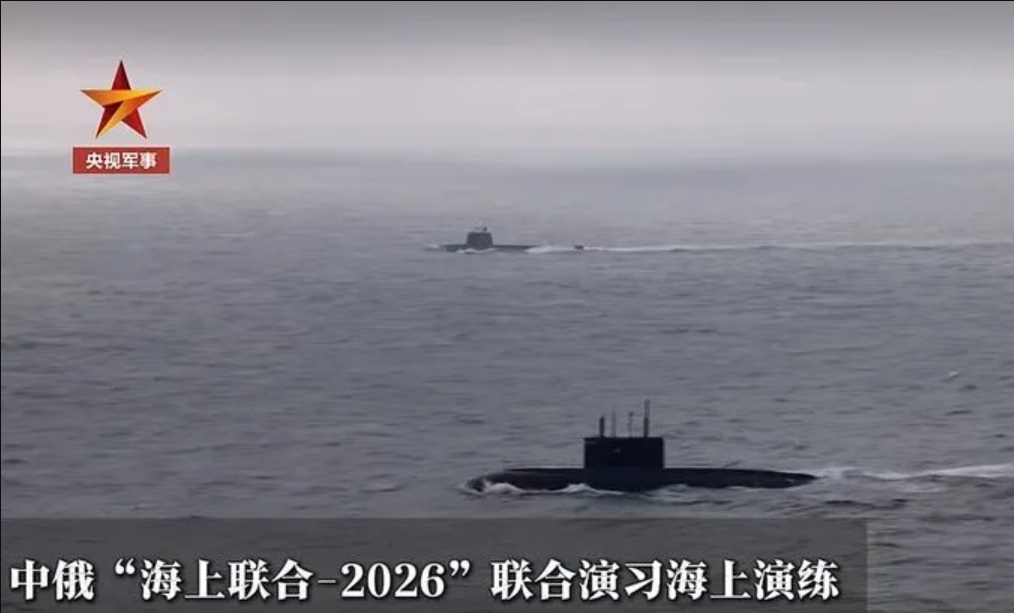
China and Russia have publicly showcased coordinated submarine operations for the first time during the Joint Sea 2026 naval exercise, a move that defense analysts say represents far more than routine military cooperation. The release of official footage showing a Chinese submarine operating alongside the Russian Improved Kilo-class submarine Ufa signals a new level of trust, interoperability, and strategic coordination between the two navies.
While Beijing has portrayed the exercise as a routine maritime security drill, military experts believe the operation demonstrates an important evolution in the China-Russia strategic partnership—particularly in one of the most sensitive domains of modern naval warfare: undersea operations.
The development is likely to draw close attention from the United States and its Indo-Pacific allies, where anti-submarine warfare (ASW) remains a cornerstone of regional defense planning.
Maritime phase of China-Russia “Joint Sea-2026” drills wrap up
The at-sea operations of China-Russia joint naval exercise “ Joint Sea-2026 ”concluded on July 11 off Qingdao.
Eight warships and two submarines from China and Russia carried out air and missile defense, maritime… pic.twitter.com/SIVj5Ymks6
— CGTN Frontline (@Frontlinestory) July 12, 2026
Why This Exercise Is Different
The annual Joint Sea exercise has been conducted since 2012, gradually expanding from basic naval interoperability drills into increasingly sophisticated combined operations.
Joint Sea 2026, however, crossed a significant threshold.
For the first time, official imagery confirmed simultaneous Chinese and Russian submarine operations, providing visual evidence of tactical coordination between two submarine forces whose acoustic signatures and operational procedures are among the most closely guarded military secrets.
Military analysts generally view such public disclosure as deliberate strategic signaling rather than routine public relations.
Undersea Cooperation Requires Exceptional Trust
Unlike surface warships, submarines operate in an environment where even minor mistakes can be catastrophic.
Safe operations require shared procedures covering:
- Secure underwater communications
- Navigation and deconfliction
- Formation maneuvering
- Rescue protocols
- Emergency coordination
- Command-and-control procedures
Perhaps most importantly, operating submarines in close proximity inevitably exposes aspects of each platform’s acoustic signature—the unique underwater noise profile used by adversaries to detect and identify submarines.
These signatures are among the most closely protected elements of any navy’s combat capability.
Allowing another navy to operate nearby reflects a level of military confidence rarely seen outside formal alliances.
A Shift from Political Partnership to Military Integration
China and Russia have described their relationship as a “comprehensive strategic partnership.”
Joint Sea 2026 suggests that cooperation is becoming increasingly operational.
The exercise involved:
- Eight major warships
- Two submarines
- Maritime patrol helicopters
- Marine forces
- Replenishment ships
- Dedicated submarine rescue vessels
Together they practiced:
- Air and missile defense
- Maritime strike operations
- Joint reconnaissance
- Anti-submarine coordination
- Submarine search-and-rescue
- Logistics sustainment
The combination demonstrates not simply interoperability but the ability to conduct sustained multinational naval operations under coordinated command structures.
Why Submarine Rescue Matters
One of the least discussed—but strategically significant—aspects of the exercise involved joint submarine rescue operations.
China’s Yangchenghu Type 926 submarine rescue ship operated alongside Russia’s Igor Belousov, one of the world’s most capable submarine rescue vessels.
Submarine rescue missions require:
- Highly accurate underwater positioning
- Shared operational data
- Compatible rescue systems
- Integrated command procedures
Few navies practice these missions together because they require an extraordinary level of technical cooperation.
Their inclusion in Joint Sea 2026 suggests that Beijing and Moscow are preparing for longer-duration submarine deployments that could extend far beyond their home waters.
Strategic Signaling to the Indo-Pacific
The public release of submarine footage appears intended to send a broader geopolitical message.
Rather than simply demonstrating military capability, Beijing and Moscow are signaling that they can coordinate operations across multiple maritime domains, including one traditionally dominated by the United States and its allies.
For regional defense planners, the implications are significant.
Combined submarine operations complicate efforts to monitor undersea activity and increase uncertainty regarding the location, mission, and intent of deployed naval forces.
The Exercise Extended Beyond the Yellow Sea
Joint Sea 2026 followed a structured three-phase progression:
Phase 1: Force Assembly
Russian Pacific Fleet units arrived in Qingdao to establish the combined task force.
Phase 2: Port Coordination
Personnel conducted planning sessions, communications integration, logistics coordination, and professional exchanges to standardize operating procedures.
Phase 3: Maritime Operations
The task group then conducted live exercises in the Yellow Sea before transitioning into a joint patrol in the Pacific, extending the exercise beyond a limited training event into a demonstration of sustained operational presence.
That final patrol significantly increases the strategic value of the exercise.
High-End Naval Assets Participated
The exercise included several of China’s and Russia’s most capable naval platforms.
Chinese Forces
- Type 055 destroyer Anshan
- Type 052D destroyer Kaifeng
- Type 054A frigate Wuhu
- Conventional submarine
- Type 903A replenishment ship Kekexilihu
- Type 926 rescue ship Yangchenghu
Russian Forces
- Slava-class guided missile cruiser Varyag
- Rezkiy corvette
- Improved Kilo-class submarine Ufa
- Igor Belousov submarine rescue ship
The force package emphasized balanced operational capability rather than maximum combat power, allowing both navies to focus on command integration and interoperability.
Why the United States Will Be Watching Closely
The United States has long maintained one of the world’s most sophisticated anti-submarine warfare networks.
American and allied forces routinely employ:
- Nuclear-powered attack submarines
- P-8A Poseidon maritime patrol aircraft
- Underwater sonar arrays
- Surface combatants equipped with towed-array sonar
- Satellite-supported maritime surveillance
A more coordinated Chinese-Russian undersea presence increases the complexity of these surveillance efforts.
Rather than tracking individual submarines operating independently, regional militaries may increasingly need to monitor coordinated multinational submarine patrols.
Strategic Benefits for Both China and Russia
The partnership offers advantages for both countries.
China Gains
- Access to decades of Russian submarine operational experience
- Improved rescue procedures
- Expanded command-and-control expertise
- Greater confidence in long-duration deployments
Russia Gains
- Integration with China’s rapidly modernizing navy
- Access to advanced air-defense and surface combat systems
- Enhanced Pacific Fleet operational flexibility
- Stronger political and military partnership in the Indo-Pacific
The exercise therefore benefits both navies beyond tactical training alone.
Implications for Taiwan and the Western Pacific
Although Joint Sea 2026 was officially presented as a maritime security exercise, its operational lessons are directly relevant to potential future contingencies in the Western Pacific.
Improved submarine coordination could support:
- Sea-denial operations
- Protection of carrier strike groups
- Long-range intelligence collection
- Strategic deterrence patrols
- Protection of maritime supply routes
Should tensions rise around Taiwan or elsewhere in the Indo-Pacific, greater China-Russia naval coordination could complicate operational planning for the United States and allied forces.
The Bigger Picture: Naval Cooperation Is Deepening
The exercise reflects a broader trend in China-Russia military relations.
Over the past decade, both countries have expanded cooperation across:
- Strategic bomber patrols
- Naval exercises
- Missile defense coordination
- Arctic operations
- Space security
- Intelligence sharing
Joint Sea 2026 demonstrates that cooperation is increasingly extending beneath the ocean surface, traditionally one of the most technologically demanding and strategically sensitive domains of warfare.
Outlook
The first public display of coordinated submarine operations during Joint Sea 2026 represents more than a symbolic milestone—it signals the gradual maturation of China-Russia undersea cooperation.
Although the exercise does not indicate the existence of a formal military alliance, it demonstrates a level of operational trust and interoperability that would have been difficult to imagine a decade ago.
For the United States and its Indo-Pacific allies, the significance lies not only in the submarines themselves but in what they represent: a steadily evolving partnership capable of conducting increasingly sophisticated naval operations across one of the world’s most strategically contested maritime regions.
As China continues to expand the PLA Navy and Russia seeks to maintain its influence in the Pacific, future Joint Sea exercises are likely to place even greater emphasis on integrated undersea warfare, making them a key indicator of the changing balance of power in the Indo-Pacific.