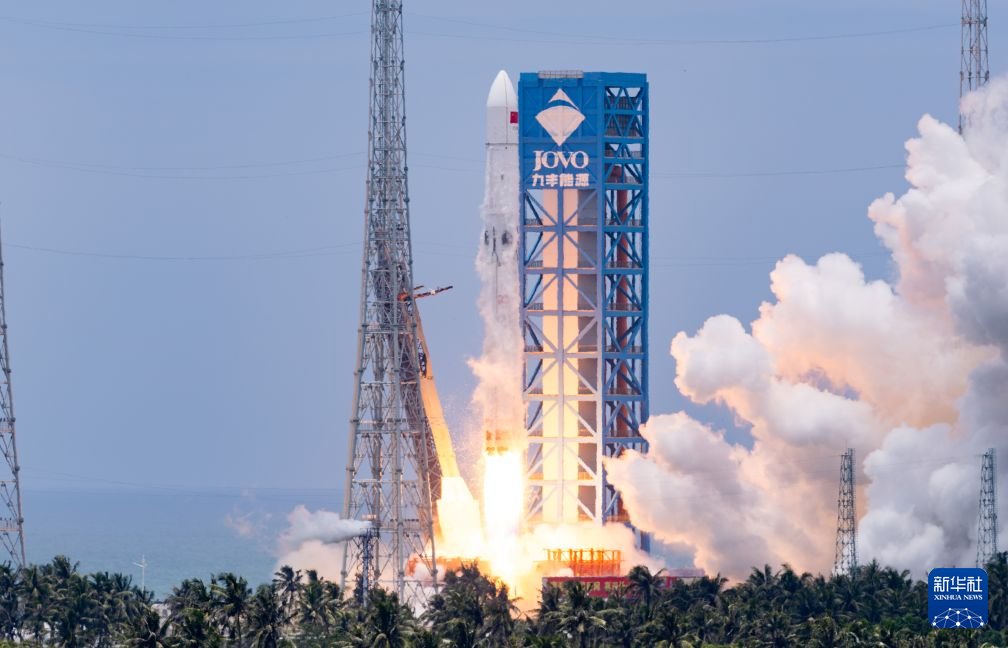
China’s latest submarine-launched ballistic missile (SLBM) test into the southern Pacific is far more than another routine military exercise. It marks an important step in Beijing’s long-term effort to build a credible, survivable, and globally deployable nuclear deterrent—one capable of challenging the strategic dominance of the United States and reshaping the nuclear balance in the Indo-Pacific.
While Chinese officials described Monday’s launch as a routine test conducted in accordance with international law, defense analysts believe the operation was designed to validate one of the most complex components of nuclear warfare: the ability to command, control, communicate with, and deploy nuclear-armed submarines while they remain hidden beneath the ocean.
The test therefore represents not only a technological milestone but also a political and strategic message to Washington and its regional allies.
🚨🇨🇳 China makes history with first submarine-launched ballistic missile test
The missile, carrying a dummy warhead, was launched from international waters in the Pacific and struck its designated target with pinpoint accuracy, state media reported.
🔺This marks the first… pic.twitter.com/AfH7ft1qNd
— Sputnik (@SputnikInt) July 6, 2026
A Rare Public Test of China’s Sea-Based Nuclear Force
According to defense analysts, the missile was launched from one of China’s Type 094 (Jin-class) nuclear-powered ballistic missile submarines (SSBNs) operating from the People’s Liberation Army Navy’s submarine base on Hainan Island.
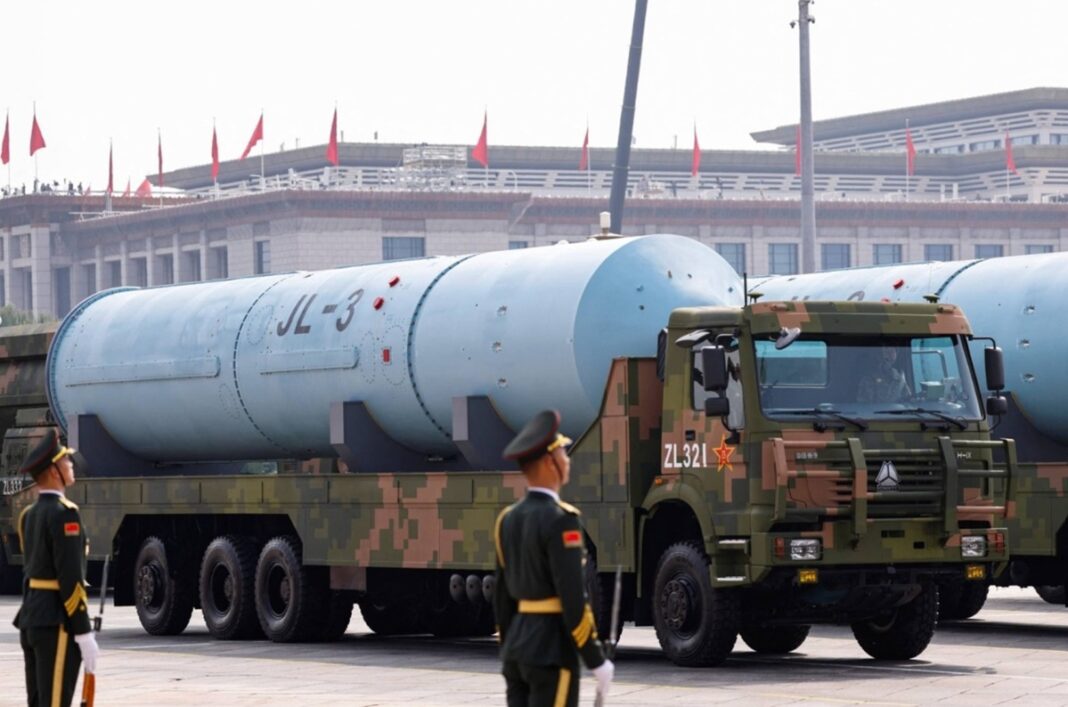
Although Beijing has not officially confirmed the submarine class or missile type, experts believe the launch involved either the JL-2 or the more advanced JL-3 submarine-launched ballistic missile, with the missile carrying a non-nuclear (dummy) warhead during the test.
Chinese state media described the exercise as a “routine military drill” that was not directed against any particular country.
However, regional governments and Western defense officials view the launch differently.
The United States confirmed that the weapon was an intercontinental ballistic missile (ICBM)-class system that landed in the southern Pacific Ocean, making it one of China’s most significant long-range missile tests since September 2024.
Why This Test Matters More Than the Missile Itself
The missile’s performance was only one part of the exercise.
Perhaps more important was Beijing’s opportunity to evaluate the entire command-and-control chain that connects China’s political leadership with a submerged nuclear submarine operating far from home waters.
Unlike land-based missiles, ballistic missile submarines spend extended periods underwater while maintaining strict radio silence to avoid detection.
Maintaining secure communications with these submarines without revealing their position is one of the most technically demanding aspects of any nuclear deterrent.
For China, where the Communist Party maintains exceptionally tight political control over the military, this challenge is even greater.
Every launch order must be transmitted securely while ensuring absolute political oversight over nuclear weapons.
The successful execution of such an operation suggests China’s sea-based nuclear command systems are becoming increasingly mature.
Strengthening China’s Second-Strike Capability
Strategically, the launch is best understood through the concept of second-strike capability.
A credible nuclear deterrent depends not on launching the first attack but on convincing an adversary that any nuclear strike would inevitably be met with devastating retaliation.
China has long maintained an official No First Use (NFU) nuclear doctrine, pledging not to use nuclear weapons unless attacked first.
For that policy to remain credible, Beijing must ensure that enough nuclear forces survive an enemy’s initial strike.
Submarines provide exactly that capability.
Unlike fixed missile silos or air bases, ballistic missile submarines can remain hidden beneath the ocean for months, making them extremely difficult to destroy before they can retaliate.
That survivability forms the backbone of every major nuclear power’s deterrence strategy.
The Evolution of China’s Nuclear Triad
For decades, China’s nuclear deterrent relied primarily on land-based missiles.
Today, Beijing is rapidly building what military planners call a nuclear triad—the ability to deliver nuclear weapons from:
- Land-based intercontinental ballistic missiles (ICBMs)
- Strategic bombers
- Nuclear-powered ballistic missile submarines (SSBNs)
The latest missile test demonstrates continued progress in completing this triad.
Chinese state media argued the launch reflects steady improvements in China’s strategic nuclear forces and strengthens national security against external military pressure.
From Beijing’s perspective, a more survivable nuclear arsenal reduces the risk of coercion during future crises involving Taiwan, the South China Sea, or broader U.S.-China competition.
The Type 094 Still Faces Operational Challenges
Despite the successful test, analysts caution that China’s current Type 094 SSBN remains significantly noisier than comparable American or Russian submarines.
Acoustic signatures remain one of the greatest weaknesses of China’s existing ballistic missile submarine fleet.
This makes the submarines easier to detect using:
- U.S. Navy attack submarines
- Underwater sonar networks
- Maritime patrol aircraft such as the P-8A Poseidon
- Allied anti-submarine warfare (ASW) forces operating throughout the Western Pacific
As a result, Chinese submarines often remain relatively close to protected waters around Hainan Island instead of conducting extended patrols deep into the Pacific.
The JL-3 Missile Changes the Strategic Equation
One of the biggest uncertainties surrounding the test concerns the missile itself.
Many analysts believe China is transitioning from the older JL-2 to the newer JL-3 submarine-launched ballistic missile.
The JL-3 reportedly has a range of approximately 10,000 kilometers, enabling Chinese submarines to threaten targets across the Pacific while remaining farther from heavily monitored waters.
The missile is also believed to carry multiple independently targetable reentry vehicles (MIRVs), allowing a single missile to strike several targets simultaneously.
If these capabilities are fully operational, China’s sea-based deterrent would become substantially more credible.
Why Guam and Hawaii Matter
Even if China’s submarines cannot yet patrol undetected near the U.S. West Coast, they may not need to.
Defense experts note that submarines operating in the Western Pacific could already threaten critical American military facilities on:
- Guam
- Hawaii
- U.S. naval logistics hubs
- Regional command centers
These installations play central roles in any potential U.S. military response to a Taiwan contingency.
Consequently, improving China’s sea-based nuclear deterrent complicates American operational planning throughout the Indo-Pacific.
China’s Next Generation: Type 096
Perhaps the most important long-term development is not the Type 094 itself but its successor.
China is widely believed to be developing the Type 096 ballistic missile submarine, expected to be significantly quieter than current designs.
If the new submarine achieves acoustic performance closer to that of U.S. Ohio-class or Russian Borei-class submarines, China’s ability to conduct undetected nuclear patrols could increase dramatically.
Such a development would represent one of the most significant shifts in global nuclear deterrence in decades.
Strategic Implications for the United States
China’s expanding submarine force is forcing Washington to devote increasing resources to anti-submarine warfare across the Indo-Pacific.
The United States and its allies—including Japan, Australia, and increasingly the Philippines—are investing heavily in:
- Underwater sensor networks
- Long-range maritime patrol aircraft
- Nuclear-powered attack submarines
- Artificial intelligence for submarine detection
- Integrated naval surveillance systems
These efforts aim to preserve the ability to track Chinese submarines before they can threaten strategic targets.
At the same time, China’s growing SSBN fleet complicates U.S. nuclear planning by introducing greater uncertainty into any future conflict.
Political Control Remains a Key Variable
One often overlooked aspect of China’s nuclear modernization is political control.
Unlike Western nuclear powers, China’s nuclear command structure remains highly centralized under the Communist Party and ultimately President Xi Jinping.
Recent purges within the People’s Liberation Army Rocket Force and broader military leadership have highlighted Beijing’s continuing concern over loyalty and command reliability.
Some analysts therefore question whether Chinese submarines routinely deploy with fully armed nuclear missiles or whether warheads remain under separate political control during peacetime.
That uncertainty itself reflects the unique characteristics of China’s evolving nuclear posture.
Outlook
China’s latest submarine-launched ballistic missile test represents far more than a successful weapons trial. It signals Beijing’s steady progress toward a credible sea-based nuclear deterrent capable of surviving a first strike and retaliating against major adversaries.
While China’s current Type 094 submarines still face detection challenges, continued advances in submarine design, long-range missiles such as the JL-3, and increasingly sophisticated command-and-control systems indicate that Beijing is steadily narrowing the capability gap with established nuclear powers.
For the United States and its Indo-Pacific allies, the implications extend well beyond a single missile launch. The test underscores that the strategic competition between Washington and Beijing is increasingly moving beneath the ocean’s surface, where silent submarines—not aircraft carriers or fighter jets—may become the most decisive instruments of nuclear deterrence in the decades ahead.