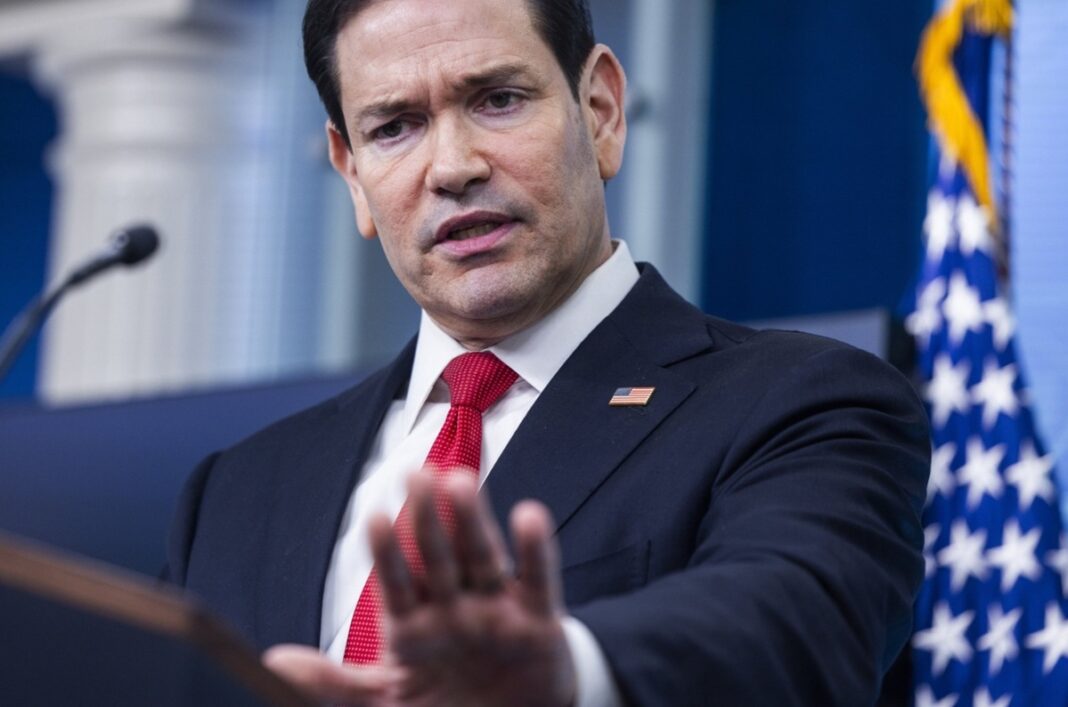
A 58-minute White House briefing by Marco Rubio has provided the clearest window yet into how the Trump administration is redefining its strategy toward Iran.
While some analysts focused on President Donald Trump’s later decision to pause “Project Freedom,” the briefing itself revealed something far more significant:
The conflict is no longer being framed as a limited crisis — but as part of a broader, long-term strategic struggle.
From Nuclear Threat to Global Order
One of the most important shifts in Rubio’s remarks was the reframing of the conflict’s core objective.
Instead of focusing primarily on stopping Iran’s nuclear program, Rubio emphasized:
- Defending global economic stability
- Preventing Iran from controlling maritime routes
- Maintaining freedom of navigation
At the center of this shift is the Strait of Hormuz, a critical artery for global trade.
Rubio warned:
“We cannot live in a world where a country can decide it owns an international shipping lane.”
This marks a transition from a nuclear-focused crisis → to a systemic geopolitical confrontation.
Redefining Escalation as “Defense”
Another key takeaway is how the administration is redefining escalation.
Rubio repeatedly described current and potential actions as “defensive”, including:
- Naval blockades
- Sinking Iranian vessels
- Escorting commercial ships
- Sanctions and economic pressure
- Possible retaliatory strikes
This rhetorical shift is significant.
When escalation is framed as defense, the threshold for further action becomes lower, making continued expansion more politically and strategically acceptable.
Preventive War Logic Returns
Perhaps the most revealing moment came when Rubio outlined the administration’s deepest concern about Iran acquiring nuclear weapons.
He stated that a nuclear-armed Iran would effectively limit U.S. options, implying that action must be taken before that point is reached.
This reflects classic preventive war logic:
➡️ Act now to prevent a future threat
➡️ Accept escalation as necessary
➡️ Justify preemptive measures
Historically, this doctrine has been associated with some of the most consequential and risky conflicts in modern history.
Economic Warfare Takes Center Stage
Rubio also made clear that economic pressure is now a central pillar of U.S. strategy.
- Sanctions are being used as a primary tool of coercion
- Maritime restrictions are shaping global trade flows
- Energy markets are directly affected
This indicates a shift toward full-spectrum economic warfare, where financial and trade systems become part of the battlefield.
Legal Signals of a Longer Conflict
Equally important was Rubio’s stance on the War Powers Act, which he described as “100% unconstitutional.”
This is not just a legal argument — it is a strategic signal.
It suggests the administration is:
- Preparing for sustained military engagement
- Reducing institutional constraints on escalation
- Building a long-term operational framework
A Government Preparing for Prolonged Conflict
Taken together, the briefing reveals a clear pattern:
- Expanding objectives
- Lower barriers to escalation
- Integration of economic warfare
- Legal positioning for sustained operations
This is not the language of a short, limited campaign.
It is the language of a government preparing for a prolonged geopolitical confrontation.
Conclusion: Beyond Crisis — Toward a Long War
While tactical pauses — such as halting naval missions — may create the appearance of de-escalation, the broader strategy suggests otherwise.
The United States is no longer approaching Iran as a short-term crisis to manage.
Instead, it is framing the conflict as:
- A struggle over global order
- A contest over economic control
- A long-term strategic challenge
The key takeaway:
This is no longer just about Iran — it is about the rules of the global system itself.