The evolving military competition between India and Pakistan is increasingly defined not by the number of fighter jets, but by network-centric warfare capabilities, where airborne command and control systems determine battlefield outcomes.
During Operation Bunyan-um-Marsoos (May 2025), the Pakistan Air Force (PAF) demonstrated that modern air superiority depends on integrated sensor networks and real-time battlespace awareness, rather than purely kinetic platforms.
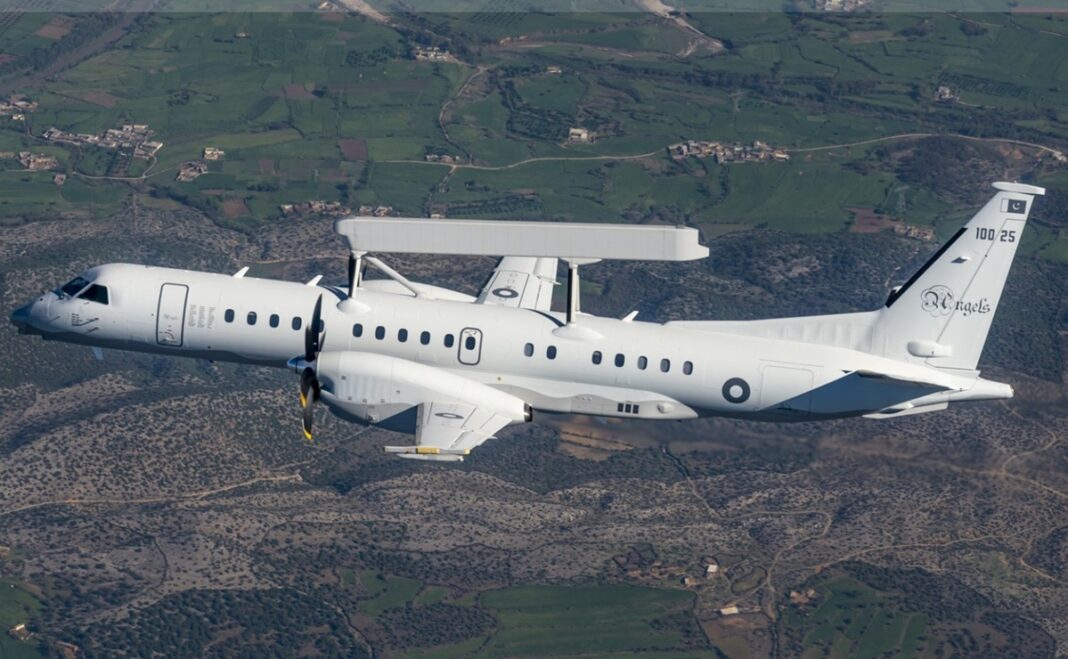
At the center of this transformation was the Saab 2000 Erieye Airborne Early Warning and Control (AEW&C) aircraft.
Erieye: The “Eyes and Brain” of Pakistan Air Force
While platforms like the JF-17 and J-10C executed visible combat operations, the Erieye functioned as the central command node, enabling:
- Real-time situational awareness
- Beyond-visual-range (BVR) engagement coordination
- Integrated air defence management
- Multi-domain battlefield synchronisation
Rather than acting as a simple surveillance platform, Erieye evolved into a full airborne command architecture, linking fighters, missiles, drones, and electronic warfare systems into a unified network.
Network-Centric Warfare: Pakistan’s Strategic Edge
Pakistan’s doctrine emphasizes force multiplication over numerical superiority.
Facing a larger adversary, the PAF has invested in:
- Sensor fusion
- Secure tactical data links
- Integrated command-and-control systems
This allows Pakistan to:
➡️ Compress sensor-to-shooter timelines
➡️ Reduce decision-making delays
➡️ Enhance coordination in contested airspace
The result is a cohesive combat system, where individual platforms operate as interconnected nodes rather than isolated units.
Technical Edge: What Makes Erieye So Effective
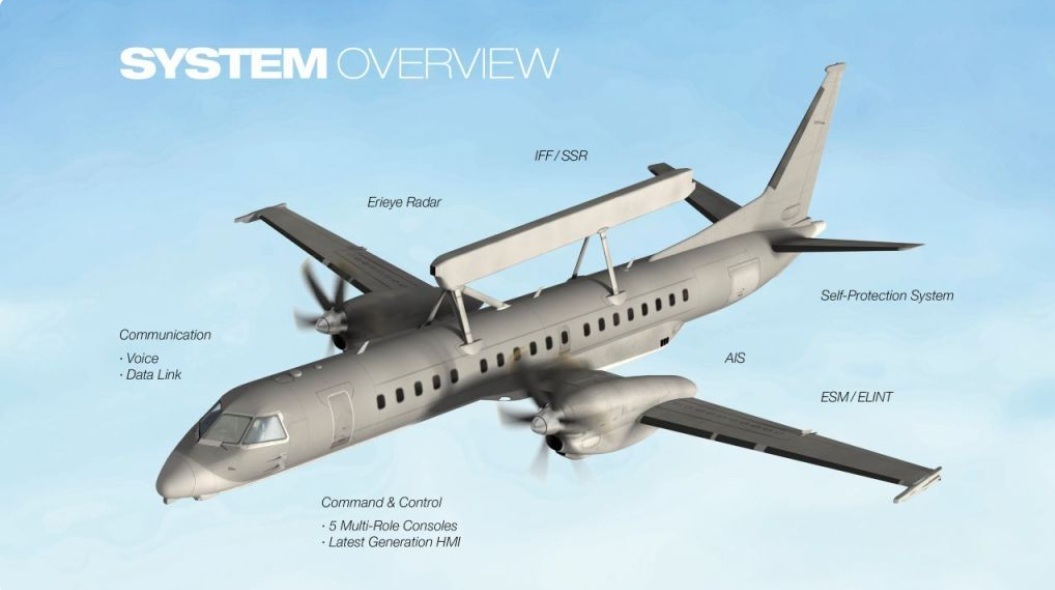
The Saab 2000 Erieye combines advanced radar and mission systems:
Key Capabilities:
- S-band AESA radar with ~300° coverage
- Detection range up to 350 km for fighter-sized targets
- Ability to track hundreds of targets simultaneously
- Electronic support measures (ESM) for threat detection
- Secure data links for real-time coordination
Powered by Rolls-Royce AE 2100 engines, the aircraft can:
- Cruise above 650 km/h
- Remain airborne for 7+ hours
This allows sustained surveillance and continuous battlespace management.
Battlefield Role in Bunyan-um-Marsoos
During the operation, Erieye reportedly enabled:
- Monitoring of Indian air activity in real time
- Early detection of missile launches
- Rapid fighter vectoring for interception
- Coordination of multi-platform strike packages
This capability significantly reduced reaction times, especially against:
- Low-altitude threats
- Cruise missiles
- Electronic warfare environments
The aircraft also acted as an airborne command post, deconflicting friendly assets and ensuring coordinated operations in congested airspace.
From Swift Retort to Bunyan-um-Marsoos: Doctrinal Evolution
Pakistan’s use of AEW&C platforms is not new.
- Operation Swift Retort (2019) demonstrated early integration
- Bunyan-um-Marsoos (2025) showed full doctrinal maturity
Over time, Erieye has transitioned from:
➡️ Surveillance asset
➡️ To central command system
This reflects a broader shift toward information dominance in modern warfare.
Survivability and Strategic Importance
High-value assets like AEW&C aircraft are prime targets in modern warfare.
During the conflict:
- One Erieye aircraft was damaged at PAF Base Bholari
- It was rapidly repaired and returned to service
This highlighted:
- The vulnerability of command platforms
- Pakistan’s prioritization of operational continuity
- The strategic importance of AEW&C survivability
Why AEW&C Defines Modern Air Superiority
Modern air warfare is shifting toward:
- Information dominance over platform dominance
- Network integration over standalone capability
- Speed of decision-making over sheer firepower
AEW&C platforms like Erieye enable:
- Faster targeting cycles
- Better threat identification
- Reduced risk of fratricide
- Enhanced survivability
Strategic Impact: Balancing Regional Airpower
Pakistan’s Erieye fleet provides a critical strategic equalizer in South Asia.
Despite India’s numerical advantage, Pakistan can:
- Maintain persistent airspace awareness
- Coordinate multi-domain operations
- Sustain deterrence credibility
This highlights a key trend:
Smaller forces can offset larger adversaries through technology and integration.
Conclusion: The Invisible Backbone of Modern Warfare
The Saab 2000 Erieye has emerged as one of the most decisive yet underappreciated assets in Pakistan’s military arsenal.
While fighter jets dominate headlines, it is airborne command systems that increasingly determine victory in modern conflicts.
Operation Bunyan-um-Marsoos demonstrated a clear reality:
Air superiority today is not just about aircraft — it’s about who controls the information battlespace.