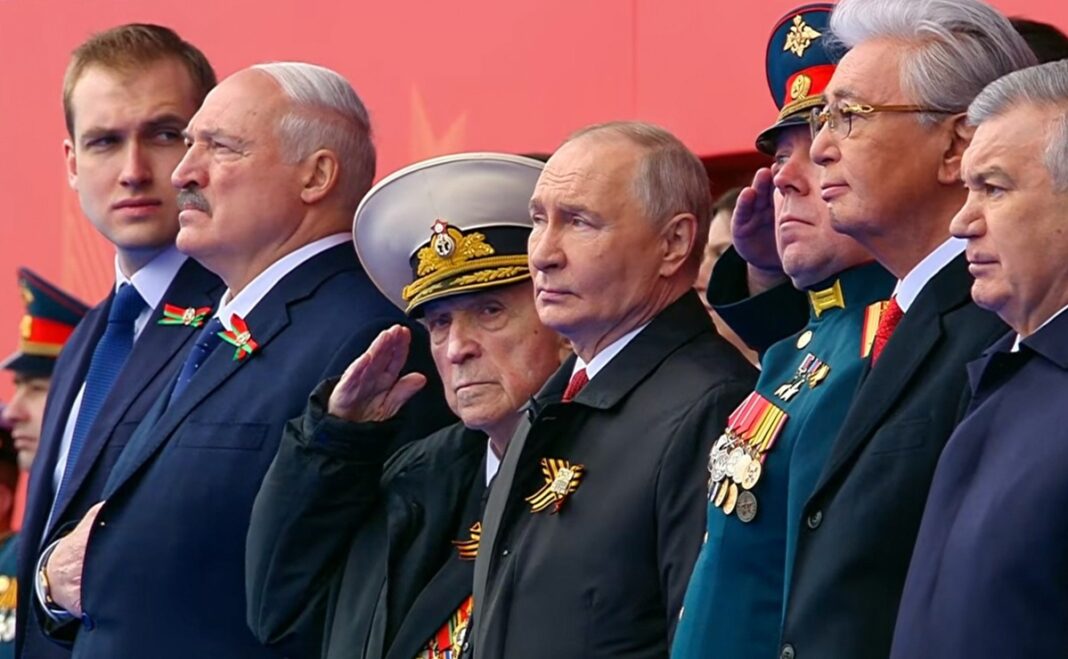
Russian President Vladimir Putin presided over one of the most subdued Victory Day parades in recent history, as a temporary ceasefire between Russia and Ukraine came into effect.
Held annually on May 9, the event commemorates the Soviet Union’s victory in World War II. Traditionally a grand display of military strength on Red Square, this year’s parade marked a stark departure:
No heavy military hardware was displayed — a first in nearly two decades.
🎙 President #Putin at the Parade marking the 81st anniversary of #Victory in the Great Patriotic War:
We will forever remember the feat of the Soviet people – who made the decisive contribution to the defeat of Nazism, saved their country & the world.https://t.co/x5DkNUTZ7l pic.twitter.com/VVgWtspuaz
— MFA Russia 🇷🇺 (@mfa_russia) May 9, 2026
From Show of Force to Show of Restraint
Instead of tanks, missile systems, and armored vehicles, the parade featured:
- Marching troops, including veterans and active soldiers
- Aerial flyovers by fighter jets
- Pre-recorded videos showcasing military operations
State media broadcast footage highlighting:
- Drone warfare capabilities
- Air defense systems
- Strategic assets such as long-range bombers and submarines
The absence of physical hardware underscored a shift toward security-driven restraint over symbolic power projection.
War Narrative: Linking Ukraine to WWII Legacy
Putin once again drew a direct connection between Russia’s war in Ukraine and the Soviet Union’s fight against Nazi Germany.
He framed current operations as a continuation of historical struggle, stating that Russian forces are confronting an “aggressive force supported by NATO.”
This narrative — often referred to in Russia as the legacy of the “Great Patriotic War” — remains central to Moscow’s justification of the conflict.
🤡“Victory has always been and always will be ours, – Putin.” pic.twitter.com/RC9yhXhmmr
— 🪖MilitaryNewsUA🇺🇦 (@front_ukrainian) May 9, 2026
Ceasefire Context: A Temporary Pause in Hostilities
The parade coincided with a three-day ceasefire (May 9–11) agreed upon by both Russia and Ukraine, following an announcement by U.S. President Donald Trump.
Key elements of the agreement include:
- Temporary halt in fighting
- Large-scale prisoner exchange
- De-escalation during commemorative events
Ukrainian President Volodymyr Zelensky confirmed a planned exchange of 1,000 prisoners for 1,000, one of the largest since the war began.
Security Concerns Shape the Parade
Heightened security concerns played a major role in shaping this year’s event.
Recent Ukrainian strikes deep inside Russian territory — including attacks on oil refineries — have:
- Increased pressure on internal security
- Forced authorities to tighten control over public events
- Led to restrictions on mobile internet and communications
The scaled-back parade reflects a defensive posture amid ongoing vulnerability.
Reduced International Presence
Unlike previous years, which saw large delegations from allied nations, attendance was notably limited.
Leaders present included:
- Belarusian President Alexander Lukashenko
- Kazakhstan’s President Kassym-Jomart Tokayev
- Uzbekistan’s President Shavkat Mirziyoyev
- Malaysia’s King Sultan Ibrahim
The reduced turnout highlights:
Russia’s growing diplomatic isolation amid the ongoing conflict
Media Restrictions and Controlled Narrative
International media access was significantly restricted.
- Foreign journalists were barred from attending
- Coverage relied heavily on state-controlled broadcasts
- Messaging remained tightly managed
This reflects a broader effort to control the narrative surrounding both the war and domestic stability.
Economic and Domestic Pressures Mount
The muted parade also comes against the backdrop of:
- Slowing economic growth
- Increasing internet and communication restrictions
- Public adaptation to prolonged wartime conditions
These factors suggest that the war’s impact is increasingly being felt within Russia itself.
Conclusion: Symbolism Shifts as War Reality Deepens
This year’s Victory Day parade marks a significant shift in tone and messaging.
Instead of projecting overwhelming strength, Russia presented:
- Controlled symbolism
- Strategic restraint
- Emphasis on narrative over spectacle
The key takeaway:
The absence of military hardware speaks as loudly as its presence once did.
As the war in Ukraine continues, events like these reflect a broader transformation — from confident projection of power to careful management of risk, perception, and reality.