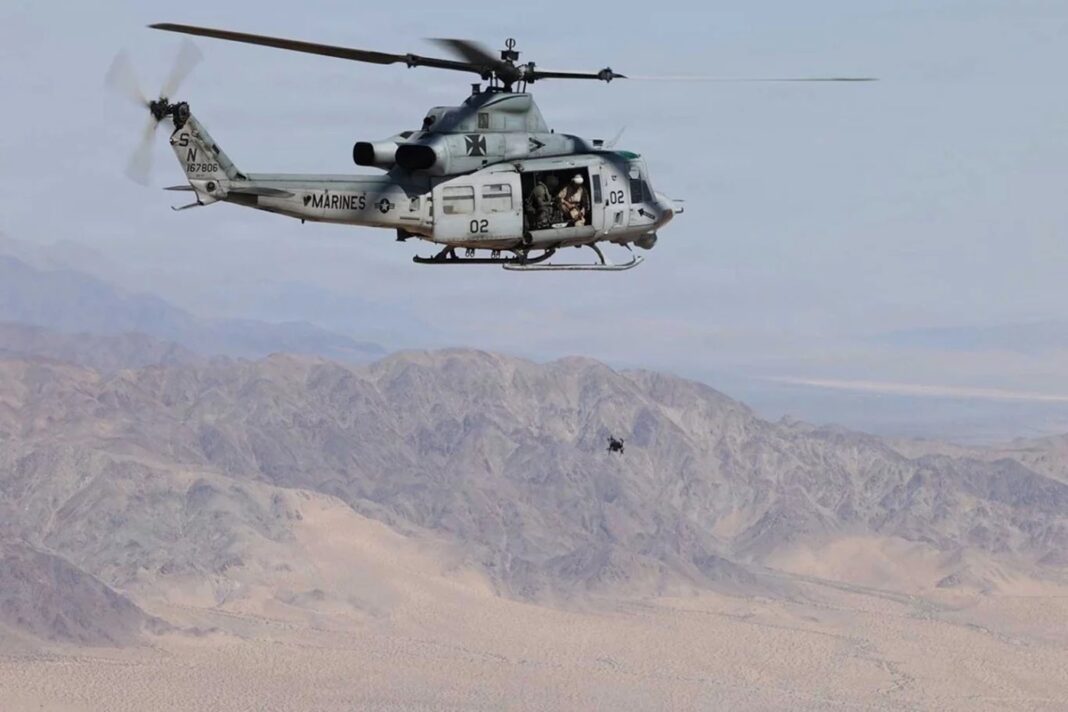
The U.S. Marine Corps has tested a new battlefield tactic using UH-1Y Venom helicopters as airborne relay and command platforms to extend the range of first-person view (FPV) strike drones, reflecting lessons drawn from the war in Ukraine, where cheap drones have transformed battlefield operations.
U.S. Marines are reportedly integrating Neros Archer FPV drones with UH-1Y Venom helicopter operations, reflecting expanding manned-unmanned teaming concepts for future expeditionary warfare and drone-enabled assault missions. #USA #USMC #UH1Y #Venom #Neros #FPV #DroneWar pic.twitter.com/je4WZDj64J
— Drone Wars (@Drone_Wars_) May 21, 2026
The exercise involved Marines from Marine Light Attack Helicopter Squadron 169 (HMLA-169), Marine Air Group 39, and 3rd Marine Aircraft Wing, working alongside infantry from 3rd Light Armored Reconnaissance Battalion.
The concept is designed to allow helicopters to support strikes without entering dangerous air-defense zones.
During the exercise, Marines launched a Neros Archer from a ground position.
Once airborne, control transferred to a specialized operator team aboard an orbiting UH-1Y Venom, flying at altitude miles away from the target area.
Because of the helicopter’s altitude, the crew maintained a stronger Line-of-sight radio connection than ground operators could sustain, effectively extending the drone’s operational reach.
The Venom acted as A flying relay antenna and airborne command node allowing operators to guide the drone to its target while remaining far from hostile fire.
“The primary objective was to test the feasibility of a non-kinetic drop and deployment of a first-person view drone from a moving helicopter,” said Captain Quinton Thornbury,a UH-1Y pilot with HMLA-169.
“From there, validate that we can control the maneuver of that drone from the back of the aircraft,” he added.
The Neros Archer is produced by Neros Technologies, a California-based firm founded in 2023.
The drone is designed without Chinese components and certified under the Pentagon’s Blue UAS Program.
It carries modular payloads for engaging:
- Light armored vehicles
- Fortified positions
- Infantry targets
and can reportedly reach speeds near 160 kilometres per hour.
The Marine Corps awarded Neros a multi-million-dollar contract in late 2025 to provide Archer drones and training to frontline units.
The service aims to equip infantry, reconnaissance and littoral combat teams with FPV strike capability by May 2026.
The tactic addresses a growing problem facing attack helicopters on modern battlefields.
The war in Ukraine highlighted how portable air-defense systems and short-range missile networks have made helicopter operations significantly more dangerous.
Russian helicopter losses in contested airspace reinforced concerns among Western militaries that traditional close-range attack profiles are increasingly risky.
By pairing helicopters with expendable drones, Marine planners hope to preserve Close air support capability, while reducing risk to aircrews.
“This tactic allows us to keep our air crews safe and sound while pushing the lethal edge of the battlefield out to where the enemy is,” said Sergeant Matthew Pocklington.
“We are still providing close air support, but in a way that lets drones close with and destroy the enemy rather than putting Marines in harm’s way.”
Military analysts increasingly view the experiment as part of a broader shift in warfare, where cheap drones, networked systems and stand-off operations are reshaping how militaries deliver firepower in contested environments.