China’s next-generation J-36 stealth fighter has appeared once again, but this time with several visible design changes that suggest the aircraft is rapidly evolving from an experimental prototype into a more mature sixth-generation combat platform.
Recent images circulating online show noticeable modifications to the aircraft’s air intake system, aerodynamic profile, landing gear arrangement, and engine exhaust configuration. Aviation analysts believe these refinements are aimed at improving stealth characteristics, flight performance, and operational reliability.
Although Chinese authorities have not officially disclosed detailed specifications, the visible changes indicate that engineers are addressing challenges identified during earlier flight testing while steadily advancing one of the world’s most closely watched military aviation projects.
🇨🇳✈️🛡️ New images of China’s sixth-generation J-36 fighter have emerged online. According to initial assessments, its design bears some resemblance to Russia’s Su-57. At this stage, there is no verified information confirming its stealth capabilities or whether they match those… pic.twitter.com/SQn0m5MpZj
— DDF NEWS (@ddfmarketing1) July 12, 2026
Unlike previous generations of fighter aircraft that often required years between major prototype revisions, the J-36 program appears to be progressing at an unusually rapid pace. Multiple prototype variants have already been observed since the aircraft’s first public appearance in late 2024, suggesting an aggressive flight-test campaign focused on refining critical technologies.
A Sixth-Generation Fighter Designed for Future Warfare
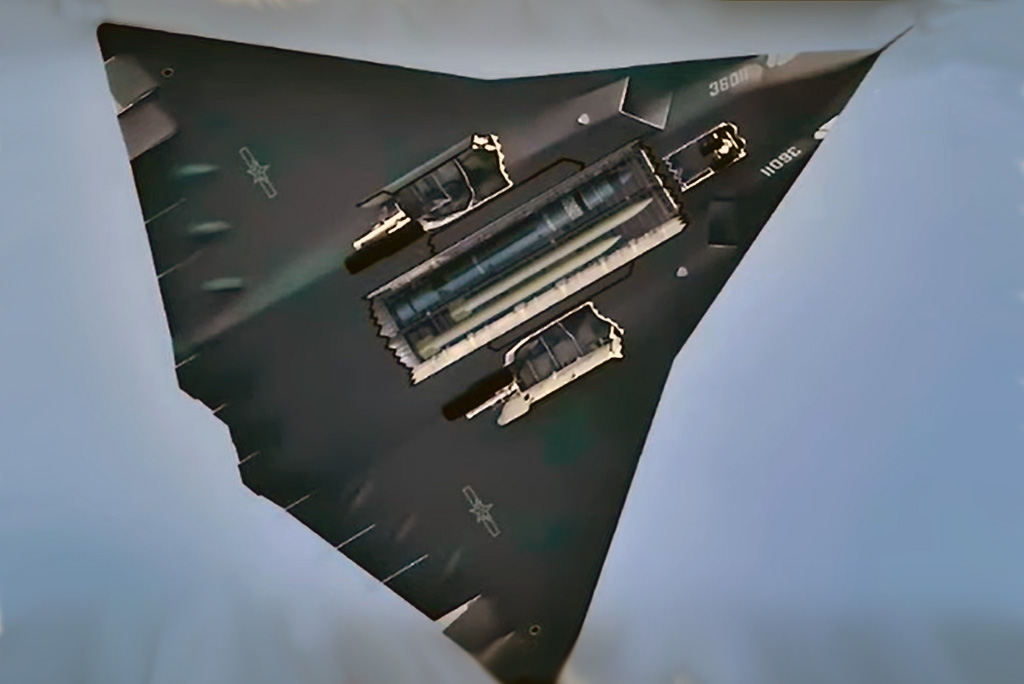
The J-36 is widely believed to be China’s flagship sixth-generation fighter project being developed by the Chengdu Aircraft Corporation (CAC).
Unlike conventional fighters, the aircraft features an unconventional tailless trijet configuration, making it one of the largest fighter-sized combat aircraft currently under development anywhere in the world.
Open-source military analysts believe the aircraft has been designed to perform multiple missions, including:
- Long-range air superiority operations
- Deep precision strike missions
- Command-and-control roles
- Coordination of unmanned combat aircraft
- Penetration of heavily defended airspace
Its large internal volume also suggests significant fuel capacity and spacious internal weapons bays, allowing longer operational range without sacrificing stealth.
The side-by-side cockpit arrangement observed in prototypes has fueled speculation that one crew member could focus on managing drones, electronic warfare systems, or battlefield networking while the other flies the aircraft. Although these assessments remain unconfirmed, they reflect the broader trend toward crewed-uncrewed teaming in future air combat.
Rapid Development Signals China’s Accelerating Aviation Ambitions
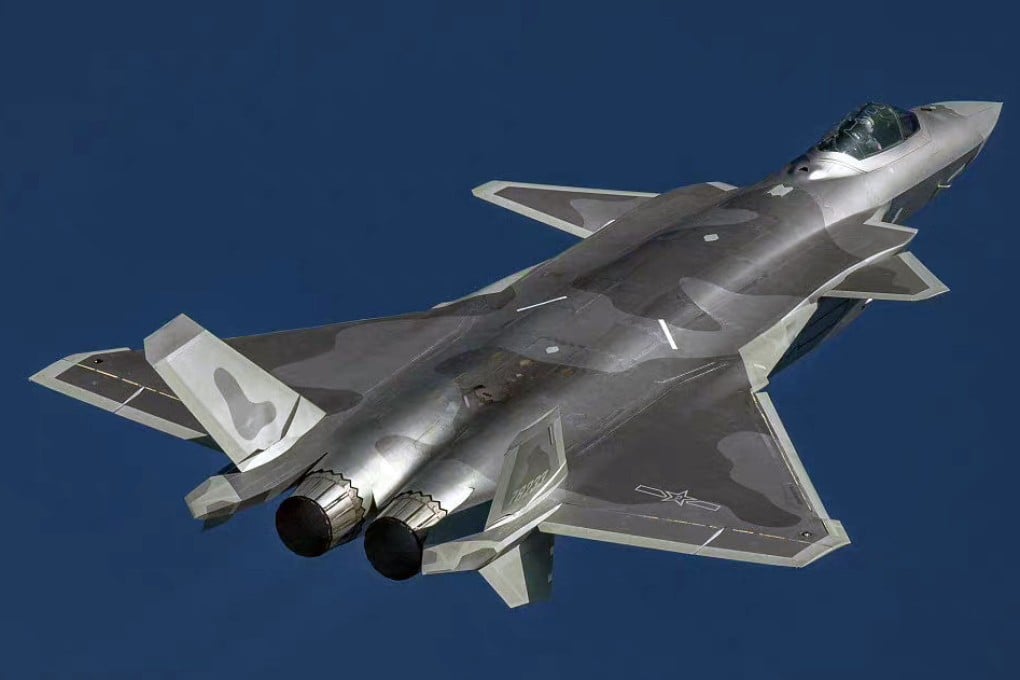
The J-36 first attracted worldwide attention on 26 December 2024, when images of the aircraft flying over Chengdu appeared online.
The unusual aircraft was escorted by a twin-seat J-20S chase aircraft, effectively confirming its association with Chengdu Aircraft Corporation.
The first prototype displayed several distinctive features:
- Large tailless diamond-shaped wing
- Three-engine (trijet) configuration
- Recessed engine exhaust arrangement
- Caret-shaped lower air intakes
- Tandem main landing gear
- Large blended fuselage optimized for stealth
At the time, analysts viewed the aircraft primarily as an early technology demonstrator intended to validate aerodynamic concepts rather than represent the final operational design.
Multiple Prototypes Point to an Aggressive Testing Strategy
Rather than relying on a single demonstrator, China appears to be testing several J-36 prototypes simultaneously.
By late 2025, analysts had identified at least three separate airframes, each incorporating incremental engineering improvements.
This approach allows designers to evaluate different solutions in parallel instead of making changes sequentially.
Military aviation experts note that such rapid prototype iteration can significantly shorten development timelines by collecting flight-test data from multiple configurations at the same time.
Each new appearance of the aircraft has revealed subtle but meaningful design changes, suggesting engineers are refining:
- Aerodynamic efficiency
- Flight control characteristics
- Engine integration
- Stealth performance
- Structural design
- Ground handling
The latest prototype continues this trend, showing that the program is moving beyond basic proof-of-concept testing toward more production-representative configurations.
Why the Latest Prototype Matters
The newest J-36 prototype is attracting attention because many of the changes appear to address practical engineering challenges rather than simply altering the aircraft’s appearance.
Among the most noticeable refinements are redesigned air intakes, revised engine exhausts, changes to the landing gear, and aerodynamic modifications intended to improve both stealth and flight performance.
These improvements suggest that engineers are using real-world flight-test data to optimize the aircraft for operational missions rather than merely demonstrating advanced technologies.
If this development pace continues, the J-36 could become one of the first sixth-generation fighter programs to move from conceptual design toward operational capability within a relatively short timeframe.
Growing Competition in Sixth-Generation Air Power

The rapid evolution of the J-36 comes at a time when several major military powers are pursuing next-generation combat aircraft.
The United States is advancing its own sixth-generation fighter efforts under the Next Generation Air Dominance (NGAD) initiative, while Europe and Japan are also developing future combat air systems.
China’s visible progress with multiple flying prototypes highlights the increasingly competitive race to develop aircraft capable of operating in heavily contested airspace using advanced stealth, long-range networking, artificial intelligence, and unmanned teaming.
For military planners across the Indo-Pacific, the J-36’s continued refinement is being closely monitored as an indicator of China’s long-term airpower ambitions.
J-36 Stealth Fighter Receives Significant Engineering Refinements
The latest J-36 prototype reveals that China’s sixth-generation fighter program is entering a new phase of development. Rather than introducing a completely new aircraft, engineers appear to be refining key components based on data collected during previous flight tests. The most visible changes involve the air intake system, engine exhausts, landing gear, and overall aerodynamic profile—areas that directly influence stealth performance, maneuverability, and operational reliability.
Redesigned Air Intakes Aim to Improve Stealth and Engine Performance
One of the most striking changes on the latest prototype is the redesigned lower air intake system.
Earlier J-36 prototypes featured caret-shaped lower air intakes, but the newest aircraft incorporates diverterless supersonic inlets (DSI) with forward-swept lips. This design is already used on several modern stealth fighters because it improves airflow while reducing radar reflections.
According to defense analysts, the redesign offers several potential advantages:
- Better airflow to the engines during high-speed flight
- Reduced radar cross-section around the intake area
- Lower drag at transonic and supersonic speeds
- Improved fuel efficiency during long-range missions
- Reduced risk of foreign object damage during takeoff and landing
The aircraft continues to retain its distinctive dorsal intake feeding the center engine, indicating that engineers remain committed to the unique three-engine configuration rather than redesigning the propulsion layout.
Why Diverterless Supersonic Intakes Matter
Modern stealth aircraft must balance two often competing requirements: maintaining low observability while supplying engines with sufficient airflow across a wide range of speeds.
Traditional fighter aircraft frequently use mechanical diverters and movable ramps to manage airflow. These systems work well but add weight, increase maintenance requirements, and create additional radar-reflective surfaces.
The J-36’s diverterless intake design addresses these issues by using carefully shaped surfaces that naturally redirect airflow while minimizing turbulence.
Potential operational benefits include:
- Improved supercruise performance
- Lower maintenance requirements
- Reduced structural complexity
- Better stealth characteristics
- Increased engine efficiency
These refinements suggest the aircraft is being optimized not only for maximum performance but also for long-term operational sustainability.
New Thrust-Vectoring Exhaust System Marks a Major Design Shift
Perhaps the most significant engineering change is found at the rear of the aircraft.
The original prototype featured recessed engine exhausts designed primarily to reduce infrared and radar signatures. The latest prototype replaces these with angular two-dimensional thrust-vectoring nozzles, a configuration that resembles concepts used on advanced stealth aircraft such as the U.S. F-22.
For a tailless aircraft, thrust vectoring plays an especially important role.
Without conventional vertical and horizontal stabilizers, the aircraft relies more heavily on advanced flight-control software and engine thrust to maintain stability during demanding flight conditions.
Military aviation specialists believe the revised exhaust system could improve:
- Pitch control
- High-angle-of-attack handling
- Low-speed maneuverability
- Takeoff performance
- Recovery from aggressive flight maneuvers
The trade-off is that two-dimensional nozzles may expose a slightly larger infrared signature from certain angles than deeply recessed exhausts. However, the improvement in flight control may outweigh this disadvantage, particularly if advanced cooling techniques are incorporated into the design.
Balancing Stealth with Real-World Flight Performance
Every stealth aircraft requires compromises.
Designers must constantly balance:
- Radar signature
- Infrared signature
- Maneuverability
- Engine efficiency
- Structural weight
- Operational reliability
The latest J-36 prototype suggests Chinese engineers are moving beyond pure stealth optimization toward a more balanced design capable of sustained operational use.
Rather than focusing solely on minimizing radar detection, the program appears to be addressing the practical demands of high-speed combat operations, long-duration missions, and complex flight profiles.
This transition is a common stage in advanced fighter development as prototypes evolve into aircraft that can meet military service requirements.
Landing Gear Redesign Suggests Improved Operational Capability
Another visible modification involves the aircraft’s landing gear.
Earlier prototypes used a tandem wheel arrangement on the main landing gear. The latest prototype replaces this with a side-by-side twin-wheel configuration.
Although this change may appear minor, it could provide several operational advantages:
- Better weight distribution
- Improved braking performance
- Increased stability during taxiing
- Enhanced operation from varied runway surfaces
- Greater support for heavier takeoff weights
The redesign may also free internal space within the fuselage for larger weapons bays or additional fuel tanks, although the aircraft’s internal layout remains unknown.
Such changes indicate that engineers are considering practical operational requirements rather than limiting development to aerodynamic experimentation.
Refining the Aerodynamic Profile
The overall shape of the latest prototype also reveals subtle aerodynamic refinements.
The aircraft retains its distinctive diamond-shaped, tailless flying-wing configuration, but analysts have noted adjustments intended to improve airflow across the wing and fuselage.
Potential objectives include:
- Reduced drag
- Increased lift efficiency
- Improved stability at high altitude
- Better fuel economy
- Enhanced supercruise capability
For a large aircraft designed to conduct long-range missions, even small aerodynamic improvements can significantly increase combat radius and endurance.
These refinements suggest engineers are optimizing the platform for extended operations over vast distances, an important consideration in the Indo-Pacific region.
Three Engines Continue to Distinguish the J-36
Unlike most modern fighter aircraft, which use either one or two engines, the J-36 continues to employ an unusual three-engine (trijet) configuration.
The arrangement is expected to provide several potential benefits:
- Higher total thrust
- Increased redundancy in the event of engine failure
- Greater payload capacity
- Longer operational range
- Enhanced power generation for future electronic warfare systems, sensors, and directed-energy technologies
While a trijet design introduces additional engineering complexity, it may better support the aircraft’s projected roles in long-range strike missions, command-and-control operations, and cooperative engagements with unmanned combat aircraft.
What These Changes Reveal About the Program
Taken together, the latest modifications indicate that the J-36 is progressing beyond an experimental demonstrator.
The changes are consistent with a program entering a more mature stage of development, where engineers refine performance, reliability, and operational practicality based on flight-test data.
Rather than pursuing radical redesigns, the latest prototype reflects a methodical effort to improve systems that are critical for real-world combat operations.
Although many details remain classified, the pace of visible refinements suggests that China is investing heavily in accelerating the development of next-generation air combat capabilities.
Strategic Implications: What China’s J-36 Means for Future Air Power
The evolution of the J-36 extends beyond engineering improvements. If the aircraft eventually enters operational service, it could significantly enhance the People’s Liberation Army Air Force’s (PLAAF) ability to conduct long-range missions across the Indo-Pacific while supporting China’s broader military modernization goals.
Although the aircraft remains in the prototype stage and many of its capabilities have not been independently verified, the steady pace of development demonstrates Beijing’s commitment to fielding advanced combat aircraft designed for future high-intensity conflicts.
Lop Nur Testing Highlights a Mature Development Program
Satellite imagery and open-source intelligence indicate that the J-36 has been undergoing testing at the remote Lop Nur flight test facility in western China.
Historically, Lop Nur has been associated with some of China’s most sensitive military programs because of its:
- Long runways suitable for large aircraft
- Restricted airspace
- High level of operational security
- Extensive flight-testing infrastructure
The use of such a facility suggests that the J-36 program has progressed beyond initial demonstration flights and is now focused on evaluating performance under operational conditions.
Analysts also note that another Chinese sixth-generation fighter concept, commonly referred to as the J-XDS, has reportedly been observed at the same location. Testing multiple advanced aircraft simultaneously could allow engineers to compare different design philosophies before making future production decisions.
A Faster Development Cycle Than Previous Fighter Programs
One notable feature of the J-36 program is the speed of its evolution.
From its first public appearance in December 2024 to multiple revised prototypes by mid-2026, the aircraft has undergone visible design refinements in a relatively short period.
Rather than relying on a single prototype, Chinese engineers appear to be evaluating several airframes simultaneously. This parallel testing approach allows multiple engineering solutions to be assessed at once, potentially shortening development timelines.
While the exact schedule remains unknown, the rapid succession of prototypes suggests an effort to accelerate the transition from experimental testing to a more mature design.
Competing in the Global Sixth-Generation Race
The J-36 is part of a broader international effort to develop sixth-generation combat aircraft.
Several major powers are pursuing similar programs, including:
- The United States through its Next Generation Air Dominance (NGAD) initiative.
- The United Kingdom, Italy, and Japan through the Global Combat Air Programme (GCAP).
- France, Germany, and Spain under the Future Combat Air System (FCAS).
While these projects differ in design and operational concepts, they share common objectives:
- Enhanced stealth
- Long-range operations
- Artificial intelligence integration
- Manned-unmanned teaming
- Advanced networking
- Improved electronic warfare capabilities
Unlike most publicly known concepts, however, the J-36 has already been observed conducting multiple flight tests, providing analysts with rare visual evidence of China’s progress. It is important to note that visible prototypes alone do not necessarily indicate operational readiness, and comparisons between programs remain limited by the lack of official technical data.
Potential Impact on the Indo-Pacific Security Environment
If the J-36 achieves its projected capabilities, it could strengthen China’s ability to conduct long-range air operations across the Western Pacific.
Military analysts suggest such an aircraft could support missions including:
- Long-range air superiority
- Deep precision strikes
- Maritime operations
- Electronic warfare
- Command-and-control missions
- Coordination with unmanned combat aircraft
Its anticipated combination of long range, internal weapons carriage, and low observability could complicate air defense planning for regional militaries.
As a result, countries across the Indo-Pacific may continue investing in:
- Advanced airborne early warning systems
- Integrated air and missile defense
- Long-range air-to-air missiles
- Next-generation fighters
- Counter-stealth sensors
- Electronic warfare capabilities
The ultimate operational impact will depend on how the aircraft performs in testing, whether it enters serial production, and how it is integrated into China’s broader military doctrine.
Strategic Signaling Beyond the Aircraft
The repeated appearance of J-36 prototypes in publicly available imagery—and the release of limited official footage in 2026—has also been interpreted as strategic messaging.
Such visibility allows China to demonstrate progress in advanced aerospace technologies while revealing relatively little about the aircraft’s actual performance.
For defense analysts, these appearances provide insight into engineering trends, but they do not confirm classified characteristics such as radar cross-section, sensor performance, weapons integration, or combat effectiveness.
As with all prototype aircraft, considerable development work may remain before operational deployment.
Challenges Still Ahead
Despite impressive progress, several critical milestones remain before the J-36 could enter service.
Among the challenges likely facing the program are:
- Long-duration flight testing
- Engine reliability validation
- Software integration
- Sensor fusion development
- Weapons integration
- Electronic warfare testing
- Production readiness
- Pilot training and doctrine development
History shows that advanced fighter programs often require years of refinement between successful prototype flights and operational deployment.
Consequently, caution is warranted when assessing projected timelines or capabilities.
Conclusion
The latest J-36 prototype offers another glimpse into China’s rapidly evolving sixth-generation fighter program. The redesigned air intakes, revised thrust-vectoring exhausts, improved landing gear, and aerodynamic refinements indicate a program moving beyond basic technology demonstration toward a more mature engineering phase.
Although many technical details remain classified, the steady pace of visible improvements suggests that China is investing heavily in next-generation air combat capabilities. At the same time, many performance claims remain based on open-source analysis rather than official confirmation, and the aircraft’s true capabilities will only become clearer as testing progresses.
Whether the J-36 ultimately reshapes the balance of air power will depend on its ability to transition from prototype to operational service. Regardless of the outcome, the aircraft has already become one of the most closely watched military aviation programs in the world, reflecting the intensifying competition to define the future of air warfare.
Frequently Asked Questions
Is the J-36 a sixth-generation fighter?
Open-source defense analysts widely assess the J-36 as a sixth-generation fighter prototype based on its tailless design, advanced stealth features, long-range concept, and potential for manned-unmanned teaming. China has not publicly released full technical specifications.
Who is developing the J-36?
The aircraft is widely believed to be developed by the Chengdu Aircraft Corporation (CAC) for the People’s Liberation Army Air Force.
Why does the J-36 have three engines?
Analysts believe the trijet configuration may provide higher thrust, greater operational range, increased payload capacity, and additional electrical power for advanced onboard systems. China has not officially explained the design choice.
When did the J-36 first fly?
The aircraft first appeared publicly during test flights over Chengdu on 26 December 2024, though its actual maiden flight may have occurred earlier.
What are the latest upgrades on the new prototype?
The newest prototype features redesigned diverterless air intakes, revised thrust-vectoring exhaust nozzles, updated landing gear, and aerodynamic refinements intended to improve performance and stealth characteristics.