
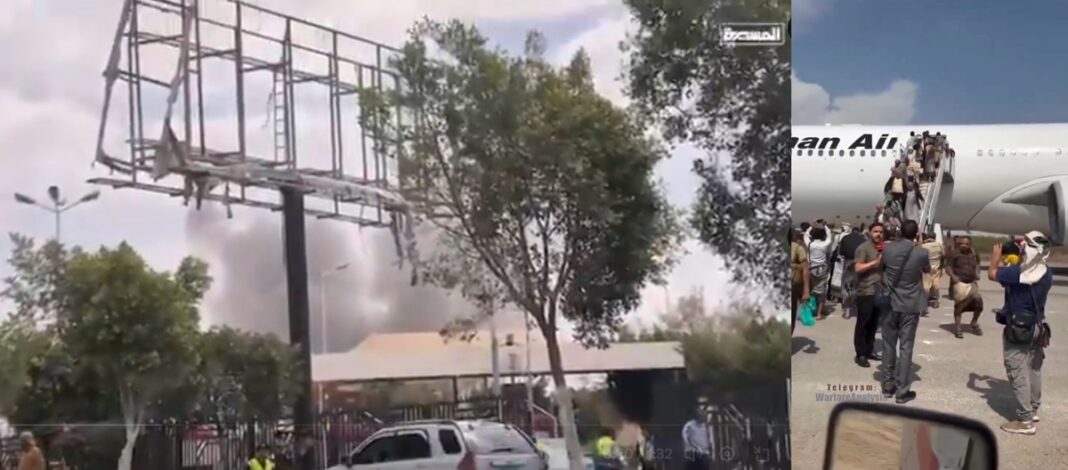
Saudi Arabia launched multiple airstrikes against Sanaa International Airport on Monday as an Iranian Mahan Air passenger aircraft approached Yemeni airspace, dramatically escalating tensions in the country’s long-running conflict.
According to regional reports, Saudi fighter aircraft were operating over northern Yemen while the Iranian Airbus A340 was nearing Sanaa. Yemeni government officials had earlier warned that they would no longer tolerate what they described as repeated Iranian and Houthi violations of Yemen’s sovereign airspace.
The Iranian aircraft ultimately diverted from Sanaa and landed at Hodeidah International Airport, avoiding the targeted airport but underscoring the increasingly volatile confrontation involving Saudi Arabia, Yemen’s internationally recognized government, the Iran-backed Houthis, and Tehran.
VIDEO | “At this moment, we say: patience has run out.”
Yemeni Defense Minister Mohsen al-Daeri issued a formal statement on Monday declaring that the government’s patience regarding the violation of Yemeni airspace by Iranian aircraft has concluded. Daeri emphasized that while… pic.twitter.com/B3edXcg51c
— The Cradle (@TheCradleMedia) July 13, 2026
The latest developments have raised concerns that the conflict could enter a more dangerous phase with potential implications for regional security, international shipping, and global energy markets.
Saudi-Led Strikes Target Sanaa International Airport
The airstrikes reportedly targeted facilities associated with Sanaa International Airport, which remains under the control of the Houthi movement.
Yemeni military officials stated that the runway was specifically targeted to prevent an Iranian aircraft from landing.
Prior to the strikes, Yemen’s Ministry of Defense issued warnings calling for:
- Immediate evacuation of Sanaa Airport
- Suspension of unauthorized flights
- Respect for Yemeni airspace
- Compliance with military instructions
Officials warned that any aircraft entering Yemeni airspace without authorization could face military action.
The Saudi-led coalition has not immediately released a detailed operational assessment of the strikes.
Iranian Mahan Air Flight Diverts to Hodeidah
According to multiple regional sources, the Iranian Mahan Air Airbus A340 continued toward Yemen despite growing military tensions.
Instead of landing in Sanaa, the aircraft eventually landed at Hodeidah Airport, located on Yemen’s Red Sea coast and also under Houthi control.
The flight reportedly ignored repeated warnings issued by Yemeni government authorities.
Iran has increased flights to Houthi-controlled areas in recent days, a move criticized by Yemen’s internationally recognized government as a violation of existing restrictions.
Officials in Aden argue these flights undermine efforts to regulate Yemen’s airspace and could facilitate logistical support for the Houthis—an allegation Tehran has consistently denied.
مشاهد للغارات الجوية التي استهدفت مطار صنعاء.#صنعاء #اليمن #Yemen pic.twitter.com/wGoSHBWJ2Q
— علي ناصر العولقي (@a_n_alawlaqi) July 13, 2026
Yemen Accuses Iran and Houthis of Violating National Airspace
Yemen’s internationally recognized government accused both Iran and the Houthis of deliberately escalating tensions.
Officials said diplomatic efforts had been made through multiple channels to persuade Tehran and Houthi leaders to halt what they described as unauthorized flights.
Government representatives warned that Iran would bear both legal and political responsibility for any future violations.
The Yemeni Armed Forces issued a strongly worded statement declaring:
“Yemen has a people and a leadership that will defend it on land, at sea, and in the air, whatever the consequences.”
The statement reflected growing frustration within the internationally recognized government over continued Houthi control of key airports and ports.
Rashad Al-Alimi Blames Houthis for Escalation
Chairman of the Presidential Leadership Council, Rashad Al-Alimi, directly blamed the Houthi movement for the latest crisis.
According to official statements, Al-Alimi accused the group of insisting on receiving the Iranian aircraft despite repeated warnings.
He argued that the Houthis’ actions risk dragging Yemen into another dangerous phase of conflict while further undermining international diplomatic efforts.
The Presidential Leadership Council remains internationally recognized as Yemen’s governing authority, while the Houthis continue to control Sanaa and large parts of northern Yemen.
Hostage Reports Raise Additional Concerns
Adding to the tension, Yemeni officials alleged that Houthi forces detained a Red Cross pilot and his assistant at Sanaa Airport.
If confirmed, the incident would represent another serious challenge for humanitarian organizations operating inside Yemen.
At the time of publication, the International Committee of the Red Cross (ICRC) had not publicly confirmed the reported detention.
Independent verification of the claim remains unavailable.
Houthis Threaten Retaliation
Following the Saudi strikes, Houthi officials vowed retaliation.
Although no official military response had been announced immediately, analysts believe possible options could include attacks against:
- Saudi oil infrastructure
- Military facilities
- Airports
- Border positions
- Commercial shipping in the Red Sea
Over recent years, the Houthis have repeatedly demonstrated the capability to launch long-range drones and ballistic missiles targeting Saudi Arabia and the United Arab Emirates.
Many of those attacks were intercepted, while others temporarily disrupted regional energy infrastructure.
Why Mahan Air Draws International Attention
Iran’s Mahan Air has long been the subject of international scrutiny.
The airline has faced sanctions from the United States over allegations that it has transported military personnel, weapons, and equipment linked to the Islamic Revolutionary Guard Corps (IRGC). Iran has rejected those accusations, maintaining that Mahan Air is a civilian carrier.
Because of its history, flights involving Mahan Air into conflict zones often receive heightened international attention.
The latest flight to Yemen is therefore likely to add to existing regional tensions and diplomatic disputes.
Yemen’s Civil War Remains a Regional Flashpoint
Yemen’s conflict began in 2014 when the Houthis seized control of Sanaa, prompting the internationally recognized government to relocate and eventually request military assistance from a Saudi-led coalition.
Since then:
- Hundreds of thousands of people have been affected directly or indirectly by the conflict.
- Millions remain dependent on humanitarian assistance.
- Critical infrastructure has suffered extensive damage.
- The conflict has increasingly become intertwined with broader regional rivalries involving Iran and Gulf Arab states.
Although periods of reduced fighting have occurred since the 2022 UN-brokered truce, negotiations have yet to produce a comprehensive political settlement.
Regional Security Risks Continue to Grow
The latest confrontation comes amid broader instability across the Middle East.
Recent months have seen:
- Increased attacks on commercial shipping in the Red Sea.
- Rising tensions around the Bab el-Mandeb Strait.
- Missile and drone exchanges involving multiple regional actors.
- Greater military activity by international naval forces protecting maritime trade.
Any renewed escalation in Yemen could further complicate security in the Red Sea and the Gulf of Aden—two waterways that are critical to global commerce.
Energy markets also remain sensitive to developments in the region, as prolonged instability can increase shipping costs and insurance premiums for vessels transiting nearby maritime routes.
What Happens Next?
Military analysts believe several scenarios are possible in the coming days:
- Additional Saudi airstrikes on Houthi-controlled infrastructure.
- Expanded Houthi missile or drone attacks on Saudi territory.
- More Iranian flights attempting to reach Houthi-held areas.
- Increased diplomatic pressure from regional and international actors.
- Greater naval security operations in the Red Sea.
Whether the crisis develops into a broader regional confrontation will largely depend on the actions of the parties involved and ongoing diplomatic efforts to contain further escalation.
Conclusion
Saudi Arabia’s strikes on Sanaa International Airport, combined with the diversion of an Iranian Mahan Air flight to Hodeidah, mark one of the most serious escalations in Yemen in recent months. The incident underscores the continuing rivalry between Saudi Arabia and Iran, with Yemen remaining a central arena for competing regional interests.
While officials on all sides continue to exchange accusations, the immediate priority will be preventing further military escalation that could threaten civilian aviation, humanitarian operations, and maritime security. With the Houthis warning of retaliation and regional tensions already elevated, the coming days will be closely watched by governments, military planners, and global energy markets alike.
Frequently Asked Questions
Why did Saudi Arabia strike Sanaa Airport?
According to Yemeni government officials, the runway was targeted to prevent an Iranian aircraft from landing, amid concerns over unauthorized flights into Houthi-controlled territory.
Why is Mahan Air controversial?
Mahan Air has been sanctioned by the United States over allegations that it has supported Iran’s Islamic Revolutionary Guard Corps. The airline and Iranian authorities deny those allegations.
Why did the Iranian aircraft land in Hodeidah?
Regional reports indicate the aircraft diverted to Hodeidah Airport after airstrikes targeted Sanaa International Airport.
Could the Houthis retaliate?
Houthi officials have threatened retaliation. Any response could include missile or drone attacks on Saudi infrastructure or other military targets, although the scale and timing remain uncertain.
Why is Yemen strategically important?
Yemen borders the Bab el-Mandeb Strait, a vital maritime chokepoint connecting the Red Sea to the Gulf of Aden. A significant share of global trade and energy shipments passes through this route, making stability in Yemen important for regional and international security.