Friday, June 5, 2026
Home Blog Page 15

Could US Marines Seize Kharg Island? Analysts Warn of Major Risks in Persian Gulf Assault

0
USS Tripoli

The deployment of the 31st Marine Expeditionary Unit (MEU) toward the Persian Gulf has sparked intense discussion among military analysts about the possibility of a US operation targeting Kharg Island, Iran’s primary oil export hub.

However, operational realities suggest that such an assault would face significant challenges, particularly with the Strait of Hormuz currently closed to military navigation.

USS Tripoli and the Limits of Amphibious Assault

The USS Tripoli, an America-class amphibious assault ship carrying the embarked 31st MEU, is one of the most powerful amphibious platforms in the US Navy.

Yet despite its capabilities, the vessel cannot easily approach Kharg Island under current conditions.

With the Strait of Hormuz closed and Iranian missile threats covering large portions of the Gulf, attempting to move large amphibious ships into the region would expose them to significant risk.

Modern anti-ship missiles, drones, and coastal defense systems have dramatically changed the operational environment in the Persian Gulf.

Warnings From Marine Corps Doctrine

The vulnerability of large naval platforms in contested environments was highlighted by former Marine Corps Commandant General David Berger in his 2019 Commandant’s Planning Guidance.

Berger warned that long-range precision weapons and expanding maritime threats were increasingly challenging the United States’ ability to project power from large amphibious ships.

He noted that concentrating forces aboard a small number of major vessels could make them attractive targets during high-intensity conflicts.

The warning emphasized the need for distributed operations and flexible deployment strategies rather than relying solely on traditional amphibious assaults.

A Possible Air Assault Scenario

If US Marines were tasked with seizing Kharg Island, analysts suggest the operation would likely need to be launched from land bases rather than from the sea.

Under such a scenario, Marine units and their MV-22 Osprey tilt-rotor aircraft could deploy to regional bases in Kuwait or Bahrain.
From there, Marines could conduct an airborne assault onto the island.

However, both Kuwait and Bahrain have recently faced Iranian missile and drone attacks, adding further risk to such an operation.

Historical Lessons: The Battle of Koh Tang

Military observers have compared the potential operation to the 1975 Battle of Koh Tang in the Gulf of Thailand.

In that mission, US Marines attempted a helicopter assault to rescue American merchant sailors captured by the Khmer Rouge.

The operation quickly turned into a deadly confrontation when Marines encountered heavily entrenched enemy forces.

During the initial landing, three helicopters were shot down and five others damaged, severely complicating the assault.

By the end of the operation, 38 Marines and US Air Force personnel were killed, with additional casualties during the extraction phase.

Three Marines were mistakenly left behind during the chaotic withdrawal and were later captured and executed.

The battle remains one of the most costly helicopter assault operations in modern Marine Corps history.

Risks of a Kharg Island Assault

Analysts warn that an assault on Kharg Island could face similar or even greater challenges.

Iran has heavily fortified its strategic oil infrastructure and surrounding islands with air-defense systems, anti-ship missiles, and drone capabilities.

A large-scale Marine landing under these conditions would likely encounter strong resistance and could expose aircraft and troop transports to significant losses.

Strategic Debate in Washington

The possibility of such an operation has revived debates within US military circles about the role of amphibious forces in modern high-threat environments.

Some observers have questioned whether traditional doctrines still apply in an era where adversaries possess advanced missile and drone capabilities.

Historical precedent also shows that military leaders have sometimes challenged operational plans before major conflicts.

During the lead-up to the 1991 Gulf War, then-Marine Corps Commandant General Al Gray reportedly formed a planning group to review operational concepts related to the liberation of Kuwait.

Uncertain Path Ahead

As tensions between the United States and Iran continue to escalate, the movement of the 31st MEU into the region is likely to remain closely watched.

Whether the deployment is intended as a deterrent, a contingency force, or preparation for potential operations remains unclear.

What is certain is that any attempt to seize Kharg Island would involve significant operational risks in one of the most heavily defended maritime regions in the world.

Japan Unveils EC-2 Stand-Off Jammer Aircraft to Strengthen Electronic Warfare Capabilities

0
The Japan Air Self-Defense Force has unveiled its new Kawasaki EC-2 SOJ electronic warfare aircraft

Japan has publicly revealed its EC-2 Stand-Off Jammer (SOJ) electronic warfare aircraft, marking a major step in the country’s effort to enhance its ability to operate in contested electromagnetic environments across the Indo-Pacific.

The aircraft, developed for the Japan Air Self-Defense Force (JASDF), represents a significant evolution in Japan’s electronic attack capability. Rather than serving as a limited support platform, the EC-2 is designed to conduct long-range electronic warfare missions that can disrupt enemy radar systems, communications networks, and missile guidance channels.

A New Era of Stand-Off Electronic Warfare

The EC-2 introduces a stand-off jamming concept, allowing the aircraft to interfere with enemy sensors and communication networks from outside the engagement range of hostile air-defense systems.

This capability is increasingly important as modern air-defense networks rely on interconnected radar systems, missile batteries, and data-link communications. By degrading these networks electronically, friendly aircraft can operate more safely in contested airspace.

Unlike earlier electronic warfare platforms that required closer proximity to threats, the EC-2 can remain at safer distances while still disrupting adversary systems.

Built on the Kawasaki C-2 Transport Aircraft

The EC-2 is based on Japan’s Kawasaki C-2 strategic transport aircraft, but the platform has undergone extensive structural and electronic modifications.

Visual analysis of official imagery reveals a dramatically altered airframe featuring:

  • A large bulbous nose radome for electronic surveillance equipment
  • Multiple fuselage protrusions housing antenna arrays and receivers
  • High-power jamming transmitters designed to operate across several frequency bands

These features indicate the presence of a sophisticated electronic warfare suite capable of both signal detection and active electronic attack.

Designed for High-Power Electronic Attack

Electronic warfare missions require large amounts of electrical power and internal space for mission equipment, cooling systems, and signal processors.

The C-2 transport platform provides these advantages through:

  • Large internal volume for electronic systems
  • Long-range flight capability
  • High electrical generation capacity

These characteristics make it well suited for sustained high-power jamming operations during long-duration missions.

Supporting Modern Air Operations

The EC-2 is intended to support a wide range of air operations by degrading an adversary’s ability to detect and track aircraft.

Key mission roles include:

  • Jamming enemy radar networks
  • Disrupting tactical communications and data links
  • Interfering with surface-to-air missile guidance systems
  • Providing electronic protection for fighter and strike aircraft

By disrupting these systems, the aircraft can create an electronic shield that improves the survivability of friendly forces operating near contested airspace.

Development Timeline and Program Structure

The EC-2 program began around 2020–2021 under the designation “C-2 SOJ.”

Development has been divided into two major phases:

Phase One (2020–2026)
Focuses on establishing core stand-off jamming capabilities against radar systems and communication data links.

Phase Two (2023–2032)
Aims to improve reliability, expand capabilities, and achieve full operational capability.

This long development timeline reflects the complexity of integrating advanced electronic warfare systems into a large aircraft platform.

Replacing the Aging EC-1 Fleet

The EC-2 will replace Japan’s aging EC-1 electronic warfare aircraft, which entered service in the mid-1980s.

Japan plans to operate four EC-2 aircraft, significantly expanding its airborne electronic attack capacity compared to the single-aircraft capability of the EC-1 era.

Operating multiple platforms will allow Japan to maintain continuous electronic warfare coverage during extended operations.

Strategic Investment in Spectrum Dominance

The EC-2 program forms part of a broader Japanese investment in intelligence and electronic warfare systems valued at approximately ¥508.6 billion (around $3.8 billion).

Development of the EC-2 aircraft itself is estimated at roughly ¥41.4 billion ($310 million).

All aircraft will be operated by the Electronic Warfare Operations Group at Iruma Air Base, enabling specialized training and mission planning for electromagnetic spectrum operations.

Preparing for Future Conflicts

Japan’s decision to invest heavily in stand-off electronic attack capabilities reflects the growing importance of electromagnetic spectrum dominance in modern warfare.

Modern military systems rely heavily on radar sensors, communications networks, and digital data links. Disrupting these systems can weaken an opponent’s situational awareness and reduce the effectiveness of integrated air-defense networks.

By introducing the EC-2, Japan is positioning itself to operate effectively in high-tech conflict environments where control of the electromagnetic spectrum may determine the outcome of air operations.

The unveiling of the EC-2 therefore represents not just the introduction of a new aircraft, but a clear signal that electronic warfare is becoming a central pillar of Japan’s future air-power strategy.

Iranian Missile Attack Damages US KC-135 Tankers at Saudi Base, Exposing Vulnerability of Air Refueling Fleet

0
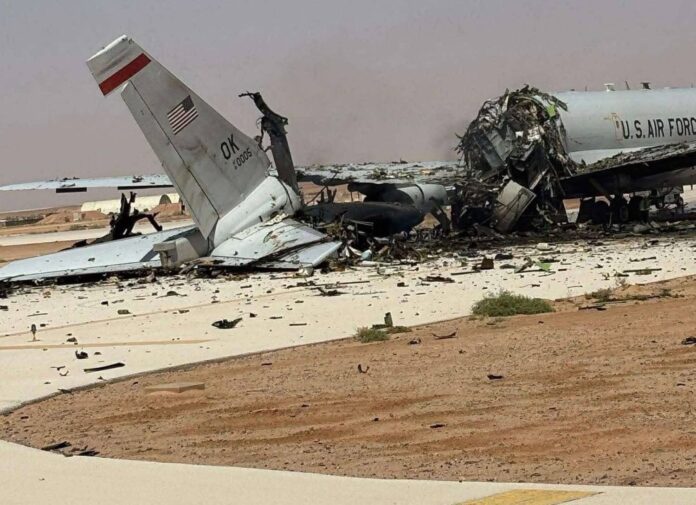
U.S. tankers were struck and damaged while on the ground at Prince Sultan Air Base in Saudi Arabia

The United States Air Force’s aerial refueling fleet has suffered a significant setback during the ongoing regional conflict involving Iran, according to emerging reports from defense sources.

At least five KC-135 Stratotanker aircraft were reportedly damaged in an Iranian missile and drone attack targeting Prince Sultan Air Base in Saudi Arabia, a major logistical hub for US operations in the Middle East.

The incident comes just days after a separate tragedy in which two KC-135 tankers collided mid-air over Iraq, further straining one of the most critical components of American airpower.

Strategic Importance of Prince Sultan Air Base

Prince Sultan Air Base, located near Riyadh, is one of the largest American operational facilities in Saudi Arabia. The base sits deep inside the Saudi interior, roughly 600 kilometers from the Iranian coastline.

Despite this distance, modern ballistic missiles can cover the gap extremely quickly. At high speeds, such missiles can reach the base in approximately six to eight minutes after launch.

This leaves very little warning time for personnel stationed on the ground.

Even if missile launch detection systems identify a threat, the time required to sound alarms and activate defensive systems is extremely limited. If missile defense systems fail to intercept the incoming threat, the base may be struck before aircrews can reach their aircraft.

Vulnerability of Large Support Aircraft

Large aircraft such as the KC-135 Stratotanker are particularly vulnerable to such attacks.

These aircraft typically remain parked in open areas of airbases due to their large size and the limited availability of hardened shelters. Their slow mobility and logistical role make them easier targets compared with combat aircraft that can scramble quickly.

Damage to aerial refueling tankers can have a major operational impact because these aircraft enable long-range missions for fighter jets, bombers, and surveillance aircraft.

Without them, the operational reach of US airpower in the region could be significantly reduced.

A Longstanding Problem in Warfare

The vulnerability of aircraft on the ground is not a new issue in military history.

During the Vietnam War, US airbases such as Tan Son Nhut and Bien Hoa were repeatedly targeted by Viet Cong mortar and rocket attacks.

Historical estimates suggest that about 5 percent of all US aircraft losses in the war occurred on the ground during base attacks. Around 75 aircraft were destroyed and nearly 900 were damaged as a result of these assaults.

Similar patterns appeared during US operations in Iraq and Afghanistan, where military bases frequently faced indirect fire attacks using rockets, mortars, and later drones.

This persistent threat environment has sometimes been described by military planners as a “rocket belt” or “drone belt” surrounding major bases.

Changing Threats: From Rockets to Drones and Missiles

Modern warfare has intensified these risks.

Where insurgent groups once relied primarily on crude rockets and mortars, today’s adversaries increasingly deploy precision ballistic missiles, cruise missiles, and armed drones capable of striking targets hundreds of kilometers away.

These systems can overwhelm traditional base defenses and threaten high-value aircraft parked on the ground.

US Response: Dispersing the Tanker Fleet

In response to the latest attack, the US Air Force is reportedly dispersing its KC-135 fleet across multiple bases throughout the Middle East.

Dispersed basing is designed to reduce the risk of losing multiple aircraft in a single strike.

Instead of concentrating critical assets in one location, aircraft are spread across several facilities, forcing adversaries to expend far more missiles and drones to achieve the same level of damage.

The Need for Hardened Infrastructure

Military analysts have long argued that hardened aircraft shelters, rapid relocation strategies, and dispersed basing are essential for survival in modern missile warfare.

Concentrating large numbers of aircraft in open parking areas can create lucrative targets for precision strikes.

Once a conflict begins, failure to disperse high-value assets quickly can dramatically increase the risk of catastrophic losses.

A Growing Challenge for Modern Airpower

The latest incident highlights a growing challenge for the United States and its allies.

As missile and drone technology becomes more accessible and sophisticated, even heavily defended bases far from front lines are no longer safe from rapid attack.

Protecting critical assets such as aerial refueling aircraft will likely remain a central concern for military planners as the conflict continues to evolve.

Why China Is Not Attacking Taiwan Despite the US–Israel War With Iran

0

The ongoing war between the United States, Israel, and Iran has triggered a major strategic debate among military analysts and on social media. A key question being discussed is whether China might take advantage of the situation and launch military action against Taiwan while the US military is heavily engaged in the Middle East.

Historically, China has taken advantage of moments when the United States was distracted by conflicts elsewhere. However, current developments suggest that Beijing is taking a very different approach this time.

Reduced Chinese Military Activity Around Taiwan

Since the outbreak of the Iran conflict, China’s military activities around Taiwan have actually declined rather than increased.

Taiwan’s air defense monitoring data shows that only two Chinese fighter jets entered Taiwan’s Air Defense Identification Zone (ADIZ) in March so far. This marks the lowest level of Chinese military incursions into Taiwanese airspace in recent years.

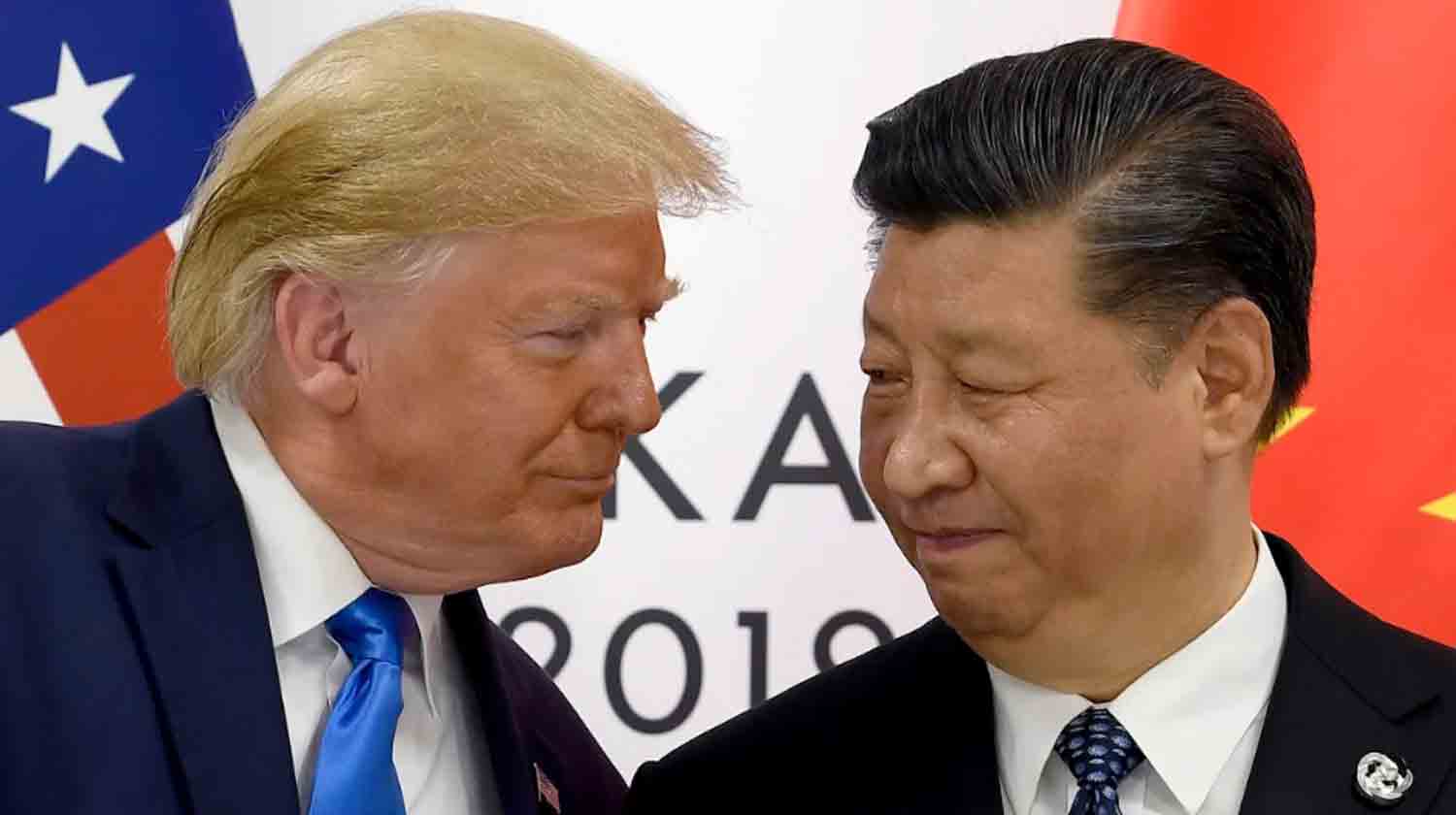
Analysts believe this decrease may be a diplomatic signal from Beijing ahead of a planned visit by US President Donald Trump to China later in March. China may be attempting to create a more stable and cooperative atmosphere before high-level talks between the two powers.

Taiwanese experts suggest that Beijing is currently signaling that it does not intend to resolve the Taiwan issue through military force in the near term.

Historical Precedent: Mao’s Strategy in 1958

China has previously attempted to exploit moments when the United States was involved in other conflicts.

In 1958, Chinese leader Mao Zedong ordered artillery bombardments of the Kinmen and Matsu islands. These islands are located just off the coast of mainland China but remain under Taiwanese control.

At the time, the United States was conducting military operations in Lebanon. Mao famously described Taiwan and Lebanon as “two traps” designed to tie down American military power.

By shelling the islands, Mao believed China was supporting anti-American movements in the Middle East while simultaneously challenging US influence in East Asia.

US Military Shift Toward the Middle East

The current Iran conflict has required the United States to shift some of its military resources away from the Indo-Pacific region.

One major example is the deployment of the aircraft carrier USS Abraham Lincoln from the South China Sea to the Middle East.

The carrier began its journey on January 14 and was expected to reach waters near Oman by January 26.

In addition, Washington has considered moving the THAAD missile defense system from South Korea to the Middle East to counter potential Iranian missile threats.

Some analysts worry these moves could temporarily weaken US deterrence against China in the Taiwan Strait.

China’s Energy Dependence Limits Military Options

Another major factor limiting China’s ability to launch a military operation against Taiwan is its heavy dependence on imported energy.

US actions against major oil-producing countries such as Venezuela and Iran have already created challenges for China’s energy supply.

Unofficial Chinese estimates suggest that in 2025 China imported approximately 463,000 barrels of crude oil per day from Venezuela. This represented around 70–80 percent of Venezuela’s total exports and about 7 percent of China’s total oil imports.

Iran is an even more critical supplier. Reports indicate that nearly 99 percent of Iran’s oil exports in 2025 were sent to China, accounting for about 13 percent of China’s seaborne crude imports.

Strategic Importance of the Strait of Hormuz

The Strait of Hormuz remains one of the most important oil routes for China.

In 2025, approximately 14.9 million barrels of oil passed through the strait each day. About 5 million barrels of that total were destined for China, representing roughly 43 percent of its daily oil imports.

Any prolonged disruption in Middle Eastern oil supplies could seriously affect China’s economy and military readiness.

Taiwanese media quoted a French economist suggesting that such energy dependence could hinder China’s ability to wage a long-term war against Taiwan.

China’s Strategic Oil Reserves

Despite these vulnerabilities, China has built a large strategic oil reserve to reduce potential supply disruptions.

Estimates suggest that China currently holds about 1.4 billion barrels of crude oil in its strategic stockpiles. If oil imports from the Middle East were completely cut off, these reserves could sustain China’s needs for approximately six months.

At the same time, Beijing is rapidly expanding domestic renewable energy production in order to reduce long-term reliance on imported fossil fuels.

Strengthening energy security has become a central pillar of China’s broader strategy for long-term competition with other major powers.

Military Reforms and Anti-Corruption Campaign

China’s military is also undergoing a major internal restructuring under President Xi Jinping’s anti-corruption campaign.

Since 2022, more than 100 senior military officers have reportedly been removed or investigated.

The shake-up has extended to the highest levels of military leadership. Between 2024 and 2026, five of the seven members of China’s Central Military Commission were removed or replaced, leaving only Chairman Xi Jinping and Vice Chairman Zhang Shengmin in their positions.

The expected resignation of Vice Chairman He Weidong in 2025 is also considered significant. He played an important role in shaping China’s “grey-zone strategy” against Taiwan, which involves pressure tactics short of open warfare.

These leadership changes could affect the operational readiness and strategic planning of the People’s Liberation Army.

Lessons From Modern Warfare

Some analysts believe China may also be closely studying recent US military operations.

Reports suggest that the performance of the Chinese-made HQ-9B air defense system used by Iran against US and Israeli strikes has raised questions about the effectiveness of certain Chinese military technologies.

Taiwanese media cited reports indicating that Iran’s mixed air defense network—combining Chinese, Russian, and locally produced systems—struggled against advanced American and Israeli electronic warfare and precision strikes.

However, China has denied supplying weapons to Iran.

These developments may be encouraging Beijing to reassess the readiness of its own military systems.

Strategic Calculations Continue

Although the US shift toward the Middle East might appear to create an opportunity for China, several factors suggest Beijing is not ready to take such a risk.

China’s military is undergoing major restructuring, its energy supply remains vulnerable to global disruptions, and diplomatic engagement with the United States remains ongoing.

At the same time, US military power and alliances in the Indo-Pacific continue to pose a significant obstacle to any potential Chinese military action against Taiwan.

For now, Beijing appears to be prioritizing strategic patience rather than military escalation.

AI-Driven Warfare: How U.S. and Israel Are Using Advanced Technology to Strike Hundreds of Targets in Iran Daily

0
The main coordination center for U.S. strikes operates from CENTCOM headquarters in Tampa, Florida.

The United States and Israel are employing advanced digital technologies and artificial intelligence-enabled systems to detect and strike hundreds of targets inside Iran every day, marking one of the fastest-paced targeting cycles in modern military history.

According to reporting by The Economist, the scale and intensity of U.S.–Israeli firepower now exceeds the operational tempo seen during the early phases of previous Gulf wars. Sophisticated software platforms and data-analysis tools allow analysts to identify targets and authorize strikes far more quickly than was possible in earlier conflicts.

Strike Tempo Surpassing Previous Gulf Wars

During the opening phases of the 1991 Gulf War and the 2003 Iraq War, coalition forces conducted roughly 1,300 air sorties per day. In the current conflict, the pace of strikes has already exceeded those levels within the first few days of combat.

After five days of operations, the U.S. Secretary of Defense stated that the ongoing campaign was employing twice the level of force used during the 2003 “Shock and Awe” campaign, highlighting the dramatic escalation in operational intensity.

AI-Assisted Target Identification

A major factor behind this unprecedented tempo is the rapid improvement in target detection and intelligence processing. Modern military systems can quickly compile vast “target banks” by integrating multiple intelligence streams, including:

  • Satellite imagery
  • Signals intelligence
  • Electronic surveillance
  • Open-source data and social media monitoring

Artificial intelligence elements embedded in these systems help analysts process enormous datasets within minutes rather than hours.

CENTCOM’s Role in Coordinating Strikes

The main coordination hub for U.S. strike operations is located at U.S. Central Command (CENTCOM) headquarters in Tampa, Florida.

Here, analysts compile and evaluate thousands of potential targets using a combination of classified and open-source intelligence. Once a target is confirmed:

  1. Weapons specialists determine the appropriate munition — such as bunker-penetrating bombs for underground facilities or GPS-guided weapons for buildings.
  2. Military legal advisers review the strike plan to ensure compliance with the laws of armed conflict.
  3. Senior commanders approve the final execution order.

This structured approval chain remains critical even as targeting processes become increasingly automated.

Palantir’s Maven Smart System

One of the most influential technologies used in the targeting process is Palantir’s Maven Smart System, an AI-enabled platform designed to integrate diverse intelligence sources.

The system combines:

  • Open-source information
  • Social media posts
  • Satellite imagery
  • Signals intelligence
  • Classified military databases

For example, if a civilian posts a message on Telegram about a missile launch, Maven can cross-reference that report with satellite imagery and electronic signals to verify the event.

Once confirmed, analysts can quickly:

  • Identify the launch location
  • Select the appropriate weapon
  • Conduct post-strike damage assessments

Tasks that once required dozens of specialists working for hours can now be completed in minutes.

A European general cited in defense discussions noted that modern systems have increased the potential strike capacity from roughly 10 targets per day to around 300, with future capabilities potentially reaching 3,000 targets daily.

Israel’s Expanding Target Database

Israel has developed similar AI-assisted targeting networks, significantly expanding its own target databases over the past decade.

U.S. officers were reportedly surprised when Israeli planners presented thousands of identified targets inside Iran, including:

  • Military bases
  • Missile launch systems
  • Weapons production facilities
  • Leadership residences
  • Strategic infrastructure

These databases allow commanders to maintain a constant flow of actionable targets during sustained operations.

Origins of Israel’s Targeting System

Israel’s modern targeting doctrine has historical roots stretching back decades.

The system’s foundation emerged after the 1973 Yom Kippur War, when the Israeli Air Force began developing sophisticated methods to locate and destroy enemy air defense systems.

The concept evolved further after the 2006 Lebanon War, when Israeli commanders complained that their available “target bank” had been exhausted after only a few weeks of combat. This led to major investments in intelligence collection and automated target generation systems.

Risks of High-Speed Targeting

Despite the advantages of AI-assisted warfare, the rapid pace of strikes also introduces new risks.

A larger target pool increases the possibility of errors, particularly if intelligence databases contain outdated information. For example, former military sites may have been converted into civilian facilities but could still remain on targeting lists.

Another concern is the declining number of U.S. specialists responsible for civilian risk assessment, which could complicate oversight during high-tempo operations.

As warfare becomes increasingly automated, future conflicts will require not only rapid target generation but also strict mechanisms to ensure that intelligence data remains accurate and current.

B-2 Bomber Strikes on Kharg Island Echo Iran-Iraq War Attacks on Iran’s Strategic Oil Hub

0

Recent footage released by U.S. President Donald Trump showing B-2 Spirit stealth bombers striking military targets on Iran’s Kharg Island has renewed attention on one of the most strategically important locations in the Persian Gulf.

The video, shared on Truth Social, shows precision strikes hitting military infrastructure on the island, including airbase facilities, missile launch positions, radar systems, and coastal defense installations. The strikes appear to involve 2,000-pound Joint Direct Attack Munitions (JDAMs) dropped by the radar-evading B-2 bomber.

However, the military action also highlights a broader historical context. Kharg Island has been attacked before — most notably during the Iran-Iraq War in the 1980s, when Iraqi forces repeatedly targeted the island’s oil infrastructure.

Despite those attacks, the island continued operating as Iran’s primary oil export hub.

A Strategic Oil Export Hub Since 1960

Kharg Island has played a central role in Iran’s energy sector for decades. The island first began exporting oil in 1960, when Iran expanded its export infrastructure to support growing global demand.

The facility was eventually developed to handle up to seven million barrels of oil exports per day, reflecting Iran’s position as one of the world’s major oil producers during the 1970s.

Today, Kharg Island remains the backbone of Iran’s crude export system.

Recent shipping data indicates that the island accounted for approximately:

  • 96% of Iran’s crude oil exports in 2025
  • Around 1.538 million barrels per day of the country’s total 1.605 million barrels per day exports

The island also contains 55 crude oil storage tanks capable of holding more than 34 million barrels of oil.

Historical Resilience During the Iran-Iraq War

The strategic importance of Kharg Island made it a primary target during the Iran-Iraq War (1980–1988), particularly during the phase known as the “Tanker War.”

Iraqi aircraft repeatedly attacked the island’s oil terminals and storage facilities in an effort to cripple Iran’s ability to export oil and finance the war.

Even after several storage tanks were destroyed in these raids, the export system proved remarkably resilient.

Even after repeated Iraqi attacks during the Iran–Iraq War in the 1980s that destroyed several storage tanks, Kharg Island was still able to export more than 1.5 million barrels of oil per day.

This experience demonstrated the redundancy and durability built into the island’s export infrastructure.

What the Recent Strikes Targeted

Initial assessments suggest that the recent B-2 strikes were aimed primarily at military installations on the island rather than the oil export facilities themselves.

Reported targets include:

  • Iranian Revolutionary Guard Corps missile launch sites
  • Coastal defense batteries
  • Radar installations monitoring the Persian Gulf
  • Military garrison facilities
  • Airbase infrastructure

These installations help defend the island and protect the surrounding maritime routes used by oil tankers.

Oil Tanker Operations Continue

Despite the military strikes, tanker operations appear to have continued at the island’s oil terminals.

Shipping tracking data indicates that a Very Large Crude Carrier (VLCC) was recently completing a 48-hour loading operation of approximately two million barrels of crude oil, while several smaller tankers were docked nearby.

Observers say the island has continued loading tankers almost continuously since the current conflict began two weeks ago.

This suggests that the strikes did not significantly disrupt the island’s core export infrastructure.

Precision Bombing and Modern Airpower

The munitions used in the strikes are believed to include GBU-31 and GBU-32 JDAM bombs, which use GPS guidance to strike targets with high accuracy.

JDAM weapons are designed to destroy hardened targets such as:

  • Runways and airbases
  • Missile launch platforms
  • Radar installations
  • Command facilities

The aircraft delivering these weapons, the B-2 Spirit stealth bomber, is designed to penetrate heavily defended airspace without detection by radar.

Its ability to carry large numbers of precision-guided bombs allows it to strike multiple targets during a single mission.

Strategic Messaging Behind the Strike

The public release of the strike footage carries both operational and political implications.

The B-2 bomber is one of the most advanced aircraft in the U.S. arsenal and is typically used for deep strike missions against high-value targets.

By releasing footage of the operation, the U.S. administration appears to be signaling its ability to strike strategic Iranian military infrastructure even in heavily defended areas.

However, the historical experience of Kharg Island suggests that attacks on the island do not necessarily stop Iran’s oil exports.

A Strategic Island With a Long Wartime History

Kharg Island’s role in regional conflicts illustrates the close link between energy infrastructure and military strategy in the Persian Gulf.

From Iraqi airstrikes during the Iran-Iraq War to modern stealth bomber operations today, the island has repeatedly found itself at the center of geopolitical confrontation.

Yet its export infrastructure has shown a remarkable ability to survive wartime damage and continue supplying global oil markets.

As tensions continue to rise in the region, Kharg Island remains both an economic lifeline for Iran and a strategic target in any conflict affecting the Persian Gulf’s energy corridors.

Iranian Missile Strike Damages U.S. KC-135 Tanker Aircraft at Prince Sultan Air Base in Saudi Arabia

0
USAF KC-135

A reported Iranian ballistic missile strike on Prince Sultan Air Base in Saudi Arabia has damaged multiple U.S. Air Force KC-135 Stratotanker aerial refueling aircraft, raising concerns about the resilience of the logistics infrastructure that supports American air operations in the Middle East.

According to information first reported by defense sources citing two unnamed U.S. officials, five KC-135 refueling aircraft were struck while parked on the ground during a recent Iranian missile attack.

Although the aircraft were not destroyed and no U.S. personnel were killed, the incident highlights a growing shift in Iranian strategy toward targeting critical support infrastructure rather than frontline combat platforms.

Strategic Impact on U.S. Air Operations

Aerial refueling aircraft such as the KC-135 Stratotanker play a crucial role in sustaining long-range air operations.

Even limited damage to tanker fleets can significantly affect:

  • Long-range strike missions
  • Combat aircraft endurance
  • Coalition air campaign tempo
  • Operational flexibility across the Gulf region

The temporary loss of several refueling aircraft could therefore introduce strategic constraints on U.S. airpower during an escalating regional conflict involving the United States, Israel, and Iran.

Rising Number of Tanker Losses

The incident increases the total number of U.S. tanker aircraft damaged or lost in recent days to at least seven.

This includes a separate KC-135 crash in western Iraq earlier in the week, which killed all six crew members aboard the aircraft.

Combined with additional operational incidents, these losses are beginning to place pressure on the limited pool of aerial refueling assets available for Middle East operations.

Iran’s Strategy: Targeting Logistics Infrastructure

Military analysts say the strike suggests Iran is increasingly focusing on logistics attrition, targeting the support systems that enable sustained combat operations.

Rather than seeking immediate battlefield victories, such attacks aim to gradually degrade operational readiness.

Damaging tanker aircraft can have disproportionate effects because aerial refueling enables fighters, bombers, and surveillance aircraft to operate over long distances.

Without sufficient refueling capacity, aircraft may be forced to reduce mission duration or operate from closer bases, limiting strategic flexibility.

Vulnerability of Forward-Deployed Tankers

Forward deployment of tanker aircraft allows rapid response to crises, but it also exposes these high-value assets to missile attacks.

Large refueling aircraft must operate from major airbases with extensive infrastructure, including long runways, fuel storage facilities, and maintenance equipment.

This makes them more predictable targets compared with smaller tactical aircraft that can disperse more easily.

Iran’s use of ballistic missiles against known airbase locations suggests an effort to exploit these predictable basing patterns.

Prince Sultan Air Base: A Key U.S. Hub

Prince Sultan Air Base has become one of the most important U.S. Air Force operating locations in Saudi Arabia.

The base supports aerial refueling missions that extend the range of U.S. fighters and bombers operating across:

  • Iraq
  • Syria
  • The Persian Gulf
  • Wider Middle East operational zones

Because tanker aircraft require significant support infrastructure, relocating these operations quickly can be difficult.

This makes such bases attractive targets for adversaries attempting to disrupt U.S. airpower.

Growing Regional Battlefield

The attack on the Saudi airbase comes amid a wider regional escalation in which Iran has launched missiles and drones at multiple locations across the Middle East.

Intercept attempts and reported attacks have occurred in:

  • Saudi Arabia
  • The United Arab Emirates
  • Kuwait
  • Other countries hosting U.S. forces

This expanding geographic scope means the current conflict is increasingly affecting partner nations hosting American military infrastructure.

Logistics Attrition as a Military Strategy

Repeated attacks on airbases can gradually weaken operational capacity even without dramatic battlefield outcomes.

Military experts note that logistics attrition — damaging aircraft on the ground or disrupting maintenance cycles — can impose significant operational costs.

Repairing damaged refueling aircraft often requires specialized parts and maintenance, which can remove them from service for extended periods.

This is particularly significant because tanker fleets are relatively limited in number, making each aircraft strategically valuable.

Pressure on Air Defense Systems

The continued missile and drone launches also place pressure on regional air defense networks.

Every interception requires defensive missiles, radar tracking, and coordinated command operations.

Even when attacks are successfully intercepted, the process consumes resources and increases operational strain.
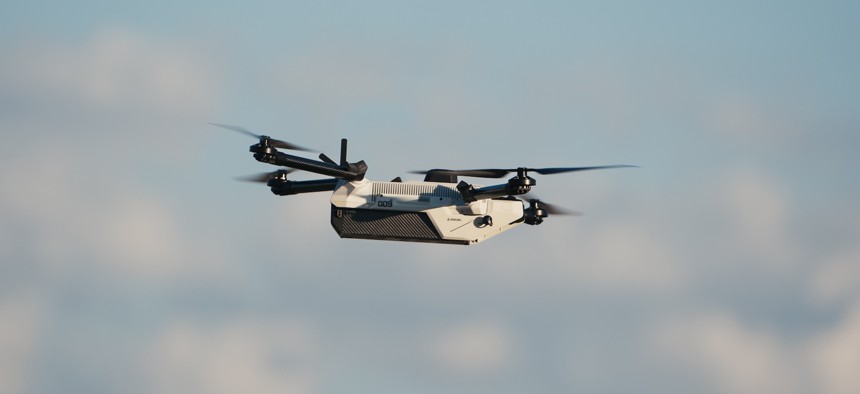
Iran’s ongoing missile launches suggest a strategy based on sustained pressure rather than a single decisive strike, forcing defending forces to remain on constant alert.

Implications for U.S. Operational Endurance

The damage to multiple KC-135 aircraft highlights how support systems underpin modern air warfare.

Tanker aircraft enable combat aircraft to remain airborne for longer periods and operate across wide geographic areas.

Reduced refueling capacity can therefore limit the ability to respond simultaneously to multiple threats across the region.

With at least seven tanker aircraft damaged or lost during the current conflict period, the cumulative effect could begin to influence U.S. operational planning, basing decisions, and mission tempo in the Middle East.
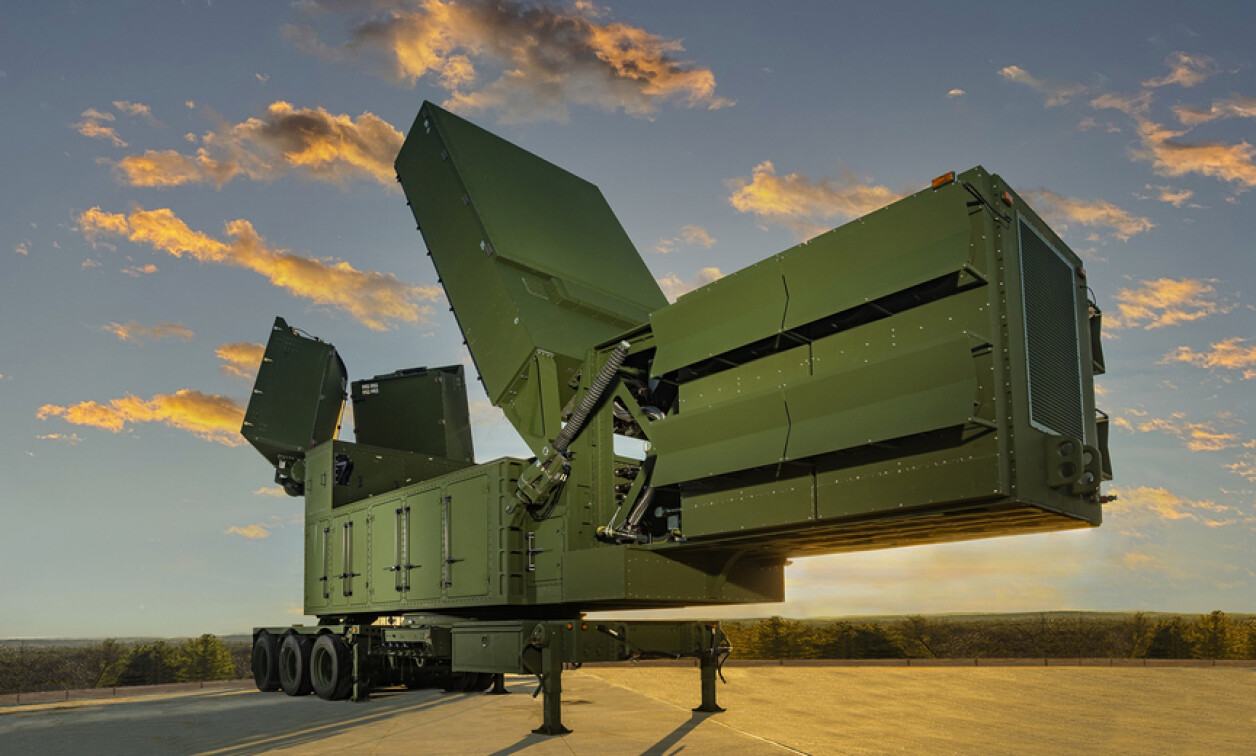
As tensions continue to rise, the resilience of logistics infrastructure — rather than just frontline combat capability — may become a decisive factor in determining the endurance of air operations in the region.

US Deploys B-1B Lancer Bombers to UK as Analysts Warn of Possible Strikes on Iran’s Underground Facilities

0
B-1B Lancer, a long-range strategic bomber capable of carrying the largest conventional payload of guided and unguided munitions

The transfer of U.S. B-1B Lancer strategic bombers to the United Kingdom has drawn significant attention from military analysts as tensions surrounding Iran continue to escalate.

Recent images and videos released from RAF Fairford air base in western England show the bombers preparing heavy bunker-busting munitions, fueling speculation that potential future strikes could target Iran’s underground military infrastructure.

The deployment comes amid intensified attacks on Iranian targets, with some eyewitnesses reporting explosions so powerful that they felt “earthquake-like” tremors.

Bombers Seen Loading Bunker-Busting Weapons

According to reports cited by Gulf News, the B-1B bombers observed at RAF Fairford were loading heavy bunker-penetrating munitions designed to destroy reinforced concrete structures and underground facilities.

These weapons are specifically designed to strike hardened military sites such as:

  • Underground missile bases
  • Command and control centers
  • Weapons storage depots
  • Tunnel networks

The presence of such munitions has led analysts to believe that future strikes could focus on deep underground military infrastructure in Iran.

JDAM Precision Bombs Reportedly Prepared

Some of the aircraft are reportedly equipped with Joint Direct Attack Munitions (JDAMs) — precision-guided bombs that use satellite navigation to strike targets with high accuracy.

JDAM weapons can penetrate fortified structures and underground bunkers, making them suitable for attacking hardened military installations.

Unlike cruise missiles, which can be launched from very long distances, JDAM bombs require the aircraft to approach the target area relatively closely — typically within about 40 kilometers.

Military analysts note that such operations generally occur when enemy air defense systems have been weakened or suppressed, allowing bombers to operate closer to their targets.

B-1B Lancer: A Key U.S. Deep-Strike Bomber

The B-1B Lancer is one of the most important long-range strike aircraft operated by the U.S. Air Force.

Introduced in the 1980s, the bomber was originally designed for nuclear missions during the Cold War. After the Cold War ended, however, the aircraft was adapted for conventional long-range strike operations.

Key capabilities of the B-1B include:

  • Payload capacity of up to 34 tons of weapons
  • Ability to fly at near-supersonic speeds
  • Long-range strike capability
  • Ability to carry large numbers of precision-guided bombs or cruise missiles

These capabilities make the aircraft particularly effective in deep-strike operations against hardened or high-value targets such as underground command centers or weapons depots.

Variable-Sweep Wing Design

One of the most distinctive technical features of the B-1B Lancer is its variable-sweep wing design.

The wings can be adjusted depending on the phase of flight:

  • Extended wings during takeoff and landing improve lift and aircraft control.
  • Swept-back wings reduce air resistance during high-speed flight.

This design allows the bomber to carry heavy weapons over long distances while still maintaining the ability to approach target areas at high speed if required.

Possible Targets: Iran’s Underground “Missile Cities”

Military analysts believe that potential targets for such bombers could include Iran’s extensive underground military infrastructure.

Over the past decade, Iranian media has repeatedly referenced networks of underground facilities often described as “missile cities.”

These complexes are typically built:

  • Deep inside mountains
  • Beneath layers of reinforced concrete
  • Within extensive tunnel networks

They are believed to store ballistic missiles, drones, launch systems, and other strategic weapons.

Such underground facilities are designed to increase survivability during air attacks and make detection more difficult.

Strategy for Attacking Underground Facilities

Military experts say that completely destroying underground facilities can be extremely difficult.

Instead, a common strategy is to target tunnel entrances, access routes, or deployment corridors.

Even if the missiles themselves remain intact, destroying these access points can effectively trap weapons inside underground bases, preventing them from being deployed.

“Earthquake-Like” Explosions Explained

Reports of unusually powerful explosions during recent strikes have also attracted attention.

Some witnesses described tremors strong enough to feel like small earthquakes.

Experts explain that this phenomenon can occur when large explosions take place deep underground, causing shock waves to travel through soil and rock, producing noticeable ground vibrations.

Strategic Importance of RAF Fairford

The deployment of B-1B bombers to RAF Fairford carries both operational and political significance.

The base is one of the most important U.S. Air Force facilities in Europe and is frequently used to host American strategic bombers during deployments and exercises.

Its long runway and infrastructure make it ideal for operating heavy bomber aircraft.

From the UK, bombers can reach operational areas in the Middle East more efficiently than flying directly from the United States.

Limited Number of B-1B Bombers

The number of operational B-1B bombers in the U.S. Air Force inventory is relatively limited.

Some estimates suggest that around 40 aircraft remain operational, making their deployment in any military operation both strategically and symbolically significant.

Analysts say that positioning these aircraft in Europe could signal U.S. readiness to use heavy conventional strike power against hardened Iranian targets if tensions continue to escalate.

Rising Regional Tensions

The bomber deployment comes as the broader regional conflict expands.

Recent weeks have seen attacks targeting:

  • Energy infrastructure
  • Oil facilities
  • Commercial shipping routes

Particular concern has focused on maritime routes near the Strait of Hormuz, one of the world’s most critical oil transit corridors.

Repeated incidents in the region have raised fears about global energy supply disruptions and further escalation of the conflict.

Pentagon Orders Deployment of 31st Marine Expeditionary Unit as Iran Escalates Strait of Hormuz Attacks

0
31st Marine Expeditionary Unit. file photo

The Pentagon has ordered the deployment of a Marine Expeditionary Unit (MEU) to the Middle East as tensions surge around the Strait of Hormuz, where Iran has intensified attacks on commercial shipping following recent U.S.–Israeli strikes.

According to defense officials, Defense Secretary Pete Hegseth approved an urgent request from U.S. Central Command (CENTCOM) to deploy the Japan-based 31st Marine Expeditionary Unit, a rapid-response force designed for maritime security and crisis operations.

31st MEU Deployment Details

The 31st MEU consists of approximately 2,200 Marines deployed aboard three U.S. Navy amphibious ships, including the USS Tripoli amphibious assault ship.

Some reports indicate the full amphibious ready group and supporting elements could bring the total personnel involved in the deployment to around 5,000, although the core Marine combat element typically ranges between 2,200 and 2,500 troops.

Marine Expeditionary Units are designed for rapid deployment and can conduct a wide range of missions including amphibious assaults, crisis response, and maritime security operations.

Escalation in the Strait of Hormuz

The deployment comes amid a sharp escalation in Iranian activity around the strategic waterway. Since the launch of Operation Epic Fury on February 28, Iran has intensified attacks on commercial shipping transiting the Strait of Hormuz.

Key developments reported so far include:

  • At least 13 commercial vessels struck by projectiles.
  • Six seafarers killed during attacks.
  • One of the targeted vessels reportedly sailed under the U.S. flag.

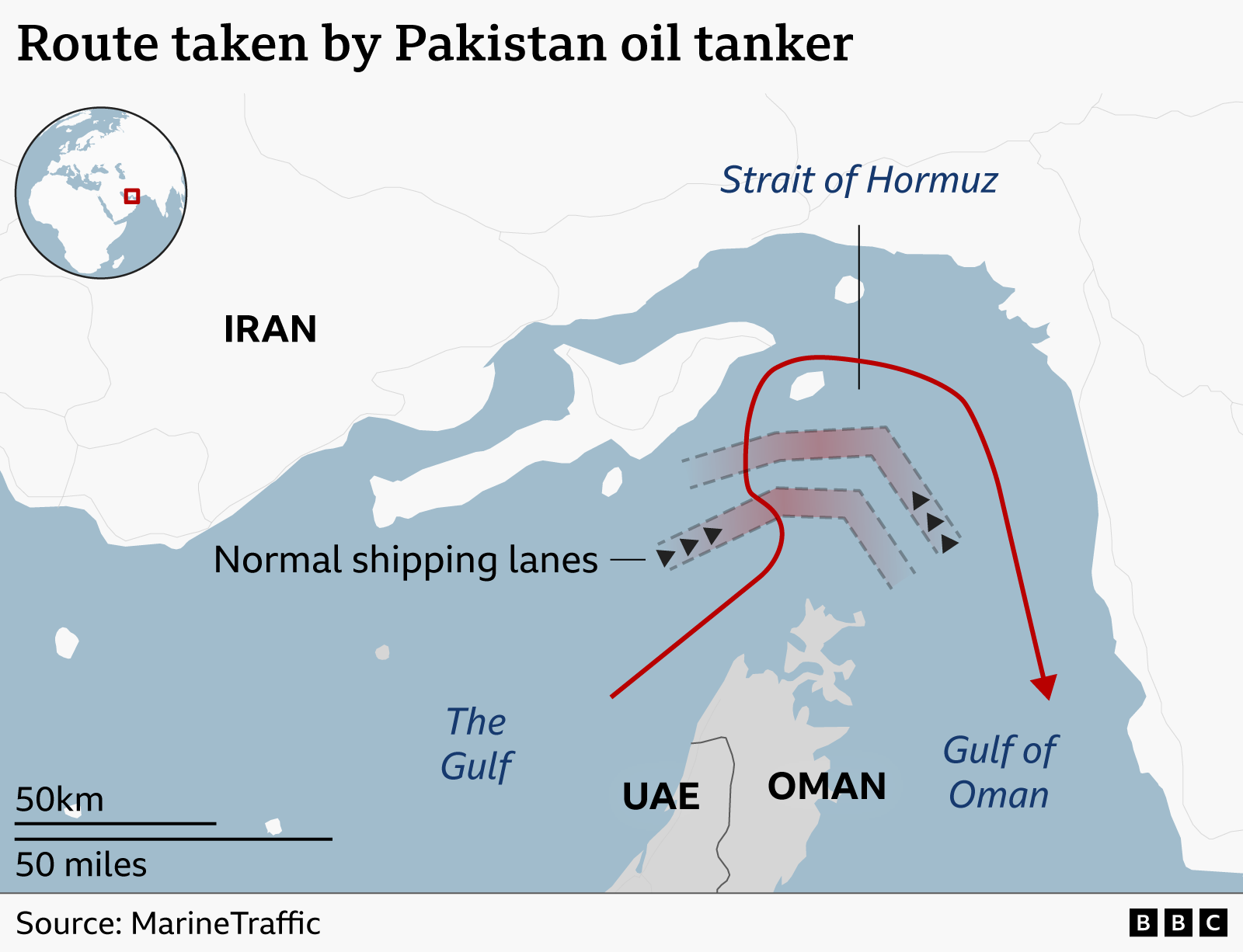
Shipping traffic through the strait has dramatically declined as a result of the escalating conflict. Maritime monitoring data indicates daily traffic has dropped from roughly 100 vessels per day before the conflict to single digits in recent days. Oil tanker movements alone have reportedly fallen by about 80 percent.

U.S. forces operating in the region have already destroyed 16 Iranian vessels believed to be laying naval mines near the critical shipping corridor.

Iran’s new supreme leader, Mojtaba Khamenei, has vowed to keep the chokepoint closed, declaring ships linked to the United States or Israel as “legitimate targets.”

As a result, only a limited number of ships are still moving through the area, often with transponders switched off in so-called “dark” transits to avoid detection.

Impact on Global Energy Markets

The Strait of Hormuz is one of the world’s most critical energy chokepoints, carrying approximately 20 percent of global oil and liquefied natural gas (LNG) shipments.

The escalating conflict has already begun affecting global energy markets. Brent crude prices have climbed above $94 per barrel, reflecting growing fears that a prolonged disruption in the strait could severely impact global oil supplies.

Capabilities of the Marine Expeditionary Unit

The 31st MEU brings a versatile mix of military capabilities designed for rapid response operations.

Its deployment includes:

  • Amphibious assault ships capable of launching Marines directly onto shorelines.
  • Ground combat units equipped for expeditionary warfare.
  • Aviation elements, including F-35 fighter jets and MV-22 Osprey tilt-rotor aircraft.
  • Logistics and support units for sustained operations.

These capabilities allow the force to conduct missions ranging from tanker escort operations and maritime security patrols to rapid amphibious deployments if required.

However, U.S. officials emphasize that the deployment is not intended for a ground invasion of Iran. Instead, it provides commanders with flexible options to protect shipping lanes and respond to potential Iranian actions in the region.

Broader U.S. Strategy: Operation Epic Escort

The Marine deployment is part of a broader U.S. strategy aimed at stabilizing maritime traffic through the Strait of Hormuz.

Military planners are reportedly developing options under what has been described as “Operation Epic Escort,” which could involve escorting commercial tankers through the strait if ordered by the White House.

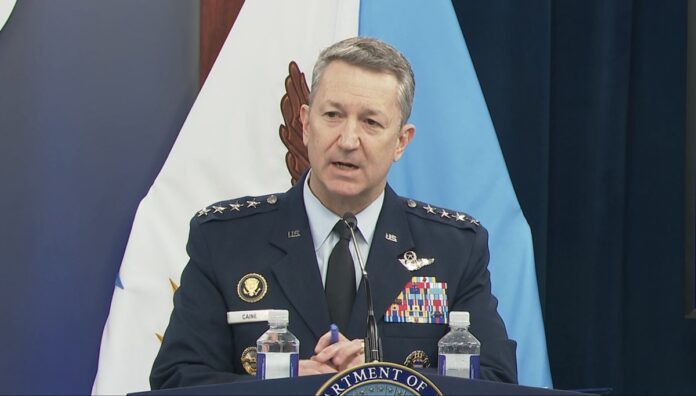
According to Joint Chiefs Chairman Gen. Dan Caine, potential escort operations may include:

  • Naval escorts for commercial vessels
  • Air cover for shipping convoys
  • Unmanned surveillance and protection assets
  • Mine countermeasure operations

At present, no escort missions have officially begun.

Defense Secretary Hegseth stated that Iranian naval forces have already suffered significant losses, saying approximately 50 Iranian boats have been destroyed in U.S. strikes.

Despite this, the Pentagon continues to reinforce the region as a precaution while tensions remain high.

A Signal of Escalation Preparedness

The deployment of the 31st Marine Expeditionary Unit signals that Washington is preparing for further escalation in the Gulf.

With shipping traffic severely disrupted and global oil markets reacting sharply, the United States appears to be positioning forces to ensure that the Strait of Hormuz — one of the world’s most important energy corridors — can be reopened if necessary.

Meanwhile, ongoing U.S. and Israeli airstrikes against Iranian targets continue to intensify, with U.S. officials warning that upcoming strikes could be among the most intense of the campaign so far.

The situation remains fluid, and defense analysts are closely watching whether the arriving Marine forces will integrate with existing U.S. carrier strike groups or become involved in future tanker escort operations in the region.

Strategic Alarm After Satellite Photos Reveal Crater at U.S. Al Dhafra Air Base

0

Satellite imagery circulating globally since March 12, 2026, has sparked intense debate among defense analysts after appearing to show a large impact crater at Al Dhafra Air Base in the United Arab Emirates, one of the most important U.S. military airpower hubs in the Gulf.

The images, widely shared across social media platforms including X, Telegram and Instagram, appear to show a developed section of the base where rows of rectangular buildings previously stood, replaced by a large dark circular crater.

Iranian sources claim the strike involved the Khorramshahr-4 ballistic missile, one of the most powerful medium-range missiles in Iran’s arsenal, designed to penetrate advanced missile-defense systems and strike hardened military infrastructure.

Strategic Importance of Al Dhafra Air Base

Al Dhafra Air Base is a central node in the United States’ military presence in the Middle East.

The facility serves as a forward-deployed air combat center supporting operations across the Gulf region and beyond. Its role includes hosting advanced aircraft and coordinating air operations across multiple theaters.

Because of this strategic role, the base has long been considered a high-priority target in any potential confrontation with Iran.

Analysts note that any confirmed ballistic missile impact at the facility would have implications not only for the UAE but also for the broader U.S. military logistics and deterrence network across the Gulf.

Iranian Claims and Missile Identification

Iran’s Islamic Revolutionary Guard Corps (IRGC) has claimed responsibility for targeting what it described as the base’s “U.S. air combat center.”

Iranian-aligned reporting has identified the weapon as the Khorramshahr-4 missile, also known as Kheibar, a heavy-payload medium-range ballistic missile unveiled by Iran in 2023 and believed to have entered operational service by 2026.

With an estimated range of about 2,000 kilometers, the missile can reach most U.S. military installations across the Gulf region.

Infographic: Al Dhafra Air Base Strike Explained- Khorramshahr-4 Missile Capabilities

Heavy Payload Raises Alarm

The Khorramshahr-4 is notable for carrying one of the largest warheads among Iran’s medium-range ballistic missiles, with a payload estimated between 1,500 and 1,800 kilograms.

Such a heavy payload is capable of producing large impact craters and significant structural damage, especially if the missile penetrates missile-defense systems and strikes a hardened facility directly.

Defense analysts say the crater visible in the viral imagery—estimated at roughly 10 to 20 meters wide—could be consistent with a large conventional ballistic missile warhead.

Advanced Missile Capabilities

The Khorramshahr-4 uses a single-stage liquid-fuel propulsion system with storable propellants, allowing the missile to remain ready for launch for extended periods.

The system is deployed on road-mobile transporter-erector-launchers, enabling rapid relocation after launch to avoid counterstrikes.

Iranian descriptions also highlight several advanced features:

  • High-speed reentry approaching hypersonic velocity
  • Maneuverable reentry vehicle (MaRV) capable of evasive maneuvers
  • Inertial navigation with possible satellite guidance updates
  • Flexible payload configurations

These capabilities are designed to complicate interception by layered missile-defense systems deployed around major Gulf bases.

Information Warfare and Satellite Imagery

Even though the exact level of damage at Al Dhafra remains unconfirmed by U.S. or Emirati officials, the rapid spread of satellite imagery demonstrates how space-based observation has become central to modern information warfare.

The before-and-after format of the images—showing intact building structures replaced by a large impact crater—has been widely used in online narratives claiming a successful Iranian strike.

Analysts believe the coordinated distribution of the imagery across multiple platforms suggests intentional information amplification rather than random sharing.

Strategic Signal Beyond the Battlefield

The alleged strike carries significance beyond the tactical level.

Linking the attack to the Khorramshahr-4 missile system serves as a strategic signal from Iran highlighting its ability to strike heavily defended U.S.-linked installations across the Gulf.

Even unverified evidence of a missile penetrating air defenses forces military planners to reconsider the resilience of forward-deployed bases in the region.

For regional allies and U.S. strategists, the incident underscores the growing challenge of defending fixed military infrastructure located within range of large-payload ballistic missile systems.

Implications for the 2026 Conflict

In the context of the ongoing 2026 regional conflict, the Al Dhafra crater imagery represents more than a single potential strike.

It highlights the evolving balance between offensive missile capability and defensive missile-defense systems across the Gulf region.

Whether or not the damage is eventually confirmed, the imagery has already become a focal point in debates about missile defense effectiveness, forward base survivability, and the future of military deterrence in the Middle East.

Global Winners and Losers of the Iran War: Oil Prices, Trade and Strategic Power

0
An oil tanker on fire in the Gulf of Oman.

Major wars rarely produce clear winners, especially for ordinary people who often bear the heaviest costs. However, large geopolitical conflicts frequently reshape global markets and power balances, creating strategic advantages for some countries even amid widespread instability.

The ongoing war involving Iran, Israel and the United States has already disrupted energy markets, supply chains and maritime routes across the Middle East, sending shockwaves through the global economy.

As the conflict intensifies, analysts are increasingly examining which countries may gain strategic or economic advantages from the turmoil — and which nations are likely to suffer the most.

Russia Could Gain From Higher Oil Prices

Despite losing an important regional partner after the assassination of Iran’s Supreme Leader Ali Khamenei, Russia may still benefit economically from the conflict.

One key reason is energy prices.

Russia’s federal budget heavily depends on oil revenues, with much of its planning based on crude prices around $59 per barrel. However, the conflict has pushed oil prices toward $100 per barrel, providing Moscow with unexpected financial relief during its ongoing war in Ukraine.

Another advantage comes from shifting military priorities in Washington.

Some analysts believe that U.S. military resources and missile defense systems previously allocated to Ukraine are being redirected toward the Middle East, potentially limiting the supply of weapons to Kyiv.

According to security analysts, reduced shipments of systems such as Patriot interceptors could weaken Ukraine’s defensive capabilities against Russia.

infographic: Global Winners and Losers of the Iran War

Energy Market Shifts Could Also Help Russia

The disruption of shipping routes in the Strait of Hormuz, one of the world’s most important energy chokepoints, has sharply increased energy prices and created uncertainty in global oil markets.

This situation may open additional export opportunities for Russia.

Some countries that had previously reduced purchases of Russian oil may now seek alternative supply sources to stabilize their energy markets.

Analysts say India and China could increase imports of Russian crude, particularly if supply disruptions in the Middle East persist.

China Faces Economic Pressure — But Also Strategic Opportunities

China’s economy has not yet experienced severe disruption from the conflict, largely because it maintains significant strategic oil reserves.

Additionally, Iran accounts for only about 12 percent of China’s total crude oil imports, meaning Beijing has some flexibility in sourcing energy from other suppliers, including Russia.

However, China could face indirect economic pressure due to its heavy dependence on global trade.

Exports account for roughly 20 percent of China’s GDP, and disruptions to maritime shipping routes in the Red Sea and Bab-el-Mandeb Strait could increase transportation costs and delay shipments.

Some cargo vessels traveling between Asia and Europe may be forced to detour around South Africa’s Cape of Good Hope, increasing shipping times by up to two weeks and adding millions of dollars in additional costs per voyage.

Despite these challenges, Beijing may also see diplomatic opportunities.

China could attempt to position itself as a more stable and responsible global power, contrasting its diplomatic approach with U.S. military intervention.

Southeast Asia Faces Rising Energy Costs

Countries heavily dependent on Middle Eastern energy supplies are likely to face some of the most immediate economic challenges.

Several Southeast Asian nations rely on oil imports from the Gulf region, making them particularly vulnerable to supply disruptions.

For example:

  • The Philippines imports about 95% of its crude oil from the Middle East
  • Governments in several countries have begun implementing energy-saving measures
  • Fuel prices have risen sharply across multiple economies

Some governments have even introduced emergency policies such as shortened workweeks, remote working arrangements, and fuel rationing to conserve energy supplies.

Economic Impact Reaches South Asia

The economic ripple effects are already visible across South Asia.

In Pakistan, authorities have introduced work-from-home measures and reduced operating hours in some sectors to conserve fuel.

Meanwhile, Bangladesh has implemented fuel rationing after panic buying created long queues at petrol stations.

These policies highlight the immediate economic pressure that energy price spikes can create in developing economies.

A Potential Food Security Crisis

The war’s impact may extend beyond energy markets.

Experts warn that disruptions in shipping through the Strait of Hormuz could also affect global fertilizer supply.

Approximately 30 percent of the world’s urea, a key fertilizer ingredient derived from petrochemicals, passes through the Strait.

If shipping disruptions significantly reduce urea availability, global agriculture could be affected.

Analysts warn that this could lead to:

  • Reduced fertilizer production
  • Lower crop yields
  • Rising food prices worldwide

The full economic impact may take six to nine months to become visible, but experts say the consequences could be severe for global food security.

No Clear Winners in War

While some countries may gain economic or strategic advantages from the conflict, the broader consequences remain overwhelmingly negative.

The war has already displaced millions of people across the Middle East, destabilized energy markets and increased global economic uncertainty.

As the conflict continues, the balance between geopolitical opportunity and global economic risk will likely shape the international response to one of the most dangerous crises in recent years.

Two Weeks Into War: Iran Threatens Hormuz Closure as Israel Strikes 200 Targets

0
Smoke rises after a reported strike on Shahran fuel tanks in Tehran, Iran

The escalating war involving Iran, Israel and the United States is approaching its two-week mark with no signs of de-escalation, as leaders on all sides have vowed to continue military operations despite rising casualties and growing economic shock across global markets.

The conflict, which began on February 28 with coordinated U.S. and Israeli strikes against Iranian targets, has already killed thousands of people and disrupted energy markets worldwide.

Mojtaba Khamenei Issues First Statement

Iran’s newly appointed Supreme Leader Mojtaba Khamenei delivered his first public message since assuming power following the death of his father during the initial strikes.

His statement was read by a television presenter rather than delivered in person, raising questions about his condition after Iranian officials reported that he had been lightly wounded during early attacks.

In the message, Khamenei vowed that Iran would continue resisting its enemies and warned that the Strait of Hormuz would remain closed, threatening global oil supply routes.

He also urged neighboring countries to shut down U.S. military bases on their territory or risk Iranian retaliation.

“I assure everyone that we will not neglect avenging the blood of your martyrs,” Khamenei said in the statement.

Infographic: Iran war, two weeks, key developments

Netanyahu Signals Regime Change Pressure

Israeli Prime Minister Benjamin Netanyahu held his first press conference since the war began, defending Israel’s military campaign and suggesting that the conflict could eventually lead to political change inside Iran.

“We are creating the optimal conditions for toppling the regime,” Netanyahu said, though he acknowledged that any government collapse would ultimately come from within Iran.

The Israeli Defense Forces (IDF) said its air force struck more than 200 targets in western and central Iran within 24 hours, including missile launchers, air defense systems and weapons production facilities.

The strikes are part of Israel’s campaign known as Operation Roar of the Lion.

Iran Launches Missile Barrages

Despite earlier claims that Iranian missile capabilities had been severely degraded, Iran launched another barrage of missiles toward Israel overnight.

Israeli emergency services reported that 58 people were taken to hospitals, most suffering minor injuries caused by shattered glass from explosions and interceptions.

Debris from missile interceptions also caused minor damage to a building in Dubai, while Saudi Arabia reported intercepting two drones in its eastern region.

Conflict Spreads Across the Region

The war has increasingly expanded beyond Iran and Israel.

In Lebanon, Israeli strikes targeting Hezbollah have reportedly killed hundreds of people, while tensions have escalated in Iraq where Iran-aligned militias claimed responsibility for downing a U.S. aircraft involved in refueling operations.

European forces have also been affected. French President Emmanuel Macron said one French soldier was killed and several others wounded during an attack in northern Iraq.

Meanwhile, ships in the Persian Gulf have been targeted by explosive drones and naval attacks, including two tankers that were set ablaze at Iraq’s Basra port earlier in the week.

Global Markets React to War

The escalating conflict has already begun to shake global financial markets.

Oil prices surged around 9% to approximately $100 per barrel, reflecting fears that prolonged disruption could threaten energy supplies passing through the Strait of Hormuz.

The S&P 500 recorded its largest three-day drop in a month, while Asian markets also fell amid concerns that the conflict could trigger a wider economic shock.

In response, the United States issued a temporary 30-day license allowing countries to purchase Russian oil cargoes currently stranded at sea in an attempt to stabilize supply.

Trump Defends War Strategy

U.S. President Donald Trump said the United States and Israel were achieving major military success and insisted the conflict would ultimately benefit the American economy.

Trump argued that rising oil prices could generate increased revenue for the United States, the world’s largest oil producer.

“The United States is the largest oil producer in the world, by far, so when oil prices go up, we make a lot of money,” Trump said in social media comments.

However, opposition Democrats criticized the administration, demanding more transparency about civilian casualties and questioning the long-term strategy for Iran after the war ends.

Rising Civilian Impact

The conflict has had a devastating humanitarian toll.

More than 2,000 people have been killed, most of them in Iran, while millions across the region have seen their daily lives disrupted by missile strikes, military activity and economic instability.

Inside Iran, residents report a heavy presence of security forces in major cities as the government attempts to maintain control while the country remains under attack.

Energy Shock Strategy

Iranian officials have indicated that their strategy may involve prolonged economic disruption aimed at forcing Washington to reconsider its military campaign.

Some Iranian military representatives have warned that global oil prices could potentially reach $200 per barrel if the conflict continues.

U.S. officials say such a scenario is unlikely but have not ruled it out.

Trump Claims Iran’s New Supreme Leader Mojtaba Khamenei Is Injured but Alive

0
Supreme leader of Iran Mojtaba Khamenei

U.S. President Donald Trump said he believes Iran’s newly appointed Supreme Leader Mojtaba Khamenei is still alive but may have been injured during the opening stages of the ongoing war between Iran, the United States, and Israel.

Speaking in an interview on Fox News’ “The Brian Kilmeade Show,” Trump suggested the new Iranian leader had survived the early strikes but might have been wounded.

“I think he probably is (alive). I think he is damaged, but I think he’s probably alive in some form,” Trump said during the interview, according to remarks published by Fox News.

Leadership Uncertainty in Tehran

Mojtaba Khamenei, the son of former Supreme Leader Ali Khamenei, was selected as Iran’s new leader by a clerical assembly after his father was reportedly killed on the first day of the conflict.

However, the new leader has not appeared publicly since his appointment.

His first remarks were delivered indirectly when a state television presenter read a statement attributed to him, raising questions about his condition and whereabouts.

According to a Reuters report citing an Iranian official, Mojtaba Khamenei was lightly injured during the conflict but continues to direct affairs.

Iranian state television later described him as “war-wounded.”

Khamenei’s First Message Since Appointment

In his first reported statement, the new supreme leader vowed that Iran would continue to confront its adversaries during the conflict.

He warned that Iran would keep the Strait of Hormuz closed, a move that could significantly disrupt global oil shipments.

The statement also called on neighboring countries to shut down U.S. military bases on their territory, warning that Iran could target those installations if they continue supporting American military operations.

War Between Iran, the US and Israel Intensifies

The current war began on February 28, when the United States and Israel launched coordinated strikes against Iranian military and strategic targets.

Iran has responded with missile and drone attacks against Israel and Gulf states hosting U.S. military bases.

As the conflict approaches the two-week mark, thousands of casualties have been reported and tensions across the Middle East have intensified.

Global Impact and Rising Tensions

The escalating conflict has also shaken global financial markets and raised concerns about energy supply disruptions.

The Strait of Hormuz, through which a large share of the world’s oil exports pass, remains a central flashpoint in the crisis.

Meanwhile, the leaders of Iran, Israel, and the United States have all issued statements signaling determination to continue fighting despite mounting international concerns about a broader regional war.

From Missiles to Data: Strategic Lessons China May Gain From the Iran War

0
Ukrainian service members walk next to a launcher of a Patriot air defence system, amid Russia's attack on Ukraine, in an undisclosed location, Ukraine.

Beyond the immediate battlefield, the ongoing conflict with Iran may carry long-term strategic consequences for the United States’ military competition with China.

While Washington’s focus has been on the Middle East, analysts say the war could influence global military balances, weapons inventories, and technological competition in ways that extend far beyond the region.

Several strategic dynamics emerging from the conflict could shape how the United States and China compete in the coming years.

1. Depletion of Advanced Weapons Stockpiles

One of the most immediate effects of the war is the rapid consumption of advanced U.S. missile systems and interceptor weapons.

Modern conflicts rely heavily on expensive precision-guided munitions and missile defense interceptors. Sustained operations can quickly deplete inventories that took years to build.

Replenishing these systems requires:

  • Significant financial investment
  • Long manufacturing timelines
  • Expanded production capacity

Even after replenishment, the United States may simply return to the same inventory levels it had before the war.

Meanwhile, competitors such as China could continue expanding their own stockpiles of offensive missiles, drones, and long-range strike systems during the same period.

How the Iran War Could Affect US Military Competitiveness With China

2. Demonstration of Integrated Surveillance and Drone Warfare

Another key lesson from the conflict involves the growing role of space-based surveillance and low-cost drone systems.

Modern warfare increasingly involves coordination between:

  • Satellite imagery
  • Targeting data
  • Drone swarms
  • Precision weapons

Analysts note that such combinations can produce effective strike capabilities even when using relatively inexpensive platforms.

For China, which operates a rapidly expanding constellation of Earth observation satellites, the lessons of this integration could be particularly relevant.

China’s large industrial base also provides the capacity to produce drones and missiles at scale.

3. Perceptions of Military Technology

Conflicts also shape global perceptions of military technology.

Some observers in the Middle East and elsewhere have raised questions about whether expensive advanced systems provide sufficient protection against large numbers of lower-cost threats, such as drones or mass-produced missiles.

These perceptions can influence international defense markets.

Countries evaluating future arms purchases may increasingly compare:

  • Highly advanced but expensive Western systems
  • Lower-cost alternatives produced by other suppliers

In global arms markets, China and Türkiye are often viewed as emerging competitors in this space.

4. Lessons From Decentralized Defense Models

Another notable aspect of the conflict is the effectiveness of decentralized defensive strategies.

Iran’s approach has involved distributing capabilities across multiple regional commands and platforms rather than relying solely on centralized command systems.

This approach can complicate efforts to disrupt operations through traditional means such as:

  • Electronic warfare
  • Targeting command-and-control centers
  • Leadership decapitation strategies

For other military planners around the world, the conflict provides a real-world case study in how decentralized systems might operate under intense pressure.

5. A Valuable Intelligence Dataset

Modern conflicts generate enormous volumes of data.

Satellite imagery, radar signals, electronic emissions, and operational patterns all create valuable intelligence datasets.

Major powers closely monitor these events to analyze how advanced systems perform in real combat environments.

For countries studying U.S. military capabilities, the conflict offers opportunities to observe:

  • Aircraft operations
  • Missile and drone employment
  • Electronic warfare activity
  • Command and control structures

Such observations can contribute to the development of future military technologies, artificial intelligence models, and operational doctrines.

Strategic Implications for Global Competition

The broader impact of the Iran war may therefore extend beyond the Middle East.

While the United States remains one of the world’s most capable military powers, prolonged conflicts can influence:

  • Weapons stockpiles
  • Industrial production capacity
  • Technological innovation
  • Global perceptions of military systems

For China, which is actively modernizing its armed forces, the conflict may offer both lessons and opportunities.

A War With Global Consequences

Wars rarely affect only the regions where they are fought.

The Iran conflict is already shaping military thinking, technology development, and geopolitical competition worldwide.

For Washington and Beijing alike, the lessons emerging from the conflict could influence strategic planning for years to come.

The Escalation Trap: How Wars Expand Beyond Their Original Goals

0
An Iranian drone strikes the terminal building of the airport in Nakhchivan

The unfolding conflict involving Iran appears to be following a pattern familiar to military historians and strategic analysts.

Many modern wars begin with rapid military success, followed by unexpected escalation and eventually a broader conflict that few planners initially intended.

Across different eras and regions, similar strategic mechanisms often drive this process.

Understanding these dynamics can help explain how conflicts expand and why early battlefield victories do not always produce political success.

1. The Escalation Trap

One of the most common dynamics in modern warfare is known as the escalation trap.

Conflicts frequently begin with tactical achievements:

  • Military infrastructure is destroyed
  • Leadership figures are targeted
  • Air defenses and weapons systems are degraded

Despite these successes, the opposing state may refuse to concede politically.

When that happens, leaders often face a difficult choice: de-escalate or intensify the campaign.

Many governments choose escalation in the hope that additional pressure will force the opponent to yield.

The result is a cycle in which tactical success leads to deeper involvement rather than a quick victory.

2. The Smart Bomb Trap

Precision-guided weapons have transformed modern warfare, allowing militaries to strike targets with remarkable accuracy.

However, this technological advantage can also create what analysts sometimes call the smart bomb trap.”

Early strikes may destroy key installations such as:

  • Command centers
  • Air defense systems
  • Missile launch sites

These successes can create the perception that the campaign is under tight control.

But if political objectives remain unmet, the natural response is to expand the list of targets and prolong the air campaign.

Over time, the adversary adapts and begins responding in unexpected ways.

3. Horizontal Escalation

Weaker states often adopt strategies designed to avoid direct confrontation with stronger military powers.

One of the most common approaches is horizontal escalation.

Instead of concentrating solely on the primary battlefield, the weaker side broadens the conflict.

Possible targets may include:

  • Regional allies of the opposing coalition
  • Maritime shipping routes
  • Energy infrastructure
  • Economic or political interests far from the main front

The objective is not necessarily to win a direct military engagement but to increase the overall cost of the war for the opposing coalition.

4. Parallel Attack Strategy

Modern air campaigns often rely on a strategy known as parallel attack.

This concept involves striking multiple components of an adversary’s system simultaneously.

Targets may include:

  • Command and control networks
  • Energy infrastructure
  • Transportation systems
  • Military logistics hubs
  • Air defense networks

The theory is that overwhelming multiple systems at once can produce rapid strategic collapse.

In practice, however, political systems often prove far more resilient than expected.

Even when infrastructure suffers severe damage, governments and institutions may continue functioning.

5. Why Air Power Alone Rarely Topples Governments

Air power has become a central tool of modern military strategy.

Yet history shows that bombing campaigns alone rarely lead to regime change.

Military planners sometimes expect that sustained bombing will cause populations to turn against their governments.

In many cases, the opposite occurs.

When a country faces external attack, public opinion often shifts toward national solidarity rather than political opposition.

Domestic debates about leadership may temporarily fade as the conflict becomes framed as a national struggle against foreign pressure.

Historical Patterns in Modern Conflicts

These strategic dynamics have appeared repeatedly in recent history.

Conflicts such as:

  • Vietnam
  • Kosovo
  • Iraq

all demonstrated how wars that begin with limited objectives can expand due to escalation, adaptation, and political realities.

What It Means for the Iran Conflict

The current confrontation involving Iran shows several of these patterns already emerging.

Early military successes have not automatically produced political concessions, and both sides appear to be exploring ways to expand pressure beyond the initial battlefield.

Understanding the strategic logic behind escalation does not predict the exact outcome of the conflict.

However, it does provide a framework for analyzing how and why wars evolve beyond their original intentions.

As history shows, the dynamics that drive escalation often become clear only after a conflict has already begun to expand.

US Intelligence Warns Iran May Be Laying Mines in Strait of Hormuz

0
Strait of Hormuz map

New intelligence reports suggest Iran may have begun deploying naval mines in the Strait of Hormuz, raising concerns about maritime security in one of the world’s most critical energy corridors.

According to CNN reporting on March 10, citing two U.S. intelligence sources, Iranian forces have reportedly used small boats to place naval mines in shipping lanes within the strait.

The report states that several dozen mines may already have been deployed in recent days.

The development comes even as global oil markets briefly declined following headlines suggesting the conflict could be nearing an end.

A Strategic Chokepoint for Global Energy

The Strait of Hormuz is one of the most important maritime chokepoints in the world.

Approximately 20 percent of global oil shipments pass through the narrow waterway connecting the Persian Gulf to international shipping routes.

Any disruption to shipping traffic in the strait can have significant consequences for global energy markets and maritime insurance systems.

Iran’s Naval Mine Capabilities

Intelligence estimates suggest that Iran possesses a large inventory of naval mines.

According to various defense assessments, Iran’s stockpile could include between 2,000 and 6,000 naval mines, originating from domestic production as well as foreign designs.

These mines can be deployed using:

  • Small fast boats
  • Fishing vessels
  • Specialized mine-laying craft

U.S. officials believe that Iran retains a large portion of its small naval craft fleet, despite recent strikes that reportedly destroyed dozens of Iranian naval assets.

US Response and Warnings

U.S. President Donald Trump responded to the reports by warning that deploying naval mines in the Strait of Hormuz could trigger serious consequences.

Trump announced that 10 Iranian vessels believed to be involved in mine-laying operations had been destroyed, although he described them as inactive platforms.

The administration also demanded that any deployed mines be removed immediately.

Washington warned that failure to do so could lead to further military action.

Lessons From the 1980s Tanker War

Naval mines have historically played a major role in conflicts in the Persian Gulf.

During the Iran–Iraq “Tanker War” of the 1980s, Iran deployed approximately 170 naval mines in Gulf waters.

In April 1988, the U.S. Navy frigate USS Samuel B. Roberts struck an Iranian contact mine, suffering severe damage.

The incident highlighted the potential danger mines pose even to heavily defended warships.

Mine Warfare Challenges

Unlike missiles or drones, naval mines are difficult to detect and remove.

Once deployed, mines can remain active underwater for extended periods and may threaten both military and commercial vessels.

Mine-clearing operations often require specialized ships and equipment.

Even with advanced technology, clearing large minefields can take weeks or months, particularly in narrow shipping channels.

Potential Impact on Global Shipping

If confirmed, the deployment of mines in the Strait of Hormuz could significantly increase risks for commercial shipping.

Insurance companies that provide war-risk coverage for tankers already closely monitor security conditions in the region.

Even a limited number of mines could force shipping companies to reconsider transit routes through the strait.

Such developments could potentially disrupt oil shipments and affect global energy markets.

Oil Markets React to Mixed Signals

Despite the intelligence reports, oil markets recently moved lower after political signals suggested the conflict might be de-escalating.

Analysts say markets may be reacting to contradictory signals, balancing diplomatic rhetoric against continuing military developments in the region.

If the security situation around the Strait of Hormuz deteriorates further, energy traders and shipping companies may quickly reassess the risks.

A New Phase of Maritime Risk

Naval mines represent a different type of threat compared with missile or drone attacks.

While missiles create visible and immediate incidents, mines introduce a persistent underwater hazard that can disrupt shipping even without frequent attacks.

As tensions continue, the presence of naval mines could become a key factor shaping the next stage of the maritime security situation in the Persian Gulf.

F-47 NGAD Fighter to Carry SiAW Missile for Deep Strike Missions

0
F-47 NGAD Fighter

The U.S. Air Force has revealed that the upcoming F-47 sixth-generation fighter will be capable of launching the Stand-In Attack Weapon (SiAW), a missile designed to strike high-value targets inside heavily defended airspace.

The information appeared in a March 4, 2026 notice on SAM.gov, where the Air Force outlined plans to expand industrial capacity for producing the SiAW missile.

The notice identified several potential launch platforms for the weapon, including the F-35, F-16, B-21 Raider bomber, and the future F-47 fighter, marking one of the clearest indications yet of the F-47’s intended operational role.

What the F-47 Fighter Is Designed For

The F-47 is being developed as the centerpiece of the Next Generation Air Dominance (NGAD) program.

When the U.S. Department of the Air Force awarded Boeing the engineering and manufacturing development contract in March 2025, officials described the aircraft as the world’s first sixth-generation fighter.

According to the Air Force, the aircraft is designed to combine:

  • Advanced stealth technology
  • Sensor fusion
  • Long-range strike capability
  • Integration with autonomous systems

These features are intended to allow the aircraft to operate inside highly contested environments against advanced adversaries.

More Than an Air-Superiority Fighter

Early discussions of the F-47 often framed the aircraft as the successor to the F-22 Raptor, focusing mainly on air-superiority missions.

However, the association with the SiAW missile suggests a broader operational role.

Rather than functioning purely as a fighter designed to defeat enemy aircraft, the F-47 appears intended to serve as a penetrating strike platform capable of attacking critical enemy systems deep inside defended airspace.

This includes the ability to dismantle key elements of an adversary’s anti-access and area-denial (A2/AD) network.

What the Stand-In Attack Weapon Is

The Stand-In Attack Weapon (SiAW) is being developed specifically for operations against highly defended targets.

According to U.S. Air Force acquisition documents, the missile is designed to allow stealth aircraft to strike targets located within dense air defense environments.

Unlike traditional long-range standoff weapons, SiAW is intended to be used inside contested airspace, enabling rapid engagement of time-sensitive targets.

The missile is expected to be capable of targeting:

  • Integrated air defense systems
  • Mobile missile launchers
  • Anti-satellite systems
  • Electronic warfare and GPS jamming systems
  • Cruise missile launchers

These targets form the backbone of modern A2/AD networks used by advanced militaries.

Integration With Modern Air Combat Systems

The F-47 is expected to operate as part of a broader NGAD “family of systems.”

This concept includes:

  • Collaborative Combat Aircraft (CCA) unmanned drones
  • Advanced command-and-control networks
  • Long-range sensors and electronic warfare systems

In this architecture, the F-47 would function as a manned command node capable of coordinating both human and autonomous systems during high-intensity operations.

The integration of the SiAW missile strengthens this concept by giving the aircraft the ability to destroy critical enemy systems while operating inside contested environments.

Procurement and Production Plans

The Air Force has already begun allocating funding to build inventory for the SiAW program.

According to the FY2026 Air Force missile procurement budget, the service plans to acquire:

  • 99 SiAW missiles in FY2026
  • With a budget allocation of approximately $185 million

Earlier procurement quantities in FY2024 and FY2025 suggest the missile program is progressing steadily toward operational deployment.

Industrial and Strategic Implications

The SAM.gov notice also indicates that the Air Force is exploring ways to expand the industrial base for advanced missiles.

By seeking industry proposals for systems comparable to or better than SiAW, the service appears to be planning for long-term scalability and production resilience.

This approach aims to ensure that advanced aircraft like the F-47 are supported by sufficient weapons inventories during prolonged high-intensity conflicts.

What Remains Unknown About the F-47

Despite these developments, many details about the F-47 remain classified.

Key unknown factors include:

  • Combat range and endurance
  • Engine configuration
  • Sensor architecture
  • Internal weapons bay capacity

However, the confirmation that the aircraft will carry the Stand-In Attack Weapon provides one of the clearest insights yet into its operational concept.

A Platform for Future High-End Conflict

The integration of SiAW suggests the F-47 will play a major role in future conflicts involving advanced military powers with sophisticated air defenses.

Rather than simply replacing older fighters, the aircraft appears designed to penetrate defended airspace and dismantle the systems that protect enemy forces.

In that sense, the F-47 represents not just a new fighter jet but a central element of the United States’ evolving strategy for air dominance in highly contested battlespaces.

Analysis: Iran’s Decentralized IRGC Command Structure Could Prolong the War

0

Iran’s current military posture may be less about coordinated strategy and more about the activation of a system designed to function without centralized leadership.

Security analysts increasingly point to the structure of the Islamic Revolutionary Guard Corps (IRGC) as a key factor shaping how the conflict is unfolding. The architecture of Iran’s military command system was deliberately designed to ensure that even the loss of national leadership would not halt military operations.

This doctrine, developed over the past two decades, may now be shaping the dynamics of the war.

The Origins of Iran’s Decentralized Military Doctrine

The concept of decentralized command within the IRGC can be traced back to the early 2000s.

After observing how quickly the United States dismantled Iraq’s centralized military command during the 2003 invasion, Iranian military planners began reassessing the vulnerabilities of centralized command structures.

Major General Mohammad Ali Jafari, who later became commander of the IRGC, played a major role in developing a new doctrine intended to prevent a similar collapse in Iran.

Between 2003 and 2007, strategic planning within the IRGC led to a restructuring of Iran’s military forces.

Creation of 31 Provincial Commands

The restructuring produced a unique command architecture.

Iran’s territory was divided into 31 provincial IRGC commands, each corresponding to one of the country’s provinces.

Each command was designed to operate with significant autonomy and includes:

  • Independent headquarters
  • Missile and drone units
  • Coastal defense systems
  • Fast-attack naval craft
  • Local militia forces under the Basij network
  • Pre-positioned weapons and logistical stockpiles

This system allows individual commands to continue operating even if national command centers are disrupted.

A System Designed for Leadership Loss

One of the key assumptions behind the doctrine was the possibility that Iran’s top leadership—including the Supreme Leader—could be targeted during a conflict.

Under Iran’s constitution, the Supreme Leader serves as commander-in-chief of all armed forces, holding ultimate authority over military decisions.

Because of this centralized legal authority, planners anticipated the need for a system capable of functioning even if the top command structure was incapacitated.

The decentralized command model was intended to ensure that military operations could continue at the provincial level without waiting for central directives.

Implications for the Current Conflict

Analysts say this structure has several important implications for the current war.

First, there may be no single command center whose destruction would end Iran’s military response.

Second, regional military activity may appear fragmented because different provincial commands can operate independently.

Third, the system makes it difficult for external actors to negotiate a ceasefire that would immediately halt all military actions.

In practice, any agreement reached with national authorities would still require compliance from multiple regional commands.

Challenges for Diplomacy and De-Escalation

The decentralized structure complicates diplomatic efforts aimed at ending the conflict.

For negotiators, the challenge is identifying a single authority capable of guaranteeing compliance across the entire military structure.

Similarly, regional states may face localized security incidents originating from specific Iranian coastal provinces without clear central coordination.

For global markets and maritime insurers monitoring the security of the Strait of Hormuz, this uncertainty adds another layer of risk.

A Doctrine Designed for Resilience

Military analysts emphasize that Iran’s decentralized system was not designed primarily for offensive victory.

Instead, it was designed for strategic resilience—ensuring that Iran’s military capability would survive even under extreme pressure.

By distributing command authority and military resources across multiple regions, Iran created a system that is much harder to disable through conventional decapitation strategies.

Strategic Implications

The existence of 31 semi-autonomous military commands means that the conflict could continue even if national leadership structures face disruption.

For military planners, diplomats, and energy markets alike, understanding this architecture is critical to interpreting the trajectory of the war.

Rather than a conflict controlled by a single command center, the situation may increasingly resemble a networked system capable of sustaining operations independently across multiple regions.

Iran Escalates Missile Strategy With One-Ton Warheads in Latest Strike Wave

0
kheibar shekan missile

Iran’s Islamic Revolutionary Guard Corps (IRGC) has announced a significant change in its missile strategy, declaring that future ballistic missile launches will carry warheads weighing at least one ton.

The announcement was made by Brigadier General Majid Mousavi, commander of the IRGC Aerospace Force, following Wave 33 of Operation True Promise 4, one of the latest missile strikes in the ongoing regional conflict.

The declaration represents a major shift in Iran’s missile doctrine, potentially increasing the destructive capability of each missile launched.

Wave 33 Targets Israel and Gulf Bases

According to Iranian military statements, more than ten Kheibar Shekan ballistic missiles were launched during Wave 33.

Reported targets included:

  • Tel Aviv in Israel
  • The U.S. Fifth Fleet base in Bahrain

The operation carried the codename “Labbayk ya Khamenei”, which translates to “At Your Service, O Khamenei,” and was presented by Iranian sources as a symbolic pledge of loyalty to Iran’s new Supreme Leader.

The Kheibar Shekan Missile

The Kheibar Shekan is one of Iran’s most advanced medium-range ballistic missiles.

Key characteristics include:

  • Range: approximately 1,450 kilometers
  • Fuel type: solid fuel for rapid launch readiness
  • Launch platform: road-mobile truck launcher
  • Guidance: satellite-assisted navigation with maneuverable re-entry vehicle

The missile is designed to launch quickly and execute terminal maneuvers during the final stage of flight, making interception more difficult.

Previously, the missile typically carried warheads weighing between 450 and 600 kilograms.

Warhead Weight Doubled

The new policy announced by the IRGC means future missiles will carry warheads of at least one metric ton, roughly doubling the explosive mass of previous payloads.

Doubling the warhead weight significantly increases:

  • The blast radius of the explosion
  • The potential damage to infrastructure and targets
  • The consequences if missile defense systems fail to intercept incoming threats

Military analysts say heavier warheads can dramatically increase the destructive effect of ballistic missiles, especially when used against urban or strategic targets.

Missile Defense Cost Challenge

The shift also highlights a growing economic challenge in missile defense.

Intercepting ballistic missiles requires expensive defensive systems such as:

  • Patriot PAC-3 interceptors
  • THAAD missile defense interceptors
  • Arrow-3 interceptors used by Israel

Each interceptor missile can cost millions of dollars, meaning defending against even a small number of incoming missiles can quickly become extremely expensive.

If heavier warheads increase the potential damage of each missile, defenders may be forced to launch multiple interceptors per incoming threat to ensure successful interception.

Additional Missiles Displayed

Footage released alongside the announcement also showed Khorramshahr-4 ballistic missiles, another powerful weapon in Iran’s arsenal.

The Khorramshahr-4 is believed to have:

  • Range: 2,000–3,000 kilometers
  • Warhead weight: up to 1,500–1,800 kilograms
  • Liquid-fuel propulsion

These missiles are capable of carrying some of the heaviest conventional warheads in Iran’s missile inventory.

Questions Over Missile Defense Effectiveness

Previous waves of missile attacks during the current conflict reportedly faced interception rates between 70 and 90 percent.

However, those defensive successes were achieved against missiles carrying smaller warheads.

The new escalation raises questions about whether existing missile defense systems can maintain similar interception rates when facing heavier payloads combined with maneuverable re-entry vehicles.

A Strategic and Symbolic Message

Beyond the technical implications, the announcement also carries a political message.

The naming of the operation after Iran’s new Supreme Leader signals the IRGC’s continued alignment with the country’s leadership during the ongoing conflict.

It also suggests that Iran intends to maintain high-intensity missile operations despite sustained airstrikes and international pressure.

A New Phase in the Missile Conflict

The decision to deploy heavier warheads could mark a new phase in the regional missile confrontation.

As missile technology and defensive systems evolve, the conflict increasingly reflects a broader strategic competition between offensive missile capabilities and defensive interception systems.

How both sides adapt to this shift may play a critical role in shaping the next stage of the conflict.

MC-130J Activity in UK Suggests Preparation for Potential Iran Ground Mission

0
usaf mc130j

Recent aircraft movements involving U.S. Air Force MC-130J special operations aircraft have drawn attention from defense analysts monitoring the evolving conflict with Iran.

Flight tracking data and satellite imagery indicate that multiple MC-130J aircraft are currently operating from RAF Mildenhall in the United Kingdom, positioning them significantly closer to the Middle East theater.

While no official mission has been confirmed, the aircraft’s presence has fueled speculation about potential special operations scenarios connected to Iran’s nuclear facilities.

MC-130J Aircraft Positioned at RAF Mildenhall

According to publicly available flight data and satellite images captured earlier this month, at least six MC-130J aircraft are operating from RAF Mildenhall, a key U.S. Air Force base in eastern England.

Analysis suggests that:

  • Three aircraft recently arrived from other European bases
  • Three others have been stationed at RAF Mildenhall for several months

Satellite imagery from March 5 shows multiple MC-130J aircraft parked on the base’s runway apron.

Recent flight activity also indicates that nearly all of the aircraft have conducted training missions over the United Kingdom and the North Sea in recent weeks.

What the MC-130J Is Designed For

The MC-130J Commando II is a highly specialized aircraft operated by U.S. Air Force Special Operations Command (AFSOC).

Unlike standard cargo aircraft, the MC-130J is specifically designed to support covert infiltration and exfiltration missions in hostile environments.

Key mission capabilities include:

  • Inserting special operations forces into denied territory
  • Extracting personnel from conflict zones
  • Conducting low-visibility night operations
  • Providing aerial refueling for special operations helicopters
  • Supporting intelligence and reconnaissance missions

Because of these capabilities, the aircraft is often associated with Joint Special Operations Command (JSOC) missions.

Why Analysts Are Watching the Deployment

The positioning of these aircraft closer to the Middle East has attracted attention because they are frequently used in high-risk covert missions, including operations involving sensitive targets.

Defense observers note that Iran’s nuclear infrastructure includes underground facilities that could potentially require direct access by special operations teams if military planners sought to secure or disable nuclear materials.

Aircraft such as the MC-130J are specifically designed to insert those teams into contested areas.

However, there is no official confirmation that such a mission is being prepared.

Strategic Positioning Rather Than Immediate Action

Military analysts caution that aircraft deployments alone do not necessarily indicate imminent operations.

Special operations aircraft often reposition during conflicts to ensure flexibility and rapid response capability.

RAF Mildenhall provides several strategic advantages:

  • Proximity to European and Middle Eastern theaters
  • Established infrastructure for U.S. special operations aviation
  • Secure logistics and maintenance support

From the United Kingdom, MC-130J aircraft can quickly deploy to multiple regions if required.

Wider Military Activity Around the Conflict

The MC-130J movements come amid broader U.S. military activity linked to the Iran conflict.

Recent weeks have seen:

  • Strategic bomber deployments to Europe
  • Increased naval presence in the Persian Gulf
  • Reinforcement of regional air defense systems

These deployments collectively indicate that the United States is maintaining multiple operational options as the conflict continues.

Iran’s Nuclear Facilities Remain a Key Concern

One of the central strategic questions in the conflict is the future of Iran’s enriched uranium stockpile, believed to be stored in heavily protected underground facilities.

Airstrikes alone may have limited ability to reach deeply buried materials, leading some analysts to discuss hypothetical scenarios involving special operations forces.

Aircraft like the MC-130J would be essential for such missions because they enable covert insertion of highly trained commandos into hostile environments.

No Official Mission Announced

Despite the speculation, neither the U.S. Department of Defense nor the White House has announced any plan for a ground operation in Iran.

The aircraft movements therefore remain part of a broader military posture designed to maintain readiness rather than confirmation of a specific mission.

Still, the presence of multiple MC-130J aircraft at RAF Mildenhall highlights how special operations aviation assets are being positioned closer to potential theaters of operation as the conflict continues.