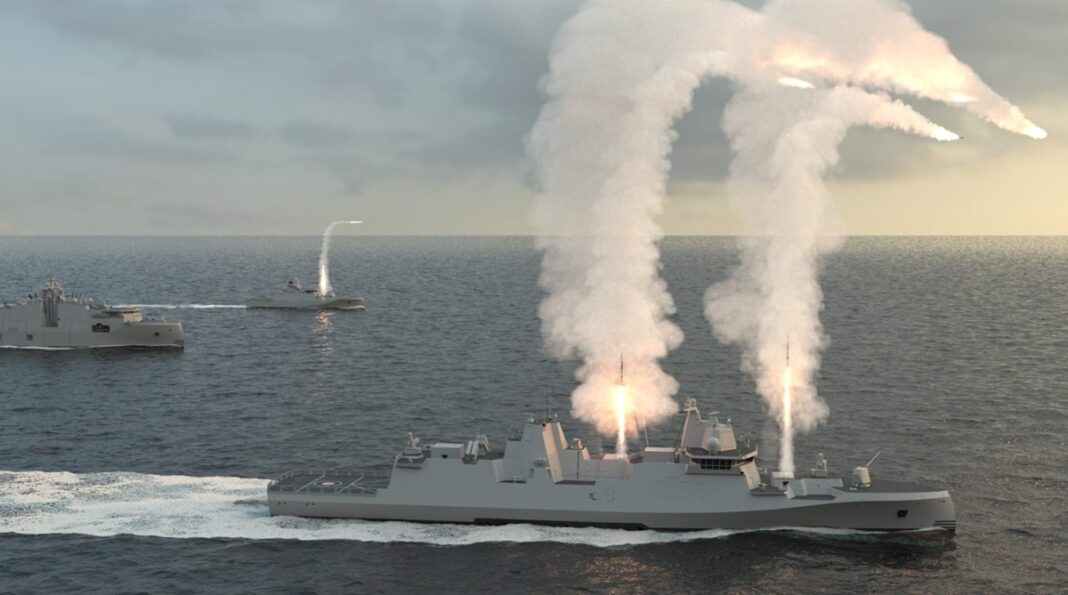
German defense giant Rheinmetall has officially unveiled the GMF140, a next-generation guided missile frigate designed to meet the evolving operational requirements of NATO and allied naval forces.
The new warship combines ballistic missile defense (BMD), advanced anti-air warfare (AAW), anti-submarine warfare (ASW), and long-range precision strike capabilities into a single multi-role platform aimed at high-intensity naval operations.
According to Rheinmetall, the 140-meter, 6,000-ton-class frigate is intended for international export markets and will initially be offered for a major naval procurement program in North America.
Designed for Modern Naval Warfare
The GMF140 has been developed to operate in some of the world’s most demanding maritime threat environments.
Rheinmetall says the frigate is optimized for:
- Blue-water operations
- NATO coalition missions
- Expeditionary deployments
- Littoral warfare
- High-end naval combat
The vessel has been designed around an open architecture, allowing operators to integrate future weapons, sensors, and mission systems throughout its service life.
The company also emphasizes reduced crew requirements through increased automation while maintaining high survivability against modern threats.
AEGIS Combat System at the Core
One of the GMF140’s most notable features is its compatibility with the AEGIS Combat System, one of the world’s most capable naval command-and-control systems.
The integration of AEGIS would allow the frigate to:
- Track hundreds of aerial targets simultaneously
- Coordinate fleet-wide air defense
- Engage cruise missiles
- Defend against ballistic missiles
- Integrate with allied naval task forces
Rheinmetall says the ship can also be equipped with the Lockheed Martin CMS330 Combat Management System, providing customers with additional flexibility depending on operational requirements.
The open combat architecture also enables integration of both U.S. and European sensors and weapons.
Advanced Air and Missile Defense
Air defense represents one of the GMF140’s primary strengths.
The ship is designed to integrate U.S.-supplied advanced air-defense radars, with optional configurations capable of full ballistic missile tracking.
Combined with the 64-cell Strike-Length Vertical Launch System (VLS), the frigate can employ a wide range of missiles for:
- Area air defense
- Ballistic missile defense
- Long-range land attack
- Fleet protection
Although Rheinmetall has not identified specific missile types, the Strike-Length VLS is compatible with many modern NATO-standard missile families, depending on customer requirements.
The company says this level of air-defense capability is typically found on significantly larger destroyers rather than frigates.
Powerful Anti-Submarine Warfare Capability
Submarine threats remain one of the most challenging aspects of modern naval warfare.
To address this, the GMF140 incorporates a comprehensive anti-submarine warfare suite featuring:
- Hull-mounted sonar
- Towed-array sonar
- Integrated acoustic management
- Low-signature hull design
- Torpedo launchers
- Embarked maritime helicopters
- Support for unmanned systems
The combination of active and passive underwater sensors is intended to improve submarine detection in both open-ocean and littoral environments.
Long-Range Strike and Multi-Domain Operations
Beyond fleet air defense, the GMF140 has been designed as a true multi-domain combat platform.
Its weapons package includes provisions for:
- Anti-ship missiles
- Long-range land-attack missiles
- Five-inch naval gun
- Close-In Weapon System (CIWS)
- Secondary gun armament
- Directed-energy laser system (optional)
- Electronic warfare systems
- Electro-optical targeting systems
- Decoy launchers
This broad range of capabilities allows the vessel to perform offensive, defensive, and maritime security missions without requiring specialized escort ships.
Built for Future Naval Warfare
One of the defining features of the GMF140 is its emphasis on digital integration.
The vessel has been designed to operate seamlessly with:
- NATO naval networks
- Coalition task groups
- Maritime surveillance aircraft
- Unmanned aerial systems
- Helicopters
- Allied missile defense architecture
The open-system design also allows future upgrades without requiring major structural modifications, extending the platform’s operational relevance over decades of service.
Potential Role in North America
Rheinmetall confirmed that the GMF140 will initially target a North American procurement campaign, although the company expects the design to appeal to other allied navies modernizing their fleets.
Countries facing increasingly complex maritime security challenges in:
- Europe
- The North Atlantic
- The Indo-Pacific
may also find the platform attractive due to its interoperability with NATO systems and its combination of air defense, missile defense, and anti-submarine capabilities.
Military Advantages of the GMF140
Compared with traditional multi-role frigates, the GMF140 offers several operational advantages:
Integrated Ballistic Missile Defense
The combination of AEGIS, advanced radar, and a 64-cell VLS enables the ship to contribute to regional ballistic missile defense networks, protecting both naval forces and coastal assets.
High Survivability
The frigate features:
- Reduced acoustic signature
- Advanced electronic warfare systems
- Decoy launchers
- Integrated self-defense weapons
- Low-observable design elements
These features improve survivability against modern anti-ship missiles and submarine threats.
True Multi-Mission Capability
Rather than specializing in a single mission, the GMF140 can simultaneously conduct:
- Air defense
- Anti-submarine warfare
- Surface warfare
- Land attack
- Maritime security
- Coalition operations
Future Growth Potential
Its modular open architecture allows operators to incorporate:
- Next-generation missiles
- Artificial intelligence-enabled command systems
- Directed-energy weapons
- New radar technologies
- Unmanned surface and underwater vehicles
without redesigning the ship.
Strategic Significance
The unveiling of the GMF140 reflects growing demand among NATO and allied navies for highly capable surface combatants able to counter increasingly sophisticated missile, submarine, and aerial threats.
Modern naval operations increasingly require ships capable of integrating into multi-domain combat networks while simultaneously defending against cruise missiles, ballistic missiles, submarines, drones, and precision-guided weapons.
By combining advanced air defense, ballistic missile defense, anti-submarine warfare, long-range strike capability, and digital interoperability within a 6,000-ton platform, Rheinmetall aims to position the GMF140 among the most capable next-generation frigates available on the international market.
As naval modernization accelerates across Europe, North America, and the Indo-Pacific, the GMF140 is expected to compete in future programs where survivability, interoperability, and multi-mission flexibility have become the defining requirements for modern surface combatants.
GMF140 Specifications
| Feature | Details |
|---|---|
| Length | 140 meters |
| Displacement | 6,000+ tonnes |
| Primary Missions | AAW, BMD, ASW, Long-Range Strike |
| Combat System | AEGIS or Lockheed Martin CMS330 |
| Vertical Launch System | 64 Strike-Length VLS Cells |
| Primary Radar | Advanced U.S.-sourced radar with optional BMD capability |
| Main Gun | 5-inch naval gun |
| Additional Weapons | Anti-ship missiles, torpedoes, CIWS, laser, secondary guns |
| Sensors | Hull sonar, towed sonar, EO systems, EW suite |
| Aviation | Maritime helicopter and unmanned systems support |