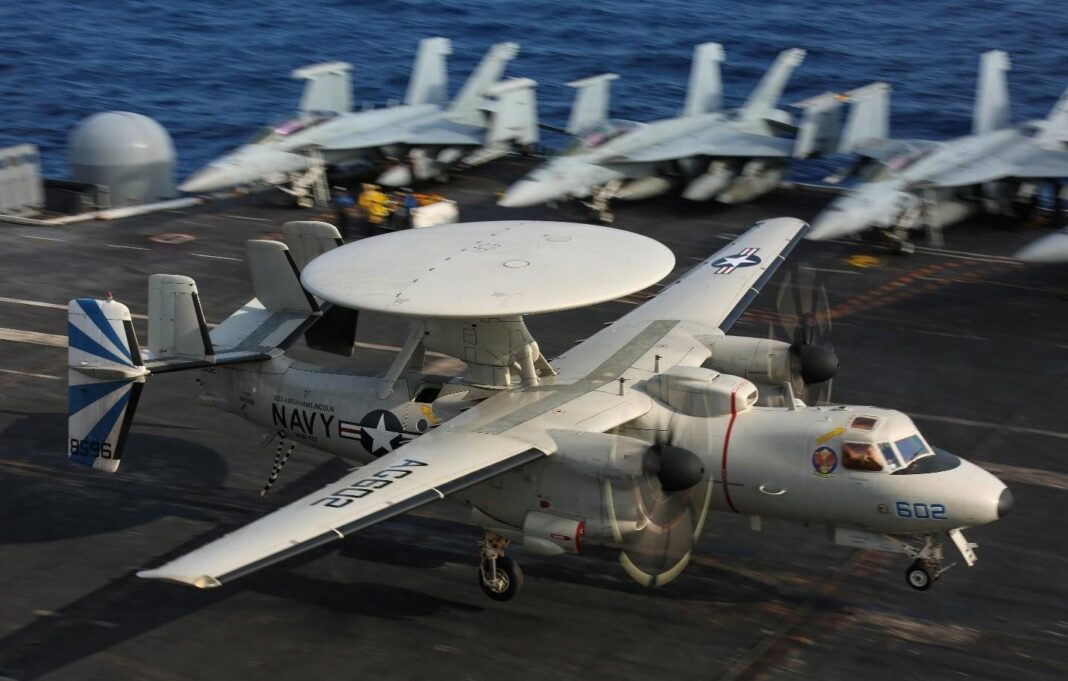
The reported deployment of multiple E-2D Hawkeye airborne early-warning aircraft to the Middle East reflects a critical shift in U.S. defensive strategy: a move from reliance on fixed radar systems to mobile, airborne surveillance.
This adjustment comes after recent strikes damaged key ground-based radar installations that form the backbone of the region’s integrated air-defense network.
The U.S. is sending additional E-2D Hawkeye airborne radar aircraft to the Middle East (at least five spotted deploying) to strengthen early warning and battle coordination.
These planes can detect drones, cruise missiles, and aircraft at long range and help direct intercepts,… pic.twitter.com/3jMouwG3K2
— Clash Report (@clashreport) March 17, 2026
The Core Problem: Degraded Sensor Network
Modern air defense systems depend not only on interceptors, but on the sensor layer—the radars that detect incoming threats and provide targeting data.
Recent developments suggest that this layer has been partially degraded:
- Damage to high-value radar systems across multiple Gulf locations
- Disruption of early-warning capability for ballistic and cruise missile detection
- Reduced ability to maintain a continuous recognized air picture
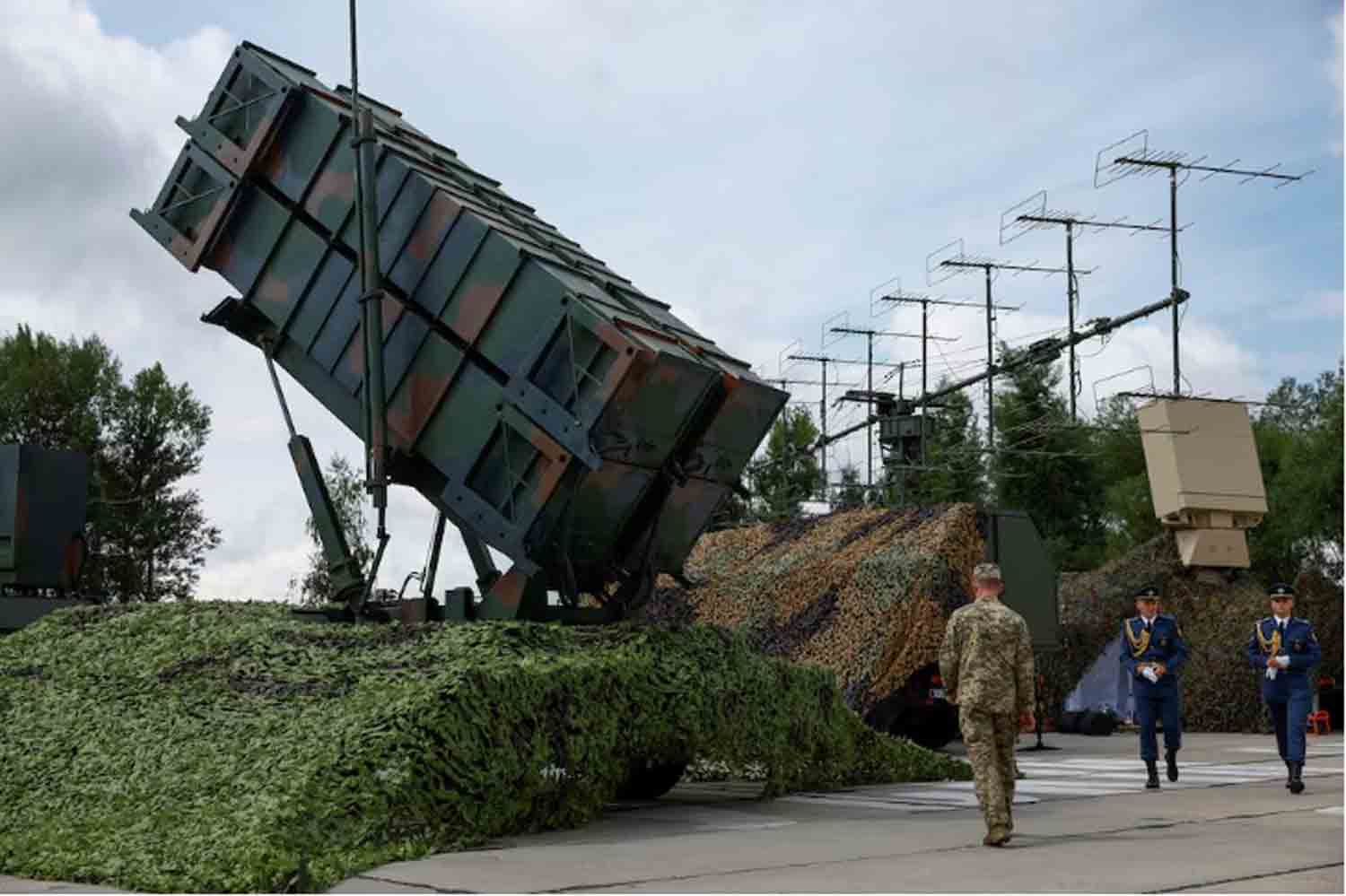
Imagery analysis indicates that several radar sites, including those associated with advanced missile-defense systems, were specifically targeted rather than launchers themselves.
Why Airborne Radar Is Being Prioritized
The deployment of E-2D Hawkeye aircraft signals an operational pivot toward mobile detection systems.
Unlike fixed radars:
- Airborne platforms can be repositioned rapidly
- They are harder to target and destroy
- They provide flexible coverage across large areas
This makes them ideal for restoring overlapping sensor coverage when ground systems are damaged or offline.
What the E-2D Hawkeye Brings
The E-2D Hawkeye is one of the most advanced airborne early-warning and battle-management platforms in U.S. service.
Key Capabilities:
- Long-range detection of aircraft, drones, and cruise missiles
- Simultaneous tracking of multiple targets
- Real-time coordination between fighters and missile-defense systems
- Extended radar horizon due to high-altitude operation
By flying at altitude, the aircraft can detect threats earlier than ground radars, especially low-flying drones or cruise missiles that exploit terrain and curvature of the earth.
The Impact of Radar Losses
Damage to systems such as long-range tracking radars has significant consequences:
- Reduced reaction time for interceptors
- Increased risk of saturation attacks overwhelming defenses
- Gaps in coverage that adversaries can exploit
Even partial degradation can weaken the entire network, as modern air defense relies on integrated data sharing across multiple systems.
A Shift in Warfare: Targeting Sensors First
The pattern of strikes suggests a deliberate strategy:
Disable detection → Then exploit the gap
Rather than focusing solely on destroying launchers or aircraft, attackers are increasingly targeting:
- Radar installations
- Sensor nodes
- Command-and-control links
This approach reduces the defender’s ability to see incoming threats, making even low-cost weapons more effective.
Why Ground Systems Can’t Be Quickly Replaced
Replacing damaged radar systems is not immediate:
- Large fixed radars require complex logistics
- Installation takes time and secure conditions
- Sites are geographically fixed and vulnerable
In contrast, airborne systems can be deployed quickly and provide immediate, though temporary, coverage.
Implications for Regional Security
The deployment of multiple Hawkeye aircraft suggests that U.S. planners expect:
- Continued pressure on regional bases
- Further attempts to degrade air-defense networks
- Sustained need for high-tempo surveillance operations
It also indicates that maintaining sensor redundancy has become a top priority.
Limits of the Airborne Solution
While airborne radar provides flexibility, it is not a complete replacement for ground-based systems:
- Requires continuous sorties for coverage
- Increases operational strain on crews and aircraft
- Cannot fully match the range and persistence of large fixed radars
This means the current approach is likely a temporary adaptation rather than a permanent solution.
Strategic Insight: The Sensor Layer Is Decisive
The situation highlights a key principle of modern warfare:
Air defense is only as strong as its ability to detect threats.
- Interceptors depend on accurate and timely data
- Even advanced systems fail without early warning
- Sensor degradation can shift the balance of power
Conclusion
The deployment of E-2D Hawkeye aircraft underscores a critical transition in the conflict: from static defense based on fixed infrastructure to a more dynamic, mobile surveillance model.
It reflects both the vulnerability of traditional radar networks and the growing importance of maintaining continuous situational awareness in a high-threat environment.
As the conflict evolves, the battle for the skies may increasingly depend not on who has the most missiles—but on who can see first.
E-2D Hawkeye vs Ground Radar Coverage
| Factor | E-2D Hawkeye | Ground Radar |
|---|---|---|
| Position | Airborne (high altitude) | Fixed (surface) |
| Coverage | Wide, flexible | Fixed, location-bound |
| Low-altitude detection | Strong | Limited |
| Survivability | Mobile, harder to target | Vulnerable to strikes |
| Persistence | Limited by flight time | Continuous (if intact) |