The Strait of Hormuz is increasingly becoming more than a maritime chokepoint in the confrontation involving Iran and Western powers. It is also driving a broader geopolitical realignment, as Tehran seeks to reduce its dependence on southern maritime routes while strengthening economic, logistical and strategic cooperation with Russia.
The Caspian Sea has emerged as a particularly important alternative.
Unlike the Persian Gulf, the Caspian is an enclosed body of water shared by five countries: Iran, Russia, Azerbaijan, Kazakhstan and Turkmenistan. Its geographical position offers Tehran a northern maritime connection with Russia and access to wider Eurasian transport networks.
For Moscow and Tehran, strengthening Caspian shipping, port infrastructure and rail connectivity offers more than an economic opportunity. It could help both countries reduce exposure to Western sanctions, diversify supply chains and maintain trade flows during periods of maritime confrontation.
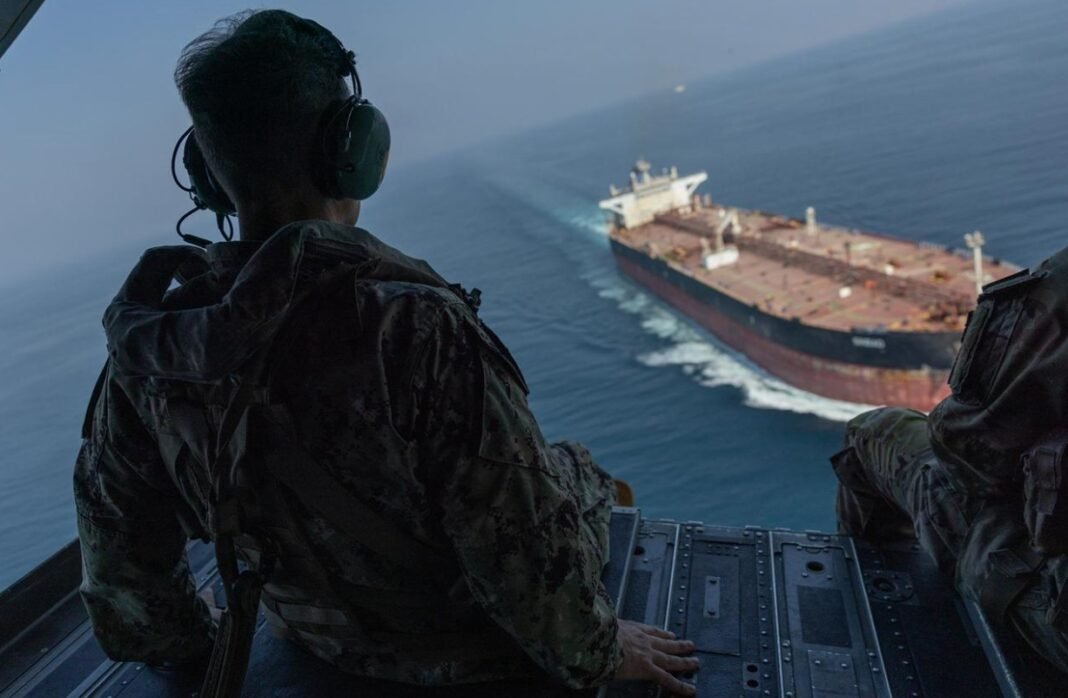
The development is taking place as UKMTO continues to report security incidents around Hormuz. Its November 11 update, designated Suspicious Activity 202-26, reported an incident involving a tanker in the Strait. The crew’s status, damage assessment and environmental impact were unknown at the time of the report.
Together, these developments point towards a growing strategic divide: while Western powers seek to maintain pressure on Iran through maritime and financial restrictions, Tehran and Moscow are attempting to strengthen alternative geographical and commercial networks.
UKMTO reports fresh tanker incident in the Strait of Hormuz
The latest UKMTO report has added to concerns over the security of international shipping in the Persian Gulf.
On November 11, UKMTO reported suspicious activity involving a tanker in the Strait of Hormuz. The initial notification did not establish the cause of the incident or confirm whether the vessel had sustained damage.
The report followed a series of maritime security incidents recorded during November.
-
November 10 – UKMTO Incident 201-26: A tanker reported being struck by an unidentified projectile approximately 19 nautical miles northeast of Lima, Oman. The crew were safe, with no environmental impact reported.
-
November 8 – UKMTO Incident 200: A tanker reported being struck by an unknown projectile while transiting outbound through the Strait of Hormuz. All crew members were accounted for.
-
November 8 – UKMTO Incident 199: A tanker was reported on fire approximately eight nautical miles northwest of Khasab, Oman. The crew were evacuated.
-
November 7 – UKMTO Advisory 198: A bulk carrier was involved in an incident with military forces approximately 18 nautical miles east of Khor Fakkan in the Gulf of Oman.
-
November 6 – UKMTO Incident 197: A tanker transiting outbound through Hormuz reported an explosion at the port-side waterline. Its crew were safe and the vessel continued its voyage.
These reports demonstrate the continuing risks facing commercial shipping in the region. However, they should not be treated as evidence that all incidents have the same perpetrator or are connected to a single military operation.
The importance of the latest advisory lies in its timing. Shipping companies, insurers and maritime operators are already operating in an environment shaped by regional military confrontation, uncertainty over navigation arrangements and the possibility of further disruption.
For Iran, these developments reinforce the strategic importance of alternative transport routes. For Russia, they create an opportunity to strengthen its economic and logistical relationship with Tehran.
Why Iran is turning towards the Caspian Sea
Iran’s northern maritime infrastructure has acquired greater strategic importance as restrictions and military tensions affect its traditional southern shipping routes.
Most of Iran’s maritime trade has historically passed through Persian Gulf ports, including Bandar Abbas and the strategically important Port of Shahid Rajaee. These facilities connect the Iranian economy with international shipping networks and provide access to the Indian Ocean.
The Caspian Sea offers a different geographical option.
Iran’s northern ports, particularly Anzali, Amirabad and Nowshahr, connect the country with Russian and Central Asian markets. Cargo can move through the Caspian and subsequently enter wider Eurasian transport networks by rail and road.
A September 27 investigation by Al Jazeera reported that Iran was increasingly redirecting trade towards its northern ports as maritime restrictions affected its southern commercial infrastructure.
According to Iranian officials cited in the report:
-
The northern ports’ share of essential-goods transportation increased from approximately 18% before the February 2026 war to around 30%.
-
Container arrivals at Caspian ports increased by 50% year-on-year during the five Iranian calendar months ending August 22.
-
Iran’s northern ports have a combined nominal capacity of approximately 30 million tonnes, compared with total national port capacity of around 300 million tonnes.
-
The government is seeking to expand connections between northern ports, railways and neighbouring countries.
These figures illustrate why Tehran is investing greater attention in the Caspian region. However, they also demonstrate the limitations of the alternative route: northern ports cannot immediately replace the capacity of Iran’s southern maritime infrastructure.
The strategic advantage is diversification rather than complete replacement.
If shipping through Hormuz becomes more difficult, Iran can redirect some imports and exports through its northern network, particularly agricultural commodities, industrial goods and essential supplies.
This reduces the vulnerability created by dependence on a limited number of maritime gateways.
Russia-Iran Caspian cooperation: A strategic corridor beyond Western naval reach
The growing importance of the Caspian Sea reflects a wider transformation in Russia-Iran relations.
Both countries face extensive Western sanctions, restrictions on financial transactions and limitations on access to international commercial networks.
Their cooperation has consequently expanded beyond traditional diplomatic and military engagement into transport infrastructure, banking arrangements, shipping and alternative payment systems.
A detailed October 30 investigation by Radio Free Europe/Radio Liberty reported a substantial increase in Russian-Iranian shipping activity across the Caspian Sea.
According to Lloyd’s List Intelligence data cited in the investigation:
-
The number of active Russian- and Iranian-flagged vessels operating in the Caspian increased by 21% year-on-year in August.
-
The number of active general cargo ships on the route rose from 105 in February to 215 in August.
-
The segment recorded a 36% year-on-year increase in carrying capacity.
-
Russian and Iranian financial institutions have expanded the use of national currencies and connected banking messaging systems to reduce reliance on Western financial infrastructure.
The report also noted that Russian grain, vegetable oils, industrial products and machinery form part of the officially recorded bilateral trade.
More sensitive allegations concern military-related cargo.
Ukraine has accused Moscow of using the Caspian corridor to transfer military equipment, while research cited by RFE/RL has identified the movement of drone components and ammunition as an area of concern.
Importantly, the investigation noted that these allegations have not been conclusively established for individual shipments and that neither government has publicly acknowledged the alleged transfers.
The geographical advantage is nevertheless clear.
Unlike the Persian Gulf and the Strait of Hormuz, the Caspian Sea is an enclosed waterway with no direct access for Western naval forces. Its five littoral states control the maritime environment, creating a different security and logistical calculation for Russia and Iran.
This does not make the route immune to sanctions, financial restrictions, intelligence monitoring or pressure on companies involved in transportation. But it makes direct naval interdiction by non-littoral Western powers substantially more complicated.
For Moscow and Tehran, this is an important strategic consideration.
The International North-South Transport Corridor: The bigger Russian-Iranian project

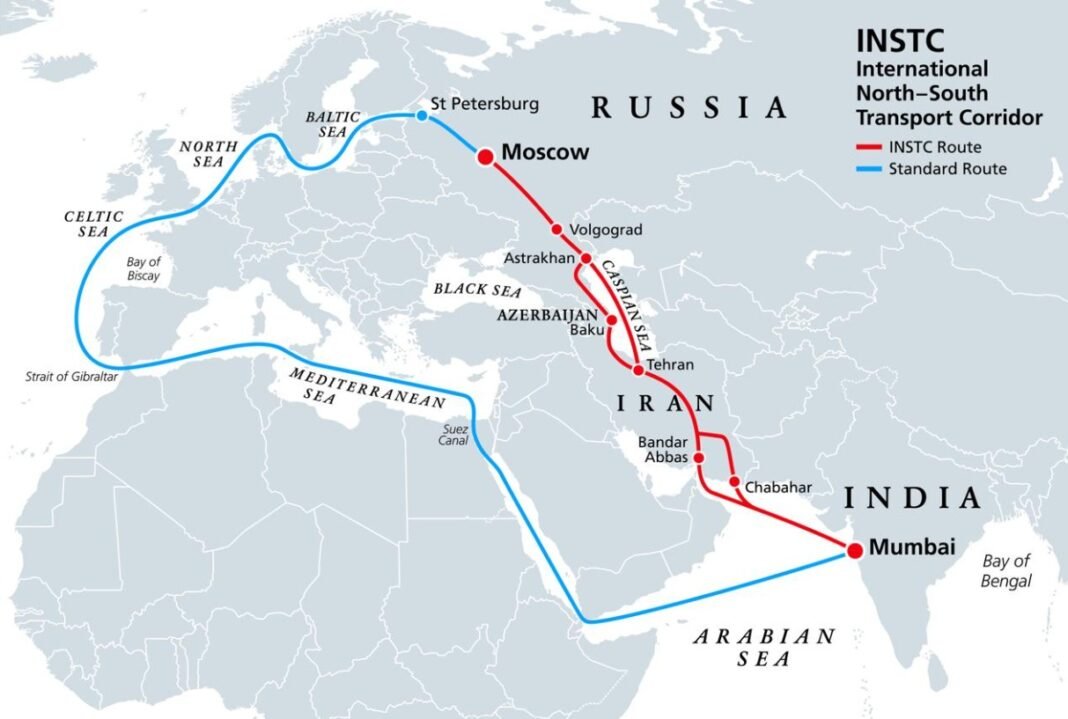
The Caspian shipping relationship is part of a much larger infrastructure initiative: the International North-South Transport Corridor (INSTC).
Originally agreed upon by Russia, Iran and India in 2000, the corridor is designed to connect northern Europe and Russia with Iran, the Persian Gulf, Central Asia and the Indian Ocean.
The planned network combines maritime transport, railways and road connections, offering an alternative to conventional routes through the Suez Canal.
Its importance has increased considerably since Russia’s war in Ukraine and the expansion of Western sanctions.
Three strategic branches
1. Western route: Russia–Azerbaijan–Iran
This branch connects Russian territory with Azerbaijan and northern Iran, providing a land-based link towards the Persian Gulf.
The Rasht-Astara railway is particularly important because completing this missing connection would strengthen rail transport between Russia and Iranian ports.
2. Trans-Caspian route: Russia–Caspian Sea–Iran
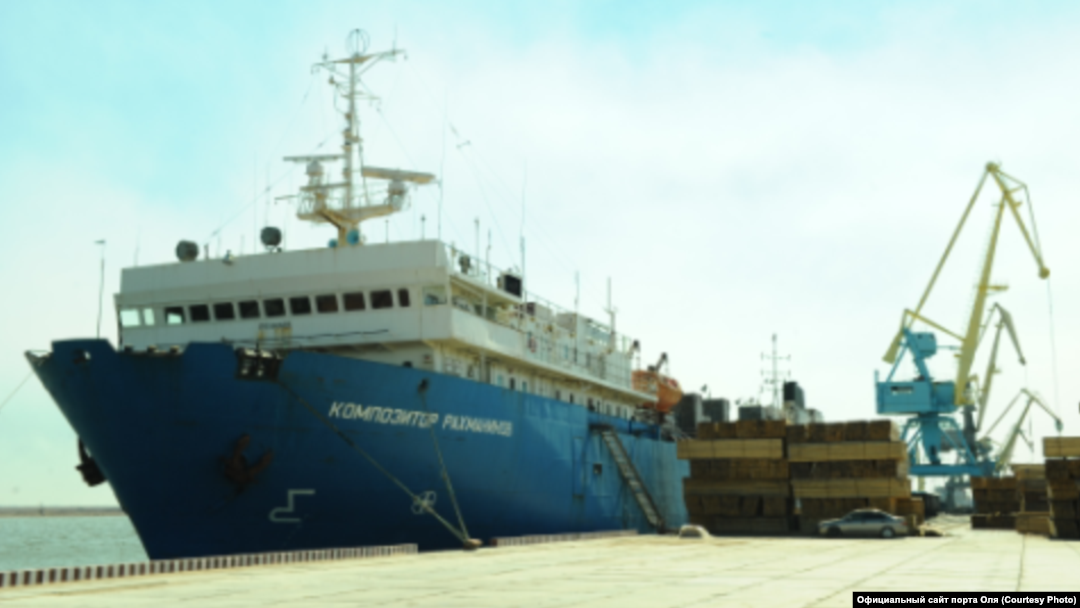
This maritime branch connects Russian ports, including Astrakhan and Olya, with Iranian Caspian ports such as Anzali and Amirabad.
It offers a direct maritime connection between the two countries without requiring passage through Western-controlled oceanic chokepoints.
3. Eastern route: Russia–Kazakhstan–Turkmenistan–Iran
This route connects Russia and Iran through Central Asian railway and road networks, providing another alternative for commercial cargo.
The three branches offer logistical flexibility. If one route encounters political, infrastructure or security restrictions, some cargo can potentially be redirected through another.
Rasht-Astara railway: The missing link
One of the most important components of the corridor is the approximately 162-kilometre Rasht-Astara railway in northern Iran.
The project is intended to connect Iran’s existing railway network with Azerbaijan and, ultimately, Russia.
Its completion would reduce dependence on road transportation and improve the efficiency of freight movement between Russia, the Caucasus and Iran.
Russia has been involved in financing and developing the project, which is central to the two countries’ broader transport cooperation.
The railway is strategically significant because it could turn the INSTC from a collection of partially connected routes into a more integrated Eurasian transport network.
However, financing, land acquisition, construction, customs coordination and regional political conditions remain obstacles.
The corridor is therefore a developing network, not yet a fully operational substitute for established international shipping routes.
Is the Caspian Sea becoming a sanctions-resistant military logistics corridor?
The military dimension of Russia-Iran cooperation deserves particular attention.
Both countries have increasingly relied on alternative transportation networks to maintain access to goods and technologies affected by Western restrictions.
The Caspian Sea offers a relatively protected geographical connection for the movement of commercial and potentially sensitive cargo.
In August 2026, Radio Free Europe reported on the emerging Caspian logistics relationship and allegations that Russia was using the waterway to send military-related supplies to Iran.
The September reporting by Le Monde also discussed claims involving Russian transfers of drone components and explosives through the Caspian.
These developments are particularly relevant because the two countries have expanded military cooperation since Russia’s invasion of Ukraine.
Iran initially supplied Russia with Shahed-type attack drones, while Moscow subsequently expanded its domestic production and technological capabilities. More recent reporting has described Russian assistance reaching Iran.
The relationship has therefore become increasingly reciprocal.
However, it would be inaccurate to describe every Caspian cargo movement as military or sanctions-related. Officially recorded agricultural and industrial trade accounts for a substantial part of the relationship.
The more important strategic issue is that the infrastructure can support both legitimate commerce and sensitive supply chains, making cargo monitoring and sanctions enforcement more difficult.
For Western governments, this creates a difficult enforcement problem.
Sanctions can target companies, banks, ship operators and cargo owners, but disrupting physical trade across an enclosed sea shared by five sovereign states presents a different challenge.
Any attempt to enforce maritime restrictions directly could also create diplomatic and military complications involving Russia and the other Caspian littoral countries.
The five Caspian states: Why regional cooperation matters
The Caspian Sea is not exclusively a Russian-Iranian strategic space.
Its five littoral countries are:
-
Russia
-
Iran
-
Azerbaijan
-
Kazakhstan
-
Turkmenistan
All five have economic, maritime and security interests in the region.
The 2018 Convention on the Legal Status of the Caspian Sea established an important framework for cooperation, including principles concerning navigation, economic activity, maritime boundaries and security.
One particularly important provision is the restriction on the presence of armed forces belonging to non-littoral states in the Caspian Sea.
This gives the five coastal countries a distinctive security position compared with the Persian Gulf, where external military powers maintain a significant naval presence.
However, it does not mean that Russia and Iran can unilaterally control the Caspian Sea.
Azerbaijan, Kazakhstan and Turkmenistan have their own foreign-policy priorities, trade relationships and infrastructure ambitions.
Kazakhstan, for example, is developing connections that support the Trans-Caspian International Transport Route, commonly known as the Middle Corridor, which links Central Asia with the South Caucasus and Europe.
Azerbaijan also has significant interests in regional transport and energy networks.
Consequently, the future of Caspian connectivity will depend on cooperation among all five littoral states, not simply bilateral coordination between Moscow and Tehran.
The limitations: Why the Caspian Sea cannot fully replace Hormuz
Despite its strategic advantages, the Caspian Sea has significant geographical, logistical and economic limitations.
The most important is capacity.
Iran’s southern ports are designed to handle large volumes of international maritime trade, including crude oil, petroleum products and containerised cargo. Northern ports operate on a much smaller scale.
Al Jazeera’s September investigation highlighted several obstacles:
Declining water levels: The Caspian Sea has experienced a long-term decline in water levels, affecting shipping conditions and port operations.
Smaller vessels: Iranian shipping officials reported that some northern ports that previously accommodated vessels carrying up to 6,000 tonnes could now handle vessels of approximately 4,000 tonnes.
Railway bottlenecks: Missing railway connections, particularly the Rasht-Astara section, limit the movement of cargo between Iran and the Caucasus.
Customs and border delays: Increased road transportation has placed pressure on border crossings, with some Iranian border terminals experiencing significant truck queues.
Limited port capacity: Iran’s northern ports represent only a fraction of its overall maritime handling capacity.
There is also a fundamental difference between the two waterways.
Hormuz connects the Persian Gulf with the Arabian Sea and international ocean shipping routes. The Caspian Sea is landlocked, meaning cargo must subsequently move through Russian, Central Asian or Caucasus transport networks to reach international markets.
Therefore, the Caspian can provide Iran with a strategic alternative for selected trade flows, but it cannot replace Hormuz as a global maritime gateway.
What the developments mean for the United States and Western sanctions policy
The growing Russia-Iran transport relationship presents a challenge to Western sanctions strategy.
The United States and European governments have relied heavily on financial restrictions, shipping controls, export limitations and sanctions against companies involved in sensitive trade.
However, the expansion of alternative transportation networks creates additional channels through which sanctioned economies can maintain commercial relationships.
Three developments deserve particular attention.
First, reduced dependence on Western financial infrastructure. Russia and Iran are expanding settlements in rubles and rials and strengthening direct banking connections, reducing their reliance on Western-controlled financial messaging systems.
Second, alternative maritime logistics. The Caspian Sea provides a route that does not require access through the Persian Gulf or the Strait of Hormuz.
Third, military-industrial cooperation. The movement of potentially sensitive industrial and defence-related components could help both countries maintain military production and technological development despite restrictions.
The strategic challenge for Washington is that economic pressure becomes less effective when targeted countries develop alternative transport, banking and supply networks.
However, the emergence of alternative corridors does not mean sanctions have become ineffective. Both countries still face restrictions on access to advanced technology, international finance, insurance, shipping services and investment.
The Caspian corridor can reduce some vulnerabilities, but it cannot eliminate the broader economic costs of isolation.
China and India: The wider Eurasian dimension
The Caspian transport network also has implications for China and India, two major economies with important interests in Eurasian connectivity.
China’s position is particularly significant.
Beijing has invested in transport and infrastructure networks connecting Central Asia with Europe and the Middle East. The Caspian region offers an alternative geographical connection between Asian markets and European destinations.
For China, the expansion of Eurasian routes creates opportunities to diversify commercial transportation and reduce reliance on traditional maritime chokepoints.
India has a different but equally important interest.
The INSTC was originally conceived through cooperation between India, Iran and Russia. It offers New Delhi a potential transport connection to Russia and Central Asian markets through Iranian infrastructure.
The corridor could also provide an alternative to some conventional shipping routes through the Suez Canal.
Nevertheless, India’s strategic relationships with the United States, European countries and Gulf states complicate its participation in networks involving heavily sanctioned countries.
China and India therefore have economic incentives to support Eurasian connectivity, but neither country’s involvement should automatically be interpreted as participation in a coordinated Russian-Iranian strategy against the West.
Strategic implications for Pakistan
The expansion of Russia-Iran Caspian connectivity also has implications for Pakistan.
Pakistan’s geographical position provides access to the Arabian Sea, the Persian Gulf region, Central Asia and the wider Eurasian transport network.
The growing importance of alternative routes could create both opportunities and competitive challenges for Islamabad.
Iran’s northern ports and the INSTC provide Tehran with additional connections to Russia and Central Asia. Pakistan, meanwhile, has its own strategic interest in regional connectivity through the Arabian Sea, Gwadar and the China-Pakistan Economic Corridor.
Several developments deserve attention:
-
Greater Russia-Iran transport cooperation could increase trade with Central Asian economies.
-
Improved connections between Iran and Russia could strengthen regional commercial networks beyond Western-controlled maritime routes.
-
Pakistan could explore greater connectivity with Iran and Central Asia through complementary road and rail arrangements.
-
Maritime insecurity around Hormuz could reinforce the importance of alternative energy supply routes and regional transport infrastructure.
For Pakistan, the central issue is not choosing between competing international corridors. It is ensuring that the country’s own ports, railways and regional trade connections remain commercially competitive.
A more connected Eurasian economy could provide Pakistan with opportunities, particularly if regional governments prioritise trade facilitation over geopolitical competition.
Three possible scenarios for the Caspian corridor
| Scenario | Possible outcome | Strategic impact |
|---|---|---|
| Expanded Russia-Iran cooperation | More shipping, rail connectivity and alternative payments | Reduced dependence on Western-controlled networks |
| Wider five-country Caspian cooperation | Greater regional trade and maritime coordination | A more integrated Eurasian transport system |
| Increased Western sanctions pressure | More scrutiny of vessels, cargoes and financial intermediaries | Higher logistical costs and possible disruptions |
The most likely development is a gradual expansion of alternative trade networks rather than the immediate creation of a fully independent economic system.
The Caspian corridor could become increasingly important for Russia and Iran, but its long-term effectiveness will depend on infrastructure investment, regional cooperation and the ability of both countries to manage sanctions-related risks.
Conclusion: Hormuz remains a chokepoint, but the Caspian is becoming a strategic alternative
The latest UKMTO reports underline the continuing vulnerability of international shipping around the Strait of Hormuz. The November 11 tanker incident, following several reported attacks and suspicious maritime activities, demonstrates that the regional security environment remains uncertain.
At the same time, Iran and Russia are strengthening a different geographical connection that could reduce their dependence on vulnerable southern maritime routes.
The Caspian Sea is emerging as more than a regional shipping area. It is becoming an increasingly important component of Russian-Iranian economic cooperation, sanctions resilience and Eurasian transport planning.
The expansion of shipping activity, alternative banking arrangements and the development of the International North-South Transport Corridor indicate that both countries are attempting to build a more diversified economic and logistical environment.
Yet the limitations remain substantial. The Caspian cannot replace the Persian Gulf as a global maritime gateway, and incomplete railway connections, declining water levels and limited port capacity could restrict its growth.
The larger geopolitical significance lies elsewhere.
While Western powers continue to exercise considerable influence over international maritime routes and financial networks, Russia and Iran are attempting to develop alternative infrastructure that reduces their exposure to that influence.
The Strait of Hormuz may remain one of the world’s most important strategic chokepoints, but the growing importance of the Caspian Sea suggests that the contest over international trade and security is increasingly extending northwards.
For Washington, the challenge will be to maintain the effectiveness of its sanctions and maritime policies without escalating tensions across the Caspian region.
For Moscow and Tehran, the objective is to turn geographical proximity and infrastructure cooperation into lasting strategic leverage.
The emerging question is whether the Caspian corridor will remain a limited alternative trade route or eventually become one of the central arteries of a more independent Eurasian economic and security system.