


The relocation of American military aircraft from a major UK airbase and growing public opposition to the Iran war have brought two important dimensions of the conflict into focus: the security of US military infrastructure in Europe and the political sustainability of Washington’s military campaign.
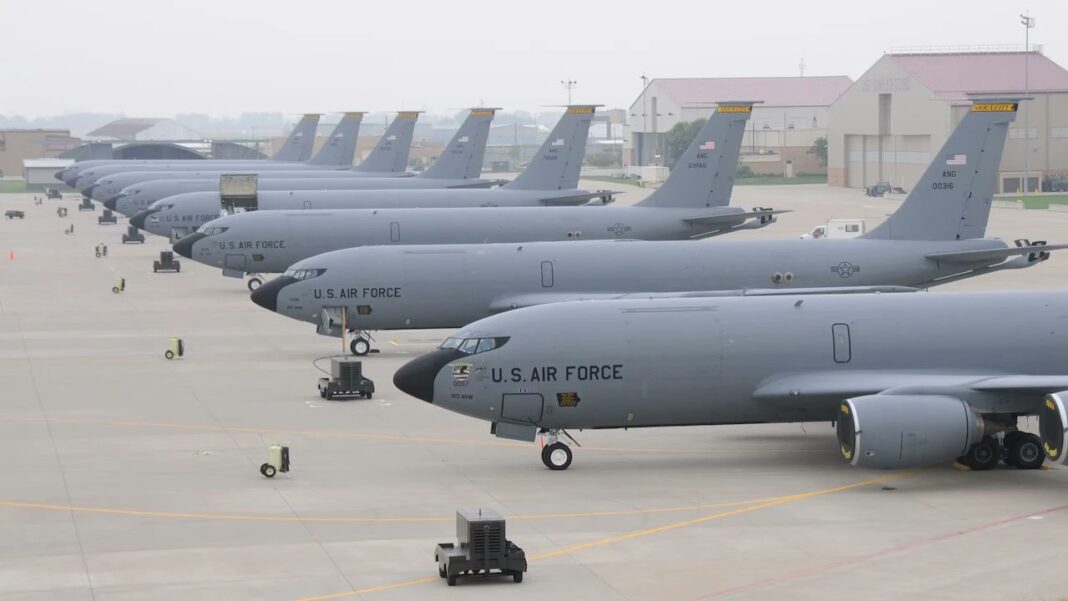
According to flight-tracking information reviewed by international media, at least 10 US Air Force KC-135R Stratotanker aircraft departed RAF Mildenhall in Suffolk on November 9. Three CV-22 Osprey aircraft also left the installation, moving to RAF Lakenheath, another US-operated airbase in Britain.
The tanker aircraft were dispersed to several locations, including Spangdahlem and Ramstein in Germany, Morón in Spain and Prestwick in Scotland.
The Wall Street Journal reported that the relocation followed an Iranian threat against US military facilities. However, the precise nature of the threat and whether it directly triggered every aircraft movement have not been publicly established.
The Pentagon and US military have not provided a detailed explanation of the individual movements, citing operational security and routine deployment requirements.
US Moves KC-135 Tankers from RAF Mildenhall
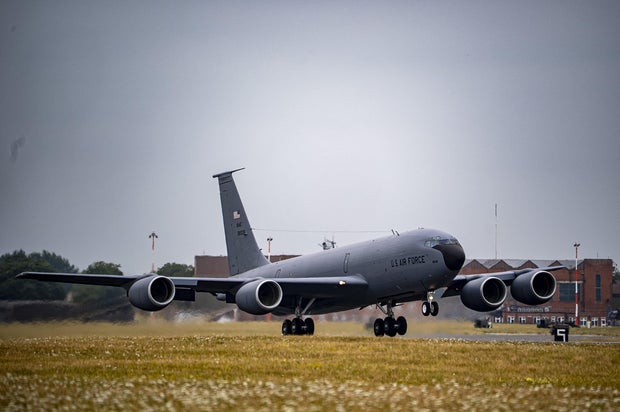
The most significant element of the relocation is the movement of the KC-135 Stratotankers, which provide aerial refuelling capabilities to American combat aircraft and strategic bombers.
The KC-135 is a central component of the US Air Force’s global airpower network. It enables fighters, bombers and other aircraft to remain airborne for extended periods and operate over considerable distances without relying entirely on intermediate ground bases.
The 100th Air Refueling Wing, headquartered at RAF Mildenhall, is the only permanently based US Air Force aerial refuelling wing in Europe.
Its presence supports American and allied air operations across Europe, the Middle East and other operational theatres.
The relocation of 10 tankers therefore represents a notable movement of aerial refuelling assets, although it does not necessarily indicate that the entire refuelling capability at Mildenhall has been withdrawn.
The reported destinations also demonstrate the importance of the wider European basing network. Germany and Spain provide alternative locations for US military aircraft, while Scotland offers another potential staging or transit point.
Three Osprey aircraft also moved to RAF Lakenheath, but available reporting does not establish that their relocation was necessarily connected to the same threat assessment.
Why the Iranian Threat Matters for US Military Bases in Europe

The reported threat has renewed attention on the vulnerability of American military installations outside the Middle East.
US bases in Britain and continental Europe play an important role in Washington’s ability to conduct operations across multiple regions.
RAF Mildenhall and nearby RAF Lakenheath are particularly important because they support aerial refuelling, fighter operations, logistics and other military activities.
A potential threat against these installations would therefore have implications beyond the immediate security of individual aircraft.
Iran has previously warned that military facilities supporting US operations against it could become legitimate targets. Iranian officials have also repeatedly criticised European countries for allowing their territories and facilities to support American military activities.
However, a distinction is necessary between Iran’s publicly stated warnings and the specific intelligence assessment reportedly behind the latest aircraft movements.
The US relocation has been linked to an Iranian threat by media reports, but no publicly released intelligence assessment has established the precise nature, timing or operational credibility of the alleged threat.
The movement should consequently be understood as a reported force-protection measure rather than confirmation of an imminent Iranian attack on Britain.
US Raises Security Posture at British Airbases
The aircraft relocation comes amid heightened security concerns surrounding US military installations in Britain.
According to reporting by Sky News, the security posture at RAF Mildenhall and RAF Lakenheath was raised to FPCON Charlie, the second-highest level in the US Department of Defense’s force-protection system.
This level is associated with intelligence indicating that a terrorist attack may be likely.
The development is particularly significant because it follows the earlier withdrawal of American strategic bombers from RAF Fairford after a suspected Iran-linked security incident near the installation.
The US Department of Justice announced on November 10 that three men had been charged over their alleged involvement in an attempted attack connected to the September incident at RAF Fairford. US authorities described the suspects as Iranian-backed operatives, while the allegations remain subject to judicial proceedings.
The sequence of developments has placed Britain’s role as a major platform for US military operations under renewed scrutiny.
Nevertheless, British officials have stressed that the country’s airbases remain secure. The UK Ministry of Defence has also declined to comment on specific aircraft movements, stating that foreign military assets regularly move according to operational requirements.

Trump Pauses Further Major Strikes Against Iran
The relocation is taking place against the backdrop of a shift in Washington’s approach to the Iran conflict.
President Donald Trump said on November 9 that he would hold off on fresh strikes against Iran for the time being, following appeals from regional partners including Qatar, Saudi Arabia, the United Arab Emirates, Bahrain and Kuwait.
Trump has described the current military situation as effectively over, while maintaining that US forces remain prepared to resume operations if circumstances change.
Secretary of State Marco Rubio reinforced the administration’s position on November 10, saying that there was no immediate need for major combat operations because the economic pressure campaign against Tehran was producing results.
The administration is maintaining its naval blockade and economic pressure while diplomatic contacts continue.
Qatar has played an important mediating role, with its prime minister holding discussions with Trump at the White House. However, a comprehensive agreement remains uncertain.
Iran has called for the lifting of sanctions and the US naval blockade, alongside an end to military operations across the region. Washington and Tehran have yet to agree on the terms of a lasting settlement.
The current situation is therefore better described as a pause in major offensive operations rather than a confirmed peace agreement or comprehensive ceasefire.
71% of Americans Want Congress to Legislate an End to Iran War

While Washington manages the military and diplomatic dimensions of the conflict, a new Reuters/Ipsos poll indicates substantial domestic pressure to bring the war to an end.
The four-day nationwide survey, completed on November 9 and published on November 10, found that 71% of American adults want Congress to pass legislation ending the conflict with Iran.
The findings are particularly notable because support for ending the war extends beyond the Democratic Party.
According to Reuters:
-
71% of Americans support legislation to end the Iran conflict.
-
93% of Democrats support congressional action to end the war.
-
51% of Republicans also favour legislation ending the conflict.
-
62% support repealing import tariffs introduced by the Trump administration.
-
Approximately 90% want Congress to prioritise cost-of-living issues during its first 100 days.
The poll surveyed 1,705 US adults nationwide and had a margin of error of approximately two percentage points.
The results suggest that the conflict has become an important domestic political issue, particularly as Americans face higher fuel prices and broader cost-of-living pressures.
Reuters reported that the war has contributed to rising fuel costs, adding to inflationary pressures already associated with the administration’s import tariffs.
The survey also found that President Trump’s approval rating stood at 32%, while the Democratic Party itself continued to receive unfavourable ratings from a substantial share of respondents.
This suggests that public dissatisfaction is not necessarily translating into unconditional support for the opposition. Instead, the poll points to a specific demand for Congress to address the economic consequences of the war and other domestic concerns.
Incoming Democratic Congress Could Challenge Trump’s Iran Policy
The timing of the survey is especially important because Democrats secured majorities in both chambers of Congress in the November 3 midterm elections.
According to Reuters, the party won its largest congressional majorities since at least 2008 and is scheduled to assume control when the new Congress convenes on January 3, 2027.
Democratic leaders have pledged to prioritise living costs and seek legislative action to end the Iran conflict.
The incoming Congress could therefore become an important institutional constraint on the administration’s ability to sustain its current approach.
Congressional legislation could seek to establish limits on military operations, impose reporting requirements or require further authorisation for continued hostilities.
However, the poll does not itself establish that a specific bill has been introduced or that Congress has already voted to terminate the conflict.
The administration’s constitutional and statutory authority to conduct military operations, alongside Congress’s powers over appropriations and war authorisation, could become a central point of political and legal debate.
The 71% figure nevertheless provides a clear indication that a majority of surveyed Americans want their elected representatives to take action rather than allow the conflict to continue indefinitely.
Military Pressure, European Security and Domestic Politics Converge
The movement of US aircraft from RAF Mildenhall and the growing demand for an end to the Iran war illustrate the multiple pressures confronting Washington.
On the military front, the United States is maintaining a substantial force-protection posture even as Trump signals that further large-scale strikes are not currently necessary.
The relocation of aerial refuelling aircraft also highlights the importance of dispersal and alternative basing arrangements in protecting critical military assets.
On the diplomatic front, Washington is attempting to maintain economic and maritime pressure while leaving room for negotiations involving regional mediators.
Domestically, the incoming Democratic-majority Congress faces growing public expectations to address the economic and military consequences of the conflict.
These developments do not necessarily indicate that the United States is preparing for another major escalation. Equally, the pause in strikes does not mean that the military confrontation has been resolved.
The combination of force-protection measures, continued economic pressure, maritime restrictions and congressional opposition suggests that the conflict has entered a different phase, in which military readiness and political negotiations are proceeding simultaneously.
For Washington, the challenge will be to maintain its regional military position while managing the security risks associated with the conflict and growing domestic pressure for a negotiated end.


