
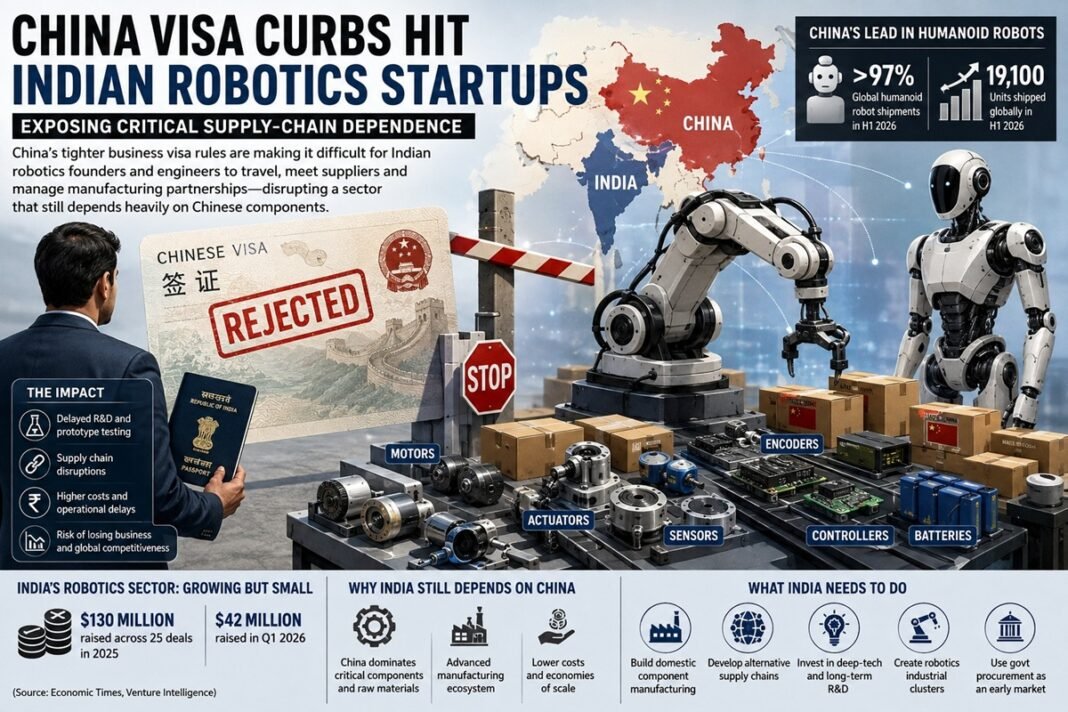
China’s tightening of business visas for Indian executives is creating an unexpected vulnerability for India’s emerging robotics and physical-AI industry: many of the very startups India wants to turn into advanced technology companies still depend on Chinese suppliers for critical hardware, components, manufacturing access and technical relationships.
A report published by The Economic Times on August 21 says Indian robotics and hardware startups are facing repeated visa rejections as Chinese authorities become more restrictive toward Indian executives travelling to China. Founders told the newspaper that the disruption is already affecting research, supply-chain management and business operations.
The issue is bigger than a visa dispute.
It exposes a fundamental contradiction in India’s technology strategy:
India wants to become a global robotics and physical-AI power, but a significant part of the hardware ecosystem required to build those robots remains dependent on China.
And that dependence becomes particularly problematic when political tensions can interfere with the movement of engineers, founders and procurement executives.
China Visa Restrictions Hit India’s Robotics Startups
According to the Economic Times, several Indian robotics founders have faced multiple visa rejections in recent months.
The impact is particularly severe because robotics companies cannot operate like conventional software startups.
A software company can often conduct most international business remotely.
A hardware company cannot.
Engineers and founders frequently need to travel to manufacturing centres to:
- inspect components;
- negotiate with suppliers;
- test prototypes;
- modify designs;
- resolve manufacturing problems;
- qualify alternative suppliers;
- monitor production;
- understand new technologies.
The Economic Times reports that some Indian robotics companies are now exploring alternative supply-chain locations including Hong Kong, Taiwan and Singapore, while others are attempting to conduct more business virtually.
That is already an indication of the underlying problem.
The XP Robotics Example Shows the Vulnerability
The case of XP Robotics illustrates the difficulty.
Vineet Saraogi, co-founder and CEO of the company, told Economic Times that he normally travels to China every two months—roughly four to five times a year—to work with supply-chain partners, identify new suppliers and follow developments in robotics.
The report says his Chinese visa applications have been rejected multiple times over the past two months.
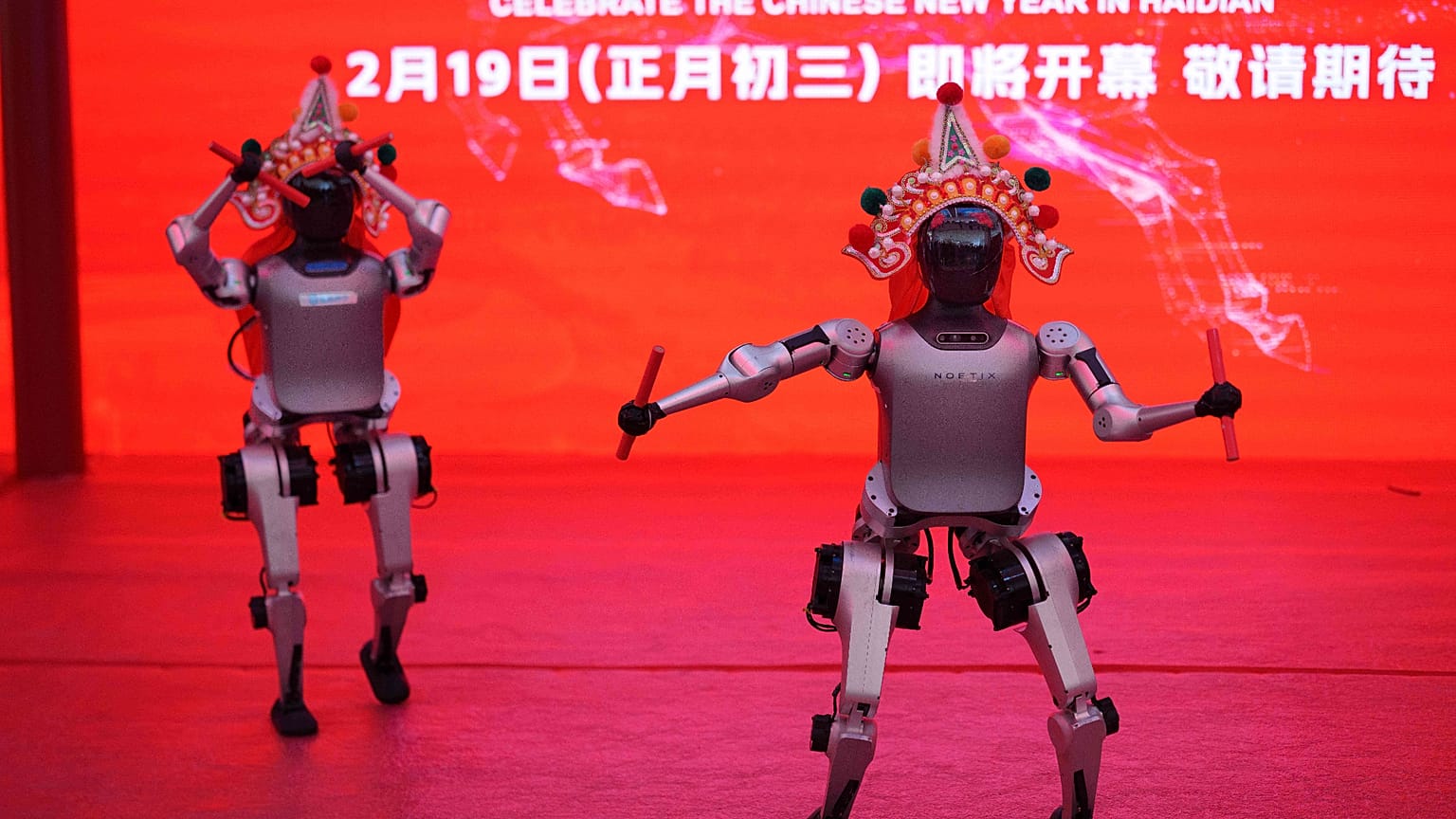
XP Robotics is developing humanoid and other robotic hardware intended to collect physical-world data for AI laboratories.
Its robots are designed in-house, while components are sourced through Chinese supply chains and manufacturing is carried out with subcontractors in India.
That model is revealing.
The robot may be Indian-designed and assembled in India, but parts of the industrial ecosystem behind it remain Chinese-dependent.
India’s Robotics Boom Is Real—But Still Small
India is not starting from zero.
Investment in its physical-AI and robotics sector has increased.
According to Economic Times data citing Venture Intelligence, Indian startups in this segment raised $130 million across 25 deals in 2025, compared with $124 million across 24 deals in 2024.
The sector then attracted approximately $42 million in the first quarter of 2026.
Companies such as Unbox Robotics, Armatrix, Octobotics and CynLr are among the startups developing technologies across warehouse automation, industrial robotics, inspection and physical AI.
But the numbers also reveal the industry’s limitations.
Robotics investment remains tiny compared with India’s overall startup ecosystem.
One recent industry assessment put robotics startup funding at only about $42.1 million during the first half of 2026, compared with $7.2 billion for Indian startups overall.
That means India is developing a promising ecosystem—but it has not yet built the industrial scale necessary to replace China’s robotics supply chain quickly.
China Has the Hardware Advantage India Still Lacks
This is the central issue.
Building a humanoid robot requires far more than artificial intelligence software.
It requires:
- motors;
- actuators;
- gear systems;
- precision bearings;
- sensors;
- encoders;
- cameras;
- batteries;
- power electronics;
- circuit boards;
- controllers;
- structural components;
- manufacturing equipment.
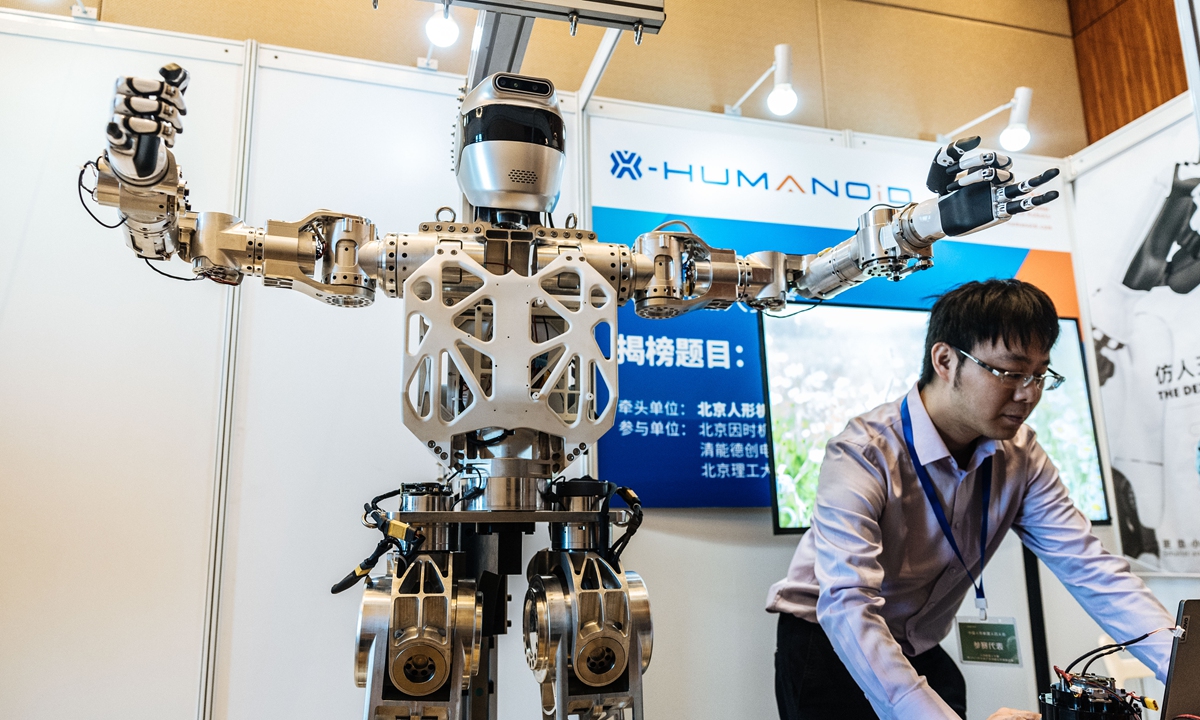
China has developed an enormous industrial ecosystem around these components.
McKinsey’s analysis of the humanoid-robot supply chain shows China’s particularly strong position in several critical components, including permanent magnets, precision bearings, encoders and position sensors. China accounts for about 90% of global capacity for permanent magnets in the supply-chain breakdown cited by McKinsey.
This matters because robotics is not simply an AI competition.
It is an industrial manufacturing competition.
And China has spent decades building precisely the kind of manufacturing ecosystem that humanoid robots now require.
China Is Also Winning the Humanoid-Robot Race
The latest shipment figures underline the gap.
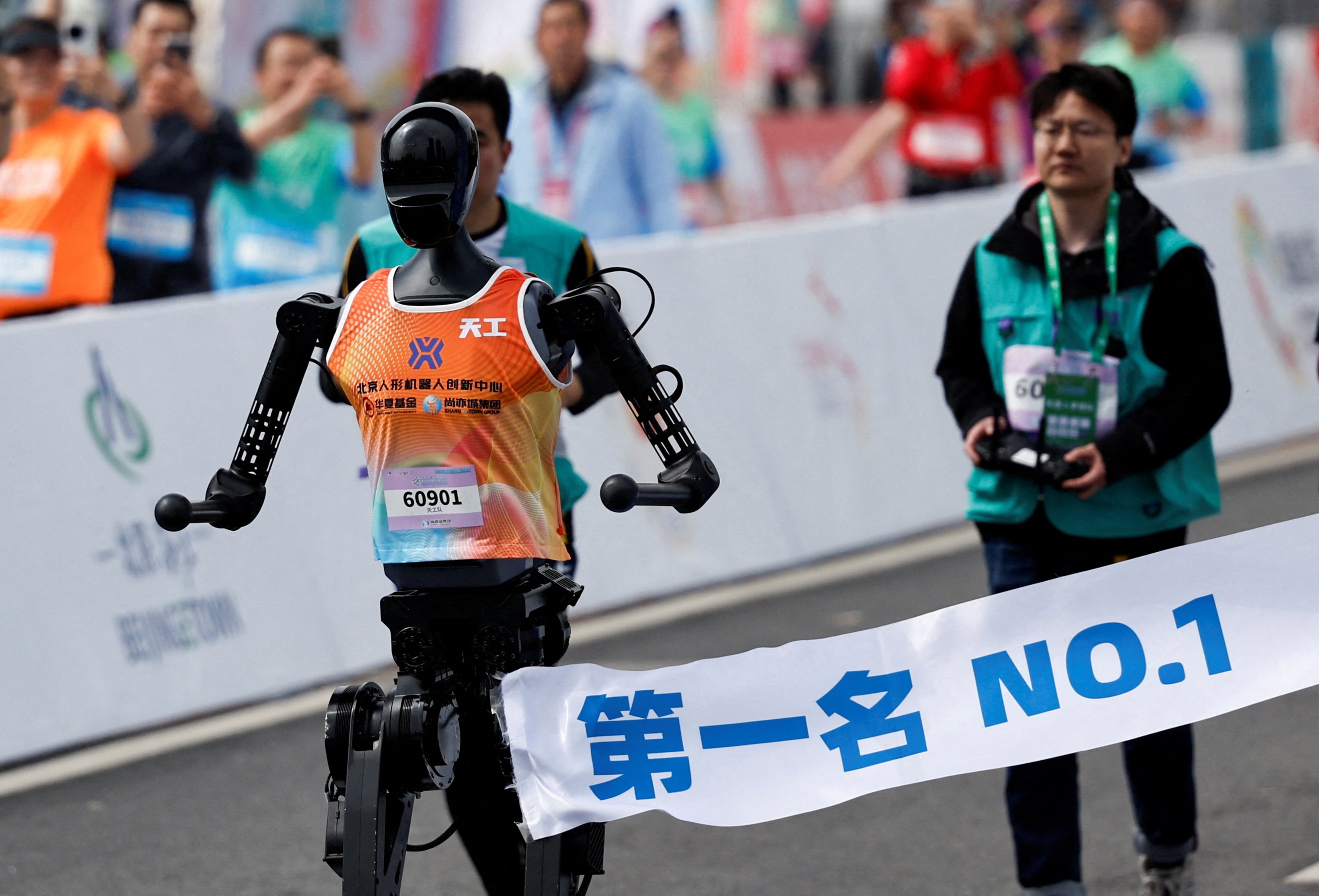
According to market research cited by China Daily, Chinese companies accounted for more than 97% of global humanoid-robot shipments during the first half of 2026.
AgiBot shipped approximately 8,400 units and Unitree about 5,900, according to the report. Global shipments reached roughly 19,100 units during the first six months of 2026.
Other market research has also identified Chinese companies as the dominant suppliers.
Omdia estimated that global humanoid-robot shipments reached 13,318 units in 2025, with Chinese manufacturers occupying the top positions. AgiBot alone accounted for nearly 38% of shipments, while Unitree accounted for about 32%.
This is the strategic problem India now faces.
The country is trying to build its robotics industry at precisely the moment China has achieved scale in the same sector.
Unitree’s IPO Shows the Scale of China’s Ambition
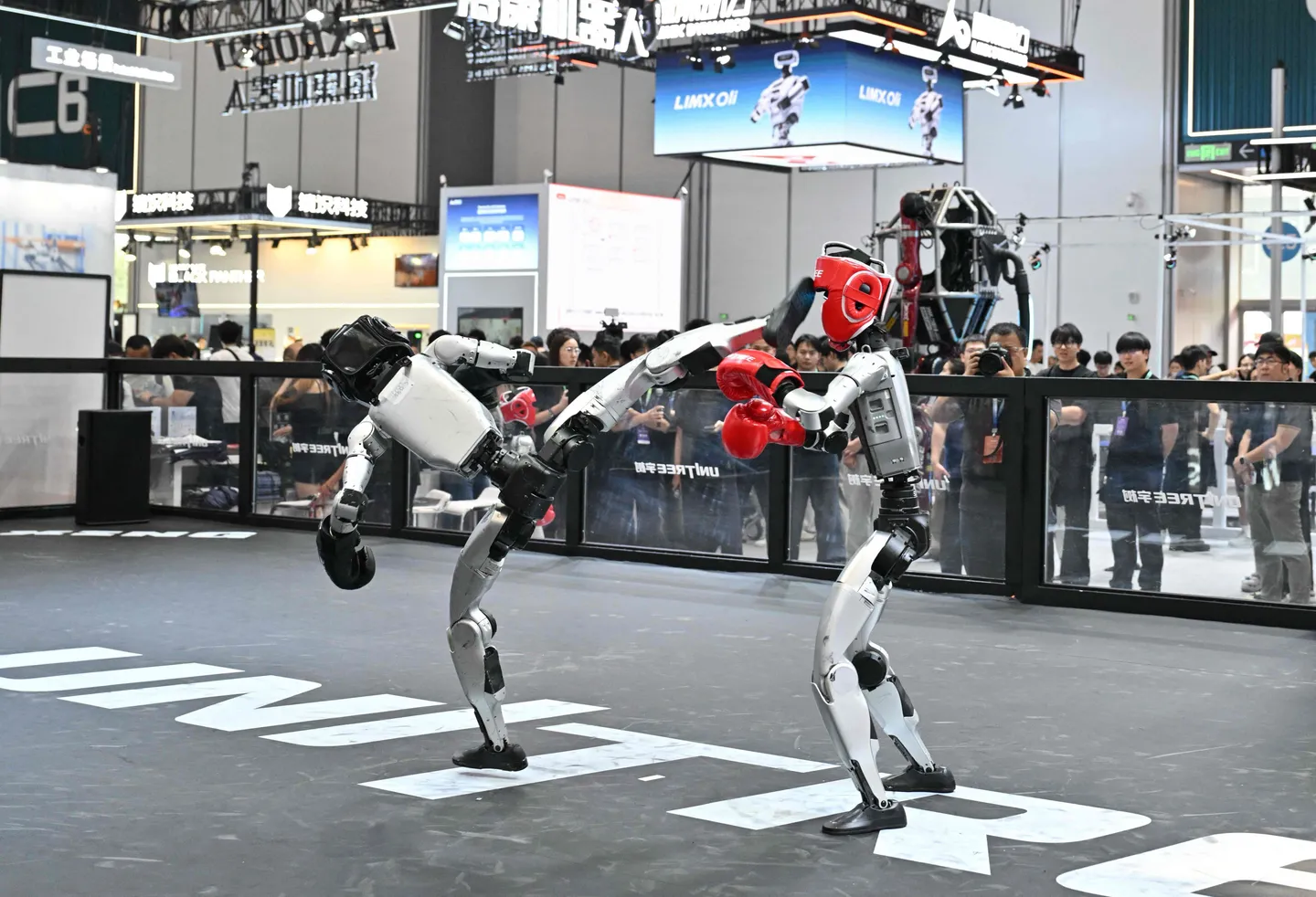
The rise of Unitree illustrates how quickly China’s robotics industry is moving.
Unitree’s Shanghai stock-market debut this week saw its shares surge dramatically, with the company raising approximately $900 million.
Reuters described the IPO as a major milestone for China’s humanoid and quadruped robotics sector.
The company’s success is not simply about one robot maker.
It demonstrates the availability of:
capital + manufacturing + engineering talent + domestic suppliers + government support + a large industrial market.
That combination is much harder for a young Indian robotics company to reproduce.
India Has Software Strength—but Robotics Requires Hardware
India’s traditional technology advantage has been in:
- software;
- IT services;
- engineering;
- mathematics;
- digital infrastructure;
- software development.
Robotics changes the equation.
A successful physical-AI company needs both:
AI intelligence + physical manufacturing.
India has considerable potential in the first category.
The weakness remains the second.
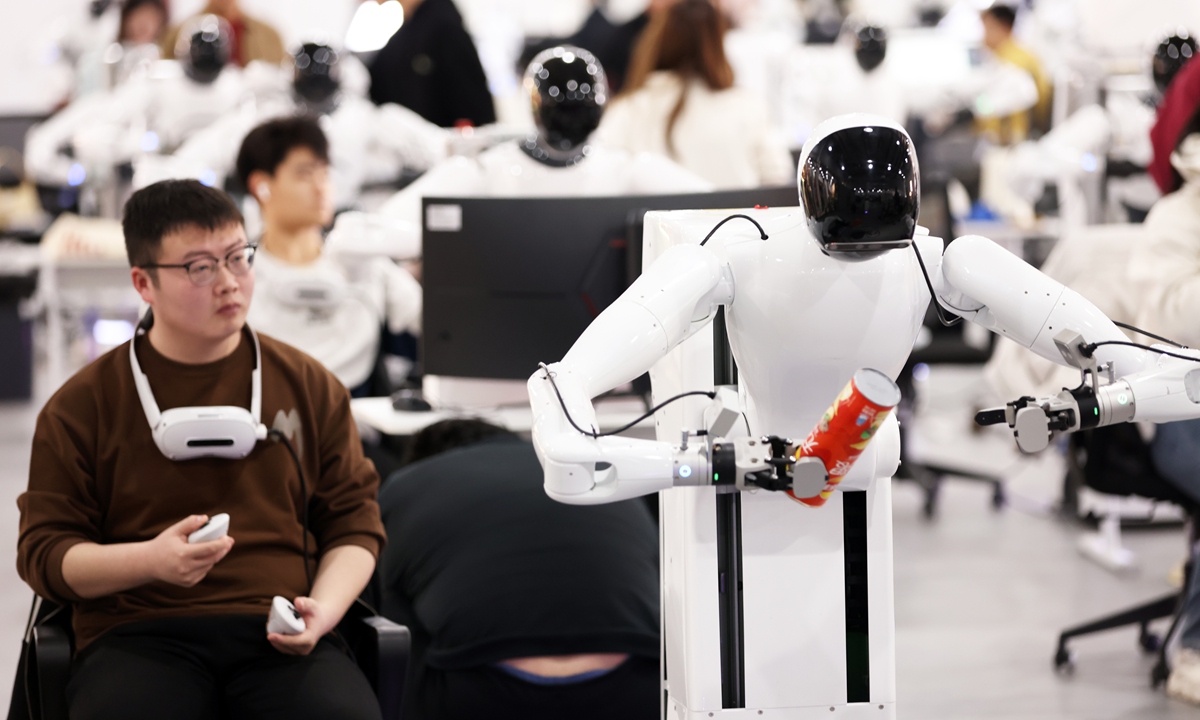
This is why Indian robotics companies may find themselves designing sophisticated robots while purchasing essential components from China.
That creates what could be described as strategic hardware dependence.
The Visa Problem Is Actually a Supply-Chain Problem
This is why reducing the story to “China is denying Indian visas” would miss the larger issue.
The visa restrictions matter because they interfere with the human infrastructure of the supply chain.
A founder who cannot travel to China may still order components.
But robotics manufacturing often requires continuous technical interaction.
A problem with an actuator may require engineers to physically inspect the manufacturing process.
A change in a PCB may require several rounds of testing.
A prototype may need to be modified at the factory.
A supplier may need to adjust tolerances.
These are difficult processes to manage entirely through video calls.
That is why one founder quoted by Economic Times warned that prolonged disruption could potentially create business losses running into millions of dollars. (The Economic Times)
India Tried to Reduce Chinese Dependence—But the Transition Is Incomplete
India’s broader strategy has increasingly emphasised domestic manufacturing.
The government has been promoting:
- electronics manufacturing;
- semiconductor production;
- advanced manufacturing;
- defence production;
- electric vehicles;
- drones;
- robotics;
- artificial intelligence.
The government also established a Technology Advisory Group to develop a strategic roadmap for robotics.
In February 2026, India’s Principal Scientific Adviser’s office said the group was examining the country’s robotics ecosystem, challenges and future strategy, with advanced robotic technologies identified as a priority.
That indicates that New Delhi recognises the strategic importance of robotics.
But recognising dependence and eliminating it are two very different things.
The Chinese Visa Issue Reveals the Gap
India’s technology policy often focuses heavily on “Make in India.”
But there is a distinction between:
assembling a robot in India
and
building an Indian robotics supply chain.
The first can happen relatively quickly.
The second requires years of investment.
It requires domestic production of:
- precision motors;
- actuators;
- harmonic drives;
- sensors;
- controllers;
- power electronics;
- advanced materials;
- batteries;
- semiconductor components.
Without those capabilities, Indian robotics companies can remain vulnerable even if final assembly takes place domestically.
India’s China Problem Is Not Unique to Robotics
The visa issue is reportedly also affecting Indian businesses involved in automotive components and electronics, sectors with established commercial ties to Chinese firms.
That is significant because it demonstrates the breadth of the problem.
India and China have attempted to stabilise their relationship after years of tension following the 2020 border crisis.
In December 2025, Reuters reported that India had eased procedures for Chinese business professionals after years of severe restrictions on Chinese visits, partly to address industrial disruption caused by a shortage of Chinese technicians.
But by August 2026, Indian companies are again reporting difficulties obtaining Chinese business visas.
That creates a troubling contradiction in the economic relationship.
India wants greater economic engagement with China while simultaneously seeking to reduce strategic dependence on China.
Managing that contradiction will be difficult.
China Also Has Its Own Reasons for Tightening Controls
India should not automatically assume that every Chinese visa restriction is designed specifically to undermine Indian robotics companies.
Beijing has increasingly linked technology, investment, data and national security.
In June 2026, China introduced new rules tightening controls over overseas transactions involving Chinese investors, technology, data and national-security considerations. Reuters reported that the measures gave Beijing greater authority over sensitive overseas transactions.
Robotics sits directly at the intersection of:
- AI;
- sensors;
- advanced manufacturing;
- computer vision;
- autonomous systems;
- industrial data.
It is therefore unsurprising that China would view parts of the robotics ecosystem through a national-security lens.
That does not make the visa restrictions harmless.
It makes them strategically significant.
The US Is Facing a Similar Robotics Dependence Problem
This is not solely an Indian problem.
The United States has also discovered that many robotics companies rely heavily on Chinese hardware.
A recent Wired report examining a robotics startup attempting to build a largely China-free robot found that even companies developing advanced systems often remain dependent on Chinese components.
The United States has responded increasingly through export controls, import restrictions and supply-chain diversification.
That demonstrates the underlying global reality:
China’s advantage in robotics is not simply that it produces robots. It produces many of the components required to build robots.
That is a much more difficult advantage to displace.
India Could Turn the Crisis Into an Opportunity
The current disruption also provides India with a strategic opportunity.
If Chinese visa restrictions continue, Indian companies and policymakers will have stronger incentives to develop alternatives.
Possible supply-chain partners include:
- Japan;
- South Korea;
- Taiwan;
- Singapore;
- Germany;
- the United States.
But these alternatives cannot simply replace China overnight.
India needs to develop domestic production simultaneously.
The goal should not be:
“Stop buying from China immediately.”
That could cripple young robotics companies.
The smarter objective would be:
“Build the capability to survive without China if necessary.”
That means dual sourcing first and domestic manufacturing later.
What India Needs to Do
If New Delhi genuinely wants to become a major robotics power, five priorities stand out.
1. Build domestic component manufacturing
India needs to focus not just on complete robots but on the components inside them.
2. Create robotics industrial clusters
Startups need suppliers, testing facilities, machine shops, electronics manufacturers and specialised engineering services in the same ecosystem.
3. Develop alternative foreign supply chains
Japan, South Korea, Taiwan, Europe and Southeast Asia can reduce concentration risk.
4. Increase long-term deep-tech funding
Robotics requires substantially more capital and longer development cycles than conventional software startups.
5. Make government procurement an early customer
Defence, logistics, manufacturing, healthcare and infrastructure can provide the demand necessary to scale domestic robotics.
India’s Defence Sector Should Pay Attention
The implications extend beyond civilian robotics.
Physical AI is increasingly relevant to defence.
Future military systems will rely on:
- autonomous ground vehicles;
- unmanned aerial systems;
- robotic logistics;
- autonomous surveillance;
- AI-enabled targeting;
- battlefield sensing;
- human-machine teaming.
If India remains dependent on foreign suppliers for critical actuators, sensors and electronics, that dependence could eventually affect defence robotics as well.
This makes robotics supply-chain security a strategic-security issue, not merely an industrial policy issue.
China Has a Scale Advantage India Cannot Ignore
India’s strongest argument is that it has a large technology workforce, a huge domestic market and a rapidly expanding manufacturing ecosystem.
But China’s advantage is currently deeper.
It combines:
industrial scale + component manufacturing + robotics research + supply chains + government support + domestic demand.
That combination allows Chinese companies to iterate faster and reduce costs.
The recent World Robot Conference in Beijing is an illustration of the scale of China’s ecosystem. Reuters reported that more than 300 exhibitors were participating, showcasing humanoid, industrial, logistics and other robotic systems.

The Real Lesson From the Visa Dispute
The biggest lesson for India is uncomfortable.
A country cannot become technologically self-reliant merely by assembling foreign components domestically.
If an Indian robotics company cannot operate efficiently because its executives cannot travel to the country supplying critical components, the vulnerability is already visible.
The solution is not necessarily to sever ties with China.
It is to ensure that China is not the only viable option.
That distinction is crucial.
India can continue importing Chinese components while simultaneously developing Indian alternatives.
Over time, the objective should be to move from:
China-dependent → China-diversified → China-optional.
That is a much more realistic industrial strategy.
The Bigger Geopolitical Contest Is Moving Into Robotics
The robotics competition between China, the United States, India, Japan, South Korea and Europe is likely to become increasingly important.
Robots are no longer simply factory machines.
They are becoming part of the broader contest over:
- artificial intelligence;
- advanced manufacturing;
- autonomous systems;
- military technology;
- labour productivity;
- industrial competitiveness.
China’s dominance of humanoid-robot shipments gives Beijing an important first-mover advantage.
India still has time to build a competitive ecosystem—but the visa dispute demonstrates how little room there is for complacency.
Final Analysis
The Chinese visa restrictions affecting Indian robotics executives may appear to be a narrow diplomatic or administrative dispute.
They are not.
They expose a much deeper structural weakness in India’s emerging physical-AI and robotics ecosystem.
India is attracting investment into robotics. Indian startups raised $130 million across 25 deals in 2025 and another $42 million in the first quarter of 2026, according to data cited by Economic Times.
But China’s lead is substantially larger.
Chinese companies accounted for more than 97% of global humanoid-robot shipments during the first half of 2026, according to market research cited by China Daily.
And China’s advantage is not confined to finished robots.
It extends into the motors, actuators, sensors, electronics, precision components and manufacturing infrastructure required to produce them.
That is why the visa issue matters.
It demonstrates that industrial dependence can become a geopolitical vulnerability even before a formal trade embargo or export ban is imposed.
For India, the answer should not be panic or an immediate attempt to decouple from China.
The more practical response is to build redundancy.
Indian robotics companies need alternative suppliers while the government accelerates domestic production of critical components.
Because the strategic objective should not be to prove that India can build a robot without China tomorrow.
It should be to ensure that no foreign government can effectively determine whether an Indian robotics company can build its next robot.
That is the real test of technological self-reliance.