
France is moving into a new category of long-range naval warfare. ArianeGroup has unveiled a proposed naval version of its B-Strike 1000 ballistic missile, designed to strike enemy warships and land targets at distances of approximately 1,000 kilometres. The concept could eventually give European navies a capability traditionally associated with China’s expanding anti-access/area-denial arsenal.
France’s aerospace and defence company ArianeGroup has presented a naval version of its B-Strike 1000 conventional ballistic missile at the Euronaval 2026 exhibition in Paris, introducing a potentially significant development in European maritime strike capabilities.
The proposed missile is designed for deep-strike and anti-ship missions, with a declared range of approximately 1,000 kilometres. Its most important proposed feature is a manoeuvrable re-entry vehicle (MaRV), intended to adjust its trajectory during the terminal phase and engage moving maritime targets.
If successfully developed, B-Strike 1000 could become one of Europe’s first dedicated anti-ship ballistic missile systems, offering a different approach to challenging heavily defended naval formations.
However, the announcement represents a proposed industrial and weapons-development capability, not a fully operational missile. Flight testing, procurement, naval integration and the demonstration of its ability to hit moving warships remain important milestones.
ArianeGroup Expands B-Strike Programme to Naval Warfare
ArianeGroup introduced its B-Strike conventional ballistic missile family at Eurosatory 2026 in June, working alongside French defence companies Thales and Soframe.
The original programme was presented as a sovereign European solution for long-range conventional strikes, drawing on ArianeGroup’s experience in ballistic missile engineering, including technologies developed for France’s M51 strategic missile programme.
At Euronaval 2026, held in Paris from November 3 to 6, the company extended the concept to naval operations through the B-Strike 1000 maritime variant.
According to ArianeGroup’s November 12 announcement, the naval version is intended to perform both deep-strike and anti-ship missions at a range of 1,000 kilometres.
The development reflects a wider French ambition to strengthen Europe’s independent defence-industrial capabilities and expand its conventional long-range strike options.
The distinction is strategically important: France is not simply developing another ship-launched cruise missile. It is exploring a ballistic weapon designed to approach targets at significantly higher speeds and potentially create new challenges for existing naval air-defence systems.

B-Strike 1000: Reported Missile Specifications
The manufacturer has confirmed the missile’s intended missions and approximate range, but has not published a complete technical datasheet.
Defence-industry reporting based on the Euronaval presentation has provided additional estimates concerning its dimensions, speed and flight characteristics.
| Specification | Reported details |
|---|---|
| Manufacturer | ArianeGroup |
| Country | France |
| Missile | B-Strike 1000 |
| Classification | Conventional ballistic missile / proposed anti-ship variant |
| Intended range | Approximately 1,000 km |
| Propulsion | Reported single-stage solid-fuel rocket |
| Length | Approximately 7 metres |
| Diameter | Approximately 609.6 mm |
| Reported maximum speed | Above Mach 10 |
| Reported flight altitude | Above 120 km |
| Estimated flight time | Approximately 10 minutes over 1,000 km |
| Re-entry technology | Manoeuvrable Re-entry Vehicle (MaRV) |
| Reported accuracy objective | Less than 10 metres |
| Warhead weight | Not publicly disclosed |
| Launch options | Proposed naval, coastal and unmanned surface platforms |
| Operational status | Under development; no confirmed operational deployment |
These figures should be treated as reported design or performance estimates, not independently demonstrated operational specifications.
Why the manoeuvrable re-entry vehicle matters
The proposed MaRV technology is central to B-Strike 1000’s anti-ship role.
Conventional ballistic missiles follow a trajectory that can become increasingly predictable during parts of their flight. A manoeuvrable re-entry vehicle is designed to make adjustments during atmospheric re-entry, potentially complicating an interceptor’s ability to predict its final position.
For an anti-ship missile, this is particularly important because naval targets are mobile.
A warship can change its position and course during the time between initial detection and missile arrival. A weapon intended to engage such targets therefore requires more than high speed and long range: it needs reliable targeting information and an effective terminal guidance system.
ArianeGroup’s proposed approach combines external maritime surveillance information with terminal guidance for the re-entry vehicle.
The effectiveness of this architecture will depend on how successfully these components are integrated and tested.

How Could France Track Warships at 1,000 Kilometres?
One of the biggest technological challenges facing any anti-ship ballistic missile programme is locating and engaging moving vessels at long distances.
Unlike fixed land targets, warships can change their position, speed and direction during an engagement.
The B-Strike concept reportedly envisages using external targeting information, including space-based surveillance, to support maritime engagements.
One relevant technology is satellite-based radio-frequency detection, which can identify and help locate vessels through their electronic emissions.
French company Unseenlabs specialises in space-based radio-frequency intelligence for maritime surveillance. Its technology illustrates the type of information that could contribute to a wider maritime tracking architecture.
However, detecting a ship’s electronic emissions does not automatically provide continuous and precise targeting data. A successful engagement requires timely information, accurate target identification and a terminal seeker capable of refining the missile’s approach.
This makes the surveillance and targeting network almost as important as the missile itself.
If France can successfully combine space-based maritime intelligence with a high-speed ballistic weapon, it could develop a new layer of conventional naval deterrence.
Four Proposed Launch Options: From Frigates to Unmanned Naval Platforms
Another distinctive feature of the B-Strike 1000 concept is its proposed flexibility in launch platforms.
Defence-industry reporting on the Euronaval presentation identified four potential configurations.
1. Naval vertical launch system
A dedicated eight-cell vertical launch module could potentially allow compatible warships to carry the missile.
2. Deck-mounted launcher
A proposed two-missile rotary launcher offers another possible configuration for naval platforms.
3. Mobile coastal launchers
A land-based mobile launcher could provide coastal forces with a long-range maritime strike capability without requiring the missile to be deployed aboard a major warship.
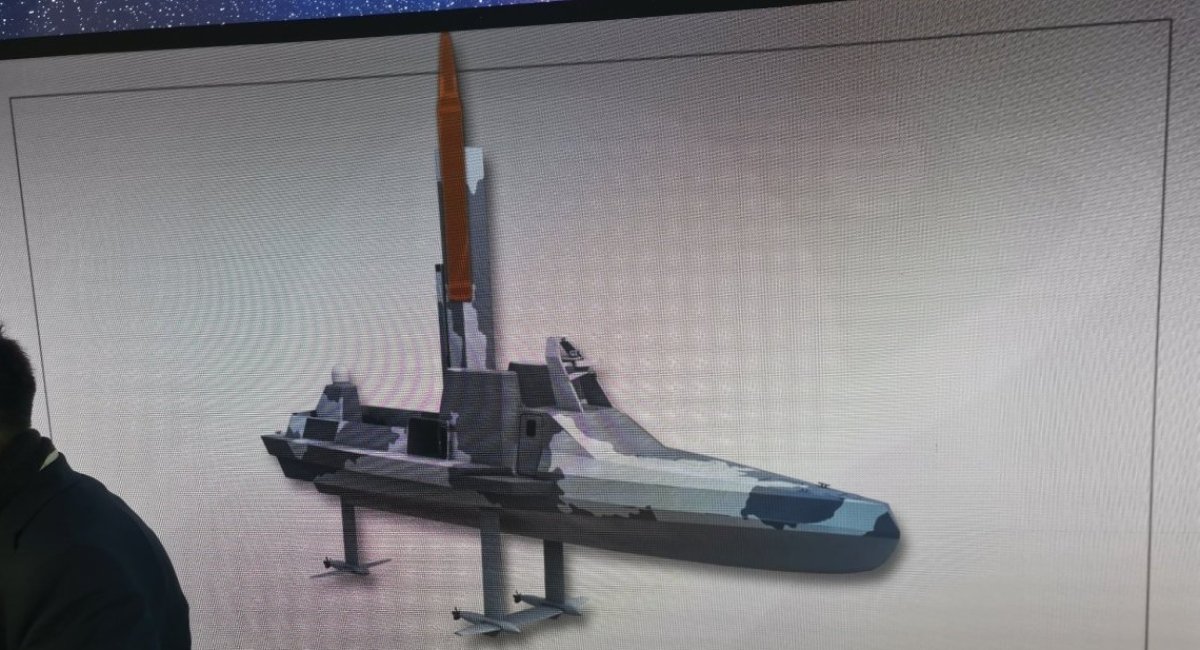
4. Hydrofoil unmanned surface vessels
Perhaps the most unusual concept involves a purpose-built hydrofoil unmanned surface vessel, including the SEAir SP200 design.
Such a platform could potentially carry a ballistic missile while operating independently of a conventional naval formation.
The concept is particularly interesting because it explores the possibility of combining unmanned maritime platforms with long-range ballistic strike weapons.
However, these configurations remain proposed integration options. Their presentation does not mean that the missile has completed testing or that the French Navy has approved its installation on existing vessels.
France’s B-Strike 1000 Versus China’s Anti-Ship Missile Arsenal

The strategic significance of the French programme becomes clearer when compared with China’s established anti-access/area-denial capabilities.
China has invested heavily in weapons designed to threaten high-value naval assets, including aircraft carrier strike groups operating in the western Pacific.
Three systems illustrate the scale of Beijing’s missile capabilities.
DF-21D: China’s land-based anti-ship ballistic missile, widely associated with its efforts to threaten aircraft carrier formations at extended distances.
DF-26: A longer-range ballistic missile with conventional and nuclear roles, including a reported anti-ship capability.
YJ-21: A high-speed naval missile associated with China’s modern surface combatants and designed to strengthen the Chinese Navy’s long-range strike options.
These systems form part of a broader Chinese maritime strategy that combines missile forces, surveillance networks, naval platforms and other intelligence capabilities.
France’s B-Strike 1000 reflects a similar technological direction, although the strategic circumstances and maturity of the respective programmes are very different.
| System | Country | Broad role | Development status |
|---|---|---|---|
| B-Strike 1000 | France | Proposed anti-ship and deep strike | Under development |
| DF-21D | China | Land-based anti-ship ballistic strike | Fielded |
| DF-26 | China | Long-range land and anti-ship strike | Fielded |
| YJ-21 | China | High-speed naval strike | Fielded/reported operational |
The comparison should not be interpreted as evidence that France has already matched China’s deployed missile capabilities.
China has an established anti-ship ballistic missile architecture supported by extensive investment in maritime surveillance and targeting. France is still at the development and industrial-proposal stage.
Nevertheless, the French initiative demonstrates that European defence planners are increasingly interested in ballistic strike capabilities as part of future maritime warfare.
Could B-Strike 1000 Threaten Aircraft Carriers?
The possibility of a European anti-ship ballistic missile raises an important question: could a weapon travelling above Mach 10 and equipped with a manoeuvrable re-entry vehicle threaten an aircraft carrier strike group?
In principle, such a missile could create a demanding interception problem.
Aircraft carriers operate within integrated defensive formations that combine guided-missile destroyers, frigates, advanced radar systems, electronic warfare capabilities and combat aircraft.
The United States Navy’s Aegis combat system provides an example of this layered approach. Its ballistic missile defence architecture uses advanced sensors and interceptors designed to address different categories of ballistic and aerial threats.
A high-speed missile with a manoeuvrable terminal vehicle could place additional demands on these systems by reducing reaction time and complicating trajectory prediction.
However, speed alone does not guarantee a successful strike.
The outcome would depend on detection, tracking, target identification, terminal guidance, missile reliability and the defensive architecture of the targeted fleet.
It would therefore be premature to describe B-Strike 1000 as an unstoppable carrier killer or to suggest that aircraft carriers have become obsolete.
The more defensible assessment is that the programme reflects the growing competition between long-range strike weapons and increasingly sophisticated naval missile-defence systems.

What Does the Missile Mean for Europe’s Military Balance?
France has particular reasons to pursue long-range maritime strike capabilities.
Its overseas territories and military interests extend across the Atlantic, Indian and Pacific oceans. The French Navy must therefore consider security requirements across multiple maritime environments.
The development of B-Strike also fits into Europe’s broader effort to strengthen defence-industrial independence.
The war in Ukraine, concerns about Russia’s military capabilities and growing competition in the Indo-Pacific have intensified European discussions about long-range precision strike systems.
ArianeGroup’s experience with the M51 programme provides an important industrial foundation. The company has decades of experience in propulsion, ballistic trajectories and re-entry technologies.
However, the transfer of experience from a strategic ballistic missile programme to a conventional anti-ship weapon does not eliminate the technical challenges involved.
The new missile must demonstrate its reliability, accuracy and ability to engage moving targets before it can become a credible operational capability.
The programme also needs government funding, procurement decisions and a clear integration pathway.
France’s initiative should therefore be viewed as part of a longer-term effort to expand European military options rather than an immediate change in the naval balance of power.

The Biggest Obstacles: Testing, Funding and Naval Integration
Despite the attention surrounding the Euronaval presentation, several major questions remain.
First, the complete technical specifications have not been officially released. Important details, including the warhead weight, launch mass and verified accuracy, remain undisclosed.
Second, naval integration will require substantial engineering work. A missile approximately seven metres long and more than 600 millimetres in diameter cannot simply be inserted into existing ship launch systems without considering launcher dimensions, structural requirements and fire-control compatibility.
Third, the anti-ship mission requires a reliable targeting architecture capable of dealing with moving vessels.
Finally, there is no confirmed operational deployment or approved French Navy procurement programme for the naval variant in the available reporting.
These limitations matter because presenting a missile at an international defence exhibition is very different from fielding a weapon that has completed flight trials and demonstrated its effectiveness.
The programme’s future will depend on government support, industrial investment and successful testing.
Strategic Assessment: Europe Enters a New Phase of Naval Missile Competition
France’s B-Strike 1000 initiative highlights an important development in modern military competition: the growing interest in conventional ballistic weapons designed to challenge naval forces at extended distances.
Its proposed combination of high-speed ballistic flight, manoeuvrable re-entry technology, space-based surveillance and flexible launch platforms could eventually add a new dimension to European maritime deterrence.
Three developments deserve particular attention.
First, the changing character of naval warfare: Long-range ballistic weapons could increase the risks faced by major surface combatants operating within contested maritime environments.
Second, the growing importance of space-based intelligence: The ability to locate and track moving naval targets may become as important as the performance of the missile itself.
Third, Europe’s search for strategic autonomy: France is seeking to develop advanced conventional strike technologies that could strengthen Europe’s ability to operate without relying entirely on external suppliers.
Yet the gap between ambition and operational capability remains substantial.
China already possesses a mature anti-ship ballistic missile capability, while France’s B-Strike 1000 remains a proposed system requiring further development.
The central question is therefore not whether France has already changed the naval balance of power. It has not.
The more important question is whether Europe can successfully develop and deploy a new generation of long-range ballistic strike weapons before the changing security environment makes such capabilities an operational necessity.
If B-Strike 1000 progresses from concept to a tested and integrated weapon, it could become an important addition to France’s conventional deterrence options and a significant development in Europe’s future naval warfare strategy.