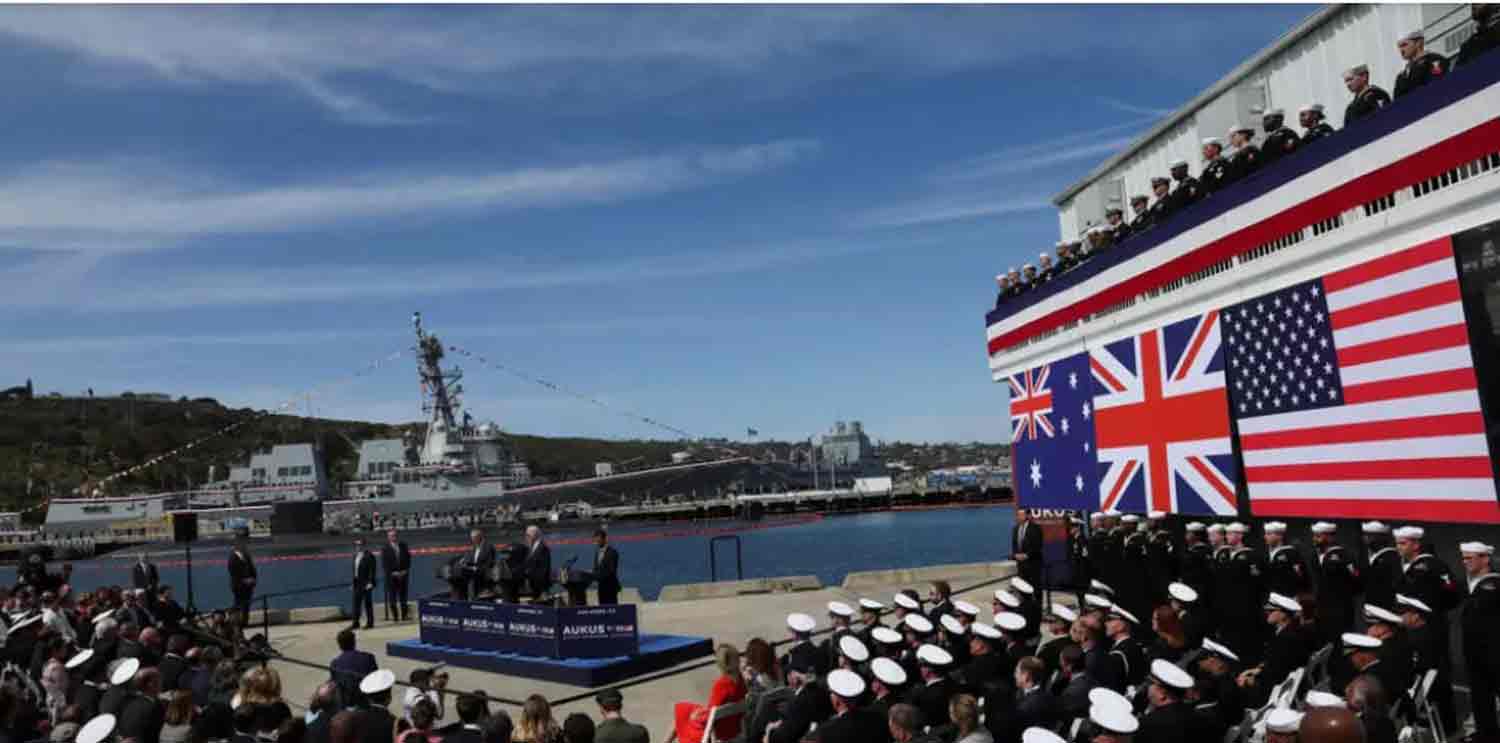
The three members of the AUKUS security partnership have signed a landmark agreement to jointly develop advanced technologies for Uncrewed Underwater Vessels (UUVs) marking the first officially announced project under:
AUKUS Pillar 2.
The agreement signals a major expansion of trilateral military cooperation between United States, United Kingdom and Australia as they seek to strengthen maritime deterrence amid intensifying competition in the Indo-Pacific.
Australia, the UK, and the US share a special bond that led to a unique defence and security partnership – AUKUS. At its core are shared beliefs that resonate across generations of shared history.
This is AUKUS explained 👇 pic.twitter.com/OWWgWLewKc
— Ministry of Defence 🇬🇧 (@DefenceHQ) May 30, 2026
What Is the New AUKUS Underwater Project?
Under the agreement, AUKUS partners will jointly develop Interchangeable payload technologies, including:
- Sensors
- Weapons systems
- Electronic warfare capabilities
- Reconnaissance technologies
for deployment across all three nations’:
Uncrewed Underwater Vehicle fleets (UUVs).
According to a joint statement issued by:
- U.S. Defense Secretary
Pete Hegseth
- UK Defence Secretary
John Healey
- Australian Defence Minister
Richard Marles
the first deliveries of these systems are expected to begin in:
2027.
The announcement came during meetings on the sidelines of the:
Shangri-La Dialogue
in Singapore.
Why This Matters: AUKUS Pillar 2 Finally Becomes Real
Since AUKUS was announced in 2021 much of the attention focused on Pillar 1 — Australia’s acquisition of Virginia-class submarine capabilities and eventual development of the:
SSN-AUKUS.
But:
Pillar 2
has often remained vague.
The initiative focuses on jointly developing:
- Artificial intelligence
- Cyber capabilities
- Quantum technologies
- Undersea systems
- Electronic warfare.
The new UUV agreement therefore represents:
The first major concrete Pillar 2 breakthrough.
UK Defence Secretary:
John Healey
described the project as:
“A big step forward” and a “breakthrough” for the partnership.
The Real Goal: Underwater Dominance
The strategic objective extends far beyond simply building underwater drones.
According to the joint statement,
the project aims to improve AUKUS capabilities in:
✔ Anti-submarine warfare
✔ Anti-surface warfare
✔ Mine countermeasures
✔ Electronic warfare
✔ Seabed infrastructure protection
✔ Surveillance and reconnaissance
✔ Contested littoral operations.
That emphasis reflects growing concern over threats to:
Critical underwater infrastructure
including:
- Internet cables
- Energy pipelines
- Naval communication systems.
Recent sabotage fears in Europe and growing:
China
undersea activity in the Indo-Pacific have significantly increased attention on seabed security.
What AUKUS Underwater Drones Could Do
Potential Missions:
✔ Submarine hunting (ASW)
✔ Mine detection and clearance
✔ Surveillance of critical seabed infrastructure
✔ Electronic warfare operations
✔ Precision strike support
✔ Logistics in contested waters
The goal is to create:
Interoperable underwater systems
usable by all three AUKUS militaries.
Shared Standards, Shared Control Systems
A key element of the agreement is interoperability.
The:
UK Ministry of Defence
said the project will establish:
Common control systems
and:
Shared operational concepts
allowing UUV payloads to move seamlessly across:
- US platforms
- British systems
- Australian fleets.
Initially,
each country will reportedly focus on developing specific technological effects before integrating systems trilaterally.
This reflects a broader AUKUS strategy of:
Pooling industrial capabilities
instead of duplicating effort.
Australia Also Changes Virginia-Class Submarine Plan
The agreement also included significant changes to:
Australia
plans under:
AUKUS Pillar 1.
Canberra will now streamline its planned acquisition of:
Virginia-class submarine
boats.
Instead of purchasing a mix of:
- New-build submarines
- Older in-service boats
Australia will reportedly focus on acquiring:
Three in-service Virginia-class submarines
from the:
United States Navy.
Officials say the change will:
✔ Simplify logistics
✔ Reduce maintenance complexity
✔ Improve supply-chain efficiency
✔ Lower long-term costs.
The submarines are intended to serve as a bridge until:
SSN-AUKUS
enters service during the:
2040s.
Why This Is Really About China
Although no country was explicitly named,
the broader strategic context is clear.
AUKUS increasingly focuses on:
Countering China’s expanding maritime power.
China now fields:
- The world’s largest navy by ship numbers
- Expanding submarine fleets
- Growing underwater surveillance capability.
Beijing’s growing presence across the:
South China Sea
and wider:
Indian Ocean
has intensified Western concerns over future naval competition.
Undersea warfare increasingly shapes:
Deterrence credibility in the Indo-Pacific.
The Bigger Strategic Shift: Autonomous Naval Warfare
The agreement highlights a wider military transformation.
Future naval power may increasingly depend on:
Autonomous and semi-autonomous systems
rather than solely traditional warships.
Uncrewed underwater vehicles can:
✔ Operate for long durations
✔ Reduce risk to personnel
✔ Conduct covert surveillance
✔ Hunt submarines quietly
✔ Protect strategic infrastructure.
Military planners increasingly view them as:
Force multipliers
for future maritime conflict.
The AUKUS deal suggests Washington,
London
and Canberra are moving quickly to avoid technological gaps in underwater autonomy.
Conclusion: AUKUS Is Moving Beyond Submarines
The new agreement marks an important milestone for:
AUKUS.
For years,
the partnership was primarily associated with:
Nuclear-powered submarines.
Now,
AUKUS appears increasingly focused on:
Future warfare technologies.
The first official:
Pillar 2
project signals a broader ambition:
Creating an integrated, interoperable military technology ecosystem for underwater warfare.
As competition intensifies in the:
Indo-Pacific,
the ability to:
See, track and dominate beneath the ocean surface
may increasingly determine naval power balances.
And AUKUS partners appear intent on ensuring they remain ahead of the curve.